Évariste Galois
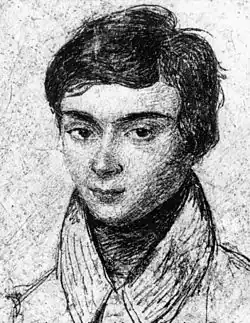
Évariste Galois (October 25, 1811 – May 31, 1832) was a French mathematician, who, while still in his teens, developed the well-known Galois theory. Galois theory is capable to determine whether a polynomial with rational coefficient can be solved by radicals and give a clear insight about what kind of length ratio can be constructed by compass and straightedge, thereby solving the long-standing problems of solving a polynomial by radicals. His life is considered to be one of the most romantic in all of mathematics because of the contributions he has made in such a short span of life.
Quotes
- ... un auteur ne nuit jamais tant à ses lecteurs que quand il dissimule une difficulté.
- ... an author never does more damage to his readers than when he hides a difficulty.
- in the preface of Deux mémoires d'Analyse pure, October 8, 1831, edited by Jules Tannery (1908). Manuscrits de Évariste Galois. Gauthier-Villars. p. 27.
- Ne pleure pas, Alfred ! J'ai besoin de tout mon courage pour mourir à vingt ans !
- Don't cry, Alfred! I need all my courage to die at twenty.
- Quoted in: Léopold Infeld (1978) Whom the gods love: the story of Évariste Galois. p. 299.
- Dès le commencement de ce siècle, l'algorithme avait atteint un degré de complication tel que tout progrès était devenu impossible par ce moyen, sans l'élégance que les géomètres modernes ont su imprimer à leurs recherches et au moyen de laquelle l'esprit saisit promptement et d'un seul coup un grand nombre d'opérations. Il est évident que l'élégance si vantée et à si juste titre n'a pas d'autre but. Du fait bien constaté que les efforts des géomètres les plus avancés ont pour objet l'élégance on peut donc conclure avec certitude qu'il devient de plus en plus nécessaire d'embrasser plusieurs opérations à la fois, parce que l'esprit n'a plus le temps de s'arrêter aux détails. ... Sauter à pieds joints sur les calculs, grouper les opérations, les classer suivant leurs difficultés et non suivant leurs formes; telle est, suivant moi, la mission des géomètres futurs; telle est la voie où je suis entré dans cet ouvrage.
- Since the beginning of the century, computational procedures have become so complicated that any progress by those means has become impossible, without the elegance which modern mathematicians have brought to bear on their research, and by means of which the spirit comprehends quickly and in one step a great many computations. It is clear that elegance, so vaunted and so aptly named, can have no other purpose. From the well-established fact that the efforts of the most advanced geometers have elegance as their goal, we can therefore conclude with certainty that it is becoming increasingly necessary to encompass several operations at once, because the mind no longer has time to dwell on details. ... Go to the roots of these calculations! Group the operations. Classify them according to their complexities rather than their appearances! This, I believe, is the mission of future mathematicians. This is the road on which I am embarking in this work.
- French version first published in Taton, René (1947) . "Les relations d'Évariste Galois avec les mathématiciens de son temps". Revue d'histoire des sciences et de leurs applications 1 (2): 114–130. ISSN 0048-7996.
- English translation quoted in: Kiernan, B. Melvin (1971) . "The Development of Galois Theory from Lagrange to Artin". Archive for History of Exact Sciences 8 (1/2): 40–154. ISSN 0003-9519.
- Preserve my memory, since fate has not given me life enough for the country to know my name.
- Ending of one of the letters written on the eve of his death. Quoted in: Kiernan, B. Melvin (1971) . "The Development of Galois Theory from Lagrange to Artin". Archive for History of Exact Sciences 8 (1/2): 40–154. ISSN 0003-9519.
- [This] science is the work of the human mind, which is destined rather to study than to know, to seek the truth rather than to find it.
- Of mathematics — as quoted in Mathematics: The Loss of Certainty (1980) by Morris Kline, p. 99.
Following quotes are reproduced in The mathematical writings of Évariste Galois. (2011, edited by Peter M. Neumann).
- Poisson, reading Galois' First Memoir, found the proof of Lemma III insufficient, and wrote in pencil the following comment.
- La démonstration de ce lemme n’est pas suffisante; mais il est vrai d’après le No . 100 du mémoire de Lagrange, Berlin, 1771. [The proof of this lemma is insufficient; but it is true according to No . 100 of the memoir by Lagrange, Berlin, 1771.]
- It angered Galois sufficiently that he wrote directly below it:
- Nous avons transcrit textuellement la démonstration que nous avons donnée de ce lemme dans un mémoire présenté en 1830. Nous y joignons 154 IV The First Memoir comme document historique le note suivante qu’a cru ^devoir^ y apposer M. Poisson. On jugera. Note de l’auteur [We have faithfully transcribed the proof of this lemma that we have given in a memoir presented in 1830. We append as a historical document the following note which Mr Poisson believed he should add. Posterity will judge. Note by the author]
- Mais je n’ai pas le temps et mes idées ne sont pas encore bien développées sur ce terrain qui est immense. [But I don't have the time and my ideas are not yet well developed on this immense terrain.]
- The Testamentary Letter of 29 May 1832
- Il parait après cela qu'il n'y a aucun fruit à tirer de la solution que nous proposons. [It seems there is no fruit to be drawn from the solution we offer.]
- Page 226, VI.4 Dossier 9: Preliminary discussion, folio 59a.
- Galois was saying that his theory proved that there is no "fruit" of a general solution to the degree-five polynomial.
Quotes about Galois
- An excessive desire for conciseness was the cause of this fault which one must try to avoid when writing on the mysterious abstractions of pure Algebra. Clarity is indeed an absolute necessity. ... Galois too often neglected this precept.
- Joseph Liouville, "Avertissement" to "Oeuvres de Galois," 382
- Quoted in: Kiernan, B. Melvin (1971) . "The Development of Galois Theory from Lagrange to Artin". Archive for History of Exact Sciences 8 (1/2): 40–154. ISSN 0003-9519.
- It is perhaps less well known that [Galois] had also, without any possible doubt, discovered the essentials of the theory of abelian integrals, as Riemann would develop it 25 years later. By what route did he arrive at these conclusions? The fragments of calculations in Analysis found among his papers do not seem to permit much of an answer to that question, but there is room to imagine that he must have been very close to the idea of the Riemann surface associated with an algebraic function, and that such an idea must also be fundamental in his investigations into what he calls the "théorie de l'ambiguïté".
- Jean Dieudonné, "Preface" to Ecrits et mémoires ďEvariste Galois, v.
- Quoted in: Kiernan, B. Melvin (1971) . "The Development of Galois Theory from Lagrange to Artin". Archive for History of Exact Sciences 8 (1/2): 40–154. ISSN 0003-9519.
- Langlands and Grothendieck are both (at least) Giants by any measure, and both were consciously successors of Galois.
- Michael Harris (18 January 2015). Mathematics without Apologies: Portrait of a Problematic Vocation. Princeton University Press. p. 24. ISBN 978-1-4008-5202-4.
- Since my mathematical youth, I have been under the spell of the classical theory of Galois. This charm has forced me to return to it again and again.
- Mario Livio (19 September 2005). The Equation that Couldn't Be Solved: How Mathematical Genius Discovered the Language of Symmetry. Simon and Schuster. p. 90. ISBN 978-0-7432-7462-3.