Charles H. Bennett (physicist)
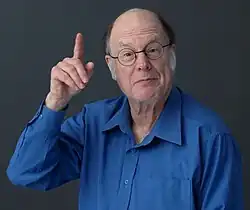
Charles Henry Bennett (born 1943) is an American physicist, information theorist, and IBM Fellow at IBM Research.
Quotes
- Throughout history philosophers and mystics have sought a compact key to universal wisdom, a finite formula or text which, when known and understood, would provide the answer to every question. The Bible, the Koran, the mythical secret books of Hermes Trismegistus, and the medieval Jewish Cabala have been so regarded. Sources of universal wisdom are traditionally protected from casual use by being hard to find, hard to understand when found, and dangerous to use, tending to answer more and deeper questions than the user wishes to ask. Like God the esoteric book is simple yet undescribable, omniscient, and transforms all who know It. The use of classical texts to foretell mundane events is considered superstitious nowadays, yet, in another sense, science is in quest of its own Cabala, a concise set of natural laws which would explain all phenomena. In mathematics, where no set of axioms can hope to prove all true statements, the goal might be a concise axiomatization of all “interesting” true statements.
- Bennett, Charles H. (2007). "On Random and Hard-to-Describe Numbers". Randomness and Complexity, From Leibniz to Chaitin. World Scientific. pp. 6–7. doi:. ISBN 978-981-277-082-0.
- Ω is in many senses a Cabalistic number. It can be known of, but not known, through human reason. To know it in detail, one would have to accept its un-computable digit sequence on faith, like words of a sacred text. It embodies an enormous amount of wisdom in a very small space, inasmuch as its first few thousand digits, which could be written on a small piece of paper, contain the answers to more mathematical questions than could be written down in the entire universe, including all interesting finitely-refutable conjectures. Its wisdom is useless precisely because it is universal: the only known way of extracting from Ω the solution to one halting problem, say the Fermat conjecture, is by embarking on a vast computation that would at the same time yield solutions to all other equally simply-stated halting problems, a computation far too large to be carried out in practice. Ironically, although Ω cannot be computed, it might accidentally be generated by a random process, e.g. a series of coin tosses, or an avalanche that left its digits spelled out in the pattern of boulders on a mountainside. The initial few digits of Ω are thus probably already recorded somewhere in the universe. Unfortunately, no mortal discoverer of this treasure could verify its authenticity or make practical use of it.
- Bennett, Charles H. (2007). "On Random and Hard-to-Describe Numbers". Randomness and Complexity, From Leibniz to Chaitin. World Scientific. p. 7. doi:. ISBN 978-981-277-082-0.
Quotes about Charles H. Bennett
- Recently I attended a workshop on the study of complexity at which two MIT computer scientists, Tom Toffoli and Norman Margolus, demonstrated the operation of an and gate on a computer monitor. Also watching the show was Charles Bennett of IBM, an expert on the mathematical foundations of computation and complexity. I remarked to Bennett that what we were watching was an electronic computer simulating a cellular automaton simulating a computer. Bennett replied that these successive embeddings of computational logic reminded him of Russian dolls.
- Quoted by Paul Davies in The Mind of God: The Scientific Basis for a Rational World (1992).