Dario Antiseri
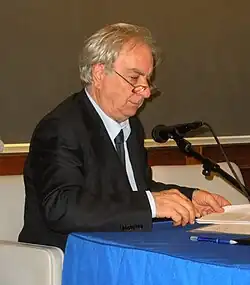
Dario Antiseri (1940) is an Italian philosopher and essayist.
Quotes
- [...] the Christian idea of man “made in the image and likeness of God” has created, on a political level, a tension that runs through the entire history of the West. It is, in fact, an ideal which, despite compromising and even murky vicissitudes, between ‘theocratic’ temptations and ‘satanocratic’ rejections of political power, has exerted, throughout history, a sometimes overwhelming pressure on its antithetical worldly element. “Render unto Caesar the things that are Caesar's, and unto God the things that are God's”: with this, the principle that Káysar is not Kýrios entered history – political power was desacralised, the worldly order relativised, and Caesar's demands subjected to a judgement of legitimacy by an inviolable conscience. On this basis, Origen could justify, against Celsus, the refusal of Christians to associate themselves with the cult of the emperor or to refuse to kill in obedience to his orders.
- Laicità. Le sue radici, le sue ragioni, Rubbettino, Soveria Mannelli, 2010, p. 59
Cristiano perché relativista, relativista perché cristiano
- *Dario Antiseri, Cristiano perché relativista, relativista perché cristiano. Per un razionalismo della contingenza, Rubbettino Editore, Soveria Mannelli, 2003.
Incipit
- You cannot be a philosopher. You cannot be one because you are a believer. A Catholic cannot be a philosopher'. So said Ugo Spirito to me one day. And this was the claim of most of the most influential philosophical movements of the century just ended. It was the presumption of those idealists for whom philosophy had among its tasks that of bringing to rational awareness contents embedded in “religious myths”.
Quotes
- In science, nothing is certain: neither general assertions nor observational assertions. (p. 7)
- The acceptability of a scientific theory is relative to the knowledge and technical resources available at a given time. (p. 7)
- An open society is [...] open to as many people as possible with different and perhaps conflicting ideas, ideals and beliefs — it is open to as many as possible, but not to everyone. It is closed, on pain of self-destruction, only to the intolerant, that is, to those who, believing themselves to be in possession of absolute truths and exclusive values, attempt to impose these truths and values at any cost, even with tears of blood. (p. 11)
- “'Information does not produce imperatives”'. And, therefore, it is not logically possible to move from being to ought to be. This, in short, is the law of Hume, the great division between indicative assertions and prescriptive assertions, between facts and values. This law is a death sentence for natural law and tells us that values are not based on science: they are based on our “choices of conscience”. (p. 62)
Due grandi patriarchi viennesi: Karl R. Popper e Konrad Lorenz
- Dario Antiseri, Due grandi patriarchi viennesi: Karl R. Popper e Konrad Lorenz; introduzione a Karl R. Popper e Konrad Lorenz, Il futuro è aperto (Die Zukunft ist offen Das Altenberger Gesprpäch Mit den Texten des Wiener Popper-Symposiums), traduzione di Dario Antiseri, prefazione di Franz Kreuzer, Rusconi Editore, 1989.
Incipit
- At the beginning of the academic year 1946-1947, Karl R. Popper received an invitation from the Secretary of the Moral Science Club in Cambridge to give a lecture. This was the occasion for the clash between Popper and Wittgenstein on the tasks of philosophy. But here is what happened the day after Popper gave his lecture. The next day, Popper recounts in his Autobiography, on the train to London, there were two students sitting opposite each other in my compartment, a boy reading a book and a girl reading a left-wing newspaper. Suddenly, the girl asked, “Who is this Karl Popper?” And the boy replied, “Never heard of him”. Such is fame. (I later learned that the newspaper contained an attack on “The Open Society”).
Quotes
- Living is learning. Science evolves in a Darwinian way: through trial and error.
- Popper argues that the worst aspects of Marxism stem from Hegelianism, namely historicism and totalitarianism. Not only Hegel, but also Marx is a “false prophet”.
- Closely connected with the idea of “rationality”, understood as a critical attitude, Popper developed the theory of the “open society”. Critical of “historicism”, i.e. the claim that one can grasp the “laws” that guide the whole of human history, Popper opposed “holism” (i.e. the idea that society can be known in its entirety) and “utopianism” (the idea that society can be “changed” in its entirety according to a deliberate plan).
- Popper developed what is today the most rigorous, articulate and devastating critique of Marxism.
Introduzione alla metodologia della ricerca
- Dario Antiseri, Introduzione alla metodologia della ricerca, Rubbettino Editore, 2005.
Incipit
- Despite the long history of the “controversy over method”, which has seen a series of attempts – from Dilthey to the Frankfurt School – to deny (especially by some historians, sociologists and philosophers) the unity of the “scientific method”, today it seems increasingly clear that scientific theories are constructed, tested, confirmed or rejected through a “single methodology”.
Quotes
- Having more theories available that allow us to see different aspects of an event and attempt to discard existing theories is not a weakness, but a strength.
- The continuous proposal of alternatives and relentless criticism are the two pillars on which all scientific research is based.
- Life is understood through life. The past is understood through the present: it is present “experience” that makes past experiences relevant, that gives blood to shadows, that brings them back to life.
Relativismo, nichilismo, individualismo: fisiologia o patologia dell'Europa?
- Dario Antiseri, Relativismo, nichilismo, individualismo: fisiologia o patologia dell'Europa?, Rubbettino Editore, 2005.
Incipit
- Quite a few intellectuals, undoubtedly well-intentioned, have repeatedly emphasised the fact that Europe does not have today, and will have even less tomorrow, a single philosophy, a single faith, a single morality. They have seen and continue to see this as the weakness of the West and the fragility of Europe. In short, Europe would be weak without such a “unifying idea, a single faith” to proudly oppose other cultures that are far more monolithic and dogmatic.
Quotes
- Christianity was the most important political event in the West: by religious decree, the state cannot be everything. Theocracy, therefore, is not part of Europe's destiny.
- Supreme values are the subject of conscious choices: they are neither “proven” theorems nor “self-evident” and “self-founding” axioms.
- Europe is its history. “And this history is not the history of an idea that allows only one tradition, but the history of a tradition that allows the most diverse and daring ideas”.
External links