Errol E. Harris
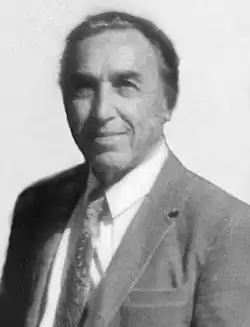
Errol Eustace Harris (February 19, 1908 – June 21, 2009), sometimes cited as E. E. Harris, was an American South-African philosopher. His work focused on developing a systematic and coherent account of the logic, metaphysics, and epistemology implicit in contemporary understanding of the world. Harris held that, in conjunction with empirical science, the Western philosophical tradition, in its commitment to the ideal of reason, contains the resources necessary to accomplish this end.
Quotes
- What follows naturally from [the] empiricist starting-point is the division of propositions into two main classes, (i) empirical propositions, about synthetic matters of fact, which are (or should be, if they are to have literal meaning) testable by experience, and (ii) those which are purely analytic, the function of which is to elucidate the use and meaning of terms, but which give no information about the world. The truth or falsity of the latter depends solely on their self-consistency and the law of non-contradiction, whereas of the former self-consistency, though necessary, is not a sufficient condition of truth. Accordingly there are two main types of science, exact science on the one hand comprising logic and mathematics, concerned with analytic truths and using purely deductive reasoning; and empirical science on the other seeking laws which are generalizations from particular experiences and are verifiable (or, more strictly, ‘probabilifiable’) only by observation and experiment.
- Hypothesis and Perception (London: George Allen & Unwin, 1970) p. 25
External links
 Encyclopedic article on Errol E. Harris on Wikipedia