James Grahame
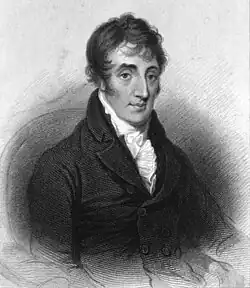
James Grahame (22 April 1765 – 14 September 1811) was a Scottish poet and clergyman. His best-known poem, The Sabbath, combines devotional feeling with vivid description of Scottish scenery.
Quotes
- How still the morning of the hallow'd day!
Mute is the voice of rural labour, hush'd
The ploughboy's whistle, and the milkmaid's song.
The scythe lies glittering in the dewy wreath
Of tedded grass, mingled with fading flowers,
That yestermorn bloom'd waving in the breeze:
The faintest sounds attract the ear, — the hum
Of early bee, the trickling of the dew,
The distant bleating, midway up the hill.- The Sabbath, l. 1 (1804)
- Nature gives a parting smile.
As yet the blue-bells linger on the sod
That copes the sheepfold ring; and in the woods
A second blow of many flowers appears,
Flowers faintly ting'd and breathing no perfume.
But fruits, not blossoms, form the woodland wreath
That circles Autumn's brow.- "An Autumn Sabbath Walk", l. 28. The Sabbath, ... to which are now added, Sabbath Walks (New York, 1805) p. 83. Variants: 'yielding' instead of 'breathing'
- How pleasant came thy rushing, silver Tweed!
Upon my ear when, after roaming long
In southern plains, I've reach'd thy lovely bank!
How bright, renowned Sark, thy little stream,
Like ray of column'd light chasing a shower,
Would cross my homeward path! how sweet the sound
When I, to hear the Doric tongue's reply,
Would ask thy well-known name.- "September", l. 190. British Georgics (Edinburgh, 1809) p. 179
Misattributed
- 'Tis thine to curb the passions' madd'ning sway,
And wipe the mourner's bitter tear away;
'Tis thine to soothe when hope itself has fled,
And cheer with angel smile the sufferer's bed;
To give to earth its charm, to life its zest,
One only task, — to bless, and to be blest.- John Graham, Granada: A Prize Poem (19 June 1833) collected in A Vision of Fair Spirits, and Other Poems (London and Oxford, 1834) p. 88. Misattributed to James Grahame in S. Austin Allibone (ed.) Poetical Quotations from Chaucer to Tennyson (Philadelphia: J. P. Lippincott & Co, 1875) p. 668 (under 'Woman')
- The helm may rust, the laurel bough may fade,
Oblivion's grasp may blunt the victor's blade:
But that bright holy wreath which learning gives,
Untorn by hate, unharm'd by envy lives.- John Graham, "Ode to the Duke of Wellington" (June 1834) collected in A Vision of Fair Spirits, &c. (1834) p. 122. Misattributed to Grahame in Poetical Quotations from Chaucer to Tennyson (1875) p. 296 (under 'Learning')
External links
 Encyclopedic article on James Grahame on Wikipedia