Jason Stanley
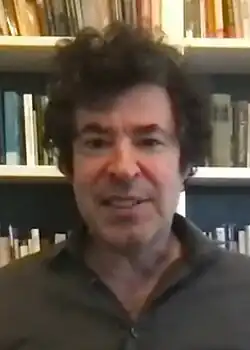
Jason Stanley (born 1969) is an American philosopher, teacher, and writer. He serves as the Jacob Urowsky Professor of Philosophy at Yale University.
Quotes
- [My mother's] advice would come out especially during any patriotic moment. She was afraid I would develop an attachment to a country and would not flee early enough. … My mother believes that injustice is the normal, unchangeable state of things. My mother believes trust is foolishness. She thinks it is not only naive to live as if justice were an attainable ideal; it is self-destructive. My mother believes they will kill you if they can.
- My Parents’ Mixed Messages on the Holocaust. The New York Times (20 August 2016).
- QAnon everywhere
- Tweet posted on 5 April 2022
- I haven't been focused as much as I should have been on supporting trans rights in the last 12 months. I now realize that this is where the fight for global democracy is. There is no avoiding it.
- Tweet posted on 9 June 2022
- You have a media environment in which Trump is very cleverly not at all like a charlatan — behaving exactly like any fascist would, claiming the other side is the democratic threat and being extremely open about his intentions.
He’s going to replace everyone in the government-by-loyalists. He’s going to target the universities, the schools. This process is called gleichschaltung in the literature on Nazi Germany, where every organization, every government institution turns loyalist-like and is transformed. Their employees are replaced by people loyal to the leader and loyal to the party. And Trump has already announced he’s going to do this. So he’s already announced a full fascist plan.- As quoted in interview by Scott Harris: "If Re-Elected, Trump Vows Fascist Regime from Day One" Between The Lines (17 January 2024)
- The significance of Project 2025 is that it calls for what in the Nazi parlance is called Gleichschaltung, the systematic replacement of civil servants by loyalists — by party loyalists — and the systematic replacement of teachers in schools and universities and, in general, institutions throughout society by party loyalists.
In the case of education, it’s completely implausible that Trump is ideologically distant from the goals of Project 2025. Trump has repeatedly said he’s going to target critical race theory, which, let’s face it, is simply Black history. The Project — he’s targeted — he said he’s going to replace education with patriotic education — namely, representing the United States as an exceptional grand nation whose exceptionality is due to its white Christian heterosexual men, who have defined the nation.- In interview video with transcript at "Fascism Expert Jason Stanley on Project 2025, Great Replacement Theory, Attacks on Immigrants & Gaza", Democracy Now! (18 September 2024)
How Propaganda Works (2015)
- The most basic problem for democracy raided by propaganda is the possibility that the vocabulary of liberal democracy is used to mask an undemocratic reality. If so, there could be a state that appeared to be a liberal democracy. It would be a state the citizens of which believed was a liberal democracy. But the appearance of liberal democracy would be merely the outer trappings of an illiberal, undemocratic reality.
- Introduction: "The Problem of Propaganda"
- Allegiance to the group identity forged by political party affiliation renders Americans blind to the essential similarities between the agendas of the two parties, similarities that can be expected to be exactly the ones that run counter to public interest, in other words, those interests of the deep-pocketed backers of elections to which any politician must be subservient in order to raise the kind of money necessary to run for national office.
- Introduction: "The Problem of Propaganda"
- The massive state bailout of financial institutions, leading to immense public debt, was followed by a demand by those very same financial institutions that were bailed out by those states for the states to pay down their debt.
- Introduction: "The Problem of Propaganda"
- The nature of liberal democracy prevents propagandistic statements from being banned, since among the liberties it permits is the freedom of speech. But since humans have characteristic rational weaknesses and are susceptible to flattery and manipulation, allowing propaganda has a high likelihood of leading to tyranny, and hence to the end of liberal democracy.
- Chapter 1: "Propaganda in the History of Political Thought"
- In the previous chapters, I laid out the concept of ideology I favor. Using Max Weber, I argued that elites in civil society invariably acquire a flawed ideology to explain their possession of an unjust amount of the goods of society. The purpose of the flawed ideology is to provide an apparently factual (in the best case, apparently scientific) justification for the otherwise manifestly unjust distribution of society’s goods. I then argued that, as a mechanism of social control, the elite seek to instill the ideology in the negatively privileged groups. By this route, the negatively privileged groups acquire the beliefs that justify the very structural features of their society that cause their oppression. I then laid out some very general psychological and epistemological facts that make it plausible that such efforts will be successful.
- Chapter 7: "The Ideology of Elites: A Case Study"
How Fascism Works (2018)
- Nathuram Godse, the man who assassinated Gandhi, was a member of RSS, as was current Indian prime minister Narendra Modi. RSS was explicitly influenced by European fascist movements, its leading politicians regularly praised Hitler and Mussolini in the late 1930s and 1940s.
- How Fascism Works: The Politics of Us and Them. New York: Random House. 2018. pp. 14–15.
- To me, my Judaism means an obligation to pay attention to equality and the rights of minority groups.
- Quoted in Jewniversity: Jason Stanley. The Jewish Chronicle'' (14 September 2020).
Erasing History (2024)
- If there is no state to support citizens in need, they will be obliged to fall back on their families and religious communities for support. This has the effect of reinforcing traditional social values, since it puts these families and communities in a position to condition their support on the rejection of certain beliefs, identities, or ways of life that they may find objectionable. A robust system of public goods gives citizens the necessary support structures to make their own choices—and to take full advantage of democracy’s freedoms.
- Chapter 5: "Anti-education". Stanley paraphrases and explains a quote from Melinda Cooper's book Family Values: Between Neoliberalism and the New Social Conservatism (Zone Books, 2017).
- According to the civilization savagism paradigm, the "uncivilized" are not fully human, and may reasonably be reduced to their capacity for labor. Because of this, they are worthy only of what we might call industrial education, a dehumanizing form of education focused entirely on technical training, which ascribes no value at all to knowledge.
- Chapter 6: "Classical Education". The term "civilization savagism paradigm" comes from David Wallace Adams' book Education for Extinction: American Indians and the Boarding School Experience, 1875–1928 (Kansas University Press, 1995).
- When fascists adopt classical education, … they rely on the flattened, instrumentalized version of it, which does nothing to challenge the practice of viewing people solely in terms of their productive capacity—in the case of women, the capacity to produce children, and in the case of men, the capacity for labor. The Nazis, for example, who praised the virtues of an education in Western civilization, were also responsible for the mass extermination of disabled people. According to the distinguished historian of Nazism Nikolaus Wachsmann, the main criterion in selecting which disabled people should be gassed was "the patients' ability to work: anyone regarded as unproductive would be killed."
- Chapter 6: "Classical Education"
- All education presupposes values, even substantive moral and political ones. The idea that it should not presuppose perspectives, even value-laden ones, involves a false conception of objectivity, and a tendentious and in fact ultimately incoherent distinction between facts and values. All inquiry must make presuppositions, and these presuppositions form an intertangled web of fact and value. The demand for neutral inquiry is philosophically incoherent. No wonder that such demands invariably, and hypocritically, mask political agendas.
- Chapter 6: "Classical Education"
- Carter Godwin Woodson is most famous today for his introduction of Black History Month. In 1933, Woodson published a now-classic work on the ways American education was failing Black Americans, titled The Mis-education of the Negro. In it, Woodson lambastes classical education, commenting that Black people in this system were "given little thought, for the best friends of the race, ill-taught themselves, followed the traditional curricula of the times, which did not take the Negro into consideration except to condemn or pity him." About, for example, the teaching of literature, Woodson noted that in the traditional curriculum Black people were "not supposed to have expressed any thought worth knowing."
- Chapter 7: "Reclaiming History"
- My father's vision of civic compassion was premised on rejecting the language of unity, as too "contaminated by propagandistic usage." If anything, his solution was the opposite—to engage respectfully, to imaginatively stand in the places of others, to inhabit worlds that initially seem strange and even threatening, to acknowledge one's inability to be as wise, as generous, or as open as pluralistic democracy requires. To resist the slide into cruelty is perhaps the most important educational goal of a people.
- Chapter 7: "Reclaiming History". Commenting on a quotation from Manfred Stanley's scholarly article "The Mystery of the Commons: On the Indispensability of Civic Rhetoric" (1983). The quotation says (in part): "Compassion is more concrete and a more reasonable expectation to have of people. Mutual estrangement, and stereotypical fantasy exist between the extremes of our class structure, between several ethnic and racial groups and between considerable numbers of males and females. This presents a major challenge for civic education, but it is not one of inducing some unrealistic and sentimental attitude of 'unity.'"
- Democracy is an ideal. It is an ideal in which every citizen has political equality rooted in the recognition of all people’s full humanity. And realizing the ideal of political equality is impossible without an understanding of who has been denied it and why.
- Concluding words of chapter 7, "Reclaiming History".
Quotes about Stanley
- He examines how propaganda operates subtly, how it undermines democracy—particularly the ideals of democratic deliberation and equality—and how it has damaged democracies of the past. … Stanley provides a historically grounded introduction to democratic political theory as a window into the misuse of democratic vocabulary for propaganda's selfish purposes. He lays out historical examples, such as the restructuring of the US public school system at the turn of the twentieth century, to explore how the language of democracy is … used to mask an undemocratic reality.
- From Princeton University Press's description of Stanley's book How Propaganda Works (2015)
References
External links
 Encyclopedic article on Jason Stanley on Wikipedia