Karen Dawisha
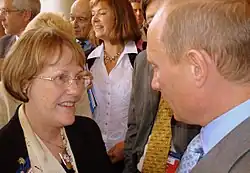
Karen Dawisha (December 2, 1949 – April 11, 2018) the daughter of a school teacher and a jazz musician, was an American political scientist and writer. She was a professor in the Department of Political Science at Miami University in Oxford, Ohio, and the director of The Havighurst Center for Russian and Post-Soviet Studies.
Quotes
- I expected a lot more criticism when I wrote the book... I think everyone is beginning to see the kind of person Putin is. What he did in Ukraine crossed a line, and that really mobilized the media to portray him as what he really is. ...I never meant for this book to bring down Mr. Putin; its purpose is to be educational... It may... provide evidence, but I would really just like it to educate readers about Russia, about Putin's presidency, and politics.
- as quoted by Victoria Slater, "Political science professor sees success with book" Miami University College of Arts and Science (Feb 4, 2015)
Putin's Kleptocracy (2014)
- : Who Owns Russia? Note: Many of the references below require use of your browser's translation app.
- Putin operates a "protection racket"... that severely punishes disloyalty while allowing access to economic predation on a world-historic scale for the inner core of his elite.
- Clifford Gaddy, Barry Ickes, "Putin’s Protection Racket" Center for Research on International Financial and Energy Security (Sep 23, 2010)
- Yevgeniy Gontmakher... deputy director of Moscow’s Institute of World Economy and International Relations... "[T]here is no state in Russia. ...millions of ...bureaucrats work," but they do not perform the [state] function... "Instead of... implementing the course of a developing country, we have a ...private structure ...diverting profits...[T]here isn't even a pale copy of ...the formation of the state." The Parliament had become "...another department of ...Presidential Administration" ...with the ...legal system, and bureaucrats who thought they worked for the state ... [but] serve only the interests of ...[a] "monopolistic business structure which can do anything it likes" and ...controls "...50 percent of the economy."
- Ref: Yevgeniy Gontmakher, Russian state does not exist Movskoskiy Komsomolets (Aug 18, 2013) Note: N/Google Translate Russian.
- Anton Surikov... former military intelligence specialist.. "...all Russian politicians are bandits from St. Petersburg." Surikov...was dead within several months of this 2009 interview.
- Ref: Ben Judah, "Last Cake with a Russian Agent" Standpoint (January/February 2010)
- [A] rich... hybrid combination of Chekists, mobsters, and officials in bureaucratic positions of power existed throughout the USSR... Putin was at the nexus of these three worlds: ...[A] former KGB ...employee, "Nikolay" ...claims ...he was approached by his superior ...1990 to be part of the following scheme:
...a new clandestine structure ...Your personnel files will be removed ...No one will ...know your past. ...you will ...work for the Fatherland. Against those who want to destroy it. ...I worked ...cleaning up the archives of the KGB. ...hundreds of [files] removed. Including ...Putin. After the failed coup of '91... as the chief financial officer ...on behalf of the KGB. ...Money ...and more money. ...in one offshore paradise or another. We... were moving millions and millions of dollars into bank vaults. ....along those same channels ...money from organized crime ...I would not be able to tell which monies belonged to the KGB and which to the mafia. In response to ...questions, they responded: just move the damn money. And I did.
- Ref: Carlo Bonini, Giuseppe D'Avanzo, "I Cekisti al Potere" [The Checkists in power] (Jul 15, 2001)
- Bank Rossiya was not... just a vehicle for investment by... what would become Putin's Ozero circle. It was... one of the many places where this circle... collaborated with, Russian organized crime. Marina Litvinovich... concluded ...18.6 percent of the original shares in Bank Rossiya were owned by ...[companies affiliated with] mob boss Gennady Petrov (arrested by Spanish police in 2008 as head of the Tambov-Malyshev crime group).
- Ref: Marina Litvinovich, "Fursenko, Andrey Aleksandrovich" Election2012.ru, (2012)
- Spanish... officials... having intercepted ..."hundreds" of phone calls ...about [Gennady Nikolaevich] Petrov's "immense power... political connections... [and] criminal activity in Russia ...directed from Spain....Troika mafia leaders invoked ...names of senior ...[Russian] officials to assure ...illicit deals would proceed ..." ...[I]n 1990 with the purchase ...of ...[a] Hotel in Peguera, Majorca ...with Leningrad Communist Party and KGB funds ...Petrov was able to host ...notables, including ...mayor Anatoliy Sobchak, Putin'’s boss. Reznik... and... wife... were co-owners of... companies with... Petrov and Aleksandr Malyshev, also arrested on suspicion of money laundering, tax evasion, and the establishment of a criminal structure that traded in contraband, arms trafficking, and murder ...traced back to ...the monopoly ...given by the St. Petersburg government to the Tambov criminal organization in ...gasoline in the 1990s.
- Ref: 1) Luis Gomez, "¿Vuelven los rusos poco recomendables?" [Do unsavory Russians return?] El País (Feb 1, 2013) 2) Francisco Mercado, "Apresados en España los jefes de la principal organización mafiosa rusa" [Bosses arrested in Spain’s main Russian mafia organization] El País (Jun 14, 2008) 3) Luis Gomez, "La Audiencia dicta orden de captura para un diputado del partido de Putin" [The National Court seeks warrant for Putin party deputy] El País, (Oct 19, 2008) 4) Petrov Gennady @Putin's List (spisok-putina.org)
- The bank... united elites close to Putin... [and] became a vehicle for investment... [e.g. for] 51 percent control over SOGAZ... A report on corruption... claimed... Bank Rossiya... [paid] $58 million, despite... [a] value of $2 billion.
- Ref: Vladimir Milov, Boris Nemtsov, Vladimir Ryzhkov, Ol'ga Shorina, "Putin. Corruption. An Independent White Paper" Putin-Itogi.ru. (2011)
- Sergey Ivanov, Nikolay Patrushev, Aleksandr Grigor’yev, Vladimir Strzhelkovskiy, and Viktor Cherkesov were... contemporaries of Putin in the Leningrad KGB in the 1980s. ...Patrushev and Ivanov... remained... closest to him. ...Strzhelkovskiy ...worked in the Leningrad KGB... In... 1990 he created... Neva ...[later] official travel agency of ...St. Petersburg ...Putin ...named Strzhelkovskiy deputy minister... of ...sports, and tourism, and after 2000... of economic development and trade... In 2008... [he] was named CEO of... Norilsk Nickel... world’s largest... nickel and palladium [producer]... [with] support... of Putin... [and] Vladimir Potanin....When he ...resigned in 2012 with a $100 million cash golden parachute, the New York Times summarized... "...another data point in the shift of corporate wealth and influence away from the first generation ...oligarchs... toward ...former security service agents ...under... Putin."
- Ref: 1) Andrew E. Kramer, "Mining Executive Receives Payout of $100 Million, Russia’s Largest Ever" New York Times (Dec 17, 2012) 2) Henry Plater-Zyberk, "The Russian Decisionmakers in the Chechen Conflict" Defence Academy of the UK (2000)
- [R]eports allege that after Putin became president, Tsepov continued... running... the Kremlin’s tribute system... "administrative resources"... provided to those who paid the largest tribute... Once... accepted... payments from... public funds were disbursed for the campaign. ...[G]overnors were chosen who responded to central interests irrespective "of ...promoting the welfare of the inhabitants of the region." ...Russkiy Kur’er wrote that ...a price list for promotion to governor ...included charges of $3 million to $5 million ...
- Ref: Andrey Petrov, "Skol'ko stoit Gubernator" [How much does a Governorship Cost?] Russkiy Kur'er (Sep 21, 2004)
- Putin began his political career in St. Petersburg in... 1990, as advisor to... Mayor Anatoliy Sobchak, and later as the deputy... mayor... From... 1991, to... 1996, he was... chairman of the Committee for Foreign Liaison (KVS)... regulating, and licensing foreign investment in St. Petersburg and Russian investment... abroad... uniquely positioned to regulate... money, goods, and services into and out of Russia’s largest trading city... When Putin went to work for Sobchak, he immediately began to gather ...the core group ...who would work with him throughout the 1990s... into his presidency. They came from... the KGB, the Main Intelligence Directorate (...GRU), Komsomol, and legal and business circles. ...[T]he inner core consisted of Dmitriy Medvedev, Igor Sechin, Viktor Zubkov, Viktor Ivanov, Aleksey Kudrin, German Gref, Sergey Naryshkin, Dmitriy Kozak, Aleksey Miller, Vladimir Kozhin, and Nikolay Shamalov.
- [Putin] was... in the KGB's active reserves until at least August 1991, and... initially... placed with Sobchak by the KGB... to monitor... emergence of democratic leaders... [F]oreigners who did business in Russia... universally reported... to get something done in the city, you worked through Putin, not Sobchak.
- Andrey Piontkovskiy... "...Putin’s political philosophy and favorite concepts—managed democracy, administrative vertical, dictatorship of law, a 'control' shot to the back of the head, etc.—are close to this group."
- Ref: Andrey Piontkovsky, "Who Is in the Minority?" The Moscow Times (Sep 5, 2005)
- Gref and Kudrin appeared... drawn to Putin... because of his... liberal economic policies and... ability to... get things done in St. Petersburg... when most... were paralyzed by the "alegal" political situation and the total eruption of criminal activity at all levels.
- Shamalov... was hired by Putin in 1993. The conflict of interest was massive. Kolesnikov... described... [Dmitri] Gorelov... director of Petromed, ordering medical equipment; Shamalov... representative of Siemens, delivering the equipment... a good friend of Putin, with whom he went on to found... Ozero.... Kolesnikov said, "When Shamalov came to us with a proposal... we understood... this was... directly from Vladimir Vladimirovich." Gorelov believed that... Putin’s KVS... provided the "roof" to protect against... organized crime. When Vladimir Yakovlev became governor of St. Petersburg... the relationship... [with] Petromed... soured, and Gorelov and Kolesnikov bought... the city's stake... They became major shareholders in Bank Rossiya, purchased a stake in Vyborg Shipyards, and by the mid-2000s were... in the Forbes Russia... richest Russians. Kolesnikov... ultimately became a whistleblower... [claiming] diversion of funds... to build "Putin's Palace."
- Ref: 1) Sergei Kolesnikov, Interviewed by Masha Gessen et al.: 'Pochemy Ya rasskazal pro Dvorets Putina. My pereshli granitsy mezhdy dobrom i zlom v 2009 gody' [Sergei Kolesnikov: Why I told about the Palace of Putin. "We crossed the line between good and evil in 2009"] Snob.ru (June 22, 2011) 2) David Ignatius, "Sergey Kolesnikov's Tale of Palatial Corruption, Russian Style." The Washington Post (Dec 23, 2010)
- No action was more symbolic of the intention of the group around Putin... than the registration... 1996, of the Ozero Dacha Consumer Cooperative... establishing... Vladimir Smirnov as its leader. ...[O]ther members ...Nikolay Shamalov, Vladimir Putin, Vladimir Yakunin, Yuriy Koval'chuk, Viktor Myachin, ...Sergey ...and ...Andrey Fursenko. ...This group ...stayed by Putin throughout his ...period in office, and ...all made hundreds of millions and... billions of dollars. ...[A] cooperative... is a... way for Putin to avoid being given money directly, while enjoying... wealth shared among co-owners. ... Smirnov had long been "closely linked with the well-known 'mafia' businessman Vladimir Barsukov (Kumarin)."
- Ref: Vladimir Milov, Boris Nemtsov, Vladimir Ryzhkov, Ol'ga Shorina, "Putin. Corruption. An Independent White Paper" Putin-Itogi.ru. (2011)
- Smirnov met Putin in 1990 in Germany... He... headed one of the companies... in the [early 1990s] food scandal... millions being stolen; [beginning in 1994] he and Putin sat... on the board of the... SPAG... accused of laundering money for Russian and Columbian organized crime; and he signed over a monopoly position to the Petersburg Fuel Company, which he co-owned with Barsukov-Kumarin. ...Putin ...appointed Smirnov head of Tekhsnabeksport, one of the world’s largest suppliers of nuclear goods and services to foreign governments...
- Ref: Vladimir Milov, Boris Nemtsov, Vladimir Ryzhkov, Ol'ga Shorina, "Putin. Corruption. An Independent White Paper" Putin-Itogi.ru. (2011)
- Vladimir Yakunin... in 2005 became head of Russian Railways. In... 2013 Putin announced... $43 billion... borrowed from Russia’s pension fund... to stimulate the economy, including $14 billion to build three infrastructure projects, two... by Russian Railways. The Russian free media... forecast... such... would... stimulate... corruption. ...Navalnyy ...criticized Yakunin’s entry to... Russia’s billionaires... as the head of a state-owned firm ...a salaried employee ..."In all other countries, the railways are used for movement, but we use them for stealing."
- Ref: Aleksey Navalnyy, "Dacha Yakunina" [Yakunin’s dacha] Navalny.livejournal.com (Jun 1, 2013)
- The Economist outlined the essential truths of the Putin era...
The job of Russian law enforcers is to protect the interests of the state, personified by their... boss, against the people. ...[F]ormer (and not so former) KGB members ...have gained huge political and economic power ...since ...Putin came to office. ...[T]op ranks in the ...FSB ...describe themselves as the ...new nobility ...personally loyal to the monarch and entitled to an estate with people to serve ...As Russia’s former Procurator General ...said in front of ...Putin: "We are the people of the sovereign." Thus they do not see a redistribution of property from private hands into their own as theft but as their right.
- Ref: "Grease My Palm: Bribery and corruption have become endemic" Economist (Nov 27, 2008)
- By 2013 the Forbes Russia list of the wealthiest businessmen in Russia was replete with friends of Putin.
- Putin’s relationship with his friends was... of reciprocity: ...supporting their raids on private businesses, providing ...no-bid state contracts ...allowing the courts to legalize their activities and criminalize those of ...opponents. In return ...they became the bulwark of his base ...helped finance and secure his electoral victories ... removed ...enemies... and... paid him tribute. All... began in St. Petersburg in the early 1990s, when he started to promote ...comrades from ...Leningrad and Dresden KGB ...
- Vladimir S. Milov...
...[A]t the same time ...income disparity in Russia had never been worse, with the superrich doubling their wealth and the bottom fifth of the population in 2011 making only 55 percent of ...1991 earnings ...despite Putin’s electoral claims that his rule had brought prosperity ......[T]hese guys have benefited and made their fortunes through deals which involved state-controlled companies... operating under... direct control of government and the president... [C]ose friends of Putin... of relatively moderate means before Putin came to power all of a sudden turned out to be billionaires.
- Ref: 1) Vladimir Milov, as quoted by Andrew E. Kramer, David M. Herszenhorn, "Midas Touch in St. Petersburg: Friends of Putin Glow Brightly." The New York Times (March 1, 2012)
2) Tom Parfitt, "Russia’s Rich Double Their Wealth, but Poor Were Better Off in the 1990s" Guardian (Apr 11, 2011)
- Ref: 1) Vladimir Milov, as quoted by Andrew E. Kramer, David M. Herszenhorn, "Midas Touch in St. Petersburg: Friends of Putin Glow Brightly." The New York Times (March 1, 2012)
- Putin's ...securing a monopoly position for select firms was a feature ...while deputy mayor. While he professed ...economic liberalization and private property, he ...acted to reduce competition ...and maximize profits for ...friends. In St. Petersburg, Åslund reported, "...Swedish and Finnish businessmen complained about Putin squeezing out their companies ...through ...lawless tax police, to the advantage of [friendly] companies ..."
- Ref: Anders Åslund, Russia's Capitalist Revolution: Why Market Reform Succeeded and Democracy Failed Petersen Institute for International Economics, (2007) p. 201. Also see: overhead from presentation. (Nov 19, 2007)
- Putin... allegedly favored a takeover of the St. Petersburg port by the Tambov organized crime group.
- Ref: 1) Louise Shelly, "Contemporary Russian Organised Crime" Organised Crime in Europe: Concepts, Patterns and Control Policies in the European Union and Beyond ed. Cyrille Fijnaut, Letizia Paoli (2004) pp. 563–85. 2) A. Konstantinov, Banditskiy Peterburg St. Petersburg: Bibliopolis, (1995) 3) A. Konstantinov, M. Dikselius, Banditskaya Rossiya St. Petersburg: Bibliopolis (1997)
- ...Timchenko's company "was a beneficiary of a large export quota under a scandal-tainted oil-for-food scheme set up by Mr. Putin when he worked as head of the city administration’s foreign economic relations committee in 1991 ..." Timchenko and his colleagues were never prosecuted, and indeed he went on to establish Gunvor.
- Ref: Catherine Belton, Neil Buckley, "On the Offensive: How Gunvor Rose to the Top of Russian Oil Trading" The Financial Times (May 14, 2008)
- 2014... U.S. government’s sanctions... claimed a direct connection between Putin, Timchenko, and Gunvor: "Timchenko’s activities in the energy sector have been directly linked to Putin. Putin has investments in Gunvor and may have access to Gunvor funds."
- Gunvor International, with Timchenko as co-owner... grew out of and benefited from the Russian state's dismantling of Yukos in 2003... gained control of... 5 percent of Russia’s total economic output and revenues of over $70 billion annually.
- Ref: Andrew E. Kramer, David M. Herszenhorn, "Midas Touch in St. Petersburg: Friends of Putin Glow Brightly" The New York Times (Mar 1, 2012) 2) Catherine Belton, Neil Buckley, "On the Offensive: How Gunvor Rose to the Top of Russian Oil Trading" The Financial Times (May 14, 2008)
- After his electoral loss in 1996, Sobchak... charged... with corruption... had to flee the country... widely reported as masterminded by Putin. ...[G]etting Sobchak out... protected those, like Putin, about whom there was a lot of incriminating information. ...Sal'ye ..."Before, Putin was under Sobchak’s protection [under his roof], and now Sobchak was under Putin’s protection [krysha]."
- Ref: Sergey Buntman, "Interview with Marina Sal'ye" Ekho Moskvy (Jan 28, 2000)
- Sal'ye summed up the operation and Putin’s ambition... "...Cook up a legally defective contract ...take a license to the Customs Office... open the border... send the goods abroad... and put the money in your pocket. ...It was ...not put out to tender. They needed their 'partners'... of the shadow economy, criminal and mafia structures, front companies that could ensure this... scam. ...[H]is ...lamentations about the disappearing firms deserve nothing but contempt."
- Ref: Marina Sal’ye, "V. Putin—'Prezident' korrumpirovannoy oligarkhii!" [V. Putin—'President' of a Corrupt Oligarchy!] Antikompromat [Source: Public Foundation "Vice"] (Mar 18 2000)
- Putin... 1991... was made head of the supervisory council overseeing the... gambling industry in St. Petersburg. ...[H]ow did the city become a majority owner in... [that] gaming industry in St. Petersburg? ..."by relinquishing the right to collect rent for the facilities that the casinos occupied," the city could claim 51 percent ownership ...[E]stablishing a joint stock company called Neva Chance, which... went on to create over twenty-five different [gambling industry] companies ...many ...headed by ex-FSB officials ...
- Ref: Yuri Felshtinsky, Vladimir Pribylovsky, The Age of Assassins: how Scary are Russia's new Rulers? (2008) pp. 64-66.
- Baltik-Eskort operated openly as a private security service to protect Putin, Sobchak, and other[s]... It... allegedly acted as a liaison with the criminal underworld in St. Petersburg, including... Aleksandr Malyshev, reputed head of the Malyshev criminal organization, and Vladimir Kumarin, the reputed head of the Tambov crime organization. Some... employees were members of criminal groups and... accused of being involved in the assassinations of political figures...
- Ref: Yuri Felshtinsky, Vladimir Pribylovsky, The Age of Assassins: how Scary are Russia's new Rulers? (2008) pp. 260-261.
- Some... gambling companies were controlled by ex-KGB, and as such ...pushed hard to get the Russian mafia to submit to their authority. ...Several reputed members of the Tambov and Malyshev gangs became acquainted with Putin at this time. ...Reputed crime bosses who might not have easily received visas to Western countries now arrived as members of official cultural delegations and did their business abroad under ...protection of ...delegations.
- Ref: Vladimir Ivanidze, "Kto takoy V. V. Kiselyev, kotoryy vyvel na stsenu V. V. Putina?" [Who is this V.V. Kiselyev, who brought V.V. Putin up on stage?] Novaya gazeta (Aug 29, 2011)
- Putin will not go gentle into the night. ...[L]ess flexible and more bombastic in his public appearances ...those in his inner circle suggest that after the 2011–12 election demonstrations, there is ...fear. Gleb Pavlovskiy, his PR guru... believes that Putin will never leave power and ...hampered by the idea that Russians will always decide ...by violence. Pavlovskiy ...heard Putin say, "We ...know that as soon as we move aside, you will destroy us. ...you'll put us to the wall and execute us. And we don’t want to go to the wall."
- The Guardian Interview with Gleb Pavlovskiy (January 2012) in Fiona Hill, Clifford G. Gaddy, Mr. Putin. Operative in the Kremlin (2013) p. 20.
"Putin's Kleptocracy - Who Owns Russia?" (Oct 16, 20014)
- Former Wilson Center Public Policy Scholar, Karen Dawisha presents her new book Putin's Kleptocracy: Who Owns Russia? with discussant Elizabeth A. Wood. WoodrowWilsonCenter channel Video source.
- [T]hese sanctions represented a public admission by the United States government of what it had known for over a decade... Putin has built a system based on massive predation not seen in Russia since the Tzars. Transparency International estimates $300 billion are paid every year in corruption. Capital flight, according to official Russian Central Bank figures since 2005 have been $335 billion, and Credit Suisse... stated that Russia now has the highest income inequality of any country in the world.
- 110 billionaires control 35% of the... wealth of this very wealthy country. ...[T]he median wealth in Russia ...(50% are richer, 50% are poorer) ...is ...$871. It is the lowest median wealth figure of any BRIC country. A country that is a net exporter of energy has a lower median wealth than India. It... scores below Nigeria in its ability to control corruption, and... its willingness to control corruption.
- The Putin system nationalizes the risk and privatizes the reward to loyalists.
- The pattern we see now of the redistribution of Bashneft to the inner core, has been in place since the beginning, and even before Yukos. This is not a system in which robber barons create the industrial basis of a robust emerging capitalist economy. This is a system in which barons are robbed by value-detracting state raiding elites whose sole position is determined by their relationship to the current president. Value-detraction is an extremely important part of this picture.
- Most of the academic world... have spent the last 20 years focusing on democracy in Russia... but not on authoritarianism succeeding, and the basic conclusion... in this book is that Russia is not a system under Putin, of accidental autocrats.
- It is a system that was created with a purpose by intelligent design from the very beginning of the Putin regime. ...[E]ven the 2000 election was fraudulent. Putin would not have won in the first round without massive fraud.
- [F]rom the very beginning the Putin project was... all about guaranteeing to win.
- Gleb Pavlovsky... an extremely important member of the PR team around Putin in 2000, and who has fallen out with the Kremlin... stated (and I agree...) that "Putin was part of a very extensive, but politically invisible layer of people, who after the end of the 1980s, were looking for a revanche in connection with the collapse of the Soviet Union."
- The argument of the book is that this group failed in 1991, but they succeeded in 2000. It's the same group, ideologically, not everybody, but ideologically.
- This group was seeking also to help themselves. They were a group of trained KGB officers, very interested in economic liberalism, but with political control, and primarily liberalism for them[selves].
- Seeing the collapse of communist rule in Eastern Europe after 1989, and the loss of the ruling status of communist parties... the Communist Party of the Soviet Union [CPSU] authorized the KGB... to move money out of the Soviet Union, realizing that if the CPSU lost its ruling status... [i.e.,] access to the state budget without limit, they would need money to live in a multi-party system. Something that the Polish, East German and Hungarian parties hadn't thought about.
- Money started to flood... in such amounts that they virtually bankrupt the Gorbachev regime first, and then when Yeltsin failed to find the Communist gold, they also significantly handicapped the ability of the Yeltsin regime to succeed.
- [T]his was CPSU money safeguarded by the KGB, but when Yeltsin outlawed the CPSU, who did the money belong to? ...[T]o whoever knew what the bank account number was, and this started the scramble for offshore accounts. Kroll International was hired... by Gaidar and Yeltsin. They couldn't find the money.
- [T]he core of the book starts 1991... I regard it as the most conservative analysis possible, based on extensive interviews, of Putin's involvement in illicit activities in the 90s. His efforts to suppress legal cases... against him, and the rise to power of the group around him.
- What we know about this episode... It's there in the written source material. We just need to do the work of... bringing it to light. ...[T]he book is dedicated to free Russian journalism because it was Russian journalists who followed this story, first and foremost! ...[T]hey wrote this story when there was free journalism. They covered it extensively. They were on Putin's tale from the very beginning. They couldn't write this now, but they were writing it in the 1990s.
- The book contains major sections on Bank Rossiya, on the food scandel in Saint Petersburg in the early 90s, on Putin's involvement in the control and emergence of the gambling industry in Saint Petersburg, Putin's involvement as a member of the board of the St. Petersburg Real Estate Holding Company [St. Peterburg Immobilien und Beteiligungs AG]... registered in Germany... investigated by Interpol and B&D for its involvement in the laundering of money from the Cali Cartel, ...giving ...a monopoly position to the Tambov gang in the Petersburg Fuel Company, ...creating and using... money from the mayor's contingency fund through... Twentieth Trust... and the unauthorized use of funds from the mayor's contingency fund in getting an apartment for himself in Saint Petersburg...
Putin's Way (Jan 13, 2015)
- Written, produced & directed by Neil Docherty, A Frontline episode from PBS. Transcript. Documentary film.
- [I]t was a detailed account of the criminal activities that [Andrey Zykov] feels Putin was involved in—abuse of power... of his official position... relations with organized crime, knowledge about money laundering... a whole range of economic crimes.
- Reference is to a 2010 YouTube video posted by Lieutenant Colonel Zykov, laying out evidence from his investigation of Putin's early years in the St. Petersburg government.
- [I]nstead of seeing Russia as a democracy... failing, we need to see it as an authoritarian system... succeeding... [and] incapable of being democratic. They don’t want to be democrats. ...And if that’s correct, when did that start? And that... took me to the '90s... [T]hey were stealing from the... beginning.
- He was the linchpin. He controlled which foreign companies could register their offices and receive offices. ...[A]ll this property was Soviet property. The Soviet Union hadn't fallen yet. So how was a company... to get access to property to set up... in St. Petersburg? Putin would... assign it.
- Referring to Putin's actions as deputy mayor of Saint Petersburg and chair of the committee on foreign economic relations.
- [F]ly-by-night companies were set up. Many of his friends... still around today, were behind those companies. The goods went out, and incomplete or no shipment came back. So millions... were made just in that episode alone.
- Referring to an investigation by Marina Salye of just one $124 million transaction document, signed by Putin, during the early 90s Saint Petersburg food scandel, following the collapse of the Soviet Union, where companies were to obtain food to resolve terrible food shortages, in exchange for Russian raw materials.
- [W]hat they saw in... [Putin] was that he had protected Sobchak. And as they said, "He didn't give up Sobchak, and he's not going to give us up."
- Referring to Boris Yeltsin and fellow oligarchs' confidence that Putin would protect them as new prime minister.
- They needed... situations in which, if they could postpone... elections entirely and make it more difficult for the opposition to focus on unimportant things, like the corruption of the Yeltsin family. ...So there was a real Yeltsin interest... also... a Putin interest because he wanted to be president. ...I think ...evidence that there was an FSB operation to place explosives in the apartment building in Ryazan is incontrovertible.
- Referring to the 1999 Russian apartment bombings and the Second Chechen War leading to the 2000 Russian presidential election.
- [T]he system is... mutual support and tribute. It's a pay-to-play system. If you are on a list of possible people who might be approached to be a member of the Duma... you have to pay for your seat. Once you’re in... you can... charge businessmen to have line items in the budget. Same thing all across all sectors.
- [T]wo numbers is all we need. The median... wealth for the average Russian is $871, according to Credit Suisse... Median wealth in India, over a thousand dollars. The other number is 110... individuals own 35 percent of the wealth of Russia.... the most unequal country by far in the world.
- [Putin] doesn't back down.
"Unmasking Team Putin" (Jan 29, 2015)
- ": Author Karen Dawisha explains how Vladimir Putin and his cronies climbed to power" Interview by Hannah Gais, U.S. News & World Report Source.
- [Saint] Petersburg... was known as the "bandit's capital," and Putin was regarded by many as the link between organized crime and the mayor's office. ...[H]is activity was investigated by city and federal officials. All... squashed when he came to power.
- [A] trillion [dollars] has been subject to capital flight from Russia since 2005... primarily to Western banks.
- Russians seeking to move money to the West... can establish an LLC and purchase... [real estate] property without revealing... the actual owner...
- Putin... believes ...[the West] can easily be manipulated through appealing to investors' and bankers' interests.
- [D]ocuments and newspaper articles that were once on Russian [websites] were scrubbed.
- I had published six books already with Cambridge.
- The Kremlin and its supporters use the courts to scare off researchers who want to expose the corruption at the core of this regime.
Is Putin’s Russia a Kleptocracy? (June 1, 2015)
- And if so, so what? A presentation on her new book Putin's Kleptocracy: Who Owns Russia (May 1, 2015) at Stanford University. Stanford CREEES channel Video Source.
- I also got a few reviews from people who said, "ok, so they're corrupt, but it's not a kleptocracy." So... what do I mean by saying that... a political system is a kleptocracy?
- I'm talking about a system in which risk is nationalized and reward is privatized. Only those loyal to Putin enjoy the benefits of this rule. ...It ...is not the case for many hundreds of thousands of small or medium-sized business owners in Russia who are subject to this... raiding by those above them... Property rights are secured by loyalty and not by law. They could take their claims to court, but those court decisions are political... and so the market... is hugely distorted by political considerations. There's no transparency.
- A lot is written now about the system now is Politburo 2.0. I yearn for the Politburo in trying to figure out what is going on in Russia. ...We don't know when decisions are made. There is no Alexandrov column in Pravda with... the criminological way of talking that allows... us... to understand what... direction the regime is going... There's huge lack of certainty... in the west and in the elite... about what is Putin's view on anything on any given day.
- Tribute is very important... It's a pay-to-play from the bottom to the absolute top... [L]oyalty and silence are demanded in return.
- [I]n... 89-91... the KGB and the conservatives within the Central Committee saw what was happening in Poland, Hungary and... East Germany and became extremely frightened about the unreliability of Gorbachev to... secure their future. They worried that... the communists would have to run as one of many parties, and... be wiped out in the elections, as happened in Poland and Hungary... [T]hey started to move money abroad along established KGB channels... kept safe for the communist party in the event that it became an unfunded legally bound party... [I]nstead... after the 1991 coup the communist party was... outlawed. So... conflict and contention started amongst... KGB groups as to who had knowledge of where the money was.
- While we talked about the failure of the 1991 coup... the failure of the efforts by the conservatives to oust Gorbachev... it's a much more complex situation. ...[S]ome ...were quickly tried and put into jail, but for very short periods and very few people... even though this was a nation-wide conspiracy... 1991 failed as an incident, but the effort to return... KGB preeminence... as a protector of the grand Russian idea... became part of the project of bringing Putin to power in 2000.
- So 91 failed but 2000 succeeded...
- [T]his older generation of KGB generals... who were not in prison, put people in and got them prepared, and Putin was the one who rose to the top... That's my argument.
- So they laundered money. They kept it abroad, first for the CPSU and then for themselves.
- In the book I detail the many cases that I investigated in Saint Petersburg of Putin's involvement with illicit activities, illicit groups.
- My basic argument is... Putin, as deputy mayor of Saint Petersburg worked with the mafia to make their activities legal. He was in a position within the government to provide license and registrations... for items going out... and coming into the country. He sent, over his signature, Tambov mafia leaders as members of cultural delegations to Germany. ...[I]n Saint Petersburg ...White Nights was a mafia front ...[F]rom the very beginning there were people involved with cultural exchanges... gambling [etc.,]... very close to Putin who were using their position for [cross-border exchanges of] goods and services... [E]ven in 1991-92 that border wasn't open for people who had a criminal record. So he verified for their applications for visas that they had no criminal record.
Quotes about Dawisha
- [D]elivers precisely the kind of meticulously researched evidence one would hope for in a work preceded by such controversy... [A]n important and valuable work because it provides the most exhaustive investigation into the patterns of Russian government corruption to date.
- Dawisha offers an account of Putin's rise... beginning with his stint with the KGB... in the 1980s. ...[S]he found that Russia's current struggles are... a product of careful planning by Putin's close-knit inner circle... that placed... individual economic interests above all else.
- Hannah Gais, "Unmasking Team Putin: Author Karen Dawisha explains how Vladimir Putin and his cronies climbed to power" U.S. News & World Report (Jan 29, 2015)
- Her 2014 book, Putin’s Kleptocracy – Who Owns Russia?, is a definitive account of how Russia’s president and his friends grabbed and consolidated power. Along the way they became among the richest people on the planet, and the beneficiaries of what Dawisha called "a kleptocratic tribute system". Putin... knowingly took Russia down an autocratic path... head of a mafia-like cabal... [that] looted the state and its natural resources. ...Karen was born in Colorado Springs in 1949. Her mother, Paula... was a school teacher and her father... a jazz musician. ...[H]er later work on Putin ...was written with clarity, moral passion and bravery, at a time when critics of Russia’s president were dying in murky ways. ...Dawisha initially believed Putin was stumbling towards democracy... until her research turned up ...multiple connections to organised crime. ...Putin’s Kleptocracy became a sort of bible for... investigative journalists looking at Putin’s money.
- Luke Harding, "Karen Dawisha obituary" The Guardian (Apr 20, 2018)
- When Karen Dawisha, Miami University political science professor and Director of the Havighurst Center for Russian and Post-Soviet Studies, compiled five years of research into a... book, she had no idea it would become a bestseller and land her... on the acclaimed TV program Frontline. ...Putin's Kleptocracy: Who Owns Russia? ...according to Dawisha, "reads like a legal brief." ...Dawisha ...appeared on PBS's Frontline in ..."Putin's Way" ..."a complete hour on the subject of my book" ...[she said].
- Victoria Slater, "Political science professor sees success with book" Miami University College of Arts and Science (Feb 4, 2015)
See also
External links
- Dawisha. Putin’s Kleptocracy. Complete Bibliography @Miami U, College of Arst & Science.
- Valdai Discussion Club @Havighurst Center for East European, Russian and Eurasian Studies, Miami U (2007)
- Valdai Discussion Club @archive.org WayBack Machine (2007)
- Putin’s Kleptocracy: Who Owns Russia? Woodrow Wilson Center (October 23, 2014)
- Putin's Way from PBS.org, Transcript.
- YouTube videos
- "Putin's Kleptocracy - Who Owns Russia?" (Oct 6, 2014)Woodrow Wilson Center
- Book TV: Karen Dawisha, "Putin's Kleptocracy" (Oct 13, 2014)
- Is Putin’s Russia a Kleptocracy? And if so, so what? (Jun 1, 2015)
- Putin Clough Center for the Study of Constitutional Democracy at Boston (Jun 15, 2015)