Mary Elizabeth Braddon
_by_William_Powell_Frith_(cropped).jpg)
Mary Elizabeth Braddon (4 October 1835 – 4 February 1915) was an English popular novelist of the Victorian era.
Quotes
- Reader, when any creature inspires you with this instinctive, unreasoning abhorrence, avoid that creature. He is dangerous. Take warning, as you take warning by the clouds in the sky and the ominous stillness of the atmosphere when there is a storm coming. Nature can not lie; and it is nature which has planted that shuddering terror in your breast; an instinct of self-preservation rather than of cowardly fear, which at the first sight of some fellow-creature tells you more plainly than words can speak, "That man is my enemy!"
- Aurora Floyd (1863) ch. 12
- Self-assertion may deceive the ignorant for a time; but when the noise dies away, we cut open the drum, and find it was emptiness that made the music.
- Aurora Floyd (1863) ch. 22
- There was a gay wedding a year ago at Compton church, and very grand and very handsome everything was; and sure the bride looked very lovely; but one thing was wrong, and that was the bridegroom.
- Darrell Markham; or, The Captain of the Vulture (1863) ch. 1
- "The past is all forgiven long ago, dear Ringwood," said his sister earnestly; "it would be ill for brother and sister if the love between them could not outlive old injuries, and be the brighter and the truer for old sorrows."
- Darrell Markham; or, The Captain of the Vulture (1863) ch. 11
- It is taken as a strong proof of a man's innocence that he should look you full in the face with a steadfast gaze when you look at him with suspicion plainly visible in your eyes; but would he not be the poorest villain if he shirked that encounter of glances when he knows full surely that he is in that moment put to the test? It is rather innocence whose eyelids drop when you peer too closely into its eyes, for innocence is appalled by the stern, accusing glances which it is unprepared to meet. Guilt stares you boldly in the face, for guilt is hardened and defiant, and has this one grand superiority over innocence—that it is prepared for the worst.
- Henry Dunbar (1864) ch. 9
- You appreciate his goodness, perhaps; but you don't appreciate him. You just tolerate him because he is good and kind to you, and works like a galley-slave to insure your welfare in the future; but if he could read 'Victor Hugo' like a play-actor and make an idiot of himself about Mendelssohn, you’d adore him.
- The Lady's Mile (1866) ch. 8
- The disease which was undermining Lady Cecil’s moral constitution was not sorrow; it was only the absence of joy.
- The Lady's Mile (1866) ch. 8
- There were many beautiful vipers in those days and she was one of them.
- "Eveline's Visitant", in Belgravia, vol. 1 (January 1867) p. 351
- That he will haunt the footsteps of his enemy after death is the one revenge which a dying man can promise himself; and if men had power thus to avenge themselves the earth would be peopled with phantoms.
- "Eveline's Visitant", in Belgravia, vol. 1 (January 1867) p. 354
- "The Lord gave, and the Lord taketh away; blessed be the name of the Lord." We repeated the holy sentences of resignation; but it was not resignation, it was despair that subdued the violence of our grief.
- "My Wife's Promise", in Harper's Magazine, vol. 12, no. 624 (12 December 1868) p. 790
- I was three-and-thirty years of age. Youth was quite gone; beauty I had never possessed; and I was content to think of myself as a confirmed old maid, a quiet spectator of life's great drama, disturbed by no feverish desire for an active part in the play.
- "At Crichton Abbey", in Belgravia, vol. 14 (May 1871) p. 354
- I am no believer in visions or omens. After all, I would sooner fancy that I was dreaming – dreaming with my eyes open as I stood at the window – than that I beheld the shadows of the dead.
- "At Crichton Abbey", in Belgravia, vol. 14 (May 1871) p. 370
- And then came a long interregnum devoted to the arts and mysteries of the toilet.
- "At Crichton Abbey", in Belgravia, vol. 14 (May 1871) p. 374
- He was a student — such things as happened to him, happen sometimes to students. He was a German — such things as happened to him, happen sometimes to Germans. He was young, handsome, studious, enthusiastic, metaphysical, reckless, unbelieving, heartless. And being young, handsome, and eloquent he was beloved.
- "The Cold Embrace", in Frank Leslies Popular Monthly, vol. 3, no. 4 (April 1877) p. 409
- "You have a corpse there, my friends?" "Yes; a corpse washed ashore an hour ago." "Drowned?" "Yes, drowned; — a young girl, very handsome." "Suicides are always handsome," he says; and then he stands for a little while idly smoking and meditating, looking at the sharp outline of the corpse and the stiff folds of the rough canvas covering. Life is such a golden holiday to him young, ambitious, clever — that it seems as though sorrow and death could have no part in his destiny.
- "The Cold Embrace", in Frank Leslies Popular Monthly, vol. 3, no. 4 (April 1877) p. 410
- He had an honest abhorrence of work and regimen of all kinds. He sometimes thought that he ought to have been created a butterfly without having been obliged to endure the laborious preliminary stages of caterpillar and chrysalis.
- Just As I Am (1880) ch. 13
- She had been told too often of her beauty not to know that she was handsomer than the majority of women. She knew that in mental power she was her lover's equal: by birth, by fortune, by every attribute and quality, she was fitted to be his wife, to rule over his household, and to be a purifying and elevating influence in his life. His mother had loved her as warmly as it was possible for that languid nature to love anything. Their two lives were interwoven by the tenderest associations of the past as well as the solemn engagement that bound them in the present. No, it was not possible for Madoline, seeing all things from the standpoint of her own calm and evenly-balanced mind, to imagine infidelity in a lover so long and so closely bound to her. Those sudden aberrations of the human mind which wreck so many lives, and make men and women a world's wonder, had never come within the range of her experience.
- Asphodel (1881) ch. 6
- "You are plain, Coraline," I said to myself; "unmistakably plain. You have tolerable eyes, and good teeth; but your nose is a failure, your complexion is pallid, and your mouth is just twice too large for prettiness. Never forget that you are plain, my dear Coralie, and then perhaps other people won't remember quite so often. Shake hands with Fate, accept your thick nose and your pallid complexion as the stern necessities of your existence, and make the most of your eyes and teeth, and your average head of hair." That is the gist of what I said to myself, in less sophisticated language, perhaps, before I was fifteen, and from that line of conduct I have never departed. So, if I have come to nineteen years of age without being admired, I have at least escaped being laughed at!
- Thou Art the Man (1894) ch. 1
- They were dreamers—and they dreamt themselves into the cemetery.
- "Good Lady Ducayne", in The Strand Magazine, vol. 11 (January–June 1896) p. 192
- What have you to do with hearts, except for dissection?
- "Good Lady Ducayne", in The Strand Magazine, vol. 11 (January–June 1896) p. 193
Lady Audley's Secret (1862)
- Miss Lucy Graham was blessed with that magic power of fascination, by which a woman can charm with a word or intoxicate with a smile.
- Ch. 1
- "I scarcely think there is a greater sin, Lucy," he said, solemnly, "than that of a woman who marries a man she does not love. You are so precious to me, my beloved, that deeply as my heart is set on this, and bitter as the mere thought of disappointment is to me, I would not have you commit such a sin for any happiness of mine. If my happiness could be achieved by such an act, which it could not—which it never could," he repeated, earnestly—"nothing but misery can result from a marriage dictated by any motive but truth and love."
- Ch. 1
- "Do you know, Bob," he said, "that when some of our fellows were wounded in India, they came home, bringing bullets inside them. They did not talk of them, and they were stout and hearty, and looked as well, perhaps, as you or I; but every change in the weather, however slight, every variation of the atmosphere, however trifling, brought back the old agony of their wounds as sharp as ever they had felt it on the battle-field. I've had my wound, Bob; I carry the bullet still, and I shall carry it into my coffin."
- Ch. 7
- The widower only sighed and puffed his cigar fiercely out of the open window. Perhaps he was thinking of that far-away time—little better than five years ago, in fact; but such an age gone by to him—when he first met the woman for whom he had worn crape round his hat three days before.
- Ch. 7
- We hear every day of murders committed in the country. Brutal and treacherous murders; slow, protracted agonies from poisons administered by some kindred hand; sudden and violent deaths by cruel blows, inflicted with a stake cut from some spreading oak, whose every shadow promised—peace. In the county of which I write, I have been shown a meadow in which, on a quiet summer Sunday evening, a young farmer murdered the girl who had loved and trusted him; and yet, even now, with the stain of that foul deed upon it, the aspect of the spot is—peace. No species of crime has ever been committed in the worst rookeries about Seven Dials that has not been also done in the face of that rustic calm which still, in spite of all, we look on with a tender, half-mournful yearning, and associate with—peace.
- Ch. 7
- As he sat in the deep embrasure of a mullioned window, talking to my lady, his mind wandered away to shady Figtree Court, and he thought of poor George Talboys smoking his solitary cigar in the room with the birds and canaries.
- Ch. 11
- "Why, I can't help smiling at people, and speaking prettily to them. I know I'm no better than the rest of the world; but I can't help it if I'm pleasanter. It's constitutional."
- Ch. 14
- Seated in the embrasure of this window, my lady was separated from Robert Audley by the whole length of the room, and the young man could only catch an occasional glimpse of her fair face, surrounded by its bright aureole of hazy, golden hair.
- Ch. 15
- It seemed as though the wise architect who had superintended the building of the Castle Inn had taken especial care that nothing but the frailest and most flimsy material should be used, and that the wind, having a special fancy for this unprotected spot, should have full play for the indulgence of its caprices. To this end pitiful woodwork had been used instead of solid masonry; rickety ceilings had been propped up by fragile rafters, and beams that threatened on every stormy night to fall upon the heads of those beneath them; doors whose specialty was never to be shut, yet always to be banging; windows constructed with a peculiar view to letting in the draft when they were shut, and keeping out the air when they were open. The hand of genius had devised this lonely country inn; and there was not an inch of woodwork, or trowelful of plaster employed in all the rickety construction that did not offer its own peculiar weak point to every assault of its indefatigable foe.
- Ch. 17
- Phoebe Marks was a person who never lost her individuality. Silent and self-constrained, she seemed to hold herself within herself, and take no color from the outer world.
- Ch. 17
- The wind came whistling up across the frosty open country, and through the leafless woods, and rattled fiercely at the window-frames.
- Ch. 17
- "You seem to have quite a taste for discussing these horrible subjects," she said, rather scornfully; "you ought to have been a detective police officer."
- Ch. 18
- Foul deeds have been done under the most hospitable roofs; terrible crimes have been committed amid the fairest scenes, and have left no trace upon the spot where they were done. I do not believe in mandrake, or in bloodstains that no time can efface. I believe rather that we may walk unconsciously in an atmosphere of crime, and breathe none the less freely. I believe that we may look into the smiling face of a murderer, and admire its tranquil beauty.
- Ch. 18
- "Justice to the dead first," he said; "mercy to the living afterward."
- Ch. 19
- He was a square, pale-faced man of almost forty, and had the appearance of having outlived every emotion to which humanity is subject.
- Ch. 22
- The Eastern potentate who declared that women were at the bottom of all mischief, should have gone a little further and seen why it is so. It is because women are never lazy. They don't know what it is to be quiet. They are Semiramides, and Cleopatras, and Joan of Arcs, Queen Elizabeths, and Catharines the Second, and they riot in battle, and murder, and clamour and desperation. If they can't agitate the universe and play at ball with hemispheres, they'll make mountains of warfare and vexation out of domestic molehills, and social storms in household teacups. Forbid them to hold forth upon the freedom of nations and the wrongs of mankind, and they'll quarrel with Mrs. Jones about the shape of a mantle or the character of a small maid-servant. To call them the weaker sex is to utter a hideous mockery. They are the stronger sex, the noisier, the more persevering, the most self-assertive sex. They want freedom of opinion, variety of occupation, do they? Let them have it. Let them be lawyers, doctors, preachers, teachers, soldiers, legislators—anything they like—but let them be quiet—if they can.
- Ch. 24
- We are apt to be angry with this cruel hardness in our life—this unflinching regularity in the smaller wheels and meaner mechanism of the human machine, which knows no stoppage or cessation, though the mainspring be forever hollow, and the hands pointing to purposeless figures on a shattered dial.
- Ch. 24
- Let any man make a calculation of his existence, subtracting the hours in which he has been thoroughly happy—really and entirely at his ease, without one arriere pensée to mar his enjoyment—without the most infinitesimal cloud to overshadow the brightness of his horizon. Let him do this, and surely he will laugh in utter bitterness of soul when he sets down the sum of his felicity, and discovers the pitiful smallness of the amount. He will have enjoyed himself for a week or ten days in thirty years, perhaps. In thirty years of dull December, and blustering March, and showery April, and dark November weather, there may have been seven or eight glorious August days, through which the sun has blazed in cloudless radiance, and the summer breezes have breathed perpetual balm. How fondly we recollect these solitary days of pleasure, and hope for their recurrence, and try to plan the circumstances that made them bright; and arrange, and predestinate, and diplomatize with fate for a renewal of the remembered joy. As if any joy could ever be built up out of such and such constituent parts! As if happiness were not essentially accidental—a bright and wandering bird, utterly irregular in its migrations; with us one summer's day, and forever gone from us on the next!
- Ch. 24
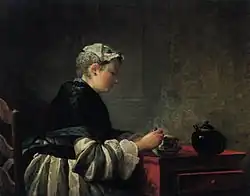
- She looked very pretty and innocent, seated behind the graceful group of delicate opal china and glittering silver. Surely a pretty woman never looks prettier than when making tea. The most feminine and most domestic of all occupations imparts a magic harmony to her every movement, a witchery to her every glance. The floating mists from the boiling liquid in which she infuses the soothing herbs; whose secrets are known to her alone, envelope her in a cloud of scented vapor, through which she seems a social fairy, weaving potent spells with Gunpowder and Bohea. At the tea-table she reigns omnipotent, unapproachable. What do men know of the mysterious beverage? Read how poor Hazlitt made his tea, and shudder at the dreadful barbarism. How clumsily the wretched creatures attempt to assist the witch president of the tea-tray; how hopelessly they hold the kettle, how continually they imperil the frail cups and saucers, or the taper hands of the priestess. To do away with the tea-table is to rob woman of her legitimate empire. To send a couple of hulking men about among your visitors, distributing a mixture made in the housekeeper's room, is to reduce the most social and friendly of ceremonies to a formal giving out of rations. Better the pretty influence of the tea cups and saucers gracefully wielded in a woman's hand than all the inappropriate power snatched at the point of the pen from the unwilling sterner sex. Imagine all the women of England elevated to the high level of masculine intellectuality, superior to crinoline; above pearl powder and Mrs. Rachael Levison; above taking the pains to be pretty; above tea-tables and that cruelly scandalous and rather satirical gossip which even strong men delight in; and what a drear, utilitarian, ugly life the sterner sex must lead.
- Ch. 25
- Do you think I will suffer myself to be baffled?
- Ch. 29
- Now love is so very subtle an essence, such an indefinable metaphysical marvel, that its due force, though very cruelly felt by the sufferer himself, is never clearly understood by those who look on at its torments and wonder why he takes the common fever so badly.
- Ch. 33
- He forgot that love, which is a madness, and a scourge, and a fever, and a delusion, and a snare, is also a mystery, and very imperfectly understood by everyone except the individual sufferer who writhes under its tortures.
- Ch. 33
- He went in search of that honored kinsman with God knows how heavy a weight of anguish at his heart, for he knew he was about to shatter the day-dream of his uncle's life; and he knew that our dreams are none the less terrible to lose, because they have never been the realities for which we have mistaken them.
- Ch. 34
- My lady, watchful and quiet as the cold stars in the wintry sky, looked up at these casements with an earnest and scrutinizing gaze. One of the windows was shrouded by a scanty curtain of faded red; and upon this curtain there went and came a dark shadow, the shadow of a woman with a fantastic head dress, the shadow of a restless creature, who paced perpetually backward and forward before the window.
- Ch. 37
- Who has not been, or is not to be mad in some lonely hour of life? Who is quite safe from the trembling of the balance?
- Ch. 38 (7th rev. ed. 1862)
The Doctor's Wife (1864)
- If there had been any one to take this lonely girl in hand and organize her education, Heaven only knows what might have been made of her; but there was no friendly finger to point a pathway in the intellectual forest, and Isabel rambled as her inclination led her, now setting up one idol, now superseding him by another; living as much alone as if she had resided in a balloon, for ever suspended in mid air, and never coming down in serious earnest to the common joys and sorrows of the vulgar life about her.
- Ch. 3
- Ruins and copious refreshment ware associated in Mr. Gilbert’s mind; and, indeed, there does seem to be a natural union between ivied walls and lobster-salad, crumbling turrets and cold chicken; just as the domes of Greenwich Hospital, the hilly park beyond, and the rippling water in the foreground, must be for ever and ever associated with floundered souchy and devilled whitebait.
- Ch. 6
- And now the senna and camomile were to flavour all her life. She was no longer to enjoy that mystical double existence, those delicious glimpses of dreamland, which made up for all the dulness of the common world that surrounded her.
- Ch. 12
Fenton's Quest (1871)
- I consider any man a fool who allows himself to be captivated by a pretty face.
- Ch. 3
- A woman's love is such a capricious thing, and so often bestowed upon the least deserving amongst those who seek it.
- Ch. 12
- You can make no excuse for his love, that fatal irresistible passion, which outweighs truth and honour when they are set in the opposite scale.
- Ch. 12
- "Naught's had, all's spent, when our desire is got without content." I wonder whether the fulfilment of one's heart's desire ever does bring perfect contentment? I think not. There is always something wanting. And if a man comes by his wish basely, there is a taint of poison in the wine of life that neutralizes all its sweetness.
- Ch. 12
- He was a very gracious and communicative person, and seemed to take life in an easy agreeable manner, like a man whose habit it was to look on the brighter side of all things, provided his own comfort was secured.
- Ch. 14
- I have waited for your return these many years. You might have found me more tenderly disposed towards you, had you come earlier; but there are some feelings which seem to wear out as a man grows older,—affections that grow paler day by day, like colours fading in the sun.
- Ch. 14
- "And has your marriage brought you happiness, Marian?" "I love my husband," she answered with a plaintive reproachful look, as if there had been a kind of cruelty in his straight question. "I do not suppose that there is such a thing as perfect happiness in the world."
- Ch. 16