Mount Takakuma
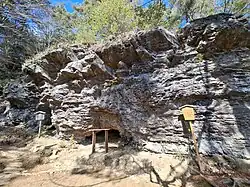
Mount Takakuma (高熊山, Takakuma-yama) (lit. 'tall bear mountain') is a sacred mountain in Anao (穴太), Kameoka, Kyoto Prefecture, Japan. It is one of the most sacred sites of the Oomoto religion. Oomoto's co-founder Onisaburo Deguchi received divine revelations on Mount Takakuma while performing ascetic training for one week during March 1–7, 1898.
Quotes about Mount Takakuma
- Whenever I visited Mount Takakuma I found myself thinking about Plato’s allegory of the cave in The Republic. He tells of men imprisoned in a cave where all they see are shadows on the wall from outside activity, and all they hear are echoes from outside noise. His point is that all humans are like these prisoners in the cave: ignorant, trapped in the depths, looking and listening to illusions they believe are real, unaware of the limits of their perceptions. On rare occasion one individual escapes and through a long painful journey discovers true reality, which according to Plato is that goodness is the great origin of everything that exists. In Plato’s view it is not kings through birth or dictators through strength or presidents through election who are best equipped to govern society but this rare individual who has left the cave and gained knowledge of what is ultimately real. The problem is this person is almost always misunderstood because the humans in the cave have not had his experience or gained his insight.
As I write these words it feels like I am telling Onisaburo’s story. He went into the cave and then had his out-of-body experiences; when he left the cave he understood the world of humans and the world of spir its. Onisaburo spent the rest of his life trying to teach the Japanese to see their illusions for what they were and to embrace the spiritual world. In the world of humans, since Onisaburo moved to his burial mound, most of us are still stuck in the cave, buried in illusions: the illusion of material wealth; the illusion of military might; the illusion of controlling destiny. The list goes on. Our illusions exclude ritual, nature, the arts, the spiritual world and other ancient ways explored in this book.- Bill Roberts (2006). A Portrait of Oomoto: The Way of Art, Spirit and Peace in the 21st Century. Oomoto Foundation. p. 328. ISBN 9784887560697.