Hipponax
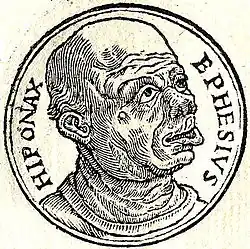
Hipponax (Ancient Greek: Ἱππῶναξ), of Ephesus and later Clazomenae, was an Ancient Greek poet who composed verses depicting the vulgar side of life in Ionian society in the sixth century BC. He was celebrated by ancient authors for his malicious wit, and ancient literary critics credited him with inventing literary parody and "lame" poetic meters suitable for expressing vigorous abuse. Little of his work survives despite its interest to Alexandrian scholars, who collected it in two or three books.
Quotes
- Τίς ὸμφαλητόμος σε τὸν διοπλῆγα
ἔψησε κἀπέλουσεν ἀσκαρίζοντα- What navel-snipper wiped and washed you as you squirmed about, you crack-brained creature?
- Quoted in Aelius Herodianus, On Inflections; translated by Douglas Gerber, Greek Iambic Poetry (1999) p. 367
Pseudo-Hipponax
- Δύ᾿ ἡμέραι γυναικός εἰσιν ἥδισται,
ὅταν γαμῇ τις κἀκφέρῃ τεθνηκυῖαν.- Two days are best of a man’s wedded life,
The days when he marries and buries his wife. - Quoted in Stobaeus, Florilegium, iv, 22, 35; translated by J. M. Edmonds for the Oxford Book of Greek Verse in Translation (1938) p. 226, no. 182
- Cf. the (apparently anonymous) English-language joke "The two best days in a boat owner’s life are the day they buy a boat and the day they sell it." Reuven Perlman, "The Best Days of a Boat Owner's Life", The New Yorker (13 January 2021)
- Two days are best of a man’s wedded life,
Quotes about Hipponax
- If you are a scoundrel, do not approach the tomb; but if you are honest and from worthy stock, sit down in confidence and, if you like, fall asleep.
- Epigram attributed to Theocritus; translated by Douglas Gerber, Greek Iambic Poetry (1999) p. 347