R. D. Blackmore
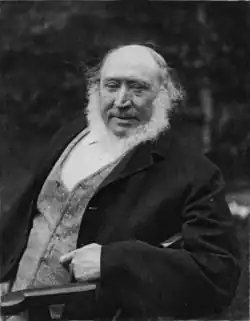
Richard Doddridge Blackmore (7 June 1825 – 20 January 1900), known as R. D. Blackmore, was an English novelist. He won acclaim for vivid descriptions and personification of the countryside, sharing with Thomas Hardy a Western England background and a strong sense of regional setting in his works.
Quotes
- In the hour of death, after this life’s whim,
When the heart beats low, and the eyes grow dim,
And pain has exhausted every limb—
The lover of the Lord shall trust in Him. For even the purest delight may pall,
And power must fail, and the pride must fall,
And the love of the dearest friends grow small—
But the glory of the Lord is all in all.- "Dominus Illuminatio Mea", sts. 1 and 4. Anonymous in Q's OBEV (1900) p. 1058, no. 883. Attributed in Notes and Queries, 11th s., vol. 10 (26 December 1914) p. 513
Lorna Doone (1869)
- London: Sampson Low, Son, & Marston
- But whatever lives or dies, business must be attended to; and the principal business of good Christians is, beyond all controversy, to fight with one another.
- Ch. 2
- But now, at Dulverton, we dined upon the rarest and choicest victuals that ever I did taste. Even now, at my time of life, to think of it gives me appetite, as once and awhile to think of my first love makes me love all goodness. Hot mutton pasty was a thing I had often heard of from very wealthy boys and men, who made a dessert of dinner; and to hear them talk of it made my lips smack, and my ribs come inwards.
- Ch. 3
- It is the manner of all good boys to be careless of apparel, and take no pride in adornment.
- Ch. 3
- “Hould thee tongue, lad,' he said sharply; 'us be naigh the Doone-track now, two maile from Dunkery Beacon hill, the haighest place of Hexmoor. So happen they be abroad to-naight, us must crawl on our belly-places, boy.”
- Ch. 3 (see West Country English)
- Soon we found Peggy and Smiler in company, well embarked on the homeward road, and victualling where the grass was good. Right glad they were to see us again—not for the pleasure of carrying, but because a horse (like a woman) lacks, and is better without, self-reliance.
- Ch. 3
- Least said soonest mended, because less chance of breaking.
- Ch. 5
- On the right-hand side was a mighty oven, where Betty threatened to bake us; and on the left, long sides of bacon, made of favoured pigs, and growing very brown and comely. Annie knew the names of all, and ran up through the wood-smoke, every now and then, when a gentle memory moved her, and asked them how they were getting on, and when they would like to be eaten. Then she came back with foolish tears, at thinking of that necessity; and I, being soft in a different way, would make up my mind against bacon. But, Lord bless you! it was no good. Whenever it came to breakfast-time, after three hours upon the moors, I regularly forgot the pigs, but paid good heed to the rashers.
- Ch. 7
- But during those two months of fog (for we had it all the winter), the saddest and the heaviest thing was to stand beside the sea. To be upon the beach yourself, and see the long waves coming in; to know that they are long waves, but only see a piece of them; and to hear them lifting roundly, swelling over smooth green rocks, plashing down in the hollow corners, but bearing on all the same as ever, soft and sleek and sorrowful, till their little noise is over.
- Ch. 12
- “Now let us bandy words no more,” said mother, very sweetly; “nothing is easier than sharp words, except to wish them unspoken.”
- Ch. 14
- “I think, Master Ridd, you cannot know,” she said, with her eyes taken from me, “what the dangers of this place are, and the nature of the people.” “Yes, I know enough of that; and I am frightened greatly, all the time, when I do not look at you.”
- Ch. 16
- Too late we know the good from bad; the knowledge is no pleasure then; being memory's medicine rather than the wine of hope.
- Ch. 17
- There was that power all round, that power and that goodness, which make us come, as it were, outside our bodily selves, to share them. Over and beside us breathes the joy of hope and promise; under foot are troubles past; in the distance bowering newness tempts us ever forward. We quicken with largesse of life, and spring with vivid mystery.
- Ch. 19
- I cannot go through all my thoughts so as to make them clear to you, nor have I ever dwelt on things, to shape a story of them. I know not where the beginning was, nor where the middle ought to be, nor even how at the present time I feel, or think, or ought to think. If I look for help to those around me, who should tell me right and wrong (being older and much wiser), I meet sometimes with laughter, and at other times with anger.
- Ch. 20
- It might have been a good thing for me to have had a father to beat these rovings out of me; or a mother to make a home, and teach me how to manage it. For, being left with none—I think; and nothing ever comes of it. Nothing, I mean, which I can grasp and have with any surety; nothing but faint images, and wonderment, and wandering.
- Ch. 20
- Often too I wonder at the odds of fortune, which made me (helpless as I am, and fond of peace and reading) the heiress of this mad domain, the sanctuary of unholiness.
- Ch. 20
- All the beauty of the spring went for happy men to think of; all the increase of the year was for other eyes to mark. Not a sign of any sunrise for me from my fount of life, not a breath to stir the dead leaves fallen on my heart's Spring.
- Ch. 22
- I for my part was nothing loth, and preferred to see London by daylight. And after all, it was not worth seeing, but a very hideous and dirty place, not at all like Exmoor.
- Ch. 24
- Having no knowledge of these great men, nor of the matter how far it was true, I had not very much to say about either of them or it; but this silence was not shared (although the ignorance may have been) by the hundreds of people around me.
- Ch. 24
- It seemed to me that if the lawyers failed to do their duty, they ought to pay people for waiting upon them, instead of making them pay for it.
- Ch. 24
- Whenever I wandered in the streets, what with the noise the people made, the number of the coaches, the running of the footmen, the swaggering of great courtiers, and the thrusting aside of everybody, many and many a time I longed to be back among the sheep again, for fear of losing temper.
- Ch. 24
- Either love me not at all, or as I love you for ever.
- Ch. 28
- The love of all things was upon me, and a softness to them all, and a sense of having something even such as they had.
- Ch. 29
- I delay so long, because I fear; because my whole life hangs in balance on a single word; because what I have near me now may never more be near me after, though more than all the world, or than a thousand worlds, to me.
- Ch. 33
- May be we are not such fools as we look. But though we be, we are well content, so long as we may be two fools together.
- Ch. 40
- There is nothing in this world to fear, nothing to revere or trust, nothing even to hope for; least of all, is there aught to love.
- Ch. 40
- I for my part was most thankful that I had not killed. For to have the life of a fellow-man laid upon one's conscience—deserved he his death, or deserved it not—is to my sense of right and wrong the heaviest of all burdens; and the one that wears most deeply inwards, with the dwelling of the mind on this view and on that of it.
- Ch. 49
- For nine women out of ten must have some kind of romance or other, to make their lives endurable; and when their love has lost this attractive element, this soft dew-fog (if such it be), the love itself is apt to languish; unless its bloom be well replaced by the budding hopes of children. Now Master Stickles neither had, nor wished to have, any children.
- Ch. 49
- Hope of course is nothing more than desire with a telescope, magnifying distant matters, overlooking near ones; opening one eye on the objects, closing the other to all objections. And if hope be the future tense of desire, the future of fear is religion—at least with too many of us.
- Ch. 56
- “Now what will ye please to eat?” she asked, with a lively glance at the size of my mouth: “that is always the first thing you people ask, in these barbarous places.” “I will tell you by-and-by,” I answered, misliking this satire upon us; “but I might begin with a quart of ale, to enable me to speak, madam.” “Very well. One quevart of be-or;” she called out to a little maid, who was her eldest child, no doubt. “It is to be expected, sir. Be-or, be-or, be-or, all day long, with you Englishmen!” “Nay,” I replied, “not all day long, if madam will excuse me. Only a pint at breakfast-time, and a pint and a half at eleven o'clock, and a quart or so at dinner. And then no more till the afternoon; and half a gallon at supper-time. No one can object to that.”
- Ch. 56
- She was altered by time, as much as I was. The slight and graceful shape was gone; not that I remembered anything of her figure, if you please; for boys of twelve are not yet prone to note the shapes of women.
- Ch. 56
- The motives of mankind are plainer than the motions they produce.
- Ch. 57
- Women who are (beyond all doubt) the mothers of all mischief, also nurse that babe to sleep, when he is too noisy.
- Ch. 57
- But a sigh is not (like a yawn) infectious; and we are all more prone to be sent to sleep than to sorrow by one another. Not but what a sigh sometimes may make us think of sighing.
- Ch. 57
- If I cared for influence—which means, for the most part, making people do one's will, without knowing it—my first step toward it would be to be called, in common parlance, “slow but sure.”
- Ch. 62
- Because I rant not, neither rave of what I feel, can you be so shallow as to dream that I feel nothing?
- Ch. 63
- Although a man may be as simple as the flowers of the field; knowing when, but scarcely why, he closes to the bitter wind; and feeling why, but scarcely when, he opens to the genial sun; yet without his questing much into the capsule of himself—to do which is a misery—he may have a general notion how he happens to be getting on.
- Ch. 67
- The lanes and fields between Charing Cross and the village of Kensington, are, or were at that time, more than reasonably infested with footpads and with highwaymen. However, my stature and holly club kept these fellows from doing more than casting sheep's eyes at me. For it was still broad daylight, and the view of the distant villages, Chelsea, Battersea, Tyburn, and others, as well as a few large houses, among the hams and towards the river, made it seem less lonely.
- Ch. 67
- Now this may seem very strange to us who live in a better and purer age—or say at least that we do so—and yet who are we to condemn our fathers for teaching us better manners, and at their own expense?
- Ch. 68
See also
External links
 Encyclopedic article on R. D. Blackmore on Wikipedia