Robert L. Park
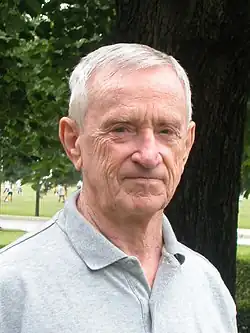
Robert Lee Park (January 16, 1931 – April 29, 2020) was an American professor of physics at the University of Maryland, College Park, and a former director of public information at the Washington office of the American Physical Society. Park was most noted for his critical commentaries on alternative medicine and pseudoscience, as well as his criticism of how legitimate science is distorted or ignored by the media, some scientists, and public policy advocates. He was also noted for his preference for robotic over crewed space exploration.
Quotes
Voodoo Science (2000)
- New York: Oxford UP
- I came to realize that many people choose scientific beliefs the same way they choose to be Methodists, or Democrats, or Chicago Cubs fans. They judge science by how well it agrees with the way they want the world to be.
- Preface (pp. viii–ix)
- Two hundred years ago, educated people imaged that the greatest contribution of science would be to free the world of superstition and humbug. It has not happened. Ancient beliefs in demons and magic still sweep across the modern landscape, but they are now dressed in the language and symbols of science: a best-selling health guru explains that his brand of healing is grounded in quantum theory; half the population believes Earth is being visited by space aliens who have mastered faster-than-light travel; and educated people wear magnets in their shoes to draw energy from the Earth. This is pseudoscience.
- Ch. 1 (pp. 9–10)
- What may begin as an honest error...has a way of evolving through almost imperceptible steps from self-delusion to fraud. The line between foolishness and fraud is thin. Because it is not always easy to tell when that line is crossed, I use the term voodoo science to cover them all: pathological science, junk science, pseudoscience and fraudulent science.
- Ch. 1 (p. 10)
- The integrity of science is anchored in the willingness of scientists to test their ideas and results in direct confrontation with their scientific peers.
- Ch. 1 (p. 16)
- Every step taken by science claims territory once occupied by the supernatural.
- Ch. 2 (p. 31)
- It is not so much knowledge of science that the public needs as a scientific worldview—an understanding that we live in an orderly universe, governed by physical laws that cannot be circumvented.
- Ch. 2 (p. 40)
- America's astronauts have been left stranded in low-Earth orbit, like passengers waiting beside an abandoned stretch of track for a train that will never come, bypassed by the advance of science.
- Ch. 4 (p. 91)
- Few scientists or inventors set out to commit fraud. In the beginning, most believe they have made a great discovery. But what happens when they finally realize that things are not behaving as they believed?
- Ch. 5 (p. 104)
- [T]he uniquely American myth of the self-educated genius fighting against a pompous, close-minded establishment.
- Ch. 6 (p. 112)
- They are betting against the laws of thermodynamics. No one has ever won that wager.
- Ch. 6 (p. 138)
- For a million years, our species was confronted with a world we could not hope to understand. Now, within a span of a single human lifetime, the book of nature has been opened wide. On its pages we are finding, if not a simple world, at least an orderly world in which everything from the birth of stars to falling in love is governed by the same natural laws.
- Ch. 10 (pp. 210–11)
- Those [natural] laws cannot be circumvented by any amount of piety or cleverness, but they can be understood. Uncovering them should be the highest goal of a civilized society. Not...because scientists have any claim to greater intellect or virtue, but because the scientific method transcends the flaws of individual scientists. Science is the only way we have of separating the truth from ideology, or fraud, or mere foolishness.
- Ch. 10 (p. 211)