REGALIA (Lat. regalis, royal, from rex, king), the ensigns
of royalty. The crown (see Crown and Coronet) and sceptre
(see Sceptre) are dealt with separately. Other ancient symbols
of royal authority are bracelets, the sword, a robe or mantle,
and, in Christian times, a ring. Bracelets, as royal emblems,
are mentioned in the Bible in connexion with Saul (2 Sam. i. 10),
and they have been commonly used by Eastern monarchs.
In Europe their later use seems to have been fitfully confined
to England, although they were a very ancient ornament for
kings among the Teutonic races. Two coronation bracelets
are mentioned among the articles of the regalia ordered to be
destroyed at the time of the Commonwealth, and two new
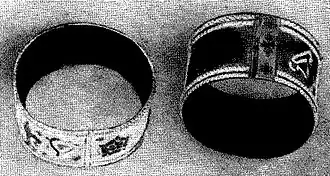
ones were made at the Restoration. These are of gold, 1½ in.
in width, and ornamented with the rose, thistle, harp and
fleur-de-lis in enamel round them. They have not been used
for modern coronations.
The sword is one of the usual regalia of most countries, and
is girded on to the sovereign during the coronation. In England
the one sword has been developed into five. The Sword of
State is borne before the sovereign on certain state occasions,
and at the coronation is exchanged for a smaller sword, with
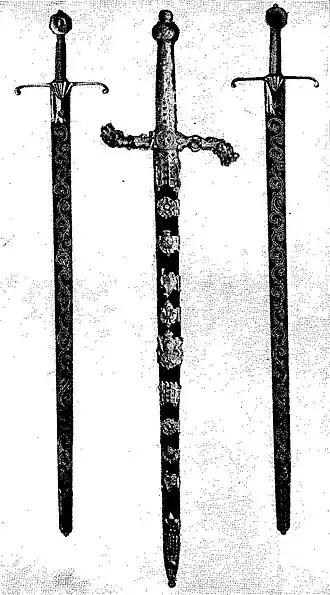
which the king is ceremonially girded. The three other swords
of the regalia are the “Curtana,” the Sword of Justice to the
Spirituality, and the Sword of Justice to the Temporality.
The Curtana has a blade cut off short and square, indicating
thereby the quality of mercy.
The mantle, as a symbol of royalty, is almost universal, but
in the middle ages other quasi-priestly robes were added to
it (see Coronation). The English mantle was formerly made
of silk; latterly cloth of gold has been used., The ring, by
which the sovereign is wedded to his kingdom, is not of so wide
a range of usage. That of the English kings held a large ruby
with a cross engraved on it. Recently a sapphire has been
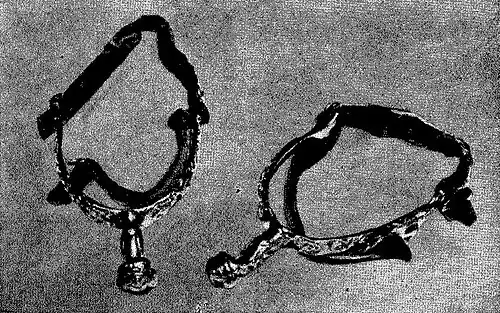
substituted for the ruby. Golden spurs, though included
among the regalia, are merely used to touch the king's feet,
and are not worn.
The orb and cross was not anciently placed in the king's
hands during the coronation ceremony, but was carried by
him in the left hand on leaving the church. It is emblematically
of monarchical rule, and is only used by a reigning sovereign.
The idea is undoubtedly derived from the globe with the figure
of Victory with which the Roman emperors are depicted. The
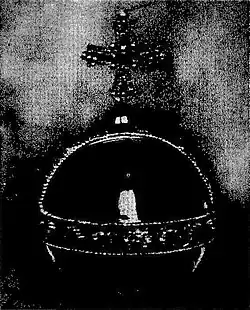
larger orb of the English regalia is a magnificent ball of gold,
6 in. in diameter, with a band round the centre edged with
gems and pearls. A similar band arches the globe, on the
top of which is a remarkably fine amethyst 1½ in. in height,
upon which rests the cross of gold outlined with diamonds.
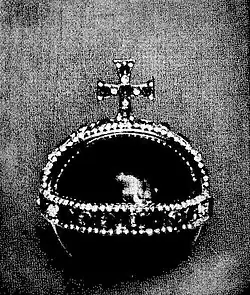
There is a smaller orb made for Mary II., who reigned jointly
with King William III.
The English regalia, with one or two exceptions, were made
for the coronation of Charles II. by Sir Robert Vyner. The
Scottish regalia preserved at Edinburgh comprise the crown,
dating, in part, from Robert the Bruce, the sword of state
given to James IV. by Pope Julius II., and two sceptres.
Besides regalia proper, certain other articles are sometimes
included under the name, such as the ampulla for the holy oil, and
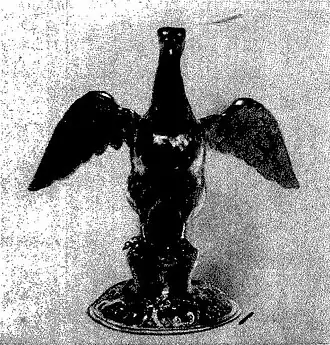
the coronation spoon. The ampulla is of solid gold in the form of
an eagle with outspread wings. It weighs 10 oz., and holds 6 oz.
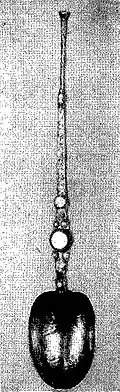
of oil. The spoon was not originally used for its present purpose.
It is of the 12th or 13th century, with a long handle and egg shaped
bowl. Its history is quite unknown.
See Cyril Davenport, The English Regalia, with illustrations in
colour of all the regalia; Leopold Wickham Legg, English Coronation
Records; The Ancestor, Nos. 1 and 2 (1902); Menin, The Form,
&c., of Coronations (translated from French, 1727).
REGENERATION OF LOST PARTS. A loss and renewal
of living material, either continual or periodical, is a familiar
occurrence in the tissues of higher animals. The surface of
the human skin, the inner lining of the mouth and respiratory
organs, the blood corpuscles, the ends of the nails, and many
other portions of tissues are continuously being destroyed and
replaced. The hair of many mammals, the feathers of birds,
the epidermis of reptiles, and the antlers of stags are shed and
replaced periodically. In these normal cases the regeneration
depends on the existence of special formative layers or groups
of cells, and must be regarded in each case as a special adaptation, with individual limitations and peculiarities, rather than
as a mere exhibition of the fundamental power of growth and
reproduction displayed by living substance. Many tissues,
even in the highest animals, are capable of replacing an abnormal
loss of substance. Thus in mammals, portions of
muscular tissue, of epithelium, of bone, and of nerve, after
accidental destruction or removal, may be renewed. The
characteristic feature of such cases appears to be, in the higher
animals at any rate, that lost cells are replaced only from cells
of the same morphological order—epiblastic cells from the
epiblast, mesoblastic from the mesoblast, and so forth. It is
also becoming clear that, at least in the higher animals, regeneration
is in intimate relation with the central nervous system.
The process is in direct relation to the general power of growth
and reproduction possessed by protoplasm, and is regarded by
pathologists as the consequence of “removal of resistances to
growth.” It is much less common in the tissues of higher
plants, in which the adult cells have usually lost the power of
reproduction, and in which the regeneration of lost parts is
replaced by a very extended capacity for budding. Still,
more complicated reproductions of lost parts occur in many
cases, and are more difficult to understand.
In Amphibia the entire epidermis, together with the slime-glands
and the integument sense-organs, is regenerated by the epidermic
cells in the vicinity of the defect. The whole limb of a Salamander
or a Triton will grow again and again after amputation. Similar
renewal is either rarer or more difficult in the case of Siren and Proteus.
In frogs regeneration of amputated limbs does not usually
take place, but instances have been recorded. Chelonians, crocodiles
and snakes are unable to regenerate lost parts to any extent,
while lizards and geckoes possess the capacity in a high degree.
The capacity is absent almost completely in birds and mammals.
In coelenterates, worms, and tunicates the power is exhibited in a
very varying extent. In Hydra, Nais, and Lumbriculus, after
transverse section, each part may complete the whole animal.
In most worms the greater, and in particular the anterior part,
will grow a new posterior part, but the separated posterior portion
dies. In Hydra, sagittal and horizontal amputations result in the
completion of the separated parts. In worms such operations
result in death, which no doubt may be a mere consequence of the
more severe wound. Extremely interesting instances of regeneration
are what are called “Heteromorphoses,” where the removed
part is replaced by a dissimilar structure. The tail of a lizard,
grown after amputation, differs in structure from the normal tail:
the spinal cord is replaced by an epithelial tube which gives off no
nerves; the vertebrae are replaced by an unsegmented cartilaginous
tube; very frequently “super-regeneration” occurs, the
amputated limb or tail being replaced by double or multiple
new structures.
J. Loeb produced many heteromorphoses on lower animals.
He lopped off the polyp head and the pedal disc of a Tubularia,
and supported the lopped stem in an inverted position in the sand;
the original pedal end, now superior, gave rise to a new polyp head,
while the neck-end, on regeneration, formed a pedal disc. In
Cerianthus, a sea-anemone, and in Cione, an ascidian, regeneration
after his operations resulted in the formation of new mouth-openings
in abnormal places, surrounded by elaborate structures characteristic
of normal mouths. Other observers have recorded heteromorphoses
in Crustacea, where antennulae have been regenerated
in place of eyes. It appears that, in the same fashion as more
simply organized animals display a capacity for reproduction of
lost parts greater than that of higher animals, so embryos and
embryonic structures generally have a higher power of renewal
than that displayed by the corresponding adult organs or organisms.
Moreover, experimental work on the young stages of organisms has
revealed a very striking series of phenomena, similar to the heteromorphoses
in adult tissues, but more extended in range. H. Driesch,
O. Hertwig and others, by separating the segmentation spheres,
by destroying some of them, by compressing young embryos by
glass plates, and by many other means, have caused cells to develop
| Plate I.
|
|
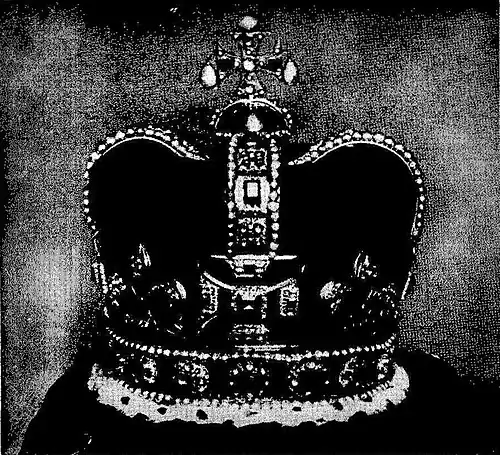
Fig. 1.—Sr EDWARDS CROWN. The ancient crown was destroyed at the Commonwealth, and a model made for Charles II's coronation.
|
|
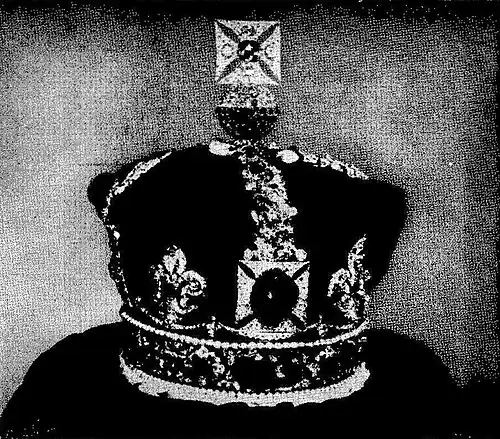
Fig. 2.—The Imperial State Crown, as worn by Queen Victoria. The Black Prince's ruby is in the centre. Modifications in the cap were made for the coronation of King Edward VII. and the smaller “Cuilinan” diamond substituted for the sapphire below the ruby.
|
|
|
|
|
|
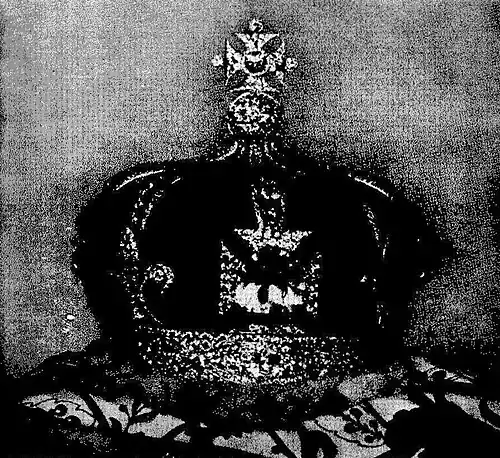
| Fig. 3.—Queen Alexandra's Coronation Crown, with the Koh-i-Noor in centre. |
|
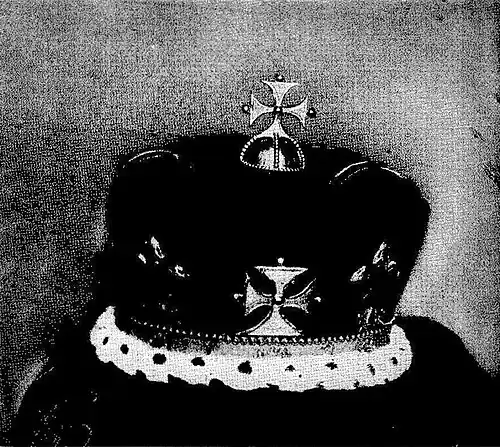
Fig. 4.—The Coronet of the Prince of Wales.
|
|
|
|
|
Fig. 5.—The Larger or King's Orb.
|
The illustrations on these plates are, except where otherwise stated, reproduced by permission from the unique collection of photographs in the possession of Sir Benjamin Stone, formerly M. P. for East Birmingham.
|
Fig. 6.—The Lesser or Queen's Orb.
|
|
|
|
| Plate II.
|
|
|
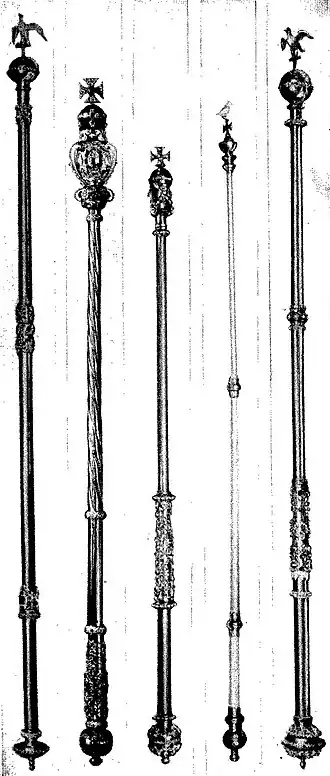
| Fig. 1.—The Sceptres: (a) The Scepter with the Dove; (b) The Royal Sceptre with the Cross (of Fig. 3); (c) The Queen's Sceptre with the Cross; (d) The Queen's Ivory Rod; (e) The Queen's Sceptre with the Dove.
|
|
|
|
|
| Fig. 6.—The Ampulla.
|
|
|
|
Fig. 2.—The Coronation Spoon.
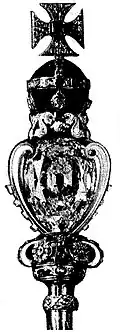
Fig. 3.—The Head of the Royal Sceptre with the largest of the “Star of Africa” (Cullinan) Diamonds.
|
|
Fig. 4.—The Swords: (a) The Spiritual Sword of Justice; (b) The Sword of State; (c) The Temporal Sword of Justice.
Fig. 5.—The Bracelets.
|
Fig. 7.—The Sr Georges Spurs.
|
|
|
| Plate III.
|
|
|
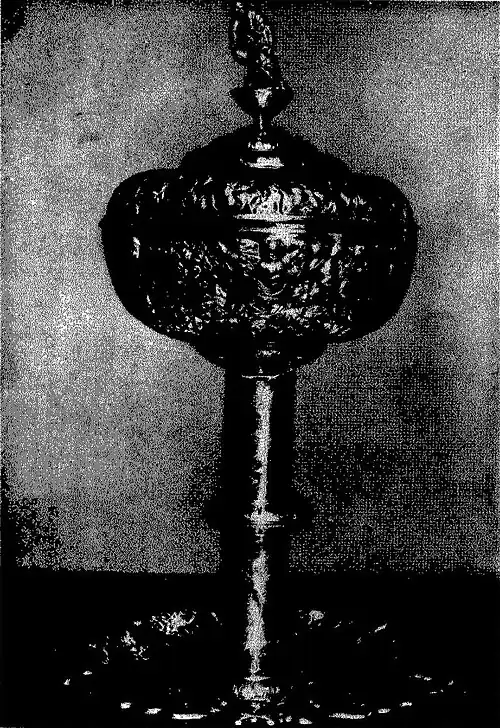
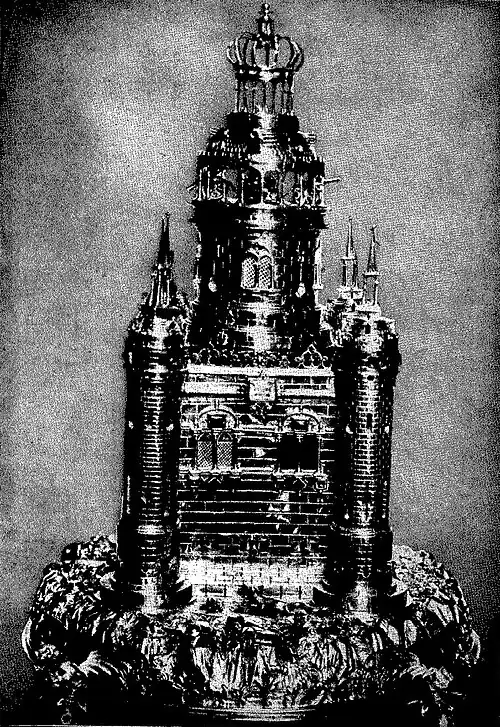
| Fig. 1.—The Silver-Gilt Christening Font, made for Charles II.
|
|
|
|
|
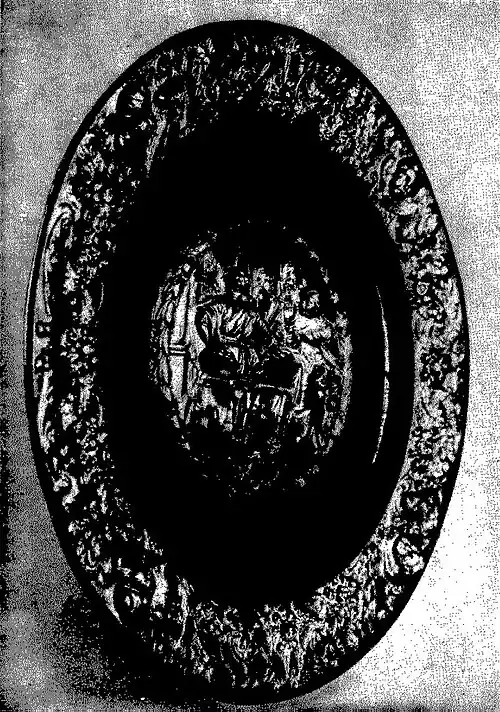
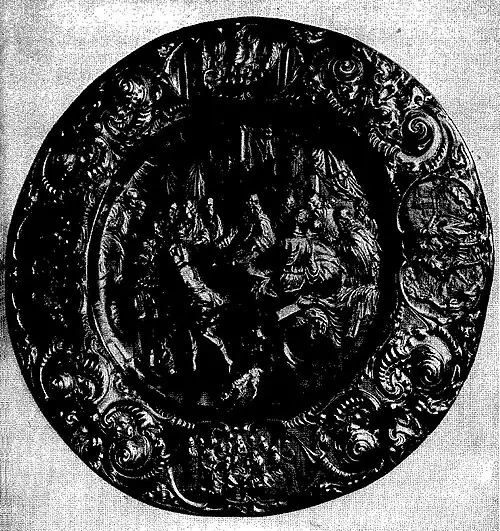
| Fig. 3.—Silver-Gilt Altar Dish, used at Christmas and Easter in the Chapel of Peter ad Vincula, Tower of London. |
|
|
|
|
|
| Fig. 2.—Queen Elizabeth's Salt-Cellar.
|
|
|
|
|
| Fig. 4.—The Gold Salt-Cellar presented to the Crown by the City of Exeter.
|
|
|
|
| Plate IV.
|
|
|
|
|
| Fig. 1.—Silver-Gilt Altar Dish dated 1660, with representation of the Last Supper; it forms part of the Altar plate at the Coronation and is in the custody of the Chapels Royal. |
|
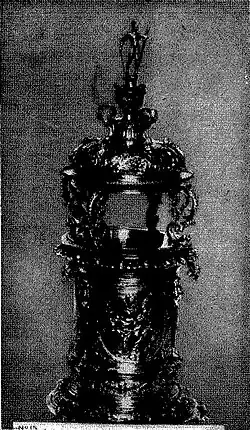
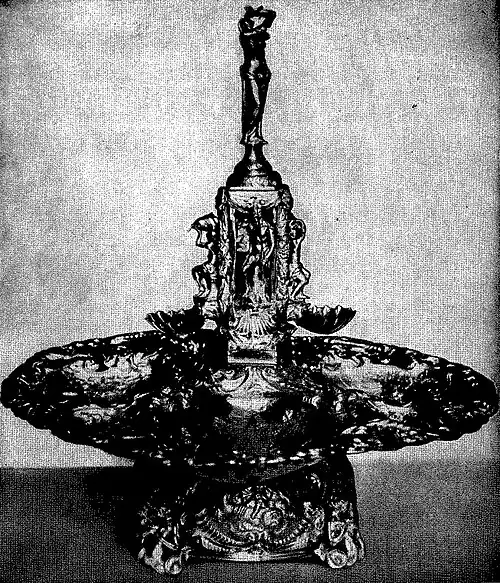
Fig. 2.—The Wine Fountain State Crown, presented to Charles II. by the Corporation of Plymouth.
|
|
|