Acadiensis/Volume 1/Number 4/Book-Plates
Book-Plates.
Article III.
.png) HE PUBLICATION of the earlier numbers of this series of articles would appear to have already been the means of arousing much interest in this fascinating subject, among local bibliophiles. One subscriber at least, to this magazine, has become the possessor of a neatly engraved copper plate, and the writer trusts that he may not be satisfied, as have others of whom he has heard, with being merely the owner of a plate, but will take the pains to insert a copy in each volume upon his library shelves. Several other readers have announced their intention of securing a plate as soon as circumstances will permit ; the chief obstacle to be over-come being the difficulty of securing a tasteful and original design. A fair amount of artistic skill, combined with a little ingenuity, will often produce very creditable results. We would recommend those of our readers who may be possessed of a library, no matter how modest it may be in its proportions, to seriously consider the advisableness of indulging themselves in this little piece of harmless extravagance.
HE PUBLICATION of the earlier numbers of this series of articles would appear to have already been the means of arousing much interest in this fascinating subject, among local bibliophiles. One subscriber at least, to this magazine, has become the possessor of a neatly engraved copper plate, and the writer trusts that he may not be satisfied, as have others of whom he has heard, with being merely the owner of a plate, but will take the pains to insert a copy in each volume upon his library shelves. Several other readers have announced their intention of securing a plate as soon as circumstances will permit ; the chief obstacle to be over-come being the difficulty of securing a tasteful and original design. A fair amount of artistic skill, combined with a little ingenuity, will often produce very creditable results. We would recommend those of our readers who may be possessed of a library, no matter how modest it may be in its proportions, to seriously consider the advisableness of indulging themselves in this little piece of harmless extravagance.
A book-plate is often a partial index to the tastes and character of its owner, and is frequently the means of restoring a mislaid volume to its rightful possessor.
In our Acadian Provinces, there are probably at present, not more than one hundred known examples of bookplates, and of this small number, the larger proportion have been brought into the country by men of literary tastes who have removed hither from older communities.
Of some of this small number the most dilligent enquiry upon the part of the writer has failed to bring to light any information whatever concerning the persons whose names they bear; and like many of the stones in an old graveyard, they are all that remain to indicate that such a person ever existed.
Rather an amusing story is told regarding the late Augustin Daly's collection of books. After the death of this great collector, and when his library was to be disposed of, it was discovered that he had never been the possessor of an ex-libris. Fully aware of the great desire which many people have for owning a book which bears the label of a great man, the persons in charge of the sale hurriedly ordered a book-plate bearing an enormous monogram formed of the letters Daly, a copy of which was pasted in the front of each volume before it was offered for sale.
The writer who relates this story remarks that many of those who possess a volume with the gray label bearing an enormous monogram, wonder why a man of such undoubted taste and knowledge should have had such an inartistic design. It is positively stated that the Daly book-plate was never seen by Augustin Daly, but in booksellers' catalogues will still be found items describing volumes "from the Daly collection, with his book-plate."
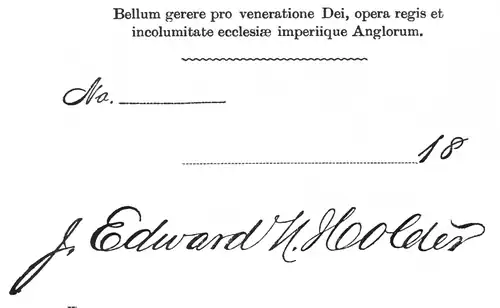
No. 17.—J. Edward N. Holder was born 11th of July, 1830, and was the oldest son of James Holder, and of Hannah Nutting his wife, daughter of Joseph Nutting, originally of St. Mary's, Westminster, England. Mr. Holder's grandfather married Elizabeth McAlpine, and they are both buried at Gagetown, Queens Co., N. B.

No. 19.

No. 20.
Mr. Holder has for many years been almost totally blind, but although unable to read, on account of his wonderful memory and of his studious habits in earlier life, is possessed of a large fund of general information. He is a devout member of the Church of England, and an enthusiastic Orangeman. He well remembers Alderman Bond, whose unique book-plate was reproduced in an earlier issue, and related many interesting reminiscences concerning the alderman to the writer.
Mr. Holder, though not in affluent circumstances, is the owner of quite an interesting collection of books and papers, many of which are of value to the local historian. He was the owner of a book-plate many years before fashion lent its aid to the encouragement of the study of ex-libris. The following is a reproduction of the plate made from the original block, which was made for him about the year 1854:
He compiled "The First Book of Arithmetic," which was approved by the Board of Education of New Brunswick, and published by J. & A. McMillan, at St. John, N. B., in 1861.
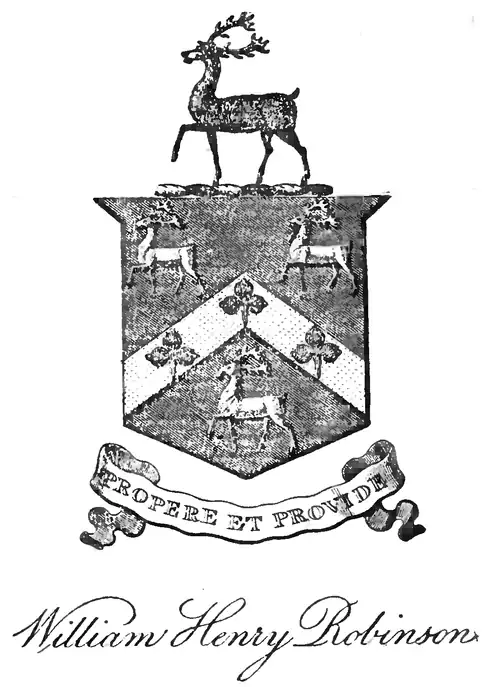
No. 18.—The writer is indebted to N. F. D. Parker, Esq., M.D., of St. Andrews, N.B., for permission to reproduce from a volume of Classics edited by Michael Maittaire, and published in London, 1713, the book-plate of William Henry Robinson.
Beneath the book-plate appears, in the donor's handwriting, "d. d. R. Parker, June, 1832," while the following brief note has been fastened on the fly-leaf with small seals:
My Dear Parker,—
No. 21.
Will you do me the favor to place upon your shelves the accompanying set of Maittaire's Classics as a memorial of
Yours affy,
W. H. Robinson.
Saturday, 16 June, 1832.
From Mr. J. de Lancey Robinson the following brief sketch of his uncle, the owner of the book-plate, has been obtained.
The third of the name was my uncle. He was the youngest son of Lt.-Col. Beverley Robinson, and was born at the Nashwaaksis in 1793. In 1808, being then not sixteen years old, he entered the army as cornet in the 17th Lancers, and served with them for fifteen years in India. He then exchanged into the 7th Dragoon Guards, from which he retired with the rank of Major in 1828. After returning to New Brunswick, he married Louisa Millidge, and resided at Berry Hill, Kingsclear, until his death in 1848. I am the proud possessor of his sabre and pair of flint-lock duelling pistols, which latter / know were out in one affair of honor when he was in India. He was also for years a member of the legislative council, and an A. D. C. to one of the Lt.-Governors, tho' I have forgotten which one.
Nos. 19 and 20.—Frederick de Peyster was one of a famous and illustrious family, whose names were intimately associated with the early history of our country. Together with his elder brother, Abraham, he, in common with other Loyalists in 1783, was a grantee of the city of St. John. After an interval of about thirteen years, Frederick de Peyster returned to the United States. Abraham de Peyster died in New Brunswick just previous to the end of the eighteenth century. General John Watts de Peyster, a grandson of Frederick de Peyster, writes as follows:
Tivoli P. O.,
Duchess County, New York,
23rd March, 1901.
D. R. Jack, Esq.
Dear Sir,—The book, or copper-plate of my grandfather's coat of arms I never saw that I know of; but if you will use it, and so inform me, I will have an electrotype made and send it to you, also an electrotype of the joint arms of Watts and de Peyster, which contains the original de Peyster seal, which was brought out from Holland two hundred and fifty years ago, and which I now own.
The elder brother of my grandfather, Abraham de Peyster, was Treasurer of New Brunswick and Colonial Commandant of the Militia.
Yours truly,
J. Watts de Peyster.
The following are extracts from other letters received from General de Peyster:
My grandfather, Frederick de Peyster, was in New Brunswick after the first great American rebellion against King George III. I send you his book-plate. It is a composite between the original brought out from Holland, and that used by an extinguished part of our family at Rouen, in Normandy, France, from whom a large amount of property was inherited and lost.
I also send you an exact fac-simile of the arms brought out from Holland two hundred and fifty years ago, of which I own the original.
I also enclose a fac-simile of the seal used by his son, Colonel Abraham de Peyster, who held every office possible under the Crown in the Province of New York about 1700, of which I own the original.
No. 21
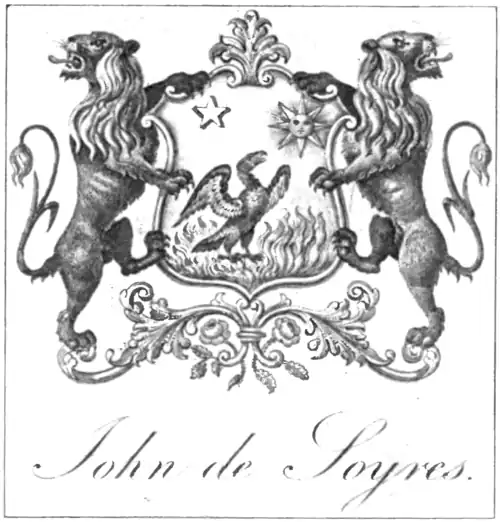
Book-Plate of Rev. J. deSoyres, M. A., D. D.
I further send you my seal, which embraces the arms of de Peyster and Watts, because my mother, Mary Justina Watts, was an heiress, and I, her only child, am entitled to bear the arms of her family, as well as the de Peyster arms, the more so because I think the motto of her family is the first I have ever seen—Forte non deficit telum, "A weapon is never wanting to a brave man," or, "a brave man is never disarmed." Some translate it, "A brave man is never destitute of resources to defend himself."
The seal impressed upon this paper is also in my possession. It must be over two hundred years old, because it was used officially by my great-great-great-great-grandfather, Mayor of New York in 1695, and Acting Governor of the Province of New York in 1700.
He was Receiver of this port, and held every office possible under the Crown about two centuries since. Receiver of the port is now equivalent to Collector. I placed his statue (a magnificent piece of bronze work) in the Bowling Green, opposite a new magnificent custom house now being erected, and there indestrucible he sits today, facing the original buildings in which he presided two hundred years ago.
No. 21.—The Rev. John deSoyres, M.A., D.D., Rector of St. John's Church, in the Parish of St. Mark, in the city of St. John, is of Huguenot descent. His book-plate, which is here reproduced, is a fine example of the armorial type, and contains several features which are unique, and which will be readily apparent to the student of heraldry. He is a son of a distinguished clergyman, a graduate of Grenville and Caius College, was Members Prizeman in 1870, Winchester Prizeman in 1873, and in 1877 attained the distinction of the Hulsean Prize. He was associated with Archdeacon Farrar in his theological and historical work, particularly in the preparation of his "Early Days of Christianity."
In 1886, Mr. deSoyres filled the position of Hulsean Lecturer in the University. He has issued three valuable works, namely: In 1881, a critical edition of Pascal's Provincial Letters, with historical notes and indices; in 1898, a valuable work upon the ecclesiastical history of the second century, entitled "Montanism and the Primitive Church;" and more lately a volume of sermons under the title "The Children of Wisdom."
In 1887, Mr. deSoyres was unanimously called to the rectorship of St. John's Church, before alluded to. He has won for himself more than a local reputation as a scholarly man, and one whose preaching is marked by breadth of thought, elegance of language, forcefulness of delivery, and a sympathy and tenderness which have caused him to be highly esteemed by many individuals entirely outside the limits of his own immediate sphere.
He has already been a contributor to the pages of this magazine, in the welfare of which he has evinced a kindly interest, and it is due to his courtesy that our work may be found to-day upon the Library table at Cambridge University, England.