Acadiensis/Volume 2/Number 4/The Micmacs
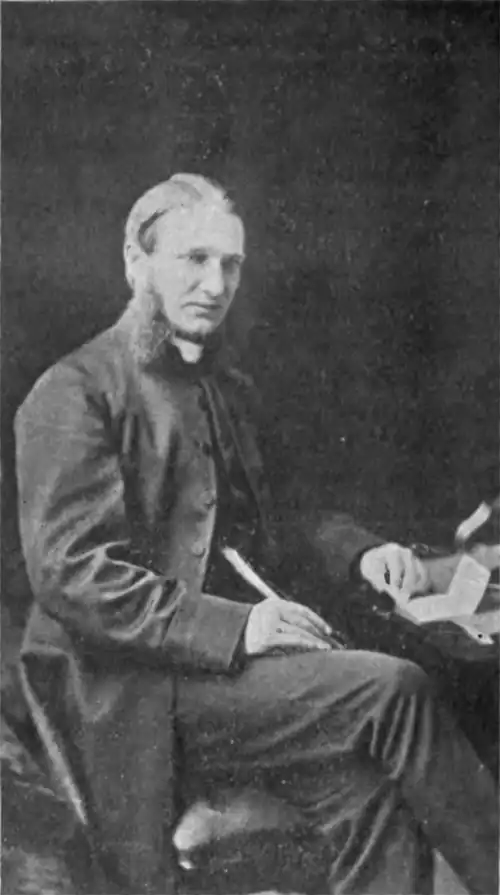
Rev. Maurice Swabey.
From a Photograph circa 1860.

A paper of recent date contains the notice of the death of Rev. Maurice Swabey, the author of the above poem, which is republished from a little volume of poetry, entitled "Voices from Abegweet; or, The Home on the Wave," and which was published in London, England, in 1878, by Mr. Swabey, then Vicar of St. Thomas' Church, Exeter.
The Exeter Post of the 5th of April last contained a long report of the proceedings in the Parish of St. Thomas, of which Mr. Swabey had been the Rector for more than a quarter of a century, during which the Rector took occasion to announce his retirement, after 48 years of active work in the ministry, 28 years of which had been in the occupation of that benefice.
In a letter addressed to the Churchwardens and Vestry of St. Thomas' Church, at that time, Mr. Swabey took occasion to express the desire that "the blessing of Almighty God may rest upon the parish, and that the harmony which for so many years has reigned in our meetings and marked all the relations between clergy and people may ever be retained."
Mr. Swabey had, through the Acadian Provinces, many friends, who will hear with sincere sorrow the news of their sad loss.
In his earlier years he was much identified with the religious and literary life of this portion of what is now the Dominion of Canada He was a contributor to Stewart's Quarterly and several other periodicals.
"Abegweet' (or the "Home on the Wave"), it might be explained, is the poetical name by which Prince Edward Island is known amongst the "Micmac" Indians, who inhabit the shores of the Gulf of St. Lawrence, and, as stated by the author, was prefixed to his little book because he first ventured to touch the lyre in that "Garden of Canada."
Mr. Swabey was educated at King's College, University of Windsor, Nova Scotia, taking his degree of Bachelor of Arts in 1852 and that of Master of Arts in 1859.
He was incumbent of Milton and Rustico, Prince Edward Island, from 1854 to 1857; assistant minister in what is familiarly known as the "Stone Church," Parish of St. Mark, in the City of St. John, New Brunswick, from 1858 to 1865.
From 1865 until 1875 Mr. Swabey was the Rector of St. Jude's Church, also in the City of St. John, N. B., and from the latter year, until his appointment as Vicar of St. Thomas, was connected with the active work of the Colonial and Continental Church Society.
The volume of poetry, published by Mr. Swabey, was dedicated to Maurice Charles Merttins Swabey, D.C.L, of Langley Marish, Bucks, "Late student of Christ Church (Oxon.), Chancellor of the Dioceses of Oxford and Ripon." In his preface to that work the author remarks that, "If, as he hardly dares to hope, these 'voices' shall be heard beyond the circle of old friends, he trusts they may arouse a deeper interest in the well being of our colonists, and likewise in the spiritual and temporal welfare of the 'Children of the Forest,' now fast fading away before the advancing tide of civilization."—Ed.
.png)
- ↑ A beautiful island in Richmond Bay, Prince Edward Island, the headquarters of the Micmacs of that province (to whom it is known as "El-nooy-mon-ago). Once every year, on St. Anne's day, the Indians, who are Roman Catholics and have a neat chapel of their own, assemble there from all parts for religious observances and festivities, and the island then presents a most animated appearance.—Note by M. S.