Across Arctic America/Chapter 15
Chapter XV
Truly Thankful
On the 13th of June we made King William's Land, at Malerualik, the spot where we had arranged to meet Miteq on his return from Kent Peninsula. Miteq was not there, but we found instead our old friend Qaqortingneq, together with a man named Itqilik (which means "The Indian") who had come all the way from Bellot Strait, having spent several years in North Somerset. These were just the people I wanted to meet, and learning at the same time that all the Netsilik folk from all villages between Adelaide Peninsula and Boothia Isthmus would be gathering in King William's Land, I decided that I could not do better than spend the summer here. I had always wanted to learn the ways of some primitive tribe more thoroughly than I had been able to do as yet, and the region in which I now found myself was one of the most isolated and inaccessible throughout the whole Eskimo territory. True, it was not altogether unexplored, since Schwatka, Roald Amundsen and Godfred Hansen had been here already, but their objects were not the same as mine, and without in the least detracting from the excellent work of these, my predecessors, I might fairly say I had struck a new field as far as my own branch of study was concerned. It was pleasant, also, to be able to look forward to a longer stay than hitherto, and make plans that allowed for good long spells of work, instead of hurrying from place to place.
On the 20th of June I made my first reconnaissance of the immediate surroundings. The country rises as one moves inland, in terraces marking the site of earlier beaches, with long narrow lakes in the hollows between, fed by small streams from the melting snow. There are a few ranges of hills, but as soon as one gets away from the sea, the country at this time of year presents the appearance of a great grassy plain. Spring was at its height, and the earth on every side was bursting into life. Geese, duck and waders were gathered in thousands on the lakes and marshy ground; red patches of saxifrage glowed among the rocks, the first of flowers to greet the light and warmth of the sun.
A few kilometres out from camp I came suddenly upon a whole ruined village of stone houses of the ancient Eskimo type. I had already heard from the natives elsewhere that such were to be found in these parts, but had not seen any myself. No permanent winter dwellings had indeed been recorded from here, and it was now of the greatest importance to examine these, by way of supplementing our material from the excavations in the Hudson Bay district. Plainly, I could hardly have chosen a better spot.
A day or two after this discovery I made a short excursion to Nunariarsaq, an island off the southeast coast of Queen Maud Gulf. Here, in a little creek, I found a whole row of stone cairns, and on enquiry, found that they were of somewhat curious origin, being, indeed, monuments erected to the memory of the dead. It appears that some women had gone out spearing salmon on the ice while their husbands were away hunting caribou inland. The ice broke up suddenly and carried them out to sea, one only making her way back to land. Each of the men then built a monument "as a tribute of respect to the souls of the dead." I was surprised to find such an observance among a people who, as a general rule, do not even bury their dead, but lay them out on the bare ground.
One old man here offered me meat for my dogs if I could let him have some ammunition. This man, whose name was Amajorsuk, was the proud possessor of a wooden leg which he had made and fitted for himself. Ten years before, when guns were first introduced at Baker Lake, he had the misfortune to lose one foot by an accidental shot. He now went about with a kind of artificial leg made from the crosspieces of a sledge lashed round the thigh and padded with caribou skin below the knee, the whole ending in a "foot" of musk ox horn, which served its purpose excellently. Amajorsuk himself was not in the least disheartened by his handicap; he was indeed, a most cheery soul, and a skilful hunter as well. But it says much for the courage and endurance of these people, that a man should have gone through all the suffering and hardship the accident must have caused him in the first place, and then have learned to shift for himself and bear his part with the rest under such conditions.
On the 1st of July, Anarulunguaq and I set to work on the ruins at Malerualik. The natives there by no means sympathized with our interest in these remains, holding that such things were best left alone. Moreover, they knew we should have the greatest difficulty in finding food here at this time of year. Already numbers had left for the interior, where the fishing season was now about to begin. By the 5th of July the place was deserted save for our own little party. My two hunters went out each day after seal, while I grubbed about among the ruins. By the 25th, the position had become critical. Despite all our efforts, it was impossible to get meat enough to feed our dogs as long as we remained here. Fortunately, however, Anarulunguaq and I had worked hard at our excavations in the meantime, and felt justified in shifting our quarters in search of other folk and other fare.
With ourselves, my two hunters and their families, we made quite a little caravan when we set off, taking with us tents, sleeping bags and rugs, cooking utensils and some extra footwear. The dogs were called into requisition this time as beasts of burden, and their pack-saddles caused us some difficulty at first. Once they have grown accustomed to the work however, dogs can easily carry a load of 25-30 kilos each for a long day's march.
One day we came upon a huge flock of geese, moulting and unable to fly. Being short of ammunition, we let the dogs loose, and a moment later we had a score of birds.
We were all suffering from want of fat with our food, and the last remains of some old rotten blubber was looked on as a treat. Altogether, we were short of quite a number of things; we had no tea, coffee, sugar and no tobacco. Living as we did chiefly on raw meat, and going about with an aftertaste of suet or blubber in one's mouth, it was hard to be deprived of one's pipe at the end of the day. The only luxury we possessed was some saccharine; and with a makeshift herb that grows here and there we could turn out something the color of tea, and tasting of nothing particular.
On the 5th of August we reached Amitsoq, the principal fishing station. I had heard so much about it during the past two months, that the reality proved rather a disappointment. The whole encampment consisted of but five poor tents, and the reports of the yield up to date were not encouraging; caribou few, salmon scarce, and no food for the dogs! We had come too early; the fishery would not begin till the 15th of August, and would be practically over by the end of the month.
We stayed here a week, during which time I wrote down over fifty of the native stories, and obtained a great deal of valuable information as to ancient customs and ways. We managed to shoot six caribou, which gave an ample supply of meat for ourselves and the rest of the camp.
I have never in my life seen half-starved, wretchedly clad, chill-ridden people so cheerily heedless of their troubles, so full of fun and merriment under the most miserable conditions. Some of the children were positively in rags, their legs, arms and hands red and swollen with the cold, yet they played about as if unconscious of it all. The native idea of happiness in the Hereafter is a life where all is play. And they seemed to be well on the way to realizing it here, for men and women as well as children spent five or six hours of each day playing games. The work on which they relied for their daily sustenance was confined to three visits per diem to the salmon pool, each occupying perhaps ten minutes; and even this was more like a game than serious work, to judge from the laughter and fun that went on.
The salmon fishing was worked on a simple plan. The fish were found in a stream connecting two lakes; the stream was dammed and a shallow basin built with stones, leaving an entrance which was allowed to remain open all day until the signal was given; it was then closed, and the whole party, armed with fish spears, plunged in and set about spearing the fish, traps being set to catch any that might otherwise escape. Later on in the summer, or early autumn, the fish would be taken in such quantities that each family could, in the space of a fortnight, obtain something like a thousand kilos of excellent fish, which was stored for the winter.
It was extremely difficult to obtain fuel of any sort at Amitsoq. The Cassiope which is used in some parts is not found here, the nearest substitute being Dryas, which is moreover in bloom at this time of year. It is most difficult to keep alight, and one has to be constantly blowing it. It took Anarulunguaq five hours to cook a potful of fish and boil a kettle of water in this fashion. It is not surprising 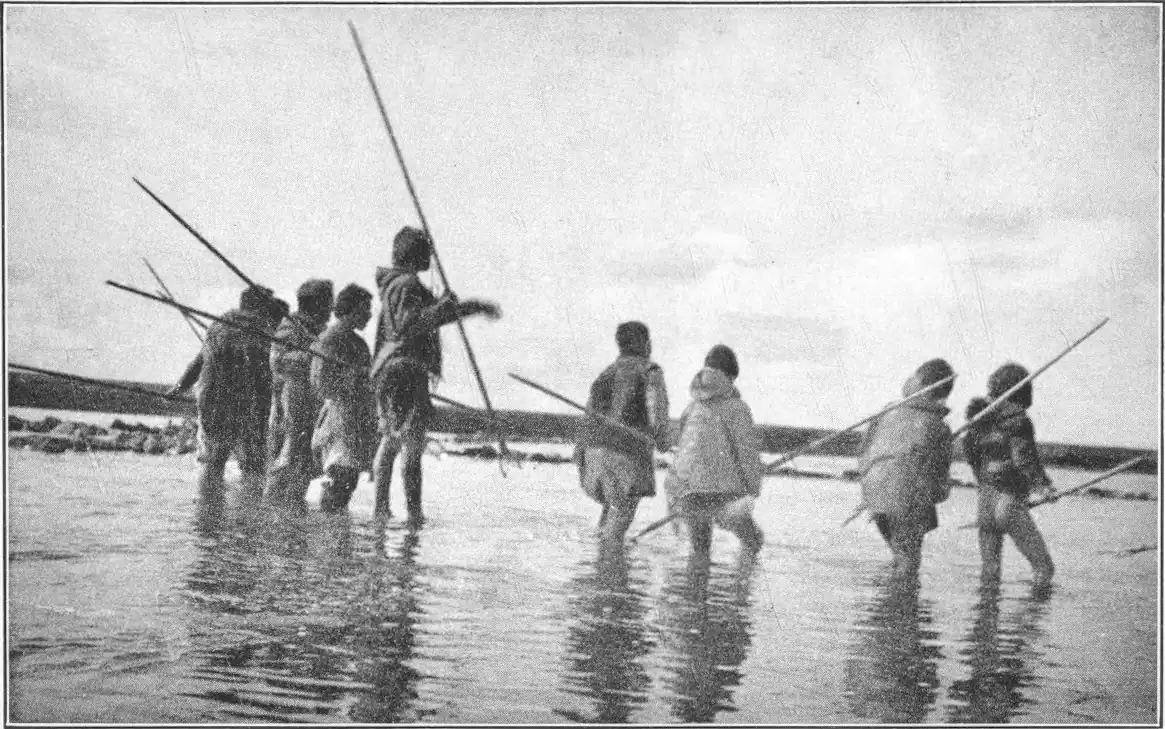
The fishing here often provides those reserves of food that may be indispensable in winter should the caribou hunting fail, and the place is regarded as sacred, just as are certain spots particularly frequented by the caribou. Strict rules had to be observed. Eating of marrow-bones, or fresh caribou brains, was forbidden; the heads, if brought to the spot, had to be picked clean and dropped in an adjacent stream where there were no fish. No needlework was to be done in the tents, nor might the men attend to their fishing gear there. No caribou skins old or new, might be worked on; not a tear might be mended nor a worn spot patched. Consequently, the whole party went about in their ragged last year's garments. The only kind of sewing allowed was for the mending of footwear, and the hide for this purpose had to be cut beforehand. This work, and the necessary repairs to fishing implements and gear had to be done at a particular spot away from the camp. Most of the party gathered here when not sleeping or at their games.
These games were of a very simple character, but served their purpose as a means of exercise and keeping warm. A favorite one was a mixture of hide-and-seek and "touch." Another was "keeping silence," the one who laughs first being given a comical nick-name which he is obliged to answer to for the rest of the day. Then there is the game of "Bear" in which one player personates the bear, crawling about on all fours, while the rest dance about him and he attacks them as best he can. There was one game of ball which caused no end of fun and excitement. It is played by partners two and two against the rest, each of a pair trying to throw to the other. All is fair in this game, collaring, tripping, charging from beyond, and all is taken in good part. Young and old joined in the game, and once started, it would go on for the rest of the day and be started again the next. Husband and wife were generally partners; and it was really touching to see the affection between the pairs. I have rarely met with people where the men were so proud of their wives, the women on their part being tireless in their praise of their respective husbands.
A curious form of pastime, popular especially among the children, was the Tunangussartut, or "spirit game," which consists in "taking off" the seances of the angakoq, often in a really humorous manner. Spirits are invoked, imaginary enemies battled with and vanquished, exactly in the grownup manner; the dread of evil powers is caricatured to the life, and prayers and spells uttered word for word as in cases of actual peril or distress. The whole thing was rank blasphemy; and yet the grown-ups looking on would gasp and rock and hold their sides with laughter, as if they found a certain satisfaction in watching their young hopefuls make fun of what to them was solemn earnest. And then perhaps, a few hours later, a sudden indisposition, or a bad dream, would call all the adults together in a real seance, none the less solemn now for the comic interlude just past. I asked one of my friends here how it could be that they were not afraid of incurring the anger of the spirits by these disrespectful harlequinades. But he answered that "of course" the spirits understood it was only in fun; and surely they knew how to take a joke! He seemed, indeed, astonished that anyone. could raise the question at all.
On the 12th of August, to my regret, I felt obliged to take leave of my friends here and try hunting elsewhere. We divided our party into two, Anarulunguaq and I, with one of the hunters, returning to Malerualik, while the other, with half the dogs, went over towards Gjoa Harbor to see if better fortune might be had there.
We reached Malerualik once more on the 17th, and found the goods we had left there untouched—a matter by no means certain unless special precautions are taken to protect stores from being plundered by the various prowling beasts. It was good to see the sea again; and there was still some work to be done. Anarulunguaq and I had another spell at the ruins, but we were not suffered to go on very long. On the 25th of August, we had a gale from the north-west, bringing with it the first snow and frost. We had, however, got through most of the excavation work and collected a fine lot of material.
With the autumn now setting in, and in view of the indoor work I had still to do in writing out my notes and observations up to date, I decided that we had better build a stone house of the North Greenland (Cape York) type. Anarulunguaq and I set to work on this on the evening of the 29th, most of the building being done by Anarulunguaq, who is an expert at the work, while I brought up stone from the ruins. Among her people it is customary for the women to build the winter houses, while the men are out hunting in the autumn. By the 31st, we had the place complete save for the final dressing of turf that was to cover the rough stone. At this stage some old acquaintances appeared on the scene, Alorneq, Itqilik, and another named Oqortoq. They helped us with the finishing touches, and the same night we were able to serve up a modest banquet in our new quarters.
The talk soon turned to the subject of Miteq and his failure to appear. Oqortoq's wife was an angakoq of some note, and had moreover, a few days before, found a bit of lead on the shore of a stream. The lead had probably been dropped by some caribou hunter, but it was now regarded as a special token from the spirits, such as may sometimes be accorded to those specially favored. A great invocation was therefore held, resulting in the intelligence that Miteq was on his way home, and not far away; we were further informed that he had killed two bears on the way, and had encountered various difficulties, not specified.
This seemed encouraging, and likely enough but there was some doubt among the rest of the party even yet. It was openly asserted that we should never see Miteq again; he and his companion must certainly have been murdered long since by the Kitdlinermiut.
Our guests had come down to visit some caches they had laid down during the spring. On leaving, each of them presented me with a stick of tobacco; which, by the way, they had originally bought from me at our first meeting. I was the better able to appreciate the kindness of the gift in that I knew it amounted to half their own supply, and all three were ardent smokers.
Another commodity now running short with us was the very ordinary box of matches. Matches were frequently demanded in payment when I was buying amulets, and as the fresh supply Miteq was to have brought up had not yet arrived, we found ourselves now reduced to a ration of two matches per diem. Anarulunguaq managed, however, by keeping peat embers on the hearth from one time of using to the next. After all, one can always manage to get a light native fashion, though it savors somewhat of the stone age. More serious was the lack of ammunition for our guns, now that winter was close at hand.
The 3rd of September was fine, with a clear sky, a slight frost and a faint breeze from the west. Anarulunguaq and I were sitting outside the tent gazing out over the water in the quiet of the afternoon, when Anarulunguaq suddenly broke out excitedly:
"Look, look, what is that? I thought it was low water, and there is a reef I am sure was not there before. Look, it is moving!"
She pointed across to the low spit of land west of the island of Eta; and there sure enough was something dark in the water. It was a small canoe, making in towards us. Kayaks are only used in fresh water lakes in this region, and are never seen out at sea. There were two men in this one; they could only be Miteq and his companion. We had been looking out for them since the middle of June, and now that they were actually in sight it seemed to take our breath away.
I got out my glass; sure enough it was they. And in less than an hour they had landed. We raced down to meet them long before they reached the shore, delighted to find them both alive and well, but eager to hear what news they brought; and what supplies. Unfortunately, there was disappointment in store to temper the joy of our meeting. Miteq's first announcement ran:
"No ammunition, no tobacco, no tea, coffee, sugar or flour. But," he added with a laugh, "we are thoroughly alive ourselves, and it might easily have been otherwise!"
The canoe grounded on the pebbles, Miteq sprang ashore and we embraced heartily.
His report may be given in brief. On leaving King William's Land at the end of May, they had found the ice so impassable along the shores of the mainland that they had crossed over to Lind's Island, near Victoria Land, and thence to White Bear Point on the southern coast of Queen Maud Gulf. On the way down to Melbourne Island they had twice. encountered the Kitdlinermiut, who had given them a most hostile reception. Only the women came down to meet them, the men lying in ambush close round, ready to fall upon them should occasion arise. As a rule they managed to get on friendly terms, but in one or two places, the natives had been so surly and their behavior so suspicious that they judged it best not to sleep among them. They generally fastened the dogs in a circle round their tent, so as to be sure of being aroused in case of danger from any quarter. Our collections had been delivered safe and sound to the Hudson's Bay Company's representative at Kent Peninsula, but the trade in fox skins there had been so exceptionally heavy that season that the station had sold out of everything by the time they arrived. They had just managed to get enough ammunition to last them on their way back. The rivers flowing out into Queen Maud Gulf had broken up at the beginning of June, and they had had to borrow a canoe to get through. All their dogs had been left with some Eskimos near Ellice River, where they themselves had stayed a month waiting for the ice to clear sufficiently for them to proceed along the coast. As it was, they had only with the greatest difficulty managed to make their way down in the frail canoe.
Despite the bad news, we were of course only too glad to have them both back safe and sound. And I was greatly relieved to find that I should not be all alone among strangers without ammunition, for there would be a hard struggle now to keep our dogs. If we lost them, the sledge trip to Nome would be out of the question.
By this time the natives were beginning to find their way back to Malerualik and we had soon over a hundred souls in camp. The caribou hunting was about to begin, and there was great excitement as to how it would turn out.
On the 15th of September, the advance guard of the caribou made their appearance. There was a shout that echoed through the camp, and all turned out, to find the animals trotting down over the hills to the eastward. At a distance, it looked like a great body of cavalry on the move, the herd advancing in line of 50 to 100 abreast, in steady formation down towards the ford at Eta. The hunters snatched up their guns and hurried off, dropping down into cover immediately, among the little hummocks on the line by which the caribou must pass. It was the first regular encounter of the season, and the unsuspecting beasts kept on at a steady trot towards the coast, until a deafening volley brought them up short. They stood as if paralyzed for a moment, and they gazed about helplessly in search of the invisible foe; this gave the hunters a fresh chance, and shot after shot rang out, the animals dropping on every side, and further confusing the rest, until the entire cavalcade broke up into scattered groups that dashed away headlong into the interior.
Miteq and I had taken no part in this battle, as we had only 75 cartridges between us, and I had no wish to see them wasted in the reckless firing that often takes place in the excitement of dealing with a mass of game at close quarters. As it was, the total bag amounted to some 50 beasts, which had, I reckoned, cost from five to seven shots apiece; a poor result for the expenditure, compared with what might have been obtained under the circumstances. The Eskimos, however, accustomed to reckon with the slower and scantier yield of bow and arrow, would reckon it very satisfactory.
There was not snow enough on the ground to start sledging, and on the 18th, early in the morning, Miteq and I set off up country to go hunting on our own account. We came back the same evening with seven fine caribou—we had deliberately picked out the finest and fattest—a heavy load, but more than welcome.
It was on the 21st of September that the Great Event took place.
I was just walking up towards the tent when I noticed a stir among the others scattered about. Then suddenly all came pouring out from the tents, men, women and children, and a great cry of wonder went up:
For a moment all stood still as if rooted to the spot, then off they went again, hurrying down past me in great excitement. I thought at first it must be a new detachment of caribou in sight, and was prepared to give a curt refusal to anyone wanting to borrow my gun. Then one of the foremost hailed me, waving his hand in the direction of the shore:
"Look, look there!"
I turned and looked; and told myself it was nothing of the sort; I must be dreaming. A ship under full sail making straight in towards us? Who ever heard of such a thing? To the young folk gathered round, agape with wonder, this was the Great Event of all their lives. A ship? They had never seen a ship. And see how it floated, that great thing! And where on earth could they have got all that wood? Here it came, actually moving, swimming on the water like some great bird, yes, and with sails spreading out above like huge white wings. . . !
In the midst of all this wonder and excitement, it occurred to me that there would be ammunition on board that ship—whose it was, or what its errand, I did not trouble to think.
A pair of ski lashed together served as a flag-staff, and in a moment we had hoisted the Danish flag and the Union Jack over our dwelling. An hour later the vessel was at anchor close inshore, and a motor boat came sputtering up to the beach with two white men on board, who introduced themselves as Peter Norberg of Hernoesand, Sweden, and Henry Bjoern of Praestoe, Denmark.
After all, it is a little world!
They had come up to establish a station for the Hudson's Bay Company in King William's Land. The vessel was called El Sueno and had originally been a private yacht stationed at San Francisco. To our unaccustomed eyes, she seemed a very frigate; though she was but 20 tons. And in this cockle-shell of a craft, without engines even, and with a heavy boat in tow, Peter Norberg had forced a way through the most difficult part of the old North-west Passage, namely, Queen Maud Gulf, a piece of seamanship the extent of which he himself was far from realizing. They had no charts, and no technical aids to navigation whatever, but as Peter Norberg very simply put it, both came of a seafaring race, the old viking strain had been turned to good account.
No fewer than forty vessels had taken part in the struggle for the North-west Passage. Roald Amundsen, with his little Gjoa was the first to win through; and here was Peter Norberg coming in second with a bit of a craft that could hardly be called a vessel at all, and had only been built for pleasure cruising round the Golden Gate.
Ten minutes later I was on board, with my teeth deep in an orange. A little later, I sat staring with wide eyes at a real cup of actual steaming coffee. There were such things as Bread, and Cheese, and Butter, on the table, but I did not touch them; being quite content to sit puffing great clouds of smoke. And having got used to the wonder of all this after a while, it seemed quite natural to be sitting on a box containing 5000 cartridges of the precise calibre we had been using; I listened calmly, was in a dream, to the promise of unlimited ammunition. . . .
Truly, a turn of events all on a sudden!
I gazed out through the open porthole; the snow was a glittering carpet of innumerable tiny crystals; and across it moved the caribou in their hundreds, trotting on all unaware towards death and destruction.