Adventure (magazine)/Tiger River/Part 2
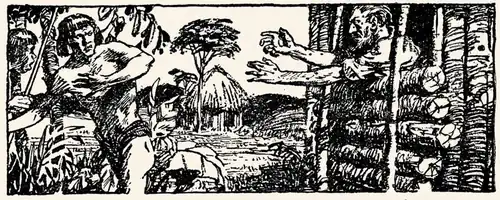
The first part of the story briefly retold in story form
DEEP in the South American jungle on the banks of the upper Amazon, José Martinez, outlaw, camped and meditated his troubles. Suddenly he was startled by a voice from across the water: and, as he waited, a river-canoe. containing twelve native paddlers and four white men, approached. With a shout of recognition José welcomed the white travelers.
“It's the Señor Tim Ryan,” he cried.
The other three were McKay, Knowlton and Rand—all his old friends from South America. They informed José that they were in search of gold and asked him to join them. He accepted and told them of the rich prospects in the little-known region of the Tigre Yacu—a branch of the Amazon—and immediately they were fired to go.
They set about procuring three small canoes at a native town a short way down the river, and got rid of their large boat. After a quarrel with a Moyamba leader there—an incident which promised to brew trouble later on—they started out anew and soon were well into the savage territory of the head-hunters.
As they were making camp one evening Knowlton and Rand volunteered to go into the jungle to fetch some game. They had just succeeding in bagging two ducks when a fierce storm came up, and the two sought refuge in the hollow of an enormous tree. Just as Rand reached the shelter a savage leaped upon him, and the two fell, fighting. A bolt of lightning crashed, and Knowlton, who had not yet entered, saw the tree topple, imprisoning his friend and the strange assailant. Tho next moment he himself was knocked unconscious.
Later, the rest. of the party, searching for their companions, came upon the helpless Knowlton and rescued him from two prowling tigres. Rand proved to he unhurt; the man who had attacked him, a white Indian, had been killed by the falling tree.
CHAPTER VIII
The White Indians
 AWN broke.
Up in the tree-tops birds and mammals started from sleep and hurled a discordant chorus of squawks, squeaks, hoots and howls out into the gray blanket of night-formed fog. Down beside a little creek men stirred, peered at their insect-bars, yawned, stretched, and sat up in their hammocks. From one of them sounded a muffled grunt of pain, instantly subdued.
“How's the leg, Dave?” asked Knowlton, protruding a white-swathed head.
“Little sore,” admitted rand inwardly cursing himself for that groan. “Nothing to speak of. How's the head?”
“Head?” with elaborate carelessness. “Forgot I had one.”
“Ye're a couple o' cheerful liars, the pair o' ye,” rumbled Tim. “Dave, ye'd oughter be on crutches, and, looey, yer neck's three inches shorter'n 'twas yesterday mornin', not sayin' nothin' about a bump on yer bean as big as me fist and gosh knows how many stitches in yer scalp. Lay down again like good dogs.”
Knowlton scowled with official severity, forgetful of the fact that the frown was hidden under his bandages.
“Sergeant Ryan, you're reduced to the ranks and fined one drink of hooch for insolence—” he began.
“Sssst! Hush; teniente!” José cut in.
His hawk face was shoved forward. His thunderous gun had slid into his hand. All froze into postures of listening. Except for the animal noises, no sound came to them save the monotonous drip of moisture in the dank jungle round about.
“Something moved yonder,” the Peruvian muttered, twitching his head. “An animal sneaking past, perhaps. It is too early for Indians to be moving. But not too early for us to move.”
With which he arose, rolled his hammock, and pitched it into his canoe. The others, with wary glances at the murky shadows, followed his example. In less than a minute the little palm hut was bare.
But none embarked. Men must eat, and Tim voiced the general sentiment when he growled:
“By cripes, I'm goin' to have me coffee before I hit the river, and have it hot. Any war-whoops that want to mix it with me before I git ready to go can come a-runnin', poison arrers and all.”
So, with ears alert but no haste, the five made their morning meal by the aid of the faithful sindicaspi wood, which burned smokily in the heavy air but did its duty. When the frugal meal was finished all hands rolled the usual cigarets and squatted beside the coals until the butts scorched their hardened fingers. But there was no more banter, and each man's gun stood within elbow-length of him.
Then, when remaining longer would have been mere bravado, they moved into the canoes and pushed away. Rand limped while getting aboard, and in his dugout he sat on some supplies, his torn leg eased out in front of him. Knowlton gave no sign of feeling less energetic than usual. In silence the small flotilla slipped away toward the misty river.
Once more on the wider water, they found the fog still too thick for any but slow travel. It was thinning, and patches of it wavered and almost dissolved, giving short views of one or the other of the banks; but the great body of it clung stubbornly to the ground. Stroking lazily, they progressed gradually upstream, awaiting the dissolution of the murk. Tim found time and inclination for a little grumbling.
“Pretty slow so far,” he declared. “Ain't nothin' happened but shootin' three cats and gittin' looey and Dave out o' the hole. Where's all them head-hunters and the thing that bites off fellers' toes and makes 'em batty? Where's the bags o' gold? All we git out o' this here, now, Tiger River is bug-bites, seems like.”
“Well, you're getting plenty of them, aren't you?” countered Knowlton. “One thing at a time. Trouble with you is that you're sore because you missed getting into that tree-racket of ours.”
“Oh, yeah. And ye're so sore ye can't see straight because ye did git into it. All the same, I would like to git a li'l action out o' this trip. I wasn't never brought up to push a paddle for nothin'. When do we git to the gold?”
“Wouldn't be a bad idea to pan a little dirt before long and see what we get,” suggested Rand. “Water's pretty shallow now, and we're well up.”
McKay nodded.
“Been thinking of that,” he conceded. “Might give us some idea of what's ahead.”
José, the real source of the expedition, said nothing, though he heard all. His eyes kept plumbing the slowly clearing shores. Gradually his strokes lengthened as the mist rolled upward, and the others automatically adapted their pace to his. At length the fog burned away completely, and the canoes swung into their regular speed.
For several hours they forged on, silent as usual, hot as usual, bitten as usual by the insect swarms. Along the bank little life showed—macaws, quarrelsome toucans, surly male cotomonos which howled monkey execrations at the intruders while the females scurried away through the branches, carrying their young clinging on their backs. Then on the quiet surface appeared bubbles, floating down from ahead; and to the ears of the canoemen came a soft, elusive sound like wind among high leaves.
“Ah! We approach a mal-paso—a rapid,” José announced. “Do you not hear the water, amigos? It now is low and quiet; but we soon shall reach rocks.”
The mechanical swing of the paddles quickened a bit. Rocks! For many long days the voyagers from the Andes had seen not the tiniest stone—nothing but clay banks and the everlasting walls of tree and bush. Now the arrival at rock-country meant harder work and slower progress, but it also meant that the mysterious Cordillera del Pastassa, offshoot of the precious Llanganati, was creeping nearer to them. And up there to the northwest might be—what? The dream-city of El Dorado? The fabulous Mother Lode of all gold?. Who knew? Save one man whose brain was twisted, none had ever come back to tell.
Peering over-side for the first time in hours, McKay saw gravel on the bottom. His iron face lightened a little, and he put another pound of power on his paddle.
But when the rocks appeared the eager faces of the North Americans fell. Accustomed to the fierce mal-pasos and the gorged pongos of the upper Marañon, they had unconsciously looked for a chasm, even though small. The obstacles now before them could hardly be dignified by the name of “bad-pass.” They were only a few boulders at a bend, protruding above the surface like dingy, worn-down molars, visible only because of the low stage of the water. Yet they were rocks, real rocks, the farthest out posts of the host of mountain-fragments waiting beyond. And, despite their insignificance, the treasure-hunters smiled at them and at the sleepily murmuring water flowing down between them.
“Here's where you can exercise your manly right arm, Tim, and pan some gold,” Knowlton chaffed. “Just hop over with a shovel and dig down to bed-rock. We'll get lunch.”
“Huh! I'd dig half-way to China before I'd hit bed-rock in this here mud country. But],I'll pan her once anyways, jest to see what's the color.”
And, when the canoes had been forced beyond the barrier, he did. With a dexterity betokening much practise somewhere farther west, he swirled the water and the mingled mud and gravel in his pan until he was down to the dregs.
“Begorry, it's here!” he exploded. “Nothin' much—jest a few flakes—but it's color! Free gold, gents! Lookit here!”
Eager heads clustered over his pan. For a moment there was silence.
“Uh-huh,” commented McKay. “Pretty poor showing, though.”
“True for ye, cap. But mebbe further up we'll hit the real stuff. This here bed is all gummed up with mud. I'll give her another whirl, jest for luck.”
His luck seemed not to improve, however, though he scooped up several more pans from below and worked them with extreme care. His first enthusiasm oozed away. After giving the last pan a couple of tilts and a sour survey he desisted without trying to wash it.
“Yeah, she's got to come acrost better'n this or I won't never tell nobody she's a friend o' mine,” he asserted, clawing out some muddy gravel. “If only these dirty li'l stones was somethin' besides dirt”
 HE STOPPED, his mouth open. His red lashes lifted, and his eyes seemed to bulge. Very carefully he set the pan down on the nearest rock. With the fingers of his free hand he rubbed the “dirty li'l stones” in his cupped palm against one another. Then he picked one out and grated it along the boulder beside him.
“Ho-lee jum-pin' Jee-hosh—” he began.
Then, mute, he held up the stone. From its scraped side flashed a yellow gleam.
“Nugget!” barked Knowlton.
With sudden energy Tim scraped his find again, then scrubbed it under water with a hard thumb-ball. When he again held it aloft it shone like a gilt ball.
“Sure as the Kaiser got crazy, 'tis a nugget!” he exulted. “Mud stuck to it and camouflaged it. Weighs a couple ounces, easy. Forty dollars, gents—eight bucks apiece for you guys that ain't panned nothin' but me. Now le's see ye do a lick or two o' work for yerselves. Come on in, the water's fine. Beat ol' Timmy Ryan if ye can! Oh, you li'l yeller baby!”
His exuberant challenge met with instant response. Into the river splashed his companions, heedless of hunger and of recent injuries from tiger-claw and falling tree. They brought up fistfuls of gravel which had lodged around the boulders, and with minute care inspected each one. Tim, carefully buttoning his nugget in a pocket after assuring himself that the pocket had no hole in it, fell to scraping and rubbing each of the little stones which had suddenly become potential treasures.
One by one, however, he cast them away. The whole pan received a rigid inspection, but no glimmer of yellow showed. He brought up another panful from the same spot where he had caught the nugget. This, too, yielded no result.
At length the dripping company ceased its labors, empty-handed.
“Guess you're the only lucky one in the crowd, Tim,” admitted Knowlton. “Let's see that nugget.”
Tenderly Tim drew it out and handed it over.
“Don't drop it, for the love o' Mike,” he adjured. “If she once gits back in the muck she's gone. Water's all riled up.”
With a nod, the lieutenant studied the chunk of metal. Then he passed it to McKay.
“No wonder we didn't find any more,” he said. “That nugget never rolled down this stream.”
“Huh? Oh, I s'pose it rained down last night, then, or mebbe it fell off one o' these here trees,” jeered the red man.
“It never came down in the water,” insisted the other. “It's too rough. Water would wear it smooth. Look at the stones around here—even these big ones are smoothed off. Not a sharp edge on any of
“Right,” concurred McKay. “It's well rounded, but not smooth. You can feel the edges, and see them too.”
“Um. Begorry, ye're right, cap. But how'd she git here—one lonesome nugget like that? 'Tain't right.”
All stared at it, groping for a solution. Presently Knowlton laughed:
“Old Dame Fortune left it here for us, maybe, to encourage us. Sort of a come-on stunt, eh? Like a girl dropping her handkerchief on the sidewalk when you look good to her. She's a flirty old dame, is Lady Fortune.”
“Si,” grinned José. “But you are forgetting Rafael Gonzales, comrades. It may have been he, not the old lady, who dropped this here. It is less than a month since he returned to Iquitos, as I have told you, with his bag of gold. Is it not quite likely that he lost this, and other nuggets as well, on his outward trail?”
“Guess you've hit the only sensible answer,” agreed Rand. “Come on, let's eat.”
The close-drawn knot of men drew apart and turned toward shore. With a sudden gulp Tim halted short. His mates froze.
Armed Indians confronted them.
There on the bank, arrows drawn back and aimed with deadly accuracy at each white man's breast, stood a dozen hard-faced savages. Their skins were light, their hair black and cut straight across the brow, their bodies naked save for tooth-and-claw necklaces and red loin-cloths. In stature, in build, and in expression they might have been brothers of the dead man left last night in the tree-butt tomb beside the black lagoon.
Motionless from surprize for an instant, the men in the water then began reaching stealthily toward their wet pistols.
“Alto!” snapped a sharp voice behind them. “Lift those hands or you die!”

THE LAND OF THE HEADHUNTERS
The five heads jerked around. On the other bank they beheld eight more of the white Indians. These held no bows. Instead, seven of them squinted down the barrels of big-bored rifles. The eighth, standing a little to the rear, had a similar rifle but was not aiming it. His face had a markedly Spanish cast.
The hands of the North Americans poised exactly where they were. The situation was utterly hopeless. But Captain McKay's voice, when he replied, was as cold and calm as if he held the power.
“If we do not die here we die hereafter. When and how?”
Across the mouth of the Spanish-Indian twitched a fleeting smile:
“You are cool. Die now if you will. All men die. If you do not die here you may live long. Strong men live.”
“Live through what? Torture?”
“No torture. We kill swiftly. Among us a man is all alive or all dead.”
McKay glanced once at the bowmen, running his keen gaze along their hard eyes. He looked back at the seven riflemen and the Spanish-speaking leader.
“No good, boys,” he said quietly. “We haven't a chance. Better surrender.”
His hands rose. Reluctantly his companions followed his example. Turning about, the captain waded across to the shore where the leader stood. In his wake swashed the others, still covered from both banks. Up on the land they went, and halted.
“We live on,” said McKay, smiling bleakly. “Now what?”
The leader grunted something. The riflemen closed in. Five put their gun-muzzles against the abdomens of their captives. The other two passed behind the white men.
“Now you will put the hands down. Behind your backs.”
As the order was obeyed the two spare riflemen lashed the wrists of each prisoner tightly with fiber cord. In less than two minutes all were securely bound. Their weapons were left in their sheaths.
“Now what?” demanded McKay again.
The evanescent smile fled once more across the Spanish face.
“Now we walk. One of you shall die. The others—quien sabe?”
CHAPTER IX
A Life for a Life
GLUMLY the pinioned men stood on the bank and watched their captors gather around the canoes. Despite the firmness of their bonds—every one of which had been sharply inspected by the leader of the gang—they still were guarded by two riflemen, one of whom stood at each end of the line, ready to shoot any prisoner making a sudden move. The other gun-bearers had waded across the river.
Now, under direction of the leader, half a dozen of the wild men busied themselves in thoroughly washing every piece of the white men's equipment. The rifles, the axes, the clothing, the bags and heavy tins, the cooking and mining utensils—everything was plunged into the river, swashed about and scrubbed by rough fingers, then thrown upward on the shore. Watching the immersion of the guns and the puzzled examination given the bolt-actions afterward, the captives silently raged over the carelessness in leaving their rifles while they clawed in the mud for gold. The wrath of José was not quite silent.
“Carramba!” he gritted in an undertone. “Caught like the fools we are! Snared by sneaking snakes of Indios while we snatched at stones! I, José Martinez, trapped like a child! Si, wash those guns, you measles-fearing man-killers! I hope you catch a hundred sicknesses!”
Forgotten was his recent statement that he would rather fall prey to savages than to his own countrymen; forgotten the fact that these wild men had spared his life, at least for the time. His pride in his ability to protect himself was cut to the quick, and in the same hissing monotone he heaped vitriolic maledictions on his captors.
The two guards stirred, scowling at him and moving their gun-muzzles into line with his stomach.
“Let up, José,” muttered Knowlton. “We all feel the same way, but mum's the word. Less talk and more thinking may pull us out of the hole yet.”
The outlaw's teeth clicked, and he said no more, though his eyes still smouldered. Then came a call from the Spanish-speaking leader.
“What is here?”
He pointed downward at one of the sealed tins. Baffled by the heavy solder, neither he nor his men had been able to open them.
“Open it if you dare,” snarled José. “Those boxes are full of diseases which kill quicker than the bite of a snake.”
The effect of the retort was remarkable. Every man of the Indians jumped back from those harmless tins as if they truly were filled with virulent death. Several, who had handled the containers, leaped into the river again and frantically scrubbed their hands.
The outlaw broke into a jeering laugh. Maddened, the leader of the tribesmen plunged in and came straight for him, the rest following close. Their glittering eyes and hard mouths spoke death to the captives.
“Halt!” snapped McKay. “Do you kill a man for warning you? He has done you great service. The diseases can not harm you unless you let them out. Now that he has told you, you will not let them out.”
His quick wit saved his party. The Indians, though set to kill, glanced at their leader. That leader stared at McKay's inscrutable face.
“You have promised that only one shall die,” added McKay. “Is your tongue forked?”
The other's gaze swerved to his own men and came back.
“My tongue is straight,” he declared. “What I have said shall be.”
He gave a sign to his men. Their weapons sank. He spoke, with a backward jerk of the head. They turned slowly, went back into the water, and began bringing across the equipment—all except the tins, which they avoided.
“You are a good leader,” McKay complimented. “Your men obey.”
A touch of cruel pride flitted across the other's face.
“They know it is best to obey,” was the significant retort.
With which he turned his back to the prisoners and watched the transportation of the loot.
The Scot's compliment had been no flattery. The sinewy white Indian was a good commander. He handled his followers almost as if he were an American or a European, instead of a savage son of the jungle; and, despite their position, the ex-soldiers watched with appreciative eyes.
“Spanish blood in this fellow,” thought McKay. “It sticks out all over him. Wonder if José's tale was right, and this chap's descended from Spanish stock. Wonder who they all are, anyhow. Wonder why we're not killed at once. Oh, well, we may learn.”
Aloud he asked:
“Who are you? Yámeos?”
“Men of the forest,” came the curt answer. “Now walk.”
He tilted his head to the left, indicating the direction. The captives turned down-stream. A couple of Indians glided in front of them and led the way. Behind the adventurers the main body closed in, walking in file, carrying the plunder from the canoes.
Almost at once the five found themselves in a path. A narrow, twisting trail through the forest, it was, and scarcely visible even to a man following it. But it was a path, perhaps a rod back from the edge of the bank, where the voyagers had supposed the bush to be utterly trackless; and along it the guiding pair slipped ahead as fast as if it were a broad highway. The bound men following them found themselves hard put to it to maintain the speed set by the pace-makers, for their walking wind had been shortened by many days of river travel. Rand, limping along on torn leg-muscles, found the going doubly hard. But he set his teeth and strove to keep up.
 IT WAS the commander of the party who gave the word to slow down. He trod close at Rand's heels, and he saw the lameness of the green-eyed man. Yet he made no effort to ease the prisoner's difficulty until he himself felt the consequences of it.
The injured leg, stiff and sore, failed to clear a projecting root, and Rand stumbled and fell. The Indian behind tripped over him and bumped his head sharply against a tree. He was up instantly, glaring at the prostrate man and at the tree he had hit; but he realized that the blame rested not on the prisoner but on the pace at which they were moving. He snapped something at the guiding pair, who had continued on. They stopped.
The leader glowered suspiciously at Rand's leg, as if he thought the prisoner to be malingering; for Rand now wore his boots, concealing the bandages around the limb.
“What ails the leg?” he demanded. “The forest is no place for the lame.”
“The claws of a tigre,” panted Rand, still prone and snatching a moment's rest.
A quick light flickered in the hard eyes.
“When did the claws of the tigre strike?”
“Last night.”
A short nod and a tightening of the mouth followed. Roughly he hauled Rand to his feet. To the pair ahead he grunted briefly. They resumed their advance, but at a slower pace. Wondering what was in the leader's mind, but thankful for slower progress, Rand went on.
For perhaps two hours the march continued without a halt. Glancing from time to time at the sun-slanted shadows, the captives observed that they were working steadily southward. Now and then they caught gleams of water at their left, where the river wound close to the path and then veered off again. At length, at a cool little brook, the whole band stopped to drink.
Here McKay asked a question which had been puzzling him for some time.
“Where do you get your guns?”
“From men who came here before you,” was the straightforward answer. “We use them only for war. The yellow-things-that-kill are few. From those men I learned the tongue you speak. From you we shall learn how to use these new guns—before you go.”
As he spoke he frowned down at McKay's own rifle, which he held in one hand. McKay had seen him trying to pull back the bolt, without first lifting it. So far as the Indian was concerned, the gun was locked tight. The captain did not enlighten him regarding the method of working a bolt action.
“Before we go where?” he demanded.
“Where the other men went.”
His eyes strayed to Tim, red-bearded, red-headed. His shadowy smile flitted across his mouth and was gone. Abruptly he arose and gave the sign to move on.
As they resumed their march, a chill crept up the backs of the five. All had seen that brief stare at red Tim and the slight smile that went with it. All knew this man had said one of them should die. And all recalled the grim jest of José, made days before; that Tim's hair would be braided into the hair-belt of the Jivero who killed him. That careless joke now loomed as a prophecy.
Yet on the heels of this thought came another—not one of their captors wore a girdle of human hair. They might not be Jiveros. Their commander had promised life to four of them. And—they could only march on, hoping for some miraculous change of luck.
For another hour or more no word was spoken. The occasional sidelong glances of the captives showed them that they had left the river, for no water-gleam now came to their eyes. At length they did meet water again, but it was a creek, not the river. Up along this they filed for a couple of hundred yards. Then they debouched into a clearing.
An oval-shaped house of up-and-down logs, thickly thatched with palm; a knot of armed men standing before its door; several small mud huts around it; a plantation at the rear, with women at work—these were the first impressions of the white men. McKay, striding at the head of his unfortunate company and bulking tall over the heads of the two guides, noted three more things as they neared the big house—that it was big enough to hold a hundred people, that it looked much more new than the mud huts beyond, and that the warriors before it showed signs of travel. Their faces lit up as they saw the captives, and they grunted as if they now saw something for which they had been hunting. The captain, used to watching faces, guessed that this party also had been out beating the bush in a search for strangers.
Almost up to the door the captors and captives went. Then the guides stopped. The prisoners halted. The Indians behind spread out and surrounded them in a half-horseshoe, open end toward the door. Through that door, without awaiting a summons, now came a man whom the newcomers recognized as the chief.
Slightly taller than his men, past middle age, harsh of face, with brown eyes burning like tawny coals in deep sockets, he was a grim figure. In his thick black hair, unblanched by any sign of gray, parrot-plumes rose as his crown of rank. Like his men, he wore a necklace of tiger-claws; but, unlike them, he had also arm-bands of big fang-teeth, and—a hair girdle.
Wide and thick and black was that sinister cincture, reaching from the waist to the loins. In it gleamed no lighter shade; no brown, no gold, no red. But every man of the five saw that the hollow eyes of the ruler, after passing along their faces, returned to the blond beard of Knowlton and the glinting red of Tim's hair.
He said no word until the report of the capture was made. When the white Indian holding McKay's gun finished his tale he pointed at Rand. The chief followed the gesture, looked down at the lame man's boots, lifted his gaze and somberly studied the impassive face of the former Raposa. Then he spoke.
In a tone low but harsh as his face he ground out a curt sentence. Two men went to one of the little mud huts. Immediately they came out again, bearing between them a pole litter on which lay a rigid figure covered with big leaves.
Straight up to the prisoners they came. On the ground before them they put the litter down. With a few swift motions they stripped the leaves from the still form.
The five looked down at the dead face and the torn throat of the wild man who had fallen fighting in the hollow tree.
For a moment there was utter stillness. Then the whites, looking up, found the chief's eyes boring into their faces. Abrupt ly he spoke again. The Spanish-speaking leader repeated his words in the language which the prisoners could understand.
“You have killed this man of mine. You have torn the throat of a hunter of my tribe and let out his spirit. For that you all should die. But there is other use for you. So you shall live to pull the wheel. All but the man who killed my warrior. That man dies. Who is he?”
McKay answered.
“The great chief has it wrong. This man was killed by a tree splintered by storm. We took him off the splinter. We laid him back in the tree where no tigre should destroy him. We left two dead tigres to guard him. Let the chief blame the storm.”
The hard mouth of the chief only grew tighter.
“The storm harms us not. You men have killed my hunter. One of you must go down his trail and pay him for his life. One goes or all go.”
His eyes dwelt on Rand, whose tiger-clawed leg had been reported to him. Then they shifted to Tim. Plainly he believed Rand to be the man most implicated in the death of his subject. Yet he obviously coveted the red man's hair, and hoped he might be the guilty one.
“You know the man who killed,” he rasped. “Who is the man?”
For a moment there was silence. The three soldiers, who had fronted death many times on another continent; the outlaw, who lived by his own deadliness; the former Wild Dog of the Javary jungle, who had roved for years among violent endings of life—all searched the relentless visage of the chief. Through each man's mind went the same thought—that through the death of one the rest should live.
Moved by the same impulse, all stepped forward. Like one man all answered—
“I!”
CHAPTER X
Red Spots
FOR an instant every man of the five stood defiantly fronting the chief. Then each became aware of the fact that his comrades also had volunteered for death.
“Git back!” Tim muttered. “I'll take this on! Git”
“It is mine!” hoarsely disputed José. “I am but an outlaw—let me”
“You both shut up!” growled Knowlton. “I was there and you guys weren't”
Rand cut short the tragic argument. He strode across the body, limped up to the chief, and nodded. The chief nodded in response. The Indian directness of the move went straight to his mind, and the steady green eyes convinced him that here was the right man.
Once more he spoke in the same harsh monotone. As before, the interpreter translated:
“The sun of today sinks. Those who live shall see more suns rise. This man shall see one sun. While the stars shine you shall stay there.”
The chief pointed to one of the mud hovels. Without another word he went back into the big house.
Forthwith the five were herded to the designated hut. At its entrance the leader halted them. At a word from him each man's belt was unbuckled and, with its weapons dangling from it, taken away. Then, still bound, they were shoved into the dank interior.
Leaving four warriors on guard outside the door, the rest went back to the tribe-house and busied themselves carrying in the loot. Until it was all transported, the dead man lay stark and still on the ground. Then two men grasped the litter and carried it away toward the rear of the place.
“Thought so,” nodded McKay, who had been coolly watching. “They found that fellow early and saved him for a third-degree stunt. Sent one gang up-river and the other down. They traveled fast, and the up-stream bunch caught us cold. The down-river detachment got back just before we came.”
After eyeing the guards, who stood suggestively ready, he turned and looked about at the bare prison from which Rand was to go forth to death at the next sunrise. As a place of confinement it was almost ideal, at least from the standpoint of the jailers; for it had no windows, its roof was a solid sheet of sun-baked clay supported by pole rafters, and there was no possible means of exit except through the doorway, which could easily be blocked up and guarded. To men confined in it, however, it was a miserable hole—damp, clammy, unprovided with either conveniences or necessities. No hammocks, no water—nothing at all was in it except a small cracked clay jar in one corner.
“I don't think much of this town's guest-house,” remarked Knowlton, sourly surveying the place.
“And the things I'm thinkin' about them guys that put us here ain't fit to eat,” seconded Tim. “Now we're in the coop they might untie us, if nothin' more. Me hands are dead already from these ropes on me arms.”
The others, with hands equally numb, nodded.
“They may cut us loose later,” McKay encouraged. “If not, I'll do it.”
“Huh? How?”
“Jack-knife. Got one here in my right pocket.”
“Yeah? I got one too, but I dunno how to git to it with me hands tied like this.”
“Simple enough. One of you fellows get a couple of fingers into my pocket and fish it out. We can open it somehow and cut one man's cords. Then he'll free the rest of us.”
“Gosh, ye think of everything, don't ye, cap? That'll help a lot, and a smoke afterwards will help a lot more. Then mebbe we can dope out some way to git clear o' this place.”
McKay made no answer to this. His glance strayed to Rand, who had sunk down against a wall and eased his aching leg out before him. Catching the look, Rand smiled somberly.
“This leg won't hurt me tomorrow at this time, Rod,” he said.
Black scowls met his stoic jest. Think as they might, none could see any possibility of evading the executioner at dawn. But none would admit it.
“Por Dios, I would not be too sure of that, Señor Dave,” protested José. “We have all night to work ourselves out of this place, even though they will bar the door. And if I can once get at the guards with cold steel”
He threw his head back and dropped his jaw in grisly suggestion of a man with throat cut.
But Rand only shook his head slightly and contemplated the opposite wall. One by one the others sank down beside him and silently stared at the same wall, thinking, thinking, thinking—but seeing no hope.
“If ye'd stayed where ye was, Dave, 'stead o' walkin' right up the chief's stummick, ye'd be safe now,” Tim asserted morosely. “He wants this red mop o' mine in his corset. Dang it, why didn't ye keep quiet?”
“Why didn't you keep quiet?” countered Rand. “I'm the logical candidate anyway. I jumped that Indian in the tree. Merry only fell on top of us, and you three weren't there at all. Besides, I haven't any folks up home, and I'm crippled for a while with this leg, and—well, I'm the goat. Now shut up. There's no more to say.”
Tim growlingly subsided. For some time all sat wordless, moving only to ease their positions. Outside the guards stood watching steadily through the open doorway, and other tribesmen came, stood, stared, grunt ed among themselves, and went away. The sun-shadows, already long, slid faster and faster to the eastward as the earth rolled toward darkness. Within the house the dimness shaded into dusk.
At length Knowlton hitched forward, got to his knees, and heaved himself up.
“Guess I can get that knife when you're ready, Rod,” he said. “My hands aren't quite so numb now. I've been holding my wrists close together to ease the cords.”
“Wait for dark. We're watched too closely now.”
The blond man began pacing up and down. After a few turns he approached the cracked pot, kicked it out where the light was a little better, and peered at it.
“Ugh!” he grunted. “Dried blood!”
He gave it one more kick, knocking it back to the wall. It struck sharply and broke into chunks. One of them spun against José. The bushman glanced at it, then bent and looked closely.
“Not blood,” he corrected. “It is too red. This is an old pot of anatto dye, which they use to color their red loin-cloths.”
Yawning, he got up and strode to the doorway. The guards drew together and fronted him with weapons ready.
“Oh, do not fear, poor little ones,” sneered the outlaw. “I will not attack you—not yet. I want water. Water, you fools! My throat is parched.”
The Indians made no response. They only watched uncomprehending.
“Agua!” roared José. “Water! You wood-heads, you rocks— Agua!”
From a group near the door of the big house came the leader of the gang which had caught them.
“Agua!” yelled José again. “Water, and food too! Will you starve us and choke us with thirst? Agua! Carne!”
The advancing Indian scowled at the imperious tone. But, after a gesture with one finger, he grunted something to another man near by. The man went along the curving wall of the tribe-house and barked something at women near a rear door. Presently several women approached, bearing clay jars and platters.
Reaching the guards, they stopped and stared fearfully at the gaunt red-capped outlaw, who still stood scowling in the doorway. They were young and good-looking, as light-skinned as their men, clothed only in short hip-bands of the red fiber- cloth worn by the warriors; but José showed them scant courtesy.
“Make haste!” he snarled. “We do not want to look at you, but to eat and drink. Come here!”
Instead, they retreated. The Indian leader spoke curtly. They hastily put down their burdens and fled back to the rear door. Men came forward and carried the victuals into the prison-pen.
“How are we to eat without hands?” demanded José. “Are you afraid to untie us even when we are penned up and without weapons? You are brave! Si!”
The commander scowled again. Then his eyes fastened on something peeping over the Peruvian's waist-band. In two steps and a clutch he had it—a hidden knife, whose hilt had worked up into view unnoticed by its owner.
Without a word he turned the chagrined outlaw around and cut his bonds. Then, with a sneering smile, he threw the knife down and stalked out.
With a muttered oath, José worked his stiffened fingers a minute or two, then picked up the keen weapon in mingled relief and rage—the rage due to the contemptuous manner in which the Indian had answered his taunt. Outside, the savage watched, then spoke:
“Eat well. When you are on the wheel you will not feast. Use your knife to kill yourself tonight if you will. It may be better for you.”
While José stared at him he strode away.
 IN LESS than half a minute the floor was littered with severed cords, the Americans were rubbing their numbed hands together, and José's knife had vanished into its secret sheath. In another minute all were squatting in jungle style around the food and water. The bill of fare was fish, fruit, and meat—the first two sweet and fresh, the meat offensive to both nose and palate. However, the meat went the way of the rest; and when José, with an ironical bow to the guards, put the dishes outside the door they were bare.
“I notice they keep speaking of a wheel,” remarked Knowlton, when his cigaret was going. “Seems to be something unpleasant.”
“I believe the old Spanish Inquisition had a wheel,” suggested McKay.
“Umph! Hope it's nothing like that. Besides, that fellow promised no torture. What do you make of it, José, and of these people?”
“Of the wheel I make nothing, señor. I can not guess what it may be. Of the people I make only this: They are not shrinkers of heads, unless the heads are kept in the big house, which may be possible. We have seen none. At the same time they have the Jivero custom of keeping the women apart from the men; there is a separate door at the rear for them. They are like Jiveros in some ways, unlike them in others—keeping us alive, for one. They have not been here many months; their big house is too new. If I could have my way they would not be here one hour longer, but in .”
“Yeah. Ye said a mouthful that time,” contributed Tim. “But wishin' don't git us nothin'. If it did I'd wisht for one o' them diseases they're so scairt of. I bet if we broke out with smallpox or measles or somethin' over night they'd knock down the whole jungle runnin' away from us. Hullo, here comes more trouble.”
A dozen men were coming across the stumpy clearing, bearing spears and short but heavy logs. The prisoners arose and stood alert—Tim with fists shut, José with a hand on his knife, McKay and Rand feeling for clasp-knives in their pockets, Knowlton holding a jagged section of the shattered dye-pot. But none of the Indians entered the hut. They dropped their logs at the doorway. Two more came up with stout poles.
While the prisoners watched, the poles were set into deep holes at each side of the doorway. The log sections were piled on one another, between poles and wall, across the entrance. In a few minutes the doorway was blocked by a solid wall of logs reaching from the ground to within a hand's breadth of the top, where a small opening was left to admit air. Then came sounds of men, walking on the low roof, and the barrier which had hung outward a little against the poles, was forced back tight against the door-edges as if drawn by ropes around the uprights.
“Crude jail door but mighty effective,” commented Rand. “They've roped it back against a big tree just behind here. It would take us a week to break out.”
As if in answer, through the air-hole came the warning voice of the Spanish-speaking Indian.
“Men watch through the night. They kill if this wall moves.”
No answer came from the prisoners, who now stood in dense gloom. Voices grunted outside, and a whiff of smoke drifted in. Almost at once the last sunlight vanished from the farther jungle. The night noise of animals and frogs broke out. Through the air-hole a yellowish light glimmered and the hiss of flames sounded. The guards had started a protective fire and were settling themselves for their vigil until dawn.
“Well,” came Rand's unemotional voice, “guess I'll curl up for a good sleep.”
“Wait a minute,” shot Knowlton, a quiver in his tone. “Thanks to Tim, I have an idea. Thanks to a chafed knee, I have a little can of talcum powder in my pocket. Thanks to luck, we have water and some dried anatto dye. Rod, is your flashlight in your shirt pocket as usual?”
“Yes. Why?”
“Here's why. Those fellows outside are dead afraid of disease. Now listen hard.”
His voice mumbled rapidly for a minute. Then sounded a subdued chorus of approval.
“Por Dios, it will do!”
“By cripes, ye got the right dope, looey!”
“Good head, Merry. We'll try it out.”
José stole to the door and, through the air-slit, watched the guards at their fire. The others huddled in a corner, where, in the white sheen of the little electric ray, they worked with powder and moistened dye. They worked slowly and with extreme care. At length McKay strode to José and muttered.
“All right. Your turn next.”
The outlaw stepped to the corner, and the tall captain stood guard at the slit. For a while longer the white light in the corner burned. Then it winked out.
“All set, Rod,” said Knowlton. “We can turn in now.”
The five stretched themselves on the floor.
The night wore on. To the ears of the squatting guards came the roars of prowling tigres, the howls of cotomonos, the other night noises of the tropic forest. But from the prison came no sound.
At length two of them arose, advanced with a torch, narrowly inspected the log wall, listened, passed around the house, looked at the roof, listened again at the door. At that moment came a dread sound from within—groans of a man in deadly pain and sickness. Followed other voices and a sound of water being poured. Then, except for more groans, all was still.
The pair stared soberly at each other. Then they slipped back to the fire and told their mates. None went near the door again. All watched it and listened.
Came a babbling voice, broken by louder groans and piteous appeals for water. Presently it rose to a shrill, terrible note like that of a death-scream. This was followed by an outbreak of exclamations, questions, calls to one who did not reply, scaling down into mumbling tones. Then came silence again.
The stars rolled westward. The dank chill of the hours before dawn made the guards shiver and draw close to the fire. At last a wan light came into the sky, brightening fast. The animal world roused itself to its daybreak clamor. The door of the tribe-house opened. Men emerged and the guards rose to meet them.
They grunted rapidly, pointing to the clay prison. A worried scowl came on the faces of their auditors, among whom was the leader who spoke Spanish. After a moment's hesitation he walked to the mud house and ordered the others to release the door. As quickly as possible they obeyed, pulling out half of the logs. Then they retreated.
Beyond the logs still standing, the leader saw only dimness. He stepped closer and leaned inside. For a moment he stood petrefied. Then he sprang back.
Rigid on the floor before him lay the man who was to have been executed that morning. His jaw hung slack. His upturned face was ghastly with the pallor of death. And against that awful pallor stood out a thick sprinkling of malevolent reddish spots.
CHAPTER XI
The Looter
A HOLLOW groan echoed out from the dank pen.
Before the starting eyes of the Indians, a white man came reeling from a dark corner at the rear—the tall black-bearded one. His groan was echoed by another, and a second figure staggered into sight—the blond man with the bandaged head. Both were blanched and haggard of face. And on each of those faces, on their necks and on their arms as well, flamed virulent spots far more red and appalling than those of the corpse.
They lurched to the doorway and hung there, staring glassily. Hoarsely they begged:
“Agua! Water—for the dying!”
Frozen, dry-mouthed, the savages stood staring speechless at the frightfully diseased creatures who yesterday had been strong
“Agua!” croaked the pair again.
Then, with the desperation of beings already doomed, they came crawling over the logs and lunged straight at their captors, reaching for them with the malignantly spotted hands. Behind them appeared two more men—the red-headed one and the hawk-faced Spaniard—and on them too glared the blotches of deadly contagion.
In that instant the wild men of the jungle ceased to be men. They became screaming creatures bereft of sense and reason by frenzied fear. From bullets, from cold steel, from poisoned arrows or spears they would not have retreated an inch; but from those lunging, reaching corpses whose touch meant hideous death to all their tribe—they recoiled, collided, struck and clawed one another, fought madly to get away, and, shrieking, bolted for their tribal house.
But that house, a fortress against jungle enemies, was no defense against the dread thing pursuing them now. Somehow the dying men found the strength to run after them, treading close on their flying heels and reaching, reaching, reaching for them, grinning horribly as they sped. There was no time to throw the stout door of their home into place and bar out those awful creatures. Before they could even struggle through the opening the two foremost pursuers got their clammy clutches on three or four of them—clutches which did not hold, but which froze their hearts with insane terror.
Screeching like lost souls harried through Hades by malicious demons, they fought through the portal and ran madly on toward the door connecting the quarters of the warriors with those of the women. To their horror-struck fellows they gasped the frightful news as they fled. Paralyzed for an instant, those who heard the fatal tidings gaped at the doorway and saw the red-spotted apparitions coming relentlessly on. The wave of fear which had swept the first fugitives into flight engulfed them also. The big house became a chaos of frenzied men.
The chief himself, standing beside his hammock with a throwing-spear poised for attack, was caught in the mob-terror sweeping the place. For a minute he stood his ground, fighting against the chill that enwrapped his heart. If the advancing dead-alive men had hesitated he would have held his position, hurling one javelin after another at them. But they did not hesitate, did not waver.
With inexorable tread they came straight at him, grinning those grisly grins, stretching out hands empty but more menacing than if they held weapons.
His hollow eyes darted aside. His mouth writhed in repulsion. With a choking grunt he hurled his spear at the black-bearded specter in the lead. McKay, watching keenly, lurched aside. The missile flew wild. The chief spun about and leaped headlong away toward the thin partition beyond which were the women's quarters.
Under the weight of the men hurling themselves at the one small door, that partition caved in and collapsed. Among its fragments the howling mob struggled, fell, scrambled up and dashed on toward the exit, already jammed with women shrieking and clawing their way out. For a moment or two a panic-stricken maelstrom swirled about that door. Then at last, bruised and scratched and bleeding, the whole tribe was outside and rushing for the shelter of the forest.
Had any of them paused to look back toward the mud prison, he would have seen a thing which either might have restored his reason or knocked the last vestige of sense out of his quivering brain. There among the stumps, half-way across the clearing and heading for the tribe-house, was swiftly creeping a fifth red-spotted man—the dead man who had lain just within the doorway when the logs were taken down; the man who was to have borne the vengeance of the tribe for the death of the hunter. But none paused. Men, women, children, old and young, strong and weak, all tore for the protecting labyrinth of tree and bush. And the dead man reached the house and vanished.
Within the doorway, Rand found a scene of wreckage which suggested the devastation of an exploding shell. Hammocks were torn down, weapons lay scattered over the floor, clay cooking-vessels were overturned and shattered, the débris of the partition jutted in jagged segments, and smoke from the newly fit breakfast-fires drifted over all. In the midst of it he saw his comrades, grouped at the chief's hammock, swiftly buckling on their weapon-belts, gathering up their rifles and axes and hammocks, stuffing into pockets and shirts small parts of their plundered equipment which could be carried away without hampering their movements. As fast as he could he limped to them.
“Here's Dave!” rumbled Tim. “Hullo, ye dog-gone stiff! Who said ye could come alive? Don't ye know ye croaked with smallpox last night? Wal, now shake a leg. We got to move, double time.”
The green-eyed man was moving already. In a few fleeting seconds he was belted and armed like the rest.
“Hate to leave so much of our duffle,” grumbled Knowlton, “but we have to flit from this festive scene while the flitting is good, and pack-animals are bum flitters. If we can get back to the canoes we'll find our cans of grub and cartridges there, anyhow.”
“Si,” grinned José, “and if these Indios follow us there they will soon learn that I told no lie when I said those bullet-tins were filled with quick death. And when they return here they will find none of our plunder waiting for them. If we cannot have it they shall not. Hold my rifle a moment.”
With which he snatched blazing sticks from the chief's fire and bounded to the smashed partition. Swiftly he worked along the débris, firing it in a dozen places. It flamed up instantly, the blaze crawling rapidly up to the tindery palm-thatch roof.
“An affectionate adios to the gentleman who advised me to kill myself before morning,” he chuckled, loping back. “Now outside, comrades, desde luego! If we go quickly we may go unseen. They ran into the bush at the rear—we go out at the front—the house hides us. Come!”
Out to the entrance they strode. A quick glance around, and they struck for the path, which opened ahead. At every step they expected to hear a yell from the jungle behind, announcing that they had been sighted. But none came.
 INTO the bush they plunged. There, for the space of one brief glance, they paused to look back. Already the tribe-house was vomiting black clouds from roof and doors. Up from the smoke-hole at the peak darted a flare of flame. Even if the whole tribe should rush back to it now, it was doomed. So was any man who dared to enter it.
“José, take the lead,” commanded McKay. “Dave, you march second. Tim and Merry, follow in file. March!”
Thus, in four crisp sentences, he arranged his little command in the most effective order: The veteran bushman as guide, the injured man where his bad leg would not compel him to fall behind the rest, and the bulk of his fighting force instantly available for rearguard action. McKay, in the post of danger, strode behind, keeping a watchful eye and ear open toward the rear.
For a time all forged ahead in silence, José picking the dim trail with unerring eye, Rand stoically hobbling onward at good speed, Tim and Knowlton careful not to crowd their lame comrade. Presently Knowlton began to chuckle.
“Did it work?” he exulted. “Oh, boy! We sure must be a handsome gang of corpses, from the reception we got. Dave, you missed the best show of your life.”
“Didn't miss much,” Rand denied. “Sat up and watched you chase them into the house. Saw them come yelping out of the back door, too. Finest free fight I ever clapped an eye on.”
“Yeah,” assented Tim. “I dang near laughed out loud when they busted right through the wall. Seemed like I was back home watchin' a movie show. Gosh, I'll be glad when I can wash this powder off me face. I feel like a chorus girl.”
“Silence in the ranks!” snapped the captain.
But his mouth twitched as the ludicrous side of it struck him too. Again he saw the chief turn tail and fight madly with his own men in flight from four faces whitened with talcum and dotted with harmless dye-spots. And as he caught a subdued humming from Tim and recognized the air he laughed silently. The ex-sergeant was softly singing to himself an army tune beginning:
One battalion jumped right over the other battalion's back
But the smile vanished in a flash, and he wheeled. Muffled, almost deadened by the intervening jungle, a roar of raging yells sounded back at the clearing where the tribe-house now must be a belching furnace. The Indians had returned to their toppling stronghold.
“Sounds like the beginning of another party,” muttered Knowlton, inching back his breech-bolt to make sure his gun still was loaded.
“Uh-huh. But they sure are crazy if they foller us up,” said Tim. “They ain't got nothin' to fight with but hands and teeth. They dropped everything when they made their getaway, and all their weapons are burnt. We could easy massacree the whole layout.”
For the first time the full extent of José's revenge on the Indians dawned on the rest. He had not merely burned their house; he had plunged the whole tribe into the most abject poverty, if not into actual tragedy. They were without shelter, save for the few small, wretched clay huts; without food except for the products of the plantation which they had trampled down in their flight; without weapons, in a savage jungle where weapons meant life. True, they could exist, and no doubt would exist, until they could rehabilitate themselves. But for a time they would be virtually at the mercy of any fate that came their way, and for a longer time they would be a weak, disorganized tribe.
“Guess their morale has suffered a severe jolt,” McKay summarized it. “But they'll make it hot for us if they can.”
And there was no relaxing of alertness as the little column went on. All knew that they left behind them a plain trail; that soon the absence of the dead man and the presence of the telltale broken dye-pot would be discovered; that somewhere an unbroken bow and a few arrows might yet remain; and that only five arrows, skilfully shot, were needed to wipe out their whole party. Wherefore silence and vigilance again ruled.
But whatever the furious white Indians may have thirsted to do was not done. The adventurers, once more doggedly heading toward the mysterious cordillera to the north, wound steadily onward without at tack. They passed from the creek into the streamless shadows, through them to the water-gleams of the river, up along the Tigre Yacu to the first rocks, where yesterday they had found gold and capture. To day, at the same spot, they found something equally unexpected.
Approaching it, they heard sounds which at first seemed to be the recurrent murmur of the water. A few rods farther on, they slowed and listened hard; for now the mutter seemed to be that of voices. José, scowling, slipped on ahead, motioning to the rest to wait. Hardly had he disappeared among the trees when an unmistakable noise broke through the curtain of brush—the thump of a heavily laden tin container.
“By cripes, some more guys are at our stuff!” fiercely whispered Tim. “Lemme git by, Dave. I'll learn 'em somethin', the mutts!”
Rand, however, declined to yield his place or to be hurried. Despite his injury, he was creeping forward with the old stealth that had been his when he was the Wild Dog of the Javary. Tim swallowed his impatience and trailed him in silence, Knowlton and McKay close behind.
The thumping sound came again, and with it a voice that seemed oddly familiar, speaking Spanish. In it was a note of malicious joy, with an undertone of fear.
“So the illustrious gentlemen have gone to the as they said they would. Ha! Ha! 'A quick voyage to you,' I said, and so it was. My polite señores, I trust that now you roast comfortably in . Ha, ha! Quick, you clumsy ladroncillo! Take this one also. Los Indios blancos—the white Indians—may be close to us.”
Another bump. Then the sarcastic voice of José:
“For your good wishes I thank you, 'Señor Bocaza' (Big Mouth). But I think it is you who goes to the .”
With a rush the Americans emerged from the bush beside José. The Peruvian, with a leering grin, was sighting down the barrel of his rifle. On the river lay a newly arrived canoe—a two-man craft. In it, bending over with his hands on one of the American cases, stood the Indian whom José had chastised at San Regis. On the farther bank, clutching another case, his face blanched yellow-white, crouched the Moyobambino trader, Torribio Maldonado.
CHAPTER XII
Death Passes
SHOCKED speechless, the rascally trader squatted rigidly for a moment, eyes and mouth gaping at the men whom he had just consigned to eternal torment. Then his lips moved.
“Cien mil diablos!” he gasped.
“Do you say so?” mocked José. “A hundred thousand diablillos? I did not know there were so many. I know only one—the great horned—of them all. The others must be mean little diablillos like yourself. If they are not too proud to associate with you they will soon have a new companion. How will you have your traveling ticket—in the head or the stomach?”
The yellow pallor of the other became ghastly. He tried to shrink behind the tin case, which was far too small to hide him.
“San Pablo! Santo Tomás! Santa Ana!” he mouthed.
Then, in desperation, he rose quivering to his feet.
“Amigo mio,” he whined, “I was but taking your goods to a safe place where the accursed Indios would not get them, and where I could start a party to search for you. I thought you were captured”
“And so we were,” taunted the outlaw. “Perhaps you stirred up those Indios blancos to hunt us down, yes? That would be a true Moyobamba trick.”
“But no Santo Domingo, no! Never would I do such a thing. I am mad with joy to find you alive, amigos! Only put down that gun—it gives me a coldness in the middle, though I know you are only having your little joke—ha, ha! Only put down the gun, Don José.”
José's eye flickered over his gun-sight. His trigger-finger tightened by a hair's weight. Then it loosened.
“Don José?” he purred menacingly. “What is the rest of the name, you who know so much?”
“Martinez. Oh, yes, I know you, Don José. Who has not heard of the famous”
“Pah! Your lies and your flattery both sicken me! Once I was a don, a caballero, but you know nothing of those days. All you know is that I am a killer of men. Of men, not of whining pups. I will not waste a precious bullet on you. I will save it for an Indian, a snake, a monkey—something worth killing.”
The menacing muzzle sank. But, as the Moyobambino began sidling toward his canoe, it rose again.
“Not so fast! Pick up that case under your hands and carry it into the San Regis canoe nearest you. Then carry all the others and pack them carefully, every one. If you miss one, you ladrón, or forget to take one out of your own boat, you go floating down the Tigre with a hole in your liver. Now work!”
The Señor Torribio Maldonado worked. Perspiring profusely, he packed those cases with faultless precision and extreme dispatch. Meanwhile the Americans, though watching appreciatively, kept their ears open for any sound from behind. None came.
“Shall we let him go, capitan, or take him with us?” queried José in an undertone. “We can use the pair of them for work-slaves and punish them well for sneaking after us in this way, and we shall know they stir up no danger behind us.”
McKay studied him quizzically. The hard face of the descendant of the Conquistadores showed that he was not joking. Left to his own inclinations, he would make that pair sweat blood in the days to come.
“Don't want them,” the captain refused. “More trouble than they're worth.”
“I will see that they give no trouble,” came the significant promise.
“So will I—by not having them around. I told you, back on the Marañon, that this fellow was your meat, but I'll take charge now.”
“As you wish, capitan.”
McKay motioned, and his four mates went with him into the stream. Maldonado watched their approach with obvious misgiving, but he dared not attempt to flee. On the farther shore McKay faced him.
“You! Do you want to live?” he snapped. “If you—what's the matter with you?”
Maldonado had shrunk back, staring from face to face, a new terror in his eyes.
“San Pedro! The spots!” he breathed. “Your faces, amigos—your hands”
“It is la fiebre encarnada—the red fever,” interrupted José, grinning wickedly. “You do not know the red fever? No? We caught it among your friends the white Indians back yonder. They have it much worse than we. It drives men mad, Torribio. Those wild men were tearing their own house apart when we came away, they were so mad from the red spots. In a few hours we too may be crazed. Hah!”
He shot out one red-spotted hand and rubbed it over the Moyobambino's face. With a squeak of fear the wretch tripped backward, sprawled over the edge, soused into the water. He came up gasping and scrambled into his own canoe.
“Go!” rasped McKay, gritting his teeth to hold a stern face. “This is your last chance. Paddle hard to the great river and you may live. Otherwise”
He paused. The trader, now all atremble between his fear of José, of the white Indians, and of this new disease of the river of evil repute, did not wait to hear what might happen otherwise. He went.
His canoe bumped between the boulders and fled downstream, the Indian and his master heaving it away with strokes that bent their tough paddles. Rapidly it diminished to a blot at the apex of twin angular ripples, the paddle-blades winking fast in the sunlight. Then it darted out of sight around a turn.
A chorus of chuckles sounded on the shore where the five watched the flight.
“And so the River of Missing Men sends back two more bold hearts,” laughed Knowlton. “They'll have a brave tale to tell when they return to San Regis.”
“The river has not yet returned them to that town,” suggested Rand.
“Meanin' they may git swallered by somethin' before they git clear?” guessed Tim. “Begorry, they might at that. If them white Injuns catch 'em foul they'll be out o' luck. Serves 'em good and right too, the dirty cache-robbers.
“I have a feeling, comrades, that we have not yet seen the last of that pair,” José somberly stated. “I wish I had them under my thumb—or that my old rifle had accidentally exploded when it pointed at the Moyobambino. But they are gone, and we waste time here.”
McKay nodded and gestured toward the canoes. With one more keen look at the surrounding bush and a swift survey to make sure nothing was overlooked on the ground, the voyagers returned to their respective boats. A little later the boulders around which had centered treasure-hunting, peril, capture, theft, mockery, and fear, were alone once more in a stretch of empty river.
 A MILE upstream the five spotted men slowed their strokes. Before them rose more rocks. Like the first obstructions, however, they were few, and not high enough or close enough to cause much difficulty to canoes. But before traveling much farther every man needed to get into the tins which had just been saved from the clutches of the Moyobambino. Their stomachs were empty and their cartridges few.
So, beyond the boulders, they halted. José, watching the flat boxes of cartridges emerge from one of the ammunition tins, smiled wryly.
“I should have brought with me a tin box like yours, amigos,” he said. “Or else I should have remembered to find some bullets before leaving our Indian friends. Now all the cartridges they took from me are exploded in the fire I set, and I have only five left in all the world. Señor Dave, you must make for me a bow and some arrows.”
Rand smiled and shook his head.
“Not unless we've lost a can,” he said. “Tim, is the forty-four tin still there?”
“Uh-huh. Safe and solid. Wait a minute, Hozy, old-timer, and I'll give ye all the cannon-balls ye want.”
To the Peruvian's amazement and joy, he was speedily presented with a clean, dry carton of the heavy bullets that fitted his gun.
“Trade stuff,” McKay explained. “We don't use forty-four calibre ourselves, but it's so commonly used in the jungle that we brought a batch of it over the Andes. Lots of times a few forty-four slugs will buy more than you could purchase with five times their value in money.”
“True, capitan. And to me they are worth more than all the gold that may be ahead. Now that I have them, I am curious to know whether that path of the white Indians still follows this stream upward. So I will take a little walk over yonder while you open some food.”
Dumping his ammunition into his capacious right-hand pocket, he shoved his canoe across the stream, clambered up the bank, and disappeared.
“Queer thing about that path,” remarked Rand. “It's a good deal older than the clearing and the tribe-house of the Indians back yonder. Been here longer.”
The others frowned thoughtfully. Their eyes, though experienced by previous jungle travel, were not trained to note the slight differentiations which were so obvious to the former wild man; but even they had noticed that the tribe-house seemed quite new. Now, while they labored with can-openers and gouged beef out of the cans, they pondered.
“Ol' Injun trail, prob'ly,” hazarded Tim. “Been used a hundred years, mebbe, by the wild guys travelin' up and down.”
“Quite likely. Wish my leg was in good hiking condition. I'd like to leave the canoes and hit the trail. It probably goes to where we're heading for, and canoeing will be work from now on.”
“Yeah? 'Tain't been work up to here, o' course not. But I'm game to stick to these here dugouts a long while before I make meself an army jackass and buck the bush with tin cans hung all over me. That bush-whackin' don't make no hit with me nohow. Besides, we dunno if that path does go anywheres—might lead us right into some headhuntin' town. Nope, me for the river as long as she holds out. And I'm goin't o use some of it right
Wherewith he began scrubbing the sweat-streaked talcum powder and the dye-spots from his face. The others followed his example—but not all at once. Rand and Knowlton waited, with hands on rifles and eyes scanning water- and tree-line, until the other two were through with their ablutions. Then they took their turn, while their clean-faced companions watched.
“Funny we don't hear nothin' from Hozy, cap,” muttered Tim. “Thought he'd come right back.”
McKay made no answer. But his eyes rested on the Peruvian's canoe, noting that its owner, with habitual caution, had left it under some drooping ferns which would mask it from above. Then they roved up the creeping water, pausing at a spot some rods farther on, where other ferns formed a good covert. As Rand and Knowlton lifted their wet faces he pointed upstream.
“We'll move up there,” he said.
After a look at him and at the bank, the others dipped their paddles. The twin dugouts slid across and upward and floated under cover.
The lieutenant lifted inquiring brows, getting in return a noncommittal wave of the hand. For a little time all sat in silence. All at once Rand grew tense.
His fingers tightened over his rifle. He leaned a little forward, all his senses concentrated into listening. To the ears of the others came no new sound; no sound whatever, unless it was a barely audible rustle which held a moment, then died, like the soft sigh of a passing breeze. But Rand's head slowly turned, following that tiny murmur downstream. After it had died away he still held that alert poise.
Presently his gaze swung to the faces of his companions, who were watching him keenly. Soundlessly his lips formed one word—
“Men!”
McKay pointed a thumb backward, mutely asking if the men had gone down the river. The ex-roamer of the jungle nodded.
All watched toward the rocks below. No sight or sound of human life came. From where they lurked they could not see the empty canoe of José. In every mind grew the same question: What had become of him?
At length the question was answered. Stealthy dips of a paddle floated to them, and a ripple curved along the water. The bow of the outlaw's canoe appeared, hugging the shore. Above it moved a black-haired head, minus the piratical red handkerchief. Stroking carefully, José slipped up to them.
“Por Dios, you are wise, capitan!” he whispered. “You shifted in good time. I could not get back to warn you, and I have been sweating blood, expecting to hear you attacked.
“The path is there, amigos. It is close to the water here. And along it have just gone thirty Jiveros! The head-shrinkers!”
CHAPTER XIII
Followed
McKAY reached to the newly opened ammunition tin.
Silently he extracted box after box of soft-pointed cartridges and passed them to his companions. With equal silence each of the Americans received the flat packets, slit the thin paper seals with a thumb-nail, turned back the covers, and placed the boxes on the bottoms of the canoes, the grim brass heads ready within instant reach. Boxes of forty-fives followed, and the spare clips of the belt-guns were given quick but thorough inspection. Finally Tim beckoned José closer, and, with a muffled grunt, lifted the entire case of forty-fours into the outlaw's craft.
“They're yourn,” he stage-whispered.
The Peruvian made no reply in words, but his shining eyes spoke for him. So did the swift swoop of his hand into the tin and his affectionate gaze at the cartons of death-dealing cylinders he brought forth. But he wasted no time in gloating over his treasure. After exposing the shining discs and the dull gray leads to the sun he turned and watched downstream.
Minutes dragged away while the hidden five squatted under the ferns, holding the canoes motionless by gripping the bank, straining eyes and ears for sight of savage figures near the rocks or for any returning rustle. Then José let his gaze return to the opened beef-tins.
“I believe, señores, we halted here to eat,” he suggested.
The broad hint met with immediate response. Hands relaxed from their grips on the guns, and the guns themselves were laid softly down. A minute later every one was wolfing food.
“No smoking,” refused McKay, as Tim, after devouring his meat and gulping a gourd of river-water, reached for his “makings.” The big freckled hand hesitated, then reluctantly came away from the shirt pocket.
“Dang it, I ain't had a drag since last night,” grumbled the red man. “Say, are we goin' to keep duckin' and hidin' and goin' without smokes on account of a bunch o' bare-backed boobs like them there, now, Jiveros? Me, I don't like this scairt-cat stuff. Wade into 'em and blow 'em wide open if they git sassy; that's my idea.”
“Same here, if it would get us anything,” concurred Knowlton. “But until we find something worth fighting over, what's the use? Use your head a little if you want to keep it on your neck.”
“Grrrumph!” growled Tim.
But his hand went now to his paddle, not to his tobacco.
“No use hangin' round here,” he said. “Le's go.”
And, after another look around, they went—slowly, stealthily, with open cart ridge-boxes beside them and rifles close at hand, but steadily forging on up the forbid den water toward whatever lay beyond.
Though they now were afloat once more, they tacitly held to the same formation in which they had traveled the trail that morning: José in the lead, with Rand following in the bow of Tim's canoe, and the pair of ex-officers trailing. The two jungle veterans thus were where their keen senses were of most use, while the rest of the expedition was in position for quick action toward front or rear. Yet, for all their readiness, there seemed to be nothing to do but the everlasting paddling. Since the passing of that sinister rustle in the western bush no sight or sound of anything but animal or bird life had come to them.
As they went, the sharp eyes of McKay dwelt thoughtfully on Rand. He was pushing his paddle as stoically as ever, and to all appearances his stroke was as strong as if he had had both legs curled under him. But the captain knew well that the lacerated limb was aching, and that the forced journeys through the tangled forest had pulled the torn muscles apart and undone whatever good had been accomplished by the first rough-and-ready surgical attention.
He knew, too, that unless the claw-wounds were given a fair chance to heal there would be a cripple in his company for many days to come; and that the day might not be far off when, notwithstanding his dogged grit, that cripple's inability to handle himself with his normal ease might plunge the whole party into irretrievable disaster. Humanitarian reasons aside, it was imperative that the weak link in the chain be made strong again. Rand must lie up.
But he could not lie up in the moving canoe. Not only would this throw all the work of propelling that dugout on Tim, but if a real mal-paso should be encountered he would have to take to his legs with the rest while the boats were dragged and poled upward. Moreover, another band of savages using that hidden trail—or perhaps the same band returning—might at any time see and attack the expedition. Finally, the stubborn pride of the man himself would not let him rest unless the others halted also. Wherefore the only solution was to find a covert where a secret camp could be constructed and all hands could take a few days of ease.
So, saying nothing, the commander renewed his study of the slowly passing shores. Now and then he halted his paddle and scrutinized some indentation or dried-up brook-mouth; but only for a minute. The canoes crawled on for some distance before he saw what he sought.
Then, on the eastern shore, a fair-sized creek opened. After a quick survey McKay spoke to Knowlton, and the canoe surged ahead at double speed, closing in on José.
“Think we'll look at that creek,” said the captain. “First, take another look at the trail—see if it's still there. Then hunt for another on the other shore.”
The Peruvian swung his bow inward, picked a landing-spot, and slipped away among the leaves. Rand's eyes followed him. Knowlton's turned to McKay with a look of inquiry. The captain rolled a thumb toward Rand's back, then touched his own leg. The blond man's quick nod showed that his thoughts had been traveling the same channel.
José returned, reporting that the path still ran beside the water and that it showed no sign of use since the Jiveros had gone downstream. At once the canoes crossed and entered the creek. There José disappeared for a longer time, exploring the shores of the new stream. At length he stepped out of the tangle with news.
“There is no path here, at least near the water,” he declared. “And this water is no real creek. It is only the outlet of a lago—how big I do not know, but only a little way up.”
“All right. Let's inspect it.”
The black eyes of the outlaw hung on the gray ones a moment, mutely puzzled. But he asked no question. Into his short craft he got, and up the almost motionless arm of water he led the way. He knew his capitan well enough to realize that this was no thoughtless waste of time and effort. Tim and Rand, too, wondered but held their tongues.
The waterway curved from northeast to north, cutting off all view of the Tigre Yacu. Only a few hundred yards from the river it opened into a lake, perhaps a mile long, rimmed with wide sandy shores from which rose stiff slopes of heavy timber. Nowhere on its placid bosom nor on its gleaming sands showed any sign of humanity.
“Will do,” McKay asserted.
“For what?” demanded Rand.
“For a hangout,” enlightened Knowlton.
“What's the big idea?” Tim wanted to know.
“Here you can smoke,” said McKay, his face relaxing.
“Huh? Say, I'll do that li'l thing right now!”
And in three-fifths of a second the tobacco-hungry paddler's pouch was in service.
“We'll lie up here a few days,” McKay went on. “A little rest will do us all good.”
“And that ain't no lie,” affirmed Tim. “But what makes ye so merciful all to oncet? Got religion or somethin'?”
“Look here, Rod, am I holding the gang back?” Rand sharply asked. “If that's your idea I won't”
“Yes, you will,” McKay coolly contradicted. “You'll stick with the gang, and the gang halts here.”
“But”
“No argument, Dave. Your leg's bad. It's got to get well as fast as possible. We want no lame ducks. You've got to lie up.”
“And eat up all our grub”
“We'll get more grub here. Turn the little twenty-two gun loose on monkeys, jerk the meat, save our canned stuff. May lay in a stock of fish, too. There's plenty of salt.”
“Si,” José approved, scanning the sandy shores. “And this sand should be full of tortuga eggs. The water must hold many fish. Those heavy woods beyond will mean easy hunting and good hiding. You could not have chosen a better place, capitan.”
Rand's mouth remained set, but he was silenced. Tim, with a sidelong wink at Knowlton, shoved on his paddle, and the Rand-Ryan boat moved onward. After a few more strokes from the stern Rand began to ply his own blade.
 A LITTLE way down, on the right shore, a sandy spit ran out into the water. Beyond it the five found a small cove. There they ran the canoes aground, and José and Tim were first to debark.
José, as scout, stepped off across the sand toward the steep bluff which, in the wet season, evidently formed the rim of the lake, but which now was some fifty yards distant. But he did not step far. All at once he bounded into the air, whirling like a cat, and ran for the lake. Knee-deep in the water he stopped, spluttering a hodge-podge of Spanish, Indian, and English profanity.
“What the—” Tim began.
Then he sharply picked up one booted foot, hopped off the other as if stung, caught his balance, and rushed to join José.
“Holy sufferin' cats!” he blurted. “This is some swell place ye picked out, cap! Ouch! Oo-ee! Cripes, I bet me boots are gone!”
The three still in the boats stared up the sand. From it radiated intense heat, but nothing moved on it.
“What's the matter?” demanded Knowlton.
“Matter! Git ashore and ye'll find out! That there stuff ain't jest sand. It's the top lid o' !”
“Oh. Hot, eh?”
“Hot! Aw, no! Git out and set down on it a few minutes, looey. G'wan! Ye dassn't!”
“You're right. I dassn't,” grinned the lieutenant. “Sorry, José. You must have caught it badly with no boots on.”
José, with lurid emphasis, assured him that he was burned to the bones. But after the water had cooled his suffering feet he flashed a grin.
“I wish, amigos, I had my Moyobambino pet here now,” he chuckled. “I would ride on his back. How he would prance! Hah!”
“Mebbe he's dead already, and them hundred thousand friends o' his have lit extry bonfires to welcome him,” suggested Tim. “Anyways, this sure is the upper crust o' his Winter home. Me, I'm goin' somewheres else.”
He wallowed into his canoe, where he stared at his boots as if astonished to find them still on his feet. José also tugged his bow off the sand and stepped in.
“It is the sun,” he explained. “On a cloudy day, or in the morning, one could walk here without trouble; but not now. All sand soaks up sun-heat, but some sand is worse, and this is the worst I ever met. If we stay in this place we must find a shorter way to the trees. There is one, on the other side. See.”
Following his pointing finger, the rest saw a spot where a deep indentation gave a water-path to within a few yards of the tree-growth. Pushing out, they passed over to it. The water shoaled to finger-depth at a distance of ten feet or more from the edge of the beach, making a poor landing; but the space of hot sand intervening was only a few yards wide, and with boots wet it could be traversed without much discomfort. So there they debarked.
McKay and Knowlton loped across the sand to the bush, arriving with feet hot but not painful. A short scout revealed nothing but animal sign. Returning, they brought strips of flexible but tough bark and some bush-cord, which they presented to José. The Peruvian, sitting in the water, fell to work binding the bark to his feet as protective coverings to his tender soles. Tim and Rand after a thorough soaking of their boots, made a quick trip arm-in-arm across the hot space. Then Tim returned, picking up his feet with unusual spryness.
Half an hour later a camp had been made at a little distance from the entry-cove and skilfully camouflaged with big leaves, and to it all the outfit except the canoes them selves was transported. Later on, when the sand could be crossed with impunity, the boats would be shifted to a better berth; but now they were left stranded in the shallows. Rand's leg was dressed anew by Knowlton, who was more deft at such work than the others, and he lay in his hammock, solacing himself with a cigaret.
Then, all at once, the hand holding the cigaret stopped in air. Into his face came that look of concentrated listening. José, too, turned from something he was doing and cocked an ear toward the river. The others glanced at one another and stood motionless.
The Peruvian shot a look at Rand. Then he picked up his gun and vanished among the trees. To the waiting four presently came a sound—a swishing, pelting sound which grew into a murmur, as if men were running and breathing in hoarse gasps.
A sudden near rustle, and José burst out of the forest.
“Peace is not for us, amigos,” he panted, with a hard grin. “That tribe of accursed white Indians is coming!”
CHAPTER XIV
Burning Sands
“AW, RATS!” snorted Tim, seizing his rifle. “There ain't no rest for the wicked, as the feller says. Jest when we git comfortable them guys horn in again. This ain't goin' to be no fun, neither—not unless they've dug up weapons somewheres. Too much like killin' sheep.”
The other Americans too, though swift to arm themselves, scowled as if facing a disagreeable task. Not so José. His pride still rankled at the memory of having been trapped so easily and driven like a beast to a mud pen, and now, finger on trigger, he looked vengefully back as if awaiting the appearance of that leader who had flung his knife so contemptuously on the floor and invited him to commit suicide.
When that leader did come loping into sight, however, the Peruvian stood stock still. The Indian was weaponless and was darting glances from side to side like a hunted thing; he was followed by gasping women and children.
At sight of the five whites aligned beside their hidden hut and the five deadly muzzles menacing his breast he stopped as if shot. The running horde behind struck him and knocked him forward, reeling and clutching for support. One hand caught a tree and saved him from sprawling. He snarled something over his shoulder. The human herd slowed to a halt.
For a second the women and children stared at the hard, bearded faces fronting them—faces now without a vestige of the horrible pallor and virulent spots which had been there that morning. Then their heads turned back, and from them broke whimpers of terror. Behind them sounded the hoarse voices of their men, urging them on. But again the leader snarled, and instead of surging forward they passed back his words.
“You fools!” McKay rasped. “Why do you follow us?”
“We do not follow,” the Spanish-speaking Indian retorted. “We seek safety for our women and children. Death comes behind.”
“What death?”
“The men who shrink the head. They found us helpless. They follow to take our heads and our women. Let us pass on. Or kill us quickly before they come.”
He glanced back, but his face held no fear. He seemed only coolly gaging the pursuit. When he turned again bis eyes held a malevolent glow, and the thin smile glimmered across his mouth.
“We can not live,” he ground out. “But you who destroyed us go to death with us. Your heads hang with ours. Bueno.”
Though he spoke an alien tongue, the women behind moaned as if they understood; as if they were visioning the massacre of their men and their own slavery among captors who would treat them like animals and mock them with the grotesque heads of their mates. At that sound the hard-set faces of the five turned harder. Even José, looking at the children, clenched his teeth.
Every man of them knew the Jiveros were inveterate polygamists; that their killings were actuated even more by greed for woman slaves than by cupidity for the grisly trophies of war; that it would be more merciful to shoot down these women and girls now than to let them fall into such hands. They knew, too, that the Indian spoke truth when he cast on their shoulders the blame for the present defenselessness of his people, and that he voiced no idle threat when he predicted doom for all.
“By cripes, I don't care what happens to these guys—they would have killed Dave,” Tim blurted. “But the women and kids”
McKay's voice cut in.
“Do as I say and you may live. Run on a little way. Turn to the water and run back through the trees at the edge. Do not step on the sand until you see us at our canoes. Come to us there. We will fight for you. Quick! Go!”
The other's mouth twisted in disbelief. These gun-bearers, who had been their prisoners, would fight for them? No hope of that! But, as drowning men clutch at straws, he grasped at even that hopeless chance. As the imperative commands snapped in his ears and the guns sank he bounded forward. Automatically he obeyed McKay's pointing finger, indicating the rear of the hut. Around the shelter he plunged, pressed close by the fugitives blindly following his lead.
“José! Get back and watch for Jiveros!” barked McKay. “When you see them don't shoot—run back here. Dave, hop to the canoes! Tim—Merry—bear a hand on these cases! Snap into it!”
Without a pause to watch the passing horde he leaped into the hut and clutched a couple of heavy containers, with which he plowed toward the canoes. Hard on his heels came his two able-bodied mates, each carrying all he could snatch and hold. Rand, lugging the rifles, limped rapidly in their wake.
Meanwhile José, slipping swiftly along the disordered column, found himself obliged to draw off to one side if he was to spy Jiveros instead of fighting his recent captors. The women and children, obsessed by fear, gave him hardly a passing glance. But the men, following behind in position to do their desperate best when the pursuers should overtake them, saw in him the living reason why they now were fleeing instead of battling their foes with gun and spear and bow.
They did not know he was truly the man who had thought of destroying their fortress and had put that thought into execution; if they had, not all the head-hunters in the jungle would have kept them from hurling themselves on him with their only weapons—bare hands or crude clubs wrenched from prone trees. Even as it was, the bold stare and mocking grin of the outlaw enraged them to the point of striking at him if he came within reach. So, keeping in mind his duty, he gave them plenty of room and sped on to the rear.
There, last of all, he found the chief, loping onward with frequent backward looks and grimly clutching a formidable tree-branch. Coward though he might have been that morning when confronted by dread specters of disease, he now was all man, guarding the exodus of his fallen tribe and holding himself ready to fight and fall first when the relentless death behind should strike. And the outlaw, reading his face, ceased grinning and gave the ruler a friendly nod. His answer was a hollow-eyed glare.
The retreating line faded away. The Peruvian posted himself behind a tree at the edge of the new trail and waited.
Back at the canoes, the Americans dropped their burdens and shoved the dugouts into water deep enough for floating. McKay glanced along the bank. A short distance farther on a bush swayed sharply, struck by a speeding foot. The Indian had obeyed orders, turned, and started back just at the edge of the sand.
“Time for one more load,” the captain judged. “Merry and Tim, back to the hut! Dave, hold her ready to go. I'll have to boss this gang.”
The blond and the red man, without their rifles but with pistol-holsters unbuttoned, raced back across the burning sands. They had hardly disappeared into the bush when the head of the Indian line broke out behind them. McKay beckoned imperatively. The leader made straight for him.
He was half-way across the hot grit before his face contracted with pain. But his stride never wavered; he only jumped ahead like a spurred horse. A couple of seconds later he was ankle-deep in the cooling water and barking at the women, who had begun to cry out and hesitate on the scorching surface. Between the goad of his voice and the momentum of the following mass, the waverers were propelled onward into the shallow water-lane.
The whole column followed fast. Soon all the fugitives were packed together in the inlet, and the grim chief was forcing his way through to learn from the young guide why they were here in the open, easy prey to the impending attack.
The guide had halted beside McKay and demanded the same information. Was this a cruel white-man trap, calculated to destroy their last chance of life? He snapped the question with savage brevity. With equal curtness McKay snapped back at him the answer to the riddle.
Sudden hope flared in the tawny eyes watching his. As the chief reached him and growled a wrathful query he translated the white man's talk into the Indian tongue. The tribal ruler, his feet still hot, threw a quick look at the sand, another at the point in the bush where the tribe had doubled on its trail, and a third at the water-line stretching away. Then his hard gaze bored into McKay's face.
“You are at our backs,” he pointed out, his voice rough with hostile suspicion. “Your guns at our backs, Jiveros at our faces.”
“I know it, you fool!” shot the captain. “I will do what I say. Take it or leave it. We go.”
At that moment Knowlton and Tim came careering out with more cans. They jostled past, thumped their burdens into the canoes, and hopped in after them.
“Better beat it, Rod!” called Knowlton.
“José coming?”
“Not yet, but time's short. Where do we go from here?”
“Hold up a minute.” Then, to the chief: “Your life or death are in your own hands. Do as you wish.”
With which he shouldered his way out of the press, ran to his canoe, jumped in, and commanded—
“Paddle!”
The two dugouts slid outward, leaving the little canoe of José empty and waiting. A couple of young bucks grabbed it. McKay dropped his paddle inboard and swung on them, with rifle aimed.
“Hands off!” he barked. “The man taking that canoe dies!”
The guide and the chief grunted together. The pair lifted their hands from the canoe and sullenly swung toward their commanders. At once the chief began loping outward, feet in the water, at the very edge of the sand. The rest followed.
At the mouth of the inlet the canoes swerved to the left and glided along the lake, near shore. At the same point the chief turned and ran on in the same direction. A short distance up-lake the boats slowed and stopped. The fugitives, following, splashed up to them, still only ankle-deep. The chief halted and gave gruff orders.
His people drew together, standing at the water-line, facing the jungle, which seemed to quiver in the heat-waves ascending from the intervening sand. Behind them the canoes crept up and grounded.
“Here's the dope,” McKay explained. “Jiveros, following trail, turn at that place over yonder. Trail runs back along shore. But they see their victims out here, unarmed, helpless, making a last stand. Naturally they don't loop back along the shore-line—they come straight out to get these fellows. They don't see us. Between them and us are forty yards of blistering sand. By the time they”
“Here's Hozy!” Tim broke in.
 JOSÉ was dashing at top speed from the tree-line. He tore across the sand, bounded through the water, leaped in air and alighted in his canoe with a fierce down-drive of the legs that shot the craft outward and sat him down hard in the same instant. His paddle darted out and lashed the water in tremendous strokes even before he got to his knees. Thereafter he fairly lifted the boat along toward the waiting group.
“Whew! Some getaway!” breathed Knowlton. “Our guests must be arriving.”
“Get my idea?” demanded McKay.
“Sure,” was the answering chorus. “And it's a peach.”
José slowed to a stop beside the rest.
“They come, amigos," he panted. “They are”
“All right, listen a minute!”
Swiftly the plan of battle was outlined to him. His face cracked in a ferocious grin. Without another word he scooped up extra cartridges and stepped over the side, knee-deep. The others also slipped overboard and crouched.
To the Indian who spoke Spanish, McKay gave brief instructions. He grunted them rapidly to the savages standing before the knot of gunmen. Barely had he finished when a mutter of mingled rage and fear ran down the line.
It was swallowed up by an outbreak of exultant yells from the trees. Over there beyond the dancing heat-waves a band of painted men, naked but for maroon loin-clouts, broke cover. All were light-skinned, fierce-faced, equipped with jungle weapons and wooden shields. They pointed, gesticulated, howled in gloating glee at the sight of the almost unarmed men and the huddling women and girls waiting desperately at the water's edge. Their quarry was run down at last. Heads for the taking—women for the clutching—a revel of butchery and a Jivero holiday!
Out upon the sand they sprinted, vying with one another for first blood and first slave. The waiting victims cast anxious glances back at their new allies and took heart. The white men were tense, ready, peering through the fringe of naked legs concealing them, holding their fire.
Five—six—seven yards out—the first Jiveros began to bound higher and glance down at their feet. Ten yards—sharp grunts of startled pain broke from them. Twelve—fifteen—the grunts rose into yelps and yowls. The leaders tried to swerve aside.
They collided with one another, tripped, stumbled and sprawled on the burning sands. Then they screeched.
An answering screech came from the water's edge—a shrill scream of laughter from José. Like a flash it ran along the line of fugitives standing cool-footed in the water. They howled and roared and twittered and squeaked, man and woman and child pointing derisive fingers at their foes. That ridicule stung more sorely even than the furnace below. The Jiveros, red-mad with rage and pain, leaped forward again.
As they came they loosed a wild volley of arrows. The laughter ceased abruptly. In the waiting line men slumped down and lay still, long shafts protruding from their bodies.
“Now! Open!” roared McKay.
The Indian leader howled the command in his own tongue. Before the masked battery of white men a gap sprang open, Indians plunging to right and left. Through that gap darted flame-spurts and crackling reports.
The foremost Jiveros, now only twenty yards away, sprawled again. This time they did not rise.
The clatter of four breech-bolts and of one lever action rattled out. Then another swift rip of gunfire, terminating in the sulfurous bang of José's forty-four. Five more blood-mad slayers dropped on the sizzling sand.
The rest, shocked through with sudden fear at finding guns belching death into them, dug in their heels and stopped. But they could not stop long. The burning pain at their feet bit deeper. And in the instant of their pause the guns spat a third time.
The soft thumps of more bodies striking earth, the intolerable torment under foot, the swift realization that water and relief and their enemies all were nearer now than the trees, stabbed the killers into final fierce attack. Frothing, screeching, the survivors jumped ahead, throwing spears and whirling war-clubs. In another crash of flame and smoke five more of them pitched headlong and died.
One more clatter—one more rip and bang—then the gunmen sprang up, reaching for their pistols. The last five Jiveros of the thirty-strong band were almost upon them.
But the hand-guns remained silent. In a sudden pounce the men of the white Indians hurled themselves on the remnant of their foes. Without a signal, without plan, without reason except the simultaneous primal impulse to avenge themselves on the merciless creatures who had harried them through the jungle and who now were within arm's length, the men who had just been the hunted became the killers. With tree-branch club, with fist and nail and tooth, they battered and tore those last Jiveros into mangled pulp.
The burning sands, only a moment ago alive with charging head-hunters, now were belted from bank to water with contorted bodies. Along that hot lane of death nothing moved. The Jivero band was wiped out.
CHAPTER XV
José Takes a Chance
THE white men, watching the ferocious annihilation of the few remaining warriors, backed away and reloaded their rifles.
“A wolf-pack,” McKay warned. “Look out they don't turn on us. Get aboard.”
A wolf-pack it seemed, indeed, when it drew away from the corpses it had made from fighting men. Gashed, bruised, bloodied by the last desperate thrusts and blows of the head-hunters and by injuries inflicted on one another in the savage mêlée, it glared hotly around as if seeking fresh objects on which to vent its fury. But, now that it had made its kill, the pack speedily cooled. Perhaps the steady stare of the white men and the silent menace of ready rifle-muzzles peering over the canoe gunwales aided the cooling.
For a long quiet minute savage and civilized men looked one another in the eye. Then the chief stepped forward, harsh, grim, barbaric, streaked with red from a deep slash down one cheek, but holding up a friendly hand. In tones far more mellow than the whites had heard from him heretofore, he spoke at some length. As he finished he waved a hand toward the women.
McKay made a sign of incomprehension. The chief looked about, seeking his interpreter. With the same thought in mind, the Americans also searched faces. Then Tim pointed.
“Tough luck,” he said. “We'll never know what this guy's tryin' to tell us. Lookit there.”
Huddled in the shallow water lay the chief's right-hand man—the only one in his tribe who could speak Spanish. Through his throat, and out from the back of his neck, jutted a Jivero spear.
With a sudden unintelligible sound the chief sprang toward that motionless figure. Dropping on one knee, he turned the face upward. Despite the unmistakable deadliness of the wound, he seemed loath to believe that the younger man was not still alive. Presently, however, he slowly arose and stood staring out across the water as if unseeing. When he turned back to his people his step was springless and his face seamed with new lines.
José, watching, felt a sudden twinge of sympathy. Between those two must have existed a closer bond than that of chief and subject.
“Hijo?” he asked.
The somber Indian gave no sign that he heard. McKay, who had picked up a few words of the Quichua tongue in the Andes, repeated the question in that language.
“Churi? Son?”
The hollow eyes turned to his.
“Zapai churi,” he croaked. “My only son.”
The captain nodded and strove to express condolence; but the effort was fruitless, for the requisite Quichua was not in his vocabulary. The chief, however, seemed to understand. He spoke again, a short sentence in which McKay recognized the words “iscun” and “ushushi,” and motioned again toward the women, a number of whom now stood staring sorrowfully at the head guide.
“Chief has nine daughters,” he translated. “But his only son is dead. Too bad. I rather liked that young chap. Well, we may as well go back to camp and get the rest of our stuff. May be more Jiveros along later.”
“Not unless another band is out,” José disagreed. “None of these escaped.”
“Certain, capitan. I made it my task to watch those nearest the bush and to shoot some who tried to turn back. There is none to carry news of us.”
“Good head!” Knowlton complimented. “You're a cool one, José. Well, Rod, I don't see any necessity for abandoning our camp. These chaps aren't likely to bother us after what we've done for them, even if we did bum their house a while ago. Tell 'em to beat it, and we'll resume house-keeping in our new jungle-bungle-o.”
McKay considered. The white Indians, who now owed their lives to them, were hardly to be regarded longer as enemies; moreover, even if devoid of gratitude they would not be so senseless as to attempt an attack on the riflemen whose prowess now was ineradicably fixed in their memories. Rand's leg, too, must be worse than ever by this time. And they needed the jerked meat they had planned to get.
“All right. But we'll have to shift camp,” he compromised. “Plain trail leads to it now, thanks to the feet of this gang. We'll go back there for the present. After we've shooed these people out we'll make another camp farther along.”
The three canoes floated backward, turned, and journeyed to the inlet. More slowly, the Indians came swashing behind, a long stoical file, the women watching the gliding dugouts of the bearded outlanders and the men carrying the bodies of their fellows who had gone down before Jivero arrow or spear.
The end of the homeless procession passed the spot where sprawled the disfigured bodies of the head-hunters last to die. It receded down the edge of the scorching sand which had slowed the enemy attack and aided the straight-shooting whites to annihilate the assailants. Then through the heat quivering over the battle-field came a swift rush of wings. On the motionless Jiveros settled the grisly black army of the upper air, which had been gathering from the four quarters since the first rifle-volley, and which now fixed rending beak and talon in the fallen.
Again the canoes grounded at the shallow end of the water-lane. José hopped out, thoughtfully watched the approaching horde, glanced at the stretch of sand, and spoke.
“Halt them here, capitan. They move slowly with their dead; and the feet of the young are tender.”
While the others looked puzzled, he sprinted across the hot space and was gone among the trees. Then from the bush came sounds of a chopping machete.
“Huh! Funny sort of a galoot, ain't he?” queried Tim. “He's goin' to bridge over this sand, I bet, to save the tootsies of them women and kids. And yet he don't think no more o' killin' men than o' smokin' a cigaret. Dangerous as a tiger-cat one minute and gentle as a woman—a good woman—the next. Me, I'd let 'em blister every foot in the crowd before I'd bother meself to help 'em out.”
With which he belied his own words by legging it across the furnace to aid José.
By the time the chief reached the halting-place the pair were emerging with great armfuls of poles and long palm-leaves, with which they rapidly threw a path of comparative comfort across to the head of the inlet.
“Women and kids first!” commanded Tim. “This stuff'll shrivel up in no time. Come on, make it fast!”
So, after the chief caught the idea and gave his orders, the weaker ones of the tribe scampered along the green lane which already was curling up in the heat. After them the body-bearers strode heavily. The men behind got across as best they could, for no more leaves were put down for them. Last came the Americans, Rand trying not to limp and the other two carrying ammunition cases.
Back to the camp trudged the whites. And back to the camp the whole homeless tribe flocked with them. For a minute or two, before giving further attention to the Indians, the adventurers were busy glancing over the effects which they had been compelled to leave behind.
“Jiveros found this place, all right,” commented Rand. “See how the stuff's been pawed over? But nothing's gone. They figured on looting the shack on their way back with the heads and slaves.”
“Prob'ly figgered to find our trail too, after they cleaned up these folks, and git some white-man ornaments,” agreed Tim. “But say, cap, what are these guys hangin' round for? If they think we're goin' to feed 'em and build a new house for 'em they better think again.”
It was quite evident that the white Indians wanted something; or, at least, that their chief did. He stood before the hut, grave eyes on the bearded men, obviously awaiting a chance to speak. McKay turned to him and pointed toward the river in a plain gesture of dismissal. But the chief made no move. He looked quietly into each alien face in turn. Then, in monotone, he talked.
 WHAT the chief said the five did not understand. The chief, seeing their blank expression, seemed to repeat. He pointed solemnly down at his dead son. He pointed toward the women. He waved a hand along the line of white men. Several times he reiterated two words—
“Churi chascai.”
McKay, frowning, fingered his jaw in perplexity.
“Don't get you,” he confessed. “Only word I understand is churi—son. Anybody know what churi chascai is?”
Nobody did. But Tim was, as usual, willing to take a chance.
“Mebbe chascai is a gun,” he hazarded. “We got guns. Mebbe he's tryin' to tell us we're sons-o'-guns. That might be a big compliment in his lingo.”
Ludicrous as the suggestion was, nobody snickered. Tim, testing out his wild guess, held up his rifle and raised his brows. The chief looked bewildered, then made a sign of negation and patiently began repeating his talk.
“That lets me out,” confessed Tim. “Dave, try the ol' feller with some o' yer Javary cannibal talk. Mebbe he'll understand that.”
But the tribal ruler, listening to a series of monotonous gutturals from the lips of the former Wild Dog, showed no comprehension.
“Wish we had a Quichua vocabulary along,” Knowlton regretted. “The old boy wants something and intends to get it, and he evidently can talk some Quichua, though I don't believe it's his usual language.”
“Perhaps, señor, he knows the Tupi tongue spoken by the Amazonian Indians down below,” suggested José. “I can speak it, though not well. And I know some Zaparo words also. Let us see.”
To the chief he spoke two words:
“Herayi? Niato?”
This time the chief understood.
“Niato,” he repeated, nodding down at his son's body. “Noqui cunian.”
“Ah,” said José. “He speaks the Zaparo, but not the Tupi. He has just said in Zaparo what he said before in Quichua: 'Son. My only son.' Perhaps I can learn”
The chief interrupted. With another slow wave toward the white men and then toward the women, he said—
José started.
“Acamia?” he repeated incredulously, pointing to himself. “But no!”
The Indian nodded firmly. He pointed at the outlaw, then at each of the Americans in turn. While José still stared he spoke five words. Slowly, shyly, five maidens came forward and stood beside him; graceful, handsome girls, shapely, dark-eyed, flushed, smiling a little, coy but conscious of their charms.
“Gee!” muttered Tim, “Look who's here! Funny I didn't see them li'l queens before, I must be gittin' near-sighted or somethin'.”
Wherewith he gave the little bevy a wide grin. Five perfect sets of teeth flashed a response. But, as the maidens let their deep eyes stray along the other American faces, their smiles faded. Knowlton's blond-bearded face was unresponsive, Rand's dark-haired jaw was impassive, and McKay's black-whiskered countenance was cold.
“Acamia?” muttered the captain. “I don't know Zaparo, but I'll bet I know what acamia means.”
“What?” queried Knowlton.
“Wait and see.”
José, recovering himself, pointed to the ground and squatted. The chief sank down into position for lengthy conference. Whereafter, by words and signs frequently repeated, with pauses and puzzlings and new starts, a laborious process of exchanging ideas proceeded.
After a little time the three able-bodied Americans stirred.
“Looks like a protracted pow-wow,” said Knowlton. “We might as well make ourselves useful as well as ornamental. Some of our cans are still broiling out yonder, and time's getting away.”
“Right,” the captain agreed. “Dave, keep on sitting in your hammock and twiddling your gun. We'll finish our moving.”
Leaving their rifles with Rand, they returned to the canoes and loaded themselves with the hot tins. Neither going nor returning did one of them speak a word, though Tim broke into sudden chuckles at times. Though none was positive, each had a strong suspicion regarding the subject of the conference—a surmise amounting almost to knowledge.
Back at the camp they coolly busied themselves with preparations for moving farther along, as McKay had intended. The Indians, standing about in aboriginal patience, watched them and gave ear to the progress of the difficult conversation between chief and outlaw. The five girls smiled no more, but soberly contemplated the dead younger chief, lifting their gaze now and then to see what the bearded men were about.
 AT LENGTH José and the tribal ruler arose.
“Comrades,” the outlaw announced with a grin, “the words churi chascai and acamia are not the same, but they mean the same thing to us now. The chief who yesterday wanted us for victims now wants us as—acamia. And the Zaparo word acamia means son-by-marriage!”
He paused dramatically. The Americans only nodded slightly, as if they had known it all the time.
“Behold, amigos, our brides!”
With a mock-courtly gesture he indicated the five jungle beauties. His partners complied, beheld, and looked back at him without facial change.
“Por Dios!” sputtered the exasperated Latin. “Are you sticks? Have you no eyes—no hearts—no bowels—no”
“We got plenty o' guts, feller, and we ain't blind,” retorted Tim. “But tell us somethin' new. We knowed that an hour ago.”
“Si? And you knew also that these are the highest and most beautiful maidens of the tribe—the handsomest daughters of the chief himself?”
Eyes opened at this. José, having scored a sensation at last, recovered his aplomb.
“Si, of the chief!” he repeated. “So you did not suspect you were so greatly honored. It is as I say. The chief—his name is Pachac—has never created a son, and says that Piatzo—the Great Father, or God—will give him only girls. So now that his only son is dead”
“Hold on!” expostulated Knowlton. “You're stepping on your own foot. You say he can't have sons, yet his only son”
José guffawed, drowning the rest.
“Ah, yes, amigo," he laughed. “Yet it is true. What Piatzo would not do for Chief Pachac, a Spaniard did. So says Pachac himself. Years ago a Spanish adventurer fell into the hands of Pachac—and, when Pachac was not looking, into the arms of one of the wives of Pachac. Where the Spaniard afterward went the chief does not tell me, but from that wife was born this man who now lies dead on the ground.”
Looking down into the Spanish face of that dead man, the listeners nodded.
“That explains a lot,” said McKay. “Go on.”
“Si. That bold, lone of a Spaniard must have been a man after my own heart—ready for love even in the jaws of death—a true son of the Conquistadores! Hah! If we Spaniards were not so busy with blood and gold we could people the world with men—fighting men! And Chief Pachac knows it.
“He has seen what kind of son that white man gave him. He has seen us white men kill six times our own number of Jiveros without winking an eye. He has seen us, prisoners in a mud cell, outwit his whole tribe and destroy his power. He is no fool, Pachac. Now he will make us all his sons, and behind the protection of our guns he will make his tribe strong again, and through us he will become the grandfather of many man-children who will grow into great fighters against the accursed hunters of heads.”
There was a pause. Pachac and his winsome daughters and his broken people watched the white men. The white men stared coolly back—except Tim, who grinned and finally laughed outright.
“Cripes, if this ain't the limit!” he gurgled. “Ol' Lady Fate is sure a funny ol' skate; throws ye into the fryin'-pan and then lets ye hop out into a basket o' peaches. And if ye gobble the peaches, like as not they sour on yer stummick.”
McKay's mouth twitched.
“True. Especially the last part. José, we're highly honored and so on, but we're here for gold, not girls. Tell the chief to trot along home.”
“Madre de Dios! You refuse?”
“Speaking for Roderick McKay, I do. Every man can make his own choice.”
“The gang sticks together,” seconded Knowlton.
“But, capitan—amigos—comrades! These are no dirty brown women— Their skins are fairer than our own tanned hides! And if you have no fire in your veins, think of the gold! By joining the tribe we increase our own power. When they are strong again we lead them into the cordillera. We go with fighting men of the jungle behind
“And then what?” demanded the captain.
“We find the gold, and then”
“That's it. Then?”
José cogitated.
“I see. You señores are of North America. With gold you return to your own land. You are not outlaws, like me, with no land to call home. To go you must abandon your new wives. You would not. So you will have no wives. You will be free. I see.”
His black eyes dwelt on his fighting mates, then on the handsome girls. His head tilted, and a reckless smile grew on his face.
“You all refuse these girls?” he demanded.
Four nods answered.
“But you stay here until Señor Dave is strong and you have shot and cured much meat?”
“Unless we have to move.”
“If these people will be your friends you will not drive them from you?”
“Certainly not.”
“Bueno!”
With that devil-may-care smile still stretching his mouth he turned to Pachac. Another conference ensued. At length the chief, after a dubious pause, assented to something.
The girls looked startled. Then their teeth flashed again. But this time the smiles were not for Tim or his countrymen. They were for José.
And José, with swaggering stride, stepped among them. He slipped sinewy arms over the two nearest pairs of shapely shoulders, drew the giggling girls masterfully to him, and grinned diabolically at the four “sticks” from North America.
“Gracias,” he mocked. “As you have said, capitan, every man makes his own choice. Since you scorn these little tigresses of the Tigre Yacu, I take them all!”
TO BE CONTINUED