Adventure (magazine)/Tiger River/Part 3
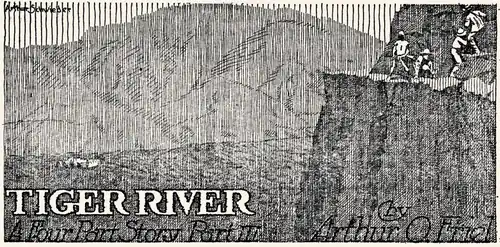
The first part of the story briefly retold in story form
DEEP in the South American jungle on the banks of the upper Amazon, José Martinez, outlaw, camped and meditated his troubles. Suddenly he was startled by a voice from across the water; and as he waited, a river-canoe, containing twelve native paddlers and four white men, approached. With a shout of recognition José welcomed the white travelers.
“It's the Señor Tim Ryan,” he cried.
The other three were McKay, Knowlton and Rand—all his old friends from North America. They informed José that they were in search of gold and asked him to join them. He accepted and told them of the rich prospect in the little-known region of the Tigre Yacu, a branch of the Amazon—and immediately they were fired to go.
They set about procuring three small canoes at a native town a short way down the river, and got rid of their large boat. After a quarrel with a Moyamba trader there—an incident which promised to brew trouble later on—they started out anew and soon were well into the savage territory of the head-hunters.
Here they had the opportunity of rescuing a party of white Indians from the head-hunters. The white Indian chief wished to show his gratitude by not only adopting his rescuers into the tribe but by having them marry his daughters as well. This the North Americans refused to do; but José indicated that he was of a different mind.
CHAPTER XVI
Three Pass Out
 LL right, old-timer,” said Knowlton. “Sorry to lose you, but we wish you luck.”
“I am not so easily lost, señor,” José laughed. “Remember that I started up this Tigre Yacu before you did. And do not think that because I have paused I have stopped.”
McKay's jaw set.
“Meaning that you don't intend to stick by what you've done?” he snapped. “If you only expect to amuse yourself a few days and then desert these girls, you've stopped for good, as far as we're concerned.”
The outlaw jerked his arms from their soft resting-places and stepped forward.
“Capitan, have care!” he warned. “I am not without honor. I abide by what I have done. I do not desert my brides. But I do not desert my quest. Nor do I desert my friends—so long as they are my friends.”
His eyes narrowed to slits, he watched McKay's grim face a moment. Then, getting no answer, he went on, his tone turning harsh.
“No man who calls me traitor—no man who even thinks me traitor—can be friend of mine. No man, friend or enemy, can tell me what I shall or shall not do. If you do not want me with you longer, go your way—and the devil go with you! But I have not stopped. Hah! No! And I have yet to see the man who can stop me!”
A red flush shot across McKay's face. Perhaps he had wronged José; but the outlaw's volcanic retort was too hot to pass unchallenged. He stepped forward. José instantly stepped to meet him.
Rand's voice, cold as a knife-edge, came between them.
“Cut it out!” he drawled. “You're both wrong. Going to fight like a couple of fools? You make me sick.”
Both slowed. Another step, and they paused. Behind José the Indians stirred and looked at their chief. Behind McKay the Americans let their hands sink to their holsters.
“Yeah,” rumbled Tim. “What's the matter with ye? Hozy, lay off cap or ye'll git all that's comin' to ye. Cap, jump Hozy and ye jump the whole tribe—he belongs to 'em now. They're scrappers. Remember what they done to them last Jiveros. Want to start another war before our guns git cooled off?”
Common-sense gripped both the belligerents. They fronted each other, eye to eye, but each saw in the other's face realization that he had spoken too hastily and harshly.
“My fault, José,” McKay coldly apologized. “I misunderstood.”
“Es culpa mia,” was the chill reply. “The fault is mine.”
“Good enough. Now you're both right,” came Rand's caustic comment. “Let it go at that.”
But, though the sudden gulf yawning between the two men had closed, a split still existed—not only between the captain and the outlaw but between Indians and whites. Standing solidly behind their chief, ready to back him in anything he did, the men of the jungle now were also solidly behind the new son of Pachac. The Americans were as doggedly loyal to their own leader, right or wrong. What might have become a harmonious alliance, even despite the refusal of the Northerners to accept membership in the tribe, was now merely a mutual tolerance. Saxon pride and Spanish pride left the gap unbridged—with José on the other side.
Now the Peruvian, ignoring McKay, somberly eyed the three men in the hut. With resolute tread he strode forward, picked up his gun leaning against a corner-post, gathered his meager personal belongings under his left arm and stalked out.
“Señores,” he stated with formal politeness, “it is a matter of regret to me that our companionship ends. It is not by my choice that it does end. But for the slur of your capitan it would not now be ended. My intention was—but no tiene remedio—it can not be helped. To you, Señor Knowlton—Señor Rand—my old friend Tim—I wish all success. If at any time José Martinez, the vile outlaw and deserter of women, can be of any aid to you three, do not hesitate to call. Adios!”
Turning his back squarely on McKay, he faced the men of Pachac and extended his gun-arm toward the back trail. Pachac himself led off. The line began to move.
Silently the white men watched them go: The barbaric chief, still gripping his crude blood-stained club, belted with his sinister black hair girdle, followed by men bearing the corpse of his dead half-son; the naked, muscular warriors, some carrying the other bodies of their slain; the fair-skinned daughters of the chief, looking wistfully back at the motionless José but asking no question; the other women, some young and robust, some carrying babes on their backs, some bent from age and work; the children, stoical as their elders. On into the dim shadows they filed, heading back toward the desolate clearing where the remnants of their plantation would yield them scant food. Then José moved.
Down the bank toward his little canoe he started without a backward look. McKay, cold and straight, still stood where he had stopped after the mutual apology which had not restored friendship. From the hut behind him came no sound. But he felt three pairs of eyes on his uncompromising back—eyes whose combined weight of disapproval hung heavy on him.
“José!” he called.
José went stonily on. He faded among the trees. He was gone.
“And there,” said Tim morosely, “goes the feller that let us in on this trip. The feller that tipped us off to the gold when we didn't know there was any up here, and would fight for us till the last dog died, as long's we didn't kick him in that sore pride o' his.”
McKay faced about. The three pairs of eyes were not on him now. They rested on the spot where the son of the Conquistadores had disappeared; and they were grave.
“My fault,” he conceded again. “But he's gone. There's nothing we can do now but move camp as we intended. I'll scout around.”
Rifle in hand, he went out alone into the bush. Knowlton hesitated, frowning at the forest; then grabbed his own gun and followed him.
“Always together, them two,” said Tim. “Merry wants to give cap a swift kick, but he trails along jest the same. Dang it, Dave, cap's too sudden sometimes. No need to jump in Hozy's face with both feet like that. What's it to him what Hozy does? Me, I think Hozy's one wise guy.”
Rand smiled slightly.
“Why didn't you take a couple of them yourself, then? You had your chance.”
“Aw, that ain't what I mean. I can git girls enough up home if I want 'em, which I don't. But lookit the thing from Hozy's side. He's a lone wolf, man without a country, too much of a he-man to set down in a town and git fat and bald-headed even if he could go back. He belongs in these here wild woods. Now he gits a whole armful o' swell girlies handed to him, gits elected son of a chief and head of a bunch o' hard guys that he can train into one fierce fightin' machine— Why wouldn't he take it? Better be a king among pigs than a pig among kings, as the feller says. And them guys ain't no pigs, neither. He'd be a sufferin' idjut to turn it down—him, a man with a price on his head and no place to go. Ain't that right?”
The green-eyed man slowly nodded.
“Sure. And what's more, all that long conflab between him and ol' Patch-Ike wasn't about girls,” Tim continued. “Hozy's got his eyes skinned all the time, and while he had the chief goin' he was gittin' a lot o' dope about somethin'. About what? About what's ahead of us, most likely—the gold and that wheel thing the young feller spoke about, and what makes fellers crazy up here, and so on. If he didn't git all o' that he got somethin', and he'd have shot the works to us if Scotch McKay hadn't turned Puritan so danged sudden. And now what do we know? Nothin'. And the only wise guy in the outfit's gone, sore clear through. And I don't blame him. Pfluh!”
He spat disgustedly. Rand said nothing. He knew Tim. He knew the grumbling veteran would carry on as loyally as ever behind the captain whom he now scored. He knew, too, that there was much of truth in what Tim said.
“And now here we are, without a guide or nothin', in the middle of a howlin' wilderness o' head-hunters. If we ever git to that gold we'll find li'l ol' Hozy and his new gang there ahead of us, I bet. And I bet ye somethin' else—one o' these days, if he don't git killed first, Hozy'll make himself the big noise round here. He ain't jest stoppin' to fool round a few girls like cap thought. He's lookin' way ahead, figgerin' on things about 'steen jumps beyond where he is now. You wait and see.”
“Hope we live to see it.”
“Yeah. Hope Hozy lives to see it, too. Wal, he's got our whole case o' forty-fours to start his clean-up with, and if he gits a Jivero with every shot he'll make head-hunters hard to find round here. And there won't be none o' them what-ye-call-'em Bambinos in Hozy's country, neither. Gee, I bet the first thing he does with his new gang is to start 'em after that greasy trader that was swipin' our stuff. Hope he gits him.”
Wherein Tim erred on both counts—as he was to learn before dark. Neither the case of ammunition nor the trader who had attempted to appropriate it had gone as far as the Americans supposed. Nor was José thinking of matters so trivial as a pursuit of the pair whom he had scared away that day.
 DOWN at the river he had expertly concealed his canoe and joined the column fording the stream; and now, first in the line, heading even the chief, he was stealing along like the jungle creature he was, his gun ready to clear from the path any menace to the people who had taken him to themselves. In his dark eyes burned a flame lit by thoughts known only to himself—thoughts not of the Americans, not of the Moyobambino, not even of his own present position, but of the mysterious land to the north. Truly, he had not stopped. But even he did not realize that he had only just started.
Meanwhile, McKay and Knowlton were threading the tangle in their silent scout. No word had been spoken between them concerning José, nor would anything further on that subject be said for some time. In his heart the stiff-backed captain was rebuking himself for his abruptness and realizing to the full what a serious loss he had brought on the expedition; but, even if it had been possible, he would not have recalled the Peruvian now.
Neither would he give up his purpose to go on into the sinister cordillera toward which he had set his face. Not if all his comrades turned back—not if he lost food and gun and clothing and had to attack the jungle bare-handed—not so long as one inch of progress and one ounce of will remained in him, would he quit forcing his way onward. When he could go no farther he would go down, face still to the front and dead fingers clutching the ground ahead. That was McKay.
At length, some distance farther along the lake and well back, he paused and scanned the ground around a small timbered knoll. Past the rise flowed a tiny but clear brooklet. Primeval solitude, unmarked by the feet of men, surrounded it. Game tracks were plentiful, and monkeys flitted along the high branches. Meat, water, secrecy, all were there for the taking. Glancing at his compass, he turned back into the labyrinth, working toward the lake bank. The present camp would be easier to find by following the top of that slope than by worming back along the devious way he had come.
A little later he and Knowlton emerged into a fresh path, showing marks of many human feet. It was the trail left by the people of Pachac and the pursuing Jiveros; the point where the fugitives had doubled back and where the head-hunters had later plunged straight out on the bare sand. The ex-officers paused, stepped nearer to the edge, and looked out.
The sand again was empty of life: the vultures had finished their work and risen. Out there now lay only stripped bones, fleshless skulls, scattered shields and spears and bows and clubs, surrounded by sinister red patches. The eyes of the men at the top of the bank ranged out to the water where they had crouched and shot. They returned, noting the positions of the bones along that red trail. They glanced carelessly at the path left on the slope itself. Then the pair turned away.
But they wheeled back. There, under a tree on that slope, they had seen something—something hastily set down beside the path by Jiveros just before charging out to kill and be killed. Their eyes widened. Then they went down, picked up what they had found, and, walking with hands well away from their sides, resumed their way to camp.
As they stopped beside the hut, up from the direction of the canoes came Tim, puffing under the weight of a tin case.
“Say!” he panted. “Know what that proud fool of a Hozy done? Throwed his can o' forty-fours back into our canoe. Took a few boxes, that's all. The danged ol'— Huh! What ye got there? Cr-r-ripes!”
The officers set down their finds. Tim's mouth worked. Then the case of cartridges slipped from his nerveless hands.
He was staring at the severed heads of the Moyobamba trader, Torribio Maldonado, and his Indian satellite.
CHAPTER XVII
North
A FIRE, carefully masked, glowed faintly at the top of the little knoll back in the jungle. Dimly outlined by its vague glimmer, the columns of near-by trees, large and small, rose into the upper dark and vanished amid grotesque lianas and great drooping leaves. Among them, a scant half-rod from the smoldering blaze, stood two straight young trunks between which stretched a horizontal pole. Under the pole squatted four men, smoking.
That pole was the front rafter of a carefully concealed hut—a hut against whose other three sides leaned newly cut bushes and ferns and whose roof-line was softened and distorted by cunningly spaced bumps and slants and juts of palm-leaf; a covert which even a jungle Indian might have passed without seeing it, unless warned by the odor of smoke which permeated the air even when no fire burned. The smoke-tang clung both to the soil and to close-hung strips of meat under the palm roof.
No Indian was near at present. But other jungle prowlers, as savage and nearly as deadly, were restlessly moving round the camp. At times their fierce eyes shone beyond the fire, and at other moments their snarls and growls told of their baffled hunger for the meat they smelled beyond the men. Yet they held their distance, partly because of the dreaded fire-demon glowering at them and partly because even their ferocious hearts had learned that here it was well to step warily.
They had learned, those tigres, that the man-creatures now living here, though clawless and gifted with no such fangs as theirs, possessed a deadly power—that they could suddenly spit out a sharp crack which struck their brothers dead. They had met men before, and more than one of those men had fallen before their rending attack and gone down their ravenous gullets. But those had not been such men as these; they had been bare of body, beardless of face, able only to stab with spear or arrow and then die. These new two-legged creatures not only would not be eaten—they killed and ate the tigres themselves!
Yes, they were tiger-eaters. They preferred other meat, such as monkeys and birds and agoutis; but after they spat that flashing report at a jungle king they stripped his flesh from his bones, ate what they wanted, and salted and smoked the rest to add to the monkey-haunches dangling from their roof. And so, though the big cats nightly slavered at the tantalizing tang which drew them there, they kept moving. And, come when they might, they never could find that meat unguarded or all the men asleep. Always one was there, alert and formidable.
For days now the camp had stood there. For days three of its men had hunted in the surrounding tangle, killing as quietly as possible and bringing back their prey to the hut where the fourth, who was lame, sat with a gun close at hand. When their butcher-work was done they had gone with the fresh meat-strips to the lake shore, where, on frames constructed at the edge of the bush, they salted and dried their provender and then brought it back to camp for a light smoking. And now, thanks to skilful hunting, straight shooting, good luck and steady work, they had tough meat enough to carry them many a hard mile onward toward the cordillera.
Now, also, Rand's leg was again in condition for use. Careful dressing and faithful though tedious resting had healed the wounds to such an extent that now he not only could walk about but could even squat beside his comrades in the nightly smoke-talk—though he squatted on only one heel instead of both. He was not yet in shape to buck a hard trail, but by favoring the injured leg a bit he could do his full share of paddle-work. Moreover, he had no intention of lolling here longer. Already he had demanded that the dugouts, which now were sunk in shallow water for concealment, be raised and loaded and the journey resumed.
“Aw, don't git so hasty,” complained Tim. “Ye've had it pretty soft lately, but we ain't. We been pluggin' all day, every day, gittin' this here grub ready. Me, I'm willin' to loaf a couple days meself now. How 'bout it, cap?”
“Wouldn't hurt to lie up one day, anyhow,” McKay agreed, mindful of the fact that the delay would heal Rand's injured leg just so much more. “All hands rest until day after tomorrow.”
Rand frowned, but gave no further sign of impatience. He puffed again on his cigaret and glanced at the vanishing gleams of a tiger's eye in the black bush beyond. The others also had caught the gleam, but made no move. So accustomed to the cordon of cats had they become that they paid little more attention to it than to the ever-present mosquitoes—unless the animals grew too aggressive. They smoked on in silence for a time.
“D'ye know, I can't git that Bambino feller's head out o' me mind,” Tim declared presently. “Keeps comin' back to me. I seen all kinds o' dead men over in France, and plenty here in South Ameriky too, and some of 'em was tough to look at, but they didn't spoil me sleep none. But some way a feller's head without no body on it gives me the jimmies. I didn't like them Jiveros much before, but I got no use at all for 'em
“So say we all,” concurred Knowlton. “Still, there's no reason why Maldonado should haunt you. You gave him a good deep burial—what there was of him. Wonder where the rest of him is.”
“Somewheres between the river bank and the white-Injun clearin', most likely. If he'd kep' on burnin' the water down-stream the head-hunters wouldn't never have got him. If he didn't try to do us dirt with the white Injuns before they caught us he tried it afterwards, I bet.”
 THE red man's random guess was right. His terror diminishing after he lost sight of the men whom he had sought to despoil, Maldonado had reflected that their fierceness and their jeering mirth were hardly in keeping with their apparently diseased condition. Tricky himself, he speedily suspected that he had been tricked. Whereupon, in a burst of vicious fury, he had plunged into the jungle to see if he could find the white Indian settlement and goad them into pursuing the men who mocked him. What might have happened to him if he had reached that clearing and its raging people may be surmised. But he never arrived there. The head-shrinkers spied him first.
“Dang funny how things have been happenin',” Tim went on. “Take them white Injuns, now. With the whole jungle to run into, they couldn't hit no other place but our camp—the last place on earth they'd expect help, and the only place on earth they could git it. Seems like a miracle.”
“Odd, but not miraculous,” disagreed Rand. “They dodged the Jiveros somehow and started running up the path. Then they quit the path—maybe waded the river a little way—to lose their trail. They undoubtedly know of this sandy lake on account of its turtle eggs and good hunting. Young leader thought they'd have a chance to escape in here, so took the chance; intended to hide the women and children farther in and then tackle the head-hunters bare-handed. They hit our camp because it was near shore and they were following the lake line. Simple enough.”
“Yeah, to hear you tell it. Now tell me somethin' else, Mister Wise Guy—where's that swaggerin' rascal Hozy, and what's he doin' right now?”
Rand shook his head.
“Don't ask me. I'm no oracle. But there's a simple way to find out.”
“What?”
“Go find José and ask him.”
“Huh! Gittin' brighter every day, ain't ye? But say, I dunno, at that.”
Tim glanced sidewise at McKay, who stared expressionless into the fire. Then he turned to Knowlton.
“Might do that li'l thing, too. Mebbe Hozy's been over here lookin' for us before now, but couldn't find this new camp—we covered up our trail dang careful. Anyways, 'twouldn't do no harm to walk over and see how he's makin' out before we pull our freight north. What d'ye think, looey?”
The lieutenant met the appeal in Tim's eye, looked at McKay's stiff neck, smiled slightly.
“I'm game if the rest are. I'd like to know if the old fire-eater's still alive.”
“Same here,” Rand added his vote.
A long pause followed. McKay said never a word.
At length Rand arose, stepped to the fire, put on more wood, yawned at another eye-flash beyond, and suggested:
“I'm on first-trick guard duty tonight. Better hit the hay, Merry.”
The blond man, whose night it was to keep vigil from midnight to dawn, agreed and promptly turned in. McKay, still silent, followed. Tim grinned slyly at Rand, jerked his head toward the obdurate captain's back and retired to his own hammock.
“Wants to go jest as much as we do, but he's too set to own up,” was his thought. “If I ever git rich and go back home I'm goin' to hire one o' them sculptor guys to carve me a li'l mule out o' the hardest rock there is, and then I'll name it McKay.”
Wherewith he curled up and slept.
Rand returned to his former place and disposed himself comfortably, facing the fire, cocked rifle now resting across his knees. Several times during his watch he lifted the gun part way, then let it sink as a menacing form swiftly dissolved in the darkness. After Knowlton relieved him he slept tranquilly, undisturbed by any shot.
The day of rest followed, and another night unbroken by gunfire. Then McKay, ending the second watch at dawn, roused his companions to a day of action.
In the cool daybreak hour, when the sandy stretch between water and shore was as devoid of heat as the forested soil behind, the four passed back and forth through the mist with meat and cans and guns and hammocks and paddles. They waded into the lake, scooped from the sunken canoes the sand ballast holding them down, rocked them in the water until clean, loaded them up, and got aboard. Before the sands beside them were even warm they were gliding away, leaving behind only a vacant hut where the tigres now might enter and sniff and snarl in chagrin.
Out to the river they swung. And there, though no word of José had been spoken for many hours, McKay turned his boat down-stream.
Down to the rocks where they had been captured by the men of Pachac they padded. There they slid the canoes under cover and worked through the bush-fringe to the path leading toward the clearing where José might or might not be. But the visit to that clearing ended before it could begin.
The path was beaten smooth by the passage of many feet. The feet had passed within forty-eight hours at most. The Americans moved along it a little way, Rand studying the toe-prints along the edges, the spots where some foot had swung a little wide. Then they stopped, looked at one another, and turned back toward the canoes.
They knew that a journey southward to the clearing of Pachac's people would be only a loss of time; that there they would find neither José nor his adopted brethren. They visioned the scene at that place as truly as if they now were standing at the end of the trail and gazing across the opening—an empty, desolate space of stumps, where a few ancient mud huts gaped vacantly at a charred ruin which had been a tribal house, and where the plantation at the rear was only an uprooted waste, despoiled of everything edible. The nomads who had tarried there a few months were there no more, and unless other wanderers came and settled on the abandoned site the ever-encroaching jungle would steadily creep inward upon it until it was engulfed in a tangle of upshooting green.
“Too late,” Rand laconically summarized. “All gone—north.”
CHAPTER XVIII
The Toeless Man
AT THE top of a steep ravine a half-squad of men paused, breathing hard, to mop their streaming faces and renew the oxygen in their laboring lungs.
Below them, clear and cold, a little stream trickled along the gully out of which they had just climbed. Behind, a stiff slope dropped from a ridge topped by tropical timber. Ahead, a short rise pitched upward at a grade, betokening another ridge and ravine beyond. And off to the right, only a few rods away but concealed from the sight of the quartet by intervening trees, the Tigre Yacu squirmed its way along a deep boulder-choked bed.
The four men knew it was there, but its only use to them now was as a guiding line. So low was its water-level, and so choked its course with rocks, that it was no longer a feasible roadway into the hinterland. After days of paddling, poling, wading, shoving and dragging their canoes over and through one bad pass after another, the indomitable adventurers had at last been compelled to abandon the sturdy craft and take to their legs.
Yet they had not left the dugouts lying carelessly among the boulders, nor even secreted them under the cover of low-drooping bush or up a cleft in the bank. The boats now were high and dry, yet ready for quick use. They lay at the top of a stiff incline, high above the present water-level, higher even than the old stains marking the topmost reach of the rainy-season
It had taken nearly a whole day of strenuous labor to get them there, for they were stout craft hollowed out from solid logs, and astoundingly heavy. But there they were, lying on crude trestles, with bows somewhat lower than the sterns and dipping downward. In them lay the paddles and a number of tin cases which once had held oil, later had served as sealed receptacles for food and ammunition, and now contained nothing at all. Only one of the containers still was heavy—the one in which remained the “trade” .44 bullets which the party could not use here but would not throw away.
The positions and equipment of those canoes were significant of three things: That their owners might be gone for some time, but intended to come back; that when they did come they might bring something with which to refill the tins; and that they might wish to depart in a hurry. With the banks only moderately full of water, it would require only a quick shove of the boats down the natural chute to get under way with utmost speed. And the season for the setting-in of the heavy rains was not many weeks away. In fact, even now the daily showers seemed to last a trifle longer than had been the case a fortnight ago.
Now the contents of the vacant tins, together with smoked meat and hammocks and other wilderness necessities, were dragging at the shoulders of the four dogged marchers. The men stood leaning far forward, hands on braced knees, distributing the weight of their packs and easing their shoulders as they breathed. Hardened though they were by paddling, iron-muscled from their strenuous toil among the rocks of the upper Tigre, they were not yet accustomed to the unceasing strain and the gruelling down-pull of their back-burdens. And all knew that stiffer work must await them.
“Cripes!” wheezed Tim. “I know now what 'tis that drives fellers crazy up this here river. It's climbin' up these blasted gullies and then tumblin' down into another one a li'l further on. Up and down, up and down, and never gittin' nowheres. If I ever git out o' here and back to N' Yawk I won't be able to travel natural on the sidewalks—I'll have to climb up the sides o' the buildin's and then fall off the other side. Pflooey!”
He blew a sweat-drop from the end of his nose and again breathed hoarsely.
His humorous arraignment of the country now surrounding them was well merited. It truly was an up-and-down region, gashed athwart by water-clefts of varying degrees of steepness, and steadily growing higher.
Had he or any of his companions taken the time and trouble to pick out the tallest tree thereabouts and climb into its lofty crown, he would have seen, to east and north and west, a maze of jungled hill-tops shouldering upward behind one another; and beyond, on all three sides, a mountain wall looming mistily against the sky some thirty miles away. That wall, curving around like the rim of a great lopsided bowl from which the southeastern quarter had been knocked away, was the mother of the hills, the mother of the Tigre boulders—the Cordillera del Pastassa, with its clawlike eastern spur, the golden mountains of their dreams.
But, though so near the unknown range toward which they had toiled and fought, not one of those pack-burdened men had yet seen it. Theirs was not the free outlook of the creatures of the tree-tops; they were earth-fettered, swallowed in the labyrinth, able to see only a few rods at most in any direction, and then seeing only the eternal tangle in which they seemed doomed to labor for all time. They were here only because they were stubbornly following the course of the shrunken river, their compasses, and a dim track pressed into the mold by bare human feet—the up-stream trail which, starting somewhere below the abandoned white-Indian settlement, still ran on and on into the north and seemed, as Tim said, to get nowhere.
Where they were now they could not tell; all sense of distance, even of time, was distorted by their surroundings. They only knew that if they fought onward long enough they must inevitably reach the mountains and there find—perhaps treasure, perhaps utter barrenness.

THE LAND OF THE HEADHUNTERS
“If we could only pick up a li'l gold to kid ourselves along, 'twouldn't be quite so bad,” Tim added. “Jest a li'l nugget, or enough color in the pan to keep us goin'. But there ain't nothin'. Seems like Hozy's yarn about the crazy guy without no toes must be a dream. Yeah, ol' Hozy himself seems like a dream now, and his Injuns and all. Nothin' but jungle and work and bugs and sweat—that's all the real things there is.”
Again he spoke the gaunt truth. In all their tortuous way up the river they had found no gold worth keeping since that day when Tim had captured the forty-dollar chunk. Though their gold-pans and other mining tools had all been lost in their capture and escape from the men of Pachac, they had made shift to wash a little dirt from time to time since then. They had found color, but in such infinitesimal quantities as to prove a discouragement rather than a lure. But for three things they might before now have decided their quest to be hopeless—though they still would have pushed onward.
Those three things were the nugget itself, still jealously prized by Tim; the tale of the mad Gonzales, which they implicitly believed—though told by an outlaw who now was no longer a comrade of theirs; and the fact that the narrator of that tale still was pressing on toward the cordillera.
How far ahead of them José and his band now were they did not know, but they knew they were ahead, and that they had gained much distance over the far slower canoes of the following whites. Traveling at the tireless pace of the jungle nomad, unburdened by packs, snatching their sustenance from the forest where civilized beings would have starved, they had pressed steadily onward while the Americans wrestled their canoes up through the boulders.
Now their trail was old—washed dim by the daily rains, trampled under by the fresher tracks of animals. But it was there, and at long intervals the men following it found unmistakable signs that the new son of Pachac still led them.
 THE signs were few and so small that only the jungle-trained eye of Rand spied them—a few threads caught on a thorn, which were recognized as torn from the Peruvian's raveled shirt sleeve or ragged breeches; an exploded .44 cartridge-shell glinting dully at one side of the path; the marks of a machete-blade on some severed sapling or vine. The three former soldiers, though by no means blind to trail-signs, would not have spotted these things as they labored on. But to Rand they spoke as plainly as if they had been printed placards announcing—
“I, José Martinez, have passed here.”
And soon they were to find larger and grimmer signs of the progress of the deadly-handed outcast.
Having caught their wind, the four straightened up.
“Feel better, Tim, now that the hourly growl is out of your system?” Knowlton quizzed, in the low tone habitually used.
“Oh, yeah. Le's go, feller-idjuts.”
They fell into route-step and plodded away.
Over the ridge they filed, Rand's eyes ceaselessly scouting ahead and aside. Down into another gully, up another slope. On again, down again, up again. And so on, as it seemed always to have been and destined always to be.
Then, on an upland somewhat longer and more level than usual, the scout slowed. His head slipped forward and he sniffed the air like a hunting animal. But he did not stop. His nose told him that whatever was ahead was dead.
Just beyond the top of the hill he found it. It lay scattered along on both sides of the trail, which here led among sizable trees and comparatively thin undergrowth. It now was nothing but bones. But a few days ago it had been a body of perhaps twenty men, who had lurked behind the trees and attacked from ambush. Broken weapons, red-stained shields, splintered arrows jutting from tree-trunks, remnants of maroon loin-clouts, and trampled ground bore mute testimony to the fierceness of the fight.
“Tidy little scrap here,” said McKay, speaking for the first time in hours.
“Pachac's gang must be armed again—with clubs, anyway,” added Knowlton, indicating a crushed skull.
“Yeah. And ol' Hozy was right on the job as usual,” Tim chimed in. “Lookit this feller. And there's another one. And a whole handful o' forty-four shells scattered round.”
The two skulls to which he pointed bore the gaping holes of heavy bullets.
“Good swift action, all right,” agreed the lieutenant. “Must have been a grand old free-for-all for a few minutes. Jiveros, these fellows. Same equipment as the ones we sent west. Some must have gotten away. Remember the drums we've been hearing lately?”
The question was hardly necessary. The mutter of those drums off to the west had caused even sharper vigilance by day and more careful concealment of the nightly camps. Because of it, no fires had been built for days. Its menacing note had throbbed in the mind of every man long after it had died out of the air. Now each glanced searchingly about. But nothing showed itself.
“Uh-huh. Wal, if more of 'em are out they're prob'ly after Hozy's gang, not watchin' us,” was Tim's comforting suggestion. “And they'll git plenty o' trouble if they catch up with 'em. Lookit here, there ain't no hair anywheres around. Ol' Patch-Ike must have most enough scalps in that belt o' his to make a whole shirt by now. If he cleans up another bunch o' Jiveros he can start makin' a pair o' pants.”
Grim smiles answered him. But the same thought was in each man's mind—Pachac's band must be smaller now than before this fight. Was José leading the tribe to victory over all raiders, or to ultimate destruction? Or was he still alive and leading?
Rand hitched his pack and resumed his vigilant advance. The short column filed onward past the other relics of jungle warfare, dipped down into another valley, and left the battlefield behind. There was no further talk.
For some time they kept on before halting again. Then their pause was caused not by men nor beasts but by weather. The light faded, a murmur of approaching rain came to them, big drops spattered, and a spanking downpour set in—the daily shower. Picking a spreading tree, they squatted against the trunk, glad enough to slip their packs and rest.
Suddenly, some distance ahead, a faint yell broke through the slash of falling water. It came but once.
At its own good time the rain swept onward and the light brightened. The four arose and advanced, keenly alert. No sound but the steady drip of moisture came to their ears, and for a while no new sight met their eyes. Then Rand stopped short—looked—listened—and advanced upon something at a bend in the trail.
There, face down, lay a man. He was naked, black-haired, but apparently a white. His hands were dug into the dirt as if he had tried to raise himself after falling. His back was a welter of spear-wounds.
Some one had run him down and stabbed him repeatedly in savage ferocity; stabbed him again and again after the death-thrust. Then the killer had vanished into the rain-swept jungle, carrying with him the spear. Nowhere around the body now was sign of any man but the newcomers.
Rand stooped, looking closer. On the skin above and below the death-wounds were scars, not old, left by a whip.
Turning him over, the four looked down into a gaunt face overgrown by black beard—a face of Spanish cast, coupled with certain Indian features; the face of a mestizo, Peruvian or Ecuadorian. Their eyes ran down his frame. Then every one started.
Back into their minds flashed the words of José, describing the crazed Rafael Gonzales who had reeled into Iquitos with his bag of gold:
“His skin was seamed with scars like those of a whip. His toes were gone—every one cut off!”
This murdered man on the ground, as they had just seen, also bore whip-scars. And his feet were mutilated. Not one toe remained.
CHAPTER XIX
The Golden Mountains
STARING down at that maltreated man, the four muttered in growling undertones. When they lifted their gaze and peered again into the misty depths ahead their faces were hard-set.
“We'll halt here,” said McKay. “Unsling packs.”
The burdens dropped. Tim, his blue eyes glittering, slipped the safety-catch off his breech-bolt and lunged ahead, seeking the man or men who had speared the scarred victim.
“Dave! Stop him!” added McKay, without raising his voice.
Rand, also ready for action, loped away after the mad Irishman. Even when cool, there was nothing subtle or stealthy about Tim; and when enraged he charged like an infuriated bull, seeing red and oblivious of the disturbance he made. Now he was slapping down his feet and knocking aside drooping bush noisily enough to warn his quarry long before he could catch him. Hearing the pursuit, the man—or men—ahead would undoubtedly slip into cover and spear him in the back after he passed.
But Rand did not attempt to fulfil the command literally and stop him short. He only sprinted up to him and hoarsely whispered:
“Less noise! They'll dodge you!”
The fear of alarming and losing his prey slowed Tim down at once, whereas an appeal to “go easy” or to “watch yourself” would have resulted only in a contemptuous snort and an increase in speed. Before long he stopped of his own accord, breathing hard and glaring around.
“We must have passed him,” he panted. “He ain't had time to git this far. Skulkin' in the bush back of us, most likely.”
His companion thought otherwise, but he did not say so. The Indian probably had turned back immediately after killing his man and loped away on his back trail, moving without haste but eating up space at every stride. By this time he undoubtedly was well ahead, unconscious of the fact that white men were behind him. Further pursuit now would mean a long chase and probable ambush. Moreover, the rain had washed out any sign of fresh footmarks. Common-sense demanded a return to their companions.
“Probably,” Rand feigned to agree. “No sign up ahead, anyway. Let's look along back.”
They looked, and, as the veteran of other jungles expected, found nothing. Returning to the body, they found Knowlton arranging a rough cairn of down-blown branches, while McKay watched in all directions.
“Best we can do,” explained the blond man. “He's part white, anyway, and I'm going to give him what cover there is. Some thorn-branches on top and around will keep off the animals.”
“What do you make of it, Rod?” asked Rand. “Jiveros didn't do this. They'd have taken his head.”
“Can't make it out,” admitted the captain. “Looks to me like pure savagery. There may be some tribe in here that nobody's heard about. Certainly there's something around here that maims men. This fellow had no gold like that Gonzales chap. Why he should be killed I can't figure.”
“Personal enmity, perhaps,” hazarded Knowlton. “Whoever downed him gave him enough stabbing to kill him a dozen times. A prisoner, possibly, who got gay with an Indian woman or two and then tried to escape.”
“Prisoner of whom?”
“Don't ask me. I'm only guessing.”
“Mebbe if we keep on pluggin' we'll learn a lot,” Tim morosely suggested. “And here's hopin' I git the guy that done this! I'm sore, I am. Killin's bad enough, but this cuttin' off toes and stabbin' in the back—grrrumph!”
For a moment all stood squinting again along the empty track which led into the north. The same thought came to all at
“José's up ahead somewhere—or his gang is, or ought to be,” Knowlton voiced it.
“Hozy wouldn't have no hand in nothin' like this,” Tim remonstrated. “Mebbe his gang would; but how would this guy git past 'em all? Whoever got him was chasin' him.”
“And these feet have been toeless a long time,” added Rand.
“Looks as if the Pachac crowd were side-tracked,” said McKay. “Or else this chap came in from some other trail. Come. Let's move.”
Tim and Knowlton bore the dead man to the cairn and covered him. Then they shouldered their packs. The file got under way.
Once more in the lead, Rand studied the damp trail more closely even than usual. It gave no sign for a time, the rain having blurred all marks except the fresh boot-heel tracks left by Tim's feet and his own. Not until they had labored up and down and onward for some distance did he find what he watched for. Then, reaching a spot where thick interlacing of branches overhead had formed a gigantic umbrella and thrown the downpour aside, he slowed, squinted, and nodded.
New footmarks receded ahead—the tracks of bare feet bound northward. And they had been made by more than one man.
Rand said nothing until an extra steep climb made all pause at the crest of another bank to recover their breath. When his lungs were pumping normally again he stated his deduction.
“Small gang of killers trailed that fellow purposely to get him. When they ran him down they finished him quick and started straight back. Looks as if they were working under orders and hurried back to report success. Otherwise they'd have hung around until the rain let up.”
“Mebbe they did.”
“No. They went at once, regardless. Rain has been washing their trail. Good thing they did, too.”
“Why?”
“Otherwise we'd be minus one crazy Irishman.”
“Huh? Say, feller, d'ye think I can't handle meself”
“With a bunch of spears in your back?”
Tim blinked.
“Oh. Yeah. I git ye. Lemme charge past and then heave their harpoons. Uh-huh. Wal, that's the only way they could git away with it, I'll tell the world!”
Nevertheless the belligerent ex-sergeant twitched his shoulders and sneaked a look at the forest behind him. He had been shot once in the back—in France, by a German infantryman who had pretended surrender and then used a short-barreled pistol—and now the old wound seemed to burn. Maybe he surmised why Rand had followed him in his recent reckless run and inveigled him back. At any rate, his next words seemingly had little connection with his last utterance.
“Ye're a good skate, Davey, old sock.”
Davey, the good skate, smiled a little and then plodded away.
As before, he kept watch of the retreating footprints ahead of him, though not so carefully now, since he had learned that what he suspected was true. They were visible only at intervals, in spots where the ground was soft, wet, and protected from the bygone rain. At length the rainfall ceased to have any influence on the marks, and the scout knew that hereabouts the killers had emerged from the westward-speeding shower. The tracks faded out, reappeared farther on, vanished, showed again at another place; always spaced the same, showing a steady pace, and always following the mysterious trail toward the mountains.
He noticed, too, as automatically as he breathed, the creeping slant of the shadows cast by the westering sun. For many weeks—ever since descending from the Andes into the lowlands, in fact—this had been their only means of gaging the passage of the hours; for every watch in the party had stopped after a few days in the heavy moisture charging the air east of the colossal cordilleras, and thus they had been reduced to the most primitive means of time measurement. Now he knew that in little more than an hour the grueling advance must end for that day, if a safe and snug camp for the night was to be made.
 THE hour dragged past, filled with nothing but Tim's summary of their previous marching—“jungle and work and bugs and sweat.” The feet of the men behind, and his own as well, were slipping now on roots and in wet spots, which, earlier in the day, they would have cleared without effort; the legs had lost resiliency, and the hungry overworn bodies were becoming like engines whose fuel was burning out. But the present spot was unsuitable for camping—an upland, devoid of live water. So Rand tramped on, seeking a night haven.
The ground still rose. It held no more of those heart-breaking gullies, however, and progress was not too difficult, even for nearly exhausted men. Doggedly they kept putting one foot before the other until half an hour more had passed. Then the light ahead grew brighter. The trees seemed to thin out.
Studying the forest around him, the scout presently spied something and paused. The column stood hunched over, the three behind looking the questions they had not the breath to ask.
“Dry camp,” puffed Rand. “Getting late. Got to stop. Water-trees here. We can make out.”
He jerked his head aside. Scanning the timber, the others recognized a tree which they knew but had never yet had to rely on—the huadhuas, or water-tree, a bamboo from whose joints could be obtained quarts of clear water. They nodded, dropped packs, staggered, adjusted their balances to the sudden loss of weight, and looked about for a good place to make camp away from the trail.
“Over there,” directed McKay, picking a place well bushed but not too thick, and near a couple of widely spaced huadhuas. Heaving up their packs on one shoulder, they threaded their way into the covert, cast about for snakes, found none, and sank down for a brief rest.
Presently Rand arose and, with no explanation, returned to the trail. Along it he journeyed toward that thinning of the trees. He was gone for some little time. When he returned his eyes glowed.
“Didn't mean to slack on camp work,” he said, glancing around at the results of the labors of his mates. “Been scouting. Come on. Want to show you something.”
They followed him. Along the path they went, feeling almost fresh again without their back-burdens. The forest grew thinner and thinner. All at once they stopped, subdued ejaculations breaking from them.
They stood at the brink of a sharp declivity where, years ago, a land-slip had occurred. Under them yawned a sizable gulf, partly filled with water dammed by the fallen earth. But, after one glance, they gave no attention to it. Their gaze darted off to the northwest.
For the first time in many a weary day they saw mountains. For the first time they looked on the end of their long trail.
There in the north, blue-black at the base and gleaming golden at the summits rose the tumbled upheavals of a bygone age—the looping range of the Pastassa, sprawling outrider of the tremendous column of the Andes. The misty atmosphere of the lower lands, which usually blurred the vista from this point, was swept clean for once by a stiff north wind now hurling itself at the faces of the four invaders; and in the fast lifting light of the dropping sun the glowing peaks seemed looming over them, aglitter with unminted treasure—a promise, a lure, which might prove false or true.
Somewhere beyond that range, draining its northern slopes, the Curaray flowed down its golden bed to the Napo. Somewhere beyond its western segment stretched the river valley of the Pastassa, homeland of the head-shrinkers whose roving outposts twice had come into the trail of the four. Somewhere ahead in that great packet of the mountains that trail must end at—what? The grim place where maimed men went mad? The final port of all the missing men of the Tigre Yacu?
Whatever might wait in the few remaining traverses between here and the cordillera, it now was masked by the rolling jungle and the long shadows thrown from the western wall. Below the sunlit summits stretched a twilight land wherein showed no sign of man; an expanse which, for all the eye could discern, might have lain untrod den by human foot since first it rose out of the waters of the vast inland sea. Only the vague path still leading Onward, only the bodies of the mutilated man and of the head-hunters who had come down it, proved that men moved somewhere under that baffling jungle cover girt by the mountain rim.
McKay, first to move, drew out his compass. The quivering needle verified the sun-slant; they were gazing north-northwest. Returning it to his pocket, he remarked in a matter-of-fact tone:
“Better move. It'll be dark soon.”
Rand, who had looked out at the scene once before, faced about promptly. Knowlton, his blue eyes shining with the light of the dreamer who sees his vision at last coming true, stood a moment longer before reluctantly turning away. Tim pivoted lazily on one heel, yawned, and agreed:
“Yeah. I'm hungry.”
Through the thickening shadows they filed back to their covert. There Knowlton spoke.
“Well, by thunder, we've something to look forward to now. We're almost there. The golden mountains!”
“Mebbe,” said Tim.
“Maybe what?”
“Golden. If they's gold there, it keeps settin' tight and don't go down the river. Say, where's that river, anyways? We lost it.”
“Over east somewhere,” said Rand. “It's no good to us any more. This trail is the thing to follow.”
“If there's no gold, Tim,” challenged Knowlton, “where did Gonzales get his? He came out of here—scarred and crippled like the fellow we met today.”
“Uh-huh. Wal, here's hopin'. We've had a run for our money—now I want to see the money for the run.”
“If it isn't there we'll keep on going until we find some,” smiled McKay. “It's only two or three hundred miles farther to the Llanganati. There's gold there—if you can find it.”
“Yeah? Only two-three hundred miles, huh? Totin' a pack all the way, o' course?”
“Of course. But when you get there all you have to do is to find the Incas' lake and get out the gold.”
“Uh-huh. And all I got to do to git from here to there tomorrer mornin' is to tune up me airyplane and let her rip. Talk to me about it after breakfast, cap. I'm tired now.”
“What's this yarn about the Incas' lake, Rod?” asked Rand. “Same old stuff you hear in Peru?”
“Same stuff. Incas threw billions of gold into an artificial lake on the side of the Llanganati during the Conquest. Good many men have lost their lives trying to find it. Still, it seems to ring truer than most of those Inca-lake stories.
“They tell about one fellow named Valverde—Spaniard, of course—who was poor as dirt and went native. A while after he took his Indian wife he became enormously rich. Girl's father showed him how to get at the Inca gold and helped him raise a lot of it. He went back to Spain, and when he died he told the king of Spain how to get at the rest of the treasure. But it's still there.”
Tim's eyes began to glisten. This was a new tale—a tale of lost treasure hundreds of miles away—far more alluring than the possibility of equal treasure within a few leagues. Inca gold! The dream of every Andes adventurer for more than three centuries!
“And nobody's got it?” he demanded.
“No. Expeditions don't come back. Even one led by a priest—Padre Longo—didn't come back. After that, nobody had the nerve to try for it.”
“Gee! Say, if we don't find nothin' here le's keep on goin'! We can git there sometime—if our cartridges hold out'—and it'll take somethin' gosh-awful to lick this gang after we land there. What d'ye say, fellers?”
The others laughed. Pessimistic a few minutes ago, croaking over the lack of gold in the Tigre—and now all afire to dare hundreds of miles of cordillera in chasing a new rainbow; that was Tim Ryan all over.
“We'll see what's here first,” chuckled McKay? “Let's eat.”
Silence fell on the darkening camp, broken only by masticatory noises and gulping of water previously drained from the huadhuas. Then across the jungle roof swept the sunset noise of birds and animals, announcing night. Gloom enveloped them. They ate on, wordless.
All at once they stopped chewing and leaned forward. On the wings of the wind still pouring out of the north came a new sound. It was not the roar of a tigre, the death-scream of stricken animal or man, the snarl of jungle battle, the report of a gun. Any of these would have held them alert for a time; but the thing they did hear made them squat motionless as frozen men until it ceased. Even after it died they held that same rigid pose, staring dumbly into the dark.
Deep, slow, doleful as a requiem for the lost men who had never returned from their quest into this fastness—a bell had tolled.
CHAPTER XX
Dead Man's Land
NOONDAY sun stabbed down through the branches stretching over the curved crest of a long, rambling ridge. In scattered splotches it lighted up sections of a faintly marked path leading along the upland. Filtering through tall ferns beside the path, it sprayed over bearded men in torn, jungle-stained clothing who sat on their packs and smoked.
Another fireless meal had just been finished, and the usual cigarets were aglow. But the four were not lounging in the careless attitudes customary to men relaxing in the languor induced by food and tobacco. Each leaned a little forward, his feet under him ready for a sudden upward jump. Each faced inward toward his companions, but his eyes kept swinging back and forth in vigilant watch of the forest beyond the man opposite.
Between his knees, butt on the ground and left hand curled around the barrel, each held an upright rifle. And every man's pistol hung ready for a swift draw.
“If the cusses would only show themselves!” complained Tim. “If we could only get a look at 'em oncet! They been trailin' along with us the last two days, and we dang well know it. But never a hair will they show. Me, I'm ready for a scrap any ol' time, and the sooner the quicker. But this thing of expectin' a spear or a poison arrer in me ribs any minute and never seein' me man—I don't like it.”
The tense attitudes of the others showed that they felt exactly the same way. For two days, as Tim said, they had been under that strain—the knowledge that they were escorted by flitting Things which they could always feel, could sometimes hear, but could never see—an unceasing harassment which wore on their nerves more than half a dozen deadly fights. For two nights, standing guard in two-hour shifts, they had felt the invisible Something close by, ready to strike yet never striking. Even now they were positive that the stealthy movements which they heard from time to time were not those of animals; that the slight waving of a bush here and there was not caused by a breeze.
“Next time I see those ferns over yonder move, I'm going to shoot into them,” breathed Knowlton, eyes fixed on something beyond Rand.
“Hold in, Merry!” warned McKay. “That's a rookie trick.”
“I don't give a whoop! They're there, and if they won't start it I'm willing to.”
“Take a brace, man! You'll hit nothing. You'll start more than you can finish. Don't be an old woman!”
“I've got a theory about this thing,” stated Rand, as calmly as if he did not feel Death lurking at his shoulder-blades. “These fellows, whoever they are, are willing to keep us coming along. They have a use for us—up ahead somewhere; up where that bell rings. If you really want to start something, start back along the trail instead of ahead. I'll bet you wouldn't get ten feet away.”
McKay nodded.
“Remember what that toeless chap's back looked like,” he added.
At the memory of that red welter the lieutenant twitched his shoulders.
“While ye're springin' theories, I got one o' me own,” Tim hinted darkly.
“Well?”
“Wal, I ain't much of a hand to believe in things that ain't. Jest the same, they's some missin' men up here. They'll keep on bein' missin'—they're dead! And they're the guys that's round us now!”
“Ghosts? Nonsense!”
“Mebbe. But why can't we see 'em? Why don't they cough or spit or breathe loud like live men? Who pulls that there funeral bell at night? How come a bell up here, anyways? I tell ye, it ain't a real bell! These things ain't real men! And it's that bell, them dead men snoopin' round, that drives live men crazy up here! If I was alone here long I'd be ravin' meself.”
There was no levity in his voice. And, though the others tried to laugh, their mirth was forced. Despite himself, every man had fallen under the uncanny spell of the deep jungle during the weeks on the weird Tigre Yacu. And it is a fact, as experienced jungle-rovers know, that in the vast tropic wilderness are things which none can explain.
Sounds like the clang of an iron bar, where there is no bar nor iron; the ringing of a bell where no bell could possibly be; a penetrating, nerve-destroying hiss like that of a huge steam-pipe, hundreds of miles from steam; these and other sounds, which the Indians ascribe to demons, coupled with the sudden and absolute disappearance of men who leave no trace of their fate—these are a few of the unearthly occurrences in the great green abyss beyond the Andes which confound logic, reason, and sense. And these four were overworn by hardship.
But none except straightforward Tim would admit, even to himself, that the weird espionage of those invisible Things was undermining his scorn of the supernatural.
“If there were such a thing as a Dead Man's Land, and if this were it,” the lieutenant doggedly combated, “you'd never catch Pachac and his people going up there. They're still ahead.”
“Yeah? How d'ye know they are? We ain't seen a sign of 'em lately. Ask ol' Eagle-Eye Rand. They ain't nothin' to show they ever got this far.”
Rand shook his head half an inch. Tim spoke truth.
“Then where did they go, if not up here?” Knowlton persisted. “There's been no sign that they turned off.”
“Where'd the other guys go that come up here? How do we know what got 'em?”
There was a silence. Now and then a fern nodded, a slight creeping sound floated to them, but no life showed.
“Theories are no good,” bluntly declared McKay. “But I've got one too. That bell belongs to some old Spanish mission; those old Jesuits would go anywhere—the more forsaken the place, the better. The descendants of their converts are still here. Maybe they're fanatics and practise a few fancy torments on fellows who don't come up to their requirements. Remember what was said about the wheel awaiting us.”
Another silence. Then Knowlton said:
“Sounds more reasonable than Tim's nightmare. That might explain the toe-cutting and the whip-scars, too. If that's it, I'm out of luck. My folks were Baptists.”
“Mine were Episcopalians,” from Rand.
“Presbyterians,” from McKay.
“Me, I'm s'posed to be Catholic, but I'm a danged poor one,” finished Tim. “'Twouldn't do me no good, anyways, if I got caught by a bunch that tried to ram religion into me with a hot poker. I'd git mad and tell 'em I was a Turk or somethin'. But what's the odds? They ain't religion enough in this hard-boiled crowd to hurt none of us, or help us either. Wait a minute, though. Mebbe I can git a rise out o' these guys. Watch.”
He rose, facing a spot where he had detected several unexplainable dips of a bush. Slowly he made the sign of the cross.
After a minute he made it again. No sound or movement answered him.
“Nope. Yer dope's no good, cap. The cross don't mean nothin' here. Now le's see if a li'l Irish nerve will git us anything.”
 WITH steady tramp he advanced at the spot he had watched. Ever so slightly, the bush dipped again. A faint rustle, hardly audible, came from beyond it. Eyes narrowed, jaw out, the ex-sergeant plowed into it and stopped. After peering around he backed out again. His broad face was not so florid as before.
“They ain't no sign here! No footmarks—no busted leaves—nothin'! By cripes, it's like I tell ye—these guys ain't human!”
The others, who also had risen and stood ready for action, glanced around and at one another. Knowlton shrugged.
“You fellows have all sprung your theories. Now here's mine,” he announced. “We'll get to the bottom of things if we keep going. And we'll get nowhere stopping here. Let's go.”
With this pronouncement every one agreed.
One by one they slung their packs—one by one, so that three always could maintain their readiness for anything. The donning of their burdens now was not so difficult as it had been a few days ago, for the men were hardened to them and the packs were lighter—too light, in fact, so far as their food content was concerned. But Tim, though anxious to be moving away from the masking ferns, could not forbear his customary half-serious growl.
“Dead guys don't have to git humpbacked luggin' these blasted packs, anyways. If these tellers are goin' to knock me in the head I hope it'll come quick, so's I can make a li'l profit on it. I'd hate to git killed jest as I git to a place where I can git rid o' this thing for good.”
With a final heave of the shoulders to swing the weight into the right place, he fell into his position in file and took up the step. The column plodded away, heads moving from side to side in constant watch. Around a huge tree it wound, and into the northward trail it vanished.
As it disappeared, a louder rustle sounded among the ferns and bushes, which swayed more abruptly than before. Then they stood motionless again, and the sound died. The encompassing Things also had moved on.
Foot by foot, stride by stride, the four forged onward along the curving ridge-top. Inch by inch the sun-shadows crept east ward. Hour by hour the hot afternoon grew old. And as steadily as the little file swung ahead, as smoothly as the sun rolled in its course, the escort of silent Dead Men kept pace on either flank of the advancing force.
The ridge seemed to have no end. It rose in long grades, sloped away again, lifted and ran level, dipped at another easy slant, but still remained a ridge. At times, as the forest growth thinned, the marchers glimpsed the sky on either side. But they saw nothing of what lay out beyond those occasional side-openings, nothing of what waited ahead at the end of the upland—and nothing of the Things trooping along in the cover at the sides of the path.
As the hours passed, no halt was made. None was needed on this ungullied upland, where no sharp declivities had to be scaled and the lungs functioned as rhythmically as the feet swung. Mile after mile crept away behind until Tim's unspoken thought was reflected in the minds of his comrades:
“We're really travelin' now! We'd ought to git somewheres by night!”
And get somewhere they did. At length, with an abruptness that halted them short, they emerged into open air. They dug in their heels and gave back, smitten with sudden qualms at the pit of the stomach. Almost under their feet yawned a gulf.
A sheer drop of hundreds of feet—a wooded country below—a tremendous mountain wall confronting them a half-mile away; these were the things their startled minds registered in the first flashing instant of instinctive recoil. So long had their vision been confined by the dense tropic growth that the sudden burst into emptiness shocked their brains and sickened their bodies. Dizzily they wavered backward.
For many seconds they hung there in a close-drawn knot, while eyes and nerves and equilibrium readjusted themselves. At length, they cautiously edged forward. A little back from the brink they peered downward, studying the green carpet far under them.
It seemed a solid mass of jungle, unbroken by any clearing, unlined by river or road—a somber abyss wherein might live weird monsters spawned in the hideous Mesozoic age, but where the foot of man never had trodden. It curved away at both ends, its continuation cut off from the eye by jutting outcrops of the wall on which they stood. A yawning pit—nothing more.
Out of it, on the farther side, towered the mountain—a huge bulk, densely overgrown in its lower reaches, clad more thinly up above, nearly bald at the top. Along its side showed no indication of life except an occasional pair of parrots winging their way from point to point. Grim, forbidding, it brooded over the chasm as if guarding its fastness from invasion.
Up and down the four studied it, and back and forth along the gulf they swung their gaze. At the first appalled glance the drop had seemed to be at least a thousand feet, but now that they had steadied themselves they estimated it at not more than six hundred. The mountain shooting up beyond might be three thousand feet high; possibly several hundred more. How long the curving valley might be they could not tell. But there seemed to be no reason for exploring it, nor any way
Tim drew in his breath sharply. The others glanced at him and found him looking over one shoulder, ashen-faced.
“Oh cripes, I knowed it!” he breathed. “Here they are, and they're dead as 1”
They whirled. At last they saw the Things.
A bare spear's-throw away, blocking the trail, stood men. But such men! Their ribs projected. Their arms seemed bones. Their eyes gleamed hollowly under matted black hair. And their skins were green.
Green as the jungle around them, they were. Had they moved and slipped into the bush, they would have vanished like specters. But they did not move. At least a dozen strong, they stood there in a solid body, holding javelins poised at their shoulders. The points of those spears were long, saw-edged, and dark with the stain of poison. One cast, one scratch from those venomed edges, and the whites would be doomed.
Fronted by death, backed by death, the four stood like statues. Then one of the ghastly figures slowly lifted its left arm. Its green forefinger pointed beyond the trapped men. With dread significance, that finger turned down. In the soulless eyes of the creature was a command.
“Oh !” groaned Tim. “We got to jump off!”
CHAPTER XXI
Into the Abyss
MOTIONLESS, wordless, breathless, the other three stood facing the gruesome things blocking the only avenue of retreat from the brink.
The green arm pointing to death hung rigid; the cavernous eyes remained fixed in a snaky stare. The poisoned points neither lifted nor lowered, poising as if truly held in dead hands. Only the regular rise and fall of the breathing lungs under the gaunt ribs proved that the Things were living men.
Rand, without moving his lips, spoke nasally from a corner of his mouth.
“Drop flat and shoot from the ground. Spears may go over us. Give the word, Rod.”
But McKay did not speak that word. Instead, he took his eyes from the green menace and glanced behind. Then he coolly turned his back, stepped to the extreme edge, and moved along it, looking down.
“Not necessary,” he said after a moment. “Trail goes down here. We'll follow it.”
“Trail?” Knowlton echoed in amazement. “Where?”
“Rock stairs drop to a shelf. Pretty risky, but possible. Not much worse than some places we struck in the Andes. Come and look.”
Gingerly the blond man backed. Tim and Rand maintained their wary watch of the Things.
McKay pointed a little to the left of a segment of the ragged edge. There, as he had said, a flight of crude steps jutted from the sheer face of the precipice—perhaps a dozen of them, widening as they descended to a narrow shelf leading away to the westward. The top stair was hardly two feet wide, the shelf not more than four—a precarious passage flanked on one side by the upstanding wall and on the other by nothing at all.
“Ugh!” muttered the lieutenant. “Dangerous even for an Indian. Impossible for us. The slightest bump of a pack against that rough rock throws you out and down. And our boots will slip on those slanting stones. Can't be done.”
“Got to do it, or end our trail here.”
It was stark truth. This was the trail. To quit it here meant, at best, only a long, sour retreat to the canoes and back down the Tigre. At worst, it meant death from the poisoned spears still closing their path. And there was little chance that all those spears would miss their marks.
“Once we're on that shelf, we can travel,” Knowlton conceded. “But getting there is the job.”
“Take off packs. Take off boots. Go down backward, easing the pack after you with your hands, step by step. If the pack slips let it go overboard. I'll try it out first.”
Stepping back a little from the edge, he nodded to the green men and pointed to the perilous stairs. The spear-heads wavered slightly, sinking a little lower. McKay unslung his pack, sat down, and began unlacing his boots.
“Tim—Dave—get ready,” he urged. “Never mind those fellows. They won't do anything just now.”
His calm voice expressed more confidence than he felt. Yet he was reasonably sure that no attack would be made unless precipitated by his own party. These green men, he reflected, could have attacked at any time during the past two days, and with greater safety to themselves. Their object, as Rand had said, seemed to be to herd the invaders onward, not to kill unless they attempted retreat. What fate waited beyond those stairs he could not even surmise. But they could hardly be trapped in a more hopeless position than the present one; and they still retained their weapons.
“Ooch! Sufferin' goats!” blurted Tim, when he saw what must be done. “Go down that? I'll fight this gang bare-handed first!”
“Then you'll fight alone,” retorted the captain, tugging at the first boot. “The rest of us are going down.”
Rand said nothing. He studied the hazardous path, clamped his jaws tighter, and began preparations for descent. Tim looked at him, at the others, at the green men; opened and shut his mouth; mumbled dolefully, and took off his pack.
As McKay arose, with boots slung around his neck and rifle looped across his shoulders, a sound from the southwest throbbed across the silence. It was the far-off boom of drums.
“Huh! They're at it again,” commented Tim. “Same ol' message stuff we been hearin'— Hullo! What ails these dead guys?”
At the rumble of the drums the green men had started. Now they had turned their heads and were looking back into the jungle. They stirred, lifted their spears higher in an involuntary gesture of defense, drew a little closer together as if threatened with attack. For the moment they seemed to have forgotten the whites.
If the adventurers had snatched the opportunity quickly enough they might have poured a devastating fire into those momentarily unready foes; might even, by fast work, have wiped them out completely. But none moved. All watched the weird creatures in wonder. Soon some of the green faces turned back. In them now was a trace of human emotion: Fear.
“Guess those drums don't belong to these greenies,” said Knowlton. “They're Jivero drums, undoubtedly, and they seem to spell trouble for our genial hosts. We're not going into Jivero country down below, then. That's something.”
“We're goin' into Dead Man's country, I'm thinkin',” croaked Tim. “This here hole is where all the rest of 'em are waitin' for us. I wonder if we'll look like these guys in a li'l while.”
“They're a good Irish color, Tim,” the captain grimly joked. “Maybe old Saint Pat is waiting for you down below. Here goes to find out.”
“Saint Pete, ye mean. Waitin' to gimme a li'l harp the minute I fall offen them crazy rock steps. But I don't want no harp yet— Hang tight, cap, and go slow, for the love o' Mike!”
McKay was dragging his pack to the edge. Cautiously but coolly he laid it at the top step, turned backward, let himself down on hands and knees, straightened a leg and felt for the second stair. Finding it, he slid over and worked down until he had his knees firmly braced below. Then, very carefully, he drew the pack toward him and tested its balance on the rock above.
“Too heavy,” he decided. “And too wide. Haul it back, will you, Dave?”
Rand dragged it back, and the captain rose. Once more on the top, he began unstrapping the roll.
“You were right, Merry—we can't handle these things,” he granted. “Every man take what he can carry in his clothes. Get all the cartridges and matches, and whatever else you can tote without making yourself clumsy. Leave the rest.”
“How about grub?” queried Tim.
“One meat-strip apiece. Down below we'll have to shoot our grub or starve. Don't overload, or you'll be twanging that harp in a few minutes.”
Faced by that alternative, the four picked from the opened packs what they could safely stow in pockets, shirts, and empty boots, plus their hammocks, the two short axes, and the light table-gun, which could be stuffed under belts or taken down by hand. The remaining duffle was ruefully cast into the edge of the bush. The green men watched wolfishly, but made no move toward the abandoned equipment.
 AGAIN McKay essayed the perilous slant, going backward as before, keeping his eyes on the rock stairs as he passed downward, feeling his way below with sockless feet. Once his rifle-butt hit a projection on the wall, jolting him suddenly. His mouth twisted, and for a second his eyes swerved outward. But he gripped the stair above, raised himself a bit, swung his hips somewhat away from the wall, towered himself again inch by inch—and the gun scraped past. A few more careful moves, and he stood on the shelf.
“One down,” he announced, his voice a little husky. “Who comes next?”
“I,” volunteered Rand. And, grimly steady, he made the descent without mishap.
“Lemme go now,” begged Tim. “Me feet are gittin' colder all the time. If I wait any longer me legs will be stiff to me hips.”
Knowlton, who stood ready to go, drew back and made room for the red man—who now was not red, but distinctly pale—to pass. Tim got on all fours, fumbled to a footing on the first step, and drew a long breath.
“Here goes nothin'!” he quavered, trying to grin. “And may God have mercy on me soul!”
His last utterance came from the bottom of his heart.
“Slow and easy does it, old top,” the lieutenant warned. “Take all the time in the world. Don't look down. Just ease yourself down slow—slow—that's the way! Get a good foot-hold every time. Slow—easy—it widens out at every step, you know.”
Set-jawed, glassy-eyed, Tim inched down. For him the passage really was harder than for any of the others—he was too broad and stocky. His whole left side hung out over the abyss, and his muscular but short legs lacked the reach of McKay's, or even of Rand's. The pair below watched every movement, coached him at every downward reach, warned him of every projection. And at last, shaky, gasping like a fish out of water, dripping with cold sweat, he found himself beside them.
“Wal, I—huh—come through without no—huh—harp in me hand,” he panted, grasping at the wall. “But I wouldn't do it again for a—huh—million dollars. I'm sick to me stummick!”
“Stand still a minute,” counseled Rand. “Watch Merry come down.”
Knowlton already was backing over the edge. He threw a final glance at the green men, who showed no sign of intending to follow.
“So long, you fragrant hunks of green cheese!” he mocked.
The menacing figures spoke no word. Their lusterless eyes showed no glint of anger at his taunting grin. Only their spear-heads, now almost resting on the ground, lifted a little and pointed at his face.
Knowlton dropped his eyes to the rocks and concentrated his attention on the deadly serious work of getting down. And now the hand of Death, hovering close over the head of each man traversing that treacherous spot, showed itself.
Perhaps it was because he was last in line and anxious to join his waiting comrades and move on; perhaps it was a touch of recklessness; or perhaps the sloping stones were slightly slippery from the passage of three perspiring men. At any rate, the lieutenant descended just a trifle too fast. Reaching for the fourth step, he slipped.
His unbooted feet caught the stair and clung. But the butt of the rifle on his back hit solidly against the same ugly projection which had caught McKay's. The barrel slapped sidewise and struck the blond head a vicious blow.
He lurched out toward the chasm, dazedly clutching at the step above. Then, balanced on the utter edge of the abyss, he lay limp.
Another movement, a slip of the gun, a shifting of something in pockets or belt, would turn him over and slide him into the green maw gaping below.
With a hoarse croak Tim jumped upward. Tim, who had confessed cold feet; Tim, still actually ill from dread; Tim, who would not touch those stairs again for a fortune, sprang up them like a mountain goat. His body slithered against the face of the precipice. His big hands clutched, one at the edge of a step, the other at his lieutenant's slack shirt. In one smooth, steady haul he slid the stunned man in toward the cliff.
And while the two below stood frozen, unable to help, he worked his own way backward and slipped the reviving man down stair after stair. He did not look to see where he stepped. He planted his feet with unerring surety, grasped tiny projections without seeing them, balanced himself as lightly as a fly. In hoarse tones he muttered over and over:
“Jest lay still, looey. Lay limp and we'll make it. We're most down and goin' strong. That's the boy! Lay still, ol' feller, la-a-ay still!”
And he reached the shelf, laid his man out straight beside the wall, and grinned gray-faced at him. Then he wavered, clutched at the crag beside him, and sank down. And for the next few minutes he was absolutely and utterly sick.
“By !” breathed McKay, who seldom swore. “I've seen men awarded the D. S. C. for deeds not half as brave as that!”
But when Tim sat up again and weakly mopped his face, he had a reward worth far more to him than government medals—a silent grip of the hand and a straight look in the eyes from his “looey,” alive and once more ready to carry on. No words were said. No words could have said what eye spoke to eye in that long quiet minute there on the face of the wall.
“Let's go,” said Rand.
Carefully they turned about, and slowly they filed along the trail, hugging the rock. Up at the top of the stair the green men stood watching them go. Presently they drew back, and for the first time sounds broke from them. With animal grunts, they fell upon the stale food left behind by the white men.
On along the narrow shelf the four adventurers trudged, looking down into the dizzy depths no more than they had to. It led on and on, widening at times, narrowing again, now roofed by overhangs of stone, again open to the high blue sky. Under a jutting outcrop it burrowed, and there it turned abruptly to the left. The marchers had rounded a shoulder of the hill which had cut off their view to the west and south.
There, on a natural platform beyond the corner, they halted with sudden murmurs. The jungle below was no longer without signs of man.
Perhaps a half-mile farther on, in a wide waterless bay among steep green mountain-slopes, the trees were thinned out at the top of a curving knoll. In that opening, dingy gray, showed the lines of stone walls and a house—masked by intervening tree-tops, but unmistakable. Whether men now dwelt there, what they did and why, were questions which only closer approach could answer; but men had been there—men who built with stone—and not so long ago. Otherwise the jungle would have swallowed up the place.
Down toward it the high trail now dipped at a stiff grade for perhaps three hundred yards. Then it vanished into trees, and at that point the precipice also ended; the tree-clad slope was a slope only, not a drop. The path must wind on down that green slant and then swing out to the house-capped knoll. Was that knoll the end of the trail, the end of all adventure, the lair of the dread ogre who swallowed missing men?
Suddenly the watchers started. A sullen, low, awful murmur was shooting toward them from the farther mountains. Instantly the solid rock under them quivered and swayed.
“Quake! Down!” barked McKay, falling prone.
The others dropped flat, hugging the stone. It moved sickeningly, became still. A few seconds passed. It shuddered again, was quiet.
Up from the depths rolled several clangs of a deep-toned bell. From somewhere below, seeming very near, broke a grinding roar followed by a great thumping crash. The rock quivered once more, but this time as if from a blow.
After a few minutes of waiting for another tremor, the prostrate men sat up and looked around. Nothing seemed changed.
“Pretty easy,” remarked Rand. “I'd hate to be caught up here in a hard one.”
“Something dropped, and mighty close,” said Knowlton. He crept to the edge and peered down. “Not along this side,” he went on. “Maybe around the corner.”
Rising, he stepped to the other side.
“Did ye hear the bell ring? 'Twas down there by that house,” said Tim. “That same dead-man's-bell we been hearin'”
“Great guns!” Knowlton's voice broke in. “Look here!”
As they joined him he pointed downward, then out along the shelf where they had just passed. Below, a great chunk of the wall grinned up from among crushed trees. Beyond, a long gap yawned in the face of the cliff.
“This trail's closed forever,” declared McKay. “Unless we can find some new way out, we're in for life.”
CHAPTER XXII
The End of the Trail
SUNSET, blood-red, burned behind the mountains.
Against its fiery flare the great misshapen bulks loomed dusky green above the sinister gulf in which stood the stone-crowned knoll. In that chasm the shadows were welling rapidly upward toward the top of the eastern heights. Moving along the bottom of the bowl, the four invaders found everything around them growing dim under the jungle canopy.
They had swung down the remainder of the steep trail without mishap, and without meeting any living thing. Soon after entering the trees the path had begun to zigzag back and forth along the steep, but no longer precipitous, side of the towering hill; and now it had become merely a succession of easy curves rambling on toward the walls guarding the house hidden beyond the trees. Along it the file was passing at good speed, each man still carrying his boots around his neck. As always, Rand led, scanning all ahead and aside.
Abruptly he halted, jumped back, collided hard with McKay, who now was second in line. Before him in the dimness a sinuous form moved slowly out of the trail.
“Snake,” he said. “Nearly stepped on him. Guess I'll put on my boots.”
With more alacrity than caution, the others followed his example. The odds and ends of equipment which had been carried in the battered footgear were shaken tumbling on the dirt, and every man hastily jammed his feet into the leather legs. By the time the lacing was completed and they were once more protected to the knee, the swiftly deepening shadows had grown so dense that it was difficult to find the articles they had dropped. And the path was swallowed in gloom.
“Better halt here and eat,” said McKay. “There'll be a good big moon in a little while. Can't see our way now.”
“Aw, we ain't got far to go,” objected Tim. “And mebbe they's some water ahead—I'm bone dry. And that low-lived snake's right round here somewheres yet. Le's go a li'l ways.”
His only answer was the sound of three pairs of jaws biting into the last of the smoked-meat supply. The others had accepted McKay's dictum. With no further protest, he straightway clamped his jaws in a meat-strip of his own.
The meal was brief, both because of the meagerness of the provender and the speed with which it was bolted. No man squatted or sat, for no man knew how many reptiles might be within striking distance. In lieu of water, each finished with a cigaret.
“No need of going without a smoke,” said Knowlton. “We're in, we can't get out, and anybody who spies my cigaret is welcome to come a-running.”
“Me, I'd like to see somethin' comin'—somethin' alive, I mean,” declared Tim. “This place is too dang spooky. Ain't seen nothin' here but one snake, ain't heard nothin'”
Like a blow, the boom of a bell struck his words and knocked them into nothing.
It came from the right. Solemnly it tolled a dozen times. Then it was still.
No other sound followed, save the usual night noises from the gloomy depths around. No human voice spoke. No dog barked. No cat or cow or other domestic animal called. No squeak or rattle or bump or footfall betokened the presence of men in that house somewhere near by. Even the jungle noises here seemed weird, ghostly, echoing hollowly among the surrounding heights. Tim shivered.
After a prolonged silence Rand spoke.
“A queer hole. Good thing we stopped here. We were heading into the woods. Path curves back, no doubt, but we'd have blundered straight on.”
Nobody replied. All stood waiting for the moonlight.
At length it came. The obscurity grew less dense. Silvery patches of light appeared here and there on the earth. The eyes of the waiting men, already dilated wide by the darkness, made out clearly the shapes of the near-by trees, but not the path. Vague even in daylight, that trail now would not again be visible before sunrise.
But McKay moved over into a little spot of light, studied his compass, and laid a course for Rand.
“West-northwest,” he said. “That'll fetch us out near that bell.”
Rand, after contemplating his compass and the trees, nodded and dropped the instrument back into his pocket. Now that he had the direction firmly fixed in mind, his old jungle instinct would carry him straight, despite necessary windings, without another consultation of the magnetized needle. He turned and stepped away.
Slowly the party followed his lead, traveling in slants and detours, but ever swinging back to the prescribed course as surely as Rand's eyes were glued to his compass instead of roving all about. They slumped into muddy spots, turned sharp to dodge boulders, straddled over down trees, and in places chopped their way with the machetes. Nowhere did they find flowing water. Their thirst, already keen, became acute discomfort as the meat they had swallowed demanded liquid. But none spoke of it, or of anything else.
All at once the trees opened. They halted at the edge of the forest, looking up at the cleared knoll.
They saw only stumps, low shrubs, scattered trees of great girth, and, at the top, a high stone wall, above which protruded the outline of a long low roof. For a time they studied the wall, seeking some moving figure, but seeing none. Under the cold moon the hard gray pile fronted the wilderness like a forgotten sepulcher guarding its dead.
Toward it the hard-bitten little column advanced, instinctively changing formation to a line of skirmishers. Each man picked his own way around tree or bush-clump, but none fell behind or went far ahead of his comrades. Several times they paused, listening and watching; then moved on.
Soon they stood under the old wall itself, looking along its length. Nowhere could they see an opening. For a hundred feet or more it ran straight north and south, then ended. Beyond rose the black mountains, looking down in insensate savagery at the line of stones taken from them by hands now moldering and piled up to bar out what ever foes might come, and at the four lost men who, all chance of return destroyed, stood under them and looked about.
To the men themselves came a queer feeling that they were back in some former life, outside the walls of some medieval robber baron's castle, likely at any moment to be spied by mail-clad sentries above and riddled with long shafts or dragged in and thrown to rot in some noisome dungeon. Knowlton caught himself listening for the grind of steel-shod feet above, the clink of armor, the rattle of a sword. Then he smiled at his own folly. But the smile faded and his eyes widened. No martial sound came to him; but another sound did.
 SOMEWHERE farther down, beyond the wall, a vaguely confused murmur arose—a noise which might have been caused by shuffling feet combined with low voices—a sound as if men, or pigs, or both, were moving sluggishly about.
“Cripes! The dead guys are gittin' up out o' their graves!” breathed Tim.
In truth, it seemed so. If living men moved on the other side of those stones they had little energy. There was no calling out, no song or laugh—only a dead, brutish sound which neither increased nor died out of the
McKay motioned along the wall and stole away. The others followed. Down almost to the end they passed, and there they paused again. From across the barrier that gruesome sound still came, more clearly now—grunting voices, bestial snores, the faint slither of feet passing about as if dragging in utter weariness. Something else came over, too—a rank odor as of an unclean pen.
The captain gaged the wall—a good twelve feet high—as if meditating an attempt to look over by climbing on the shoulders of some one of his companions. But he decided otherwise and once more moved on, stopping again at the end, or what had seemed the end, of the rock line. It proved to be a corner.
Around that corner the wall receded for perhaps forty feet, then turned again and ran back to a sharp uplift of the ground. There it merged with the shadows and the rising earth. It looked like a passageway leading into some tunnel, which in turn might run back for many yards into the steep slopes beyond. The spies had little doubt that such was the case.
The captain shook his head, signifying that further progress in this direction now would lead them nowhere. They retraced their steps. To the other end of the wall they passed, and around the corner they turned without reconnoitering. Then they stopped in their tracks.
Drawn up in a close-ranked body, stolid and silent as if they had been patiently awaiting the whites, stood ten men. Each held a rifle. Each rifle was aimed at a white man's breast. And each eye behind the gunsights glinted as coldly as that of a snake.
They were Indians all. But they were not green men; not Jiveros; not men of the vanished Pachac. They were brutes; coppery brutes in human form. Though the lower parts of their faces were half-hidden by the leveled rifles, their low foreheads, beady eyes, and bestial expressions were clear enough in the moonlight. They were more merciless than animals. And they held the lives of the intruders in the crooks of their trigger fingers.
Yet, after the first shock of surprize, the four looked them over coolly. One thing was very obvious—these were no dead men. They were alive, well fed, armed with repeating rifles of the universal .44 bore. The sight of those prosaic guns, threatening though they were, exerted a steadying rather than an alarming influence. Tim even grinned, though in a disgusted way.
“Faith, gittin' caught seems to be the best li'l thing we do,” he remarked. “Outside o' them Jiveros we caught on a fryin'-pan, we ain't licked nobody since we come in here. If I ever git back home I ain't goin' to brag much about this trip. What's the word, cap? Drop and shoot, or stick up our hands?”
“Stand fast.”
Then, in Spanish, McKay addressed the Indians.
“Do not fear. We are not enemies. Put down your guns.”
The guns remained leveled. One of the Indians replied in a harsh growl—
“Go within.”
“Within what? Where?”
“The gate.”
The captain glanced along the wall.
“I see no gate.”
“Go. You will find it.”
He moved aside as he spoke, still covering McKay. The others likewise slipped aside.
“We go.”
And, with unhurried tread, they went. Flanked on one side by the wall, on the other by the ready guns, they filed along toward the invisible gate. As they passed, the Indians swung in behind, muzzles pointing at the white men's spines.
Some distance beyond, a tree cast a deep, wide shadow on the wall. In that shadow the Americans found a stout gate of rough timbers, standing ajar. Three more of the brute-faced aborigines, also armed with guns, stood there. These stepped in, swinging the gate wide enough to admit two abreast. When red men and white were all inside, the big barrier was bumped shut. Heavy bars thumped into place.
The whites, looking rapidly about them, saw the front wall of the big house; a bell suspended from a stout tripod near at hand; and a sort of scaffolding running along the inside of the stockade walls, about four feet below the top. The house-front was pierced by a few high and extremely narrow windows—scarcely more than loop-holes—and a wide doorway in which solid double doors stood slightly open. From the peak of the low-pitched roof jutted jagged stones which at one time probably had been a belfry, now ruined by some long-forgotten earth-shock.
The bell, hanging within the triangle formed by logs solidly braced in the hard-packed earth of the yard, was black with age. The scaffolding along the walls formed a narrow runway where men could pass in patrol or fight against enemies out side. If well manned, the place was virtually an impregnable fortress against any jungle foe.
This much the four absorbed in their first survey of their surroundings. Then their gaze riveted on the big door.
Slowly that door swung farther open. Beyond it a face showed dimly in the shadow cast by the big tree outside. The Indians looked toward that vague figure, and one of them spoke.
“They are here,” he said.
The figure stood motionless a moment. The peering Americans saw that it was not tall, and that against the gloomy background its face seemed white. Then they nearly dropped. The figure replied; and its voice, though clear, was soft and low—the voice of a woman.
“It is well. They shall come in.”
As if the words were a cue, light shone in the darkness. The doors swung wide. Prodded by the Indians, the amazed soldiers of fortune moved forward, staring at a slim, fair, graceful, woman, bare-armed, black-haired and red-lipped, gowned in clinging purple, who stood with head saucily tilted and smiled at the shaggy men who had forced their way to the end of the long trail of the Tigre Yacu. Around her stood light skinned Indian damsels, nearly nude, holding bare-flamed lights.
Across the threshold passed the four, and down a bare corridor the bevy of girls and their mistress retreated before them. The Indian men remained outside, and one of them reached and swung the door shut. The lights passed into a side-wall, and the white men followed. They found themselves in a big room hung about with the same purplish cloth worn by the woman, in the middle of which stood a massive table from whose top flashed yellow gleams as the lights moved.
“Bien venido! Welcome!” smiled the woman. “You have traveled far. Have you hunger and thirst?”
The eyes of the four searched the room. No men lurked there. They relaxed, smiled in reply, and doffed their battered hats.
“Thirst we have, señorita,” answered Knowlton. “A thirst that gnaws. But no hunger.”
“It shall be quenched.”
She made a sign, and the girls, who now had set their yellow lamps on little wall-brackets, went out by another doorway.
“Sit, señores,” added the mistress of the house, nodding toward a long padded couch. “Water shall be brought for bathing, and I myself shall prepare that which will banish weariness.”
With another smile she disappeared through the other doorway. Still almost dumb with amazement, the men sat down on the couch, unconsciously gripping their guns and staring all about.
“Gee cripes!” breathed Tim. “Whaddye know about this! We come lookin' for dead men, and we tumble into a harem!”
CHAPTER XXIII
Circe
FOUR girls, bearing wide yellow basins, entered and crossed the room. Each stooped before one of the men, holding the bowl at the level of his knees. Restraining an impulse to snatch the vessels and drink the cool water in them, the travel-stained men laid their guns aside and immersed their hands. As they did so, each narrowly scanned the containers.
“Gold!” was their conviction.
The yellow metal could hardly be anything else. It certainly was not brass. The yellow lamps, too, and the gleaming things on the table—all must be gold.
“Cripes!” Tim whispered again. “This place is a reg'lar mint!”
“Looks like it,” agreed Knowlton. “First time I ever washed my face in gold, anyhow.”
Running a hand down his face to squeeze the water from his beard, he reached with the other for a small towel hanging over an arm of the girl serving him. As he did so she bent nearer and whispered something.
The sibilant words meant nothing to him. Puzzled, he stared into her face. Then he blinked, rubbed his watery eyes, and stared again.
He was looking into the brown eyes of one of the wives of José.
A glance at the other girlish faces told him that they also were of the winsome daughters of Pachac. Not only that, but they were of the five whom the son of the Conquistadores had taken as his brides. Only one of the five was missing, and she must be among those now beyond the doorway.
In the wavering lights, which did not fully illumine the room, the Americans had not previously recognized the girls. For that matter, they had paid scant attention to them in their amazement at finding themselves amid such unexpected surroundings. But now a startled grunt from Tim, whose eye for feminine charms never remained blind long, showed that he too had realized who these girls were. McKay and Rand, after a glance at him, also looked more carefully at the faces so near theirs. Their lifted brows revealed their recognition.
Knowlton's girl whispered again. Again he could not understand. Her face fell, but she moved her head a little backward, toward the door where the purple woman had gone out. In her eyes was a plain warning against something.
The blond man nodded to show he comprehended her effort to caution him, though unaware of just what that effort signified. Then he toweled his face rapidly and gave her the wet cloth. She turned away.
“Keep an eye peeled, fellows,” he muttered. “Something slippery around here. Can't tell what's in that next room, for instance.”
“Wear your poker face,” advised McKay. “Don't show that we know the girls. Maybe we're not supposed to.”
Then through that farther doorway came the fair-skinned woman in purple.
Behind her advanced girls bearing a large steaming pot and several cups of the same lustrous golden hue. Eyeing them keenly, the men saw that among them was the fifth bride of José. And, remembering that the chief of the white Indians had had nine daughters, and noting features of resemblance among all these girls, they concluded that every one of them was of the blood of Pachac. But each man kept out of his face any sign of recognition, or even of interest.
They arose, as if in honor to their returning hostess. But in doing so they unobtrusively picked up their rifles and glanced beyond her to spy any furtive movement in the room beyond. No menace, showed itself. The purple woman looked at their guns with an expression of amused contempt.
“Have no fear, my friends,” she said. “Within these walls no guns are needed. Here are only rest and welcome after a long journey.”
“Your men gave us a strange welcome, señorita,” McKay asserted.
“Ah, but you then were outside the walls! In this wild land one must be on guard against all who come, until we know them for friends. Of what country are you, Señor Gold-Hair?”
Her long-lashed eyes had turned to Knowlton, whose tumbled hair shone under the light of a near-by lamp.
“Of the United States of North America, señorita. We all are of the same land.”
“So? I have never seen one like you,” she naively confessed. “Nor one like this one whose hair is so red. These two,” nodding at McKay and Rand, “might be men of Spain. But come, let us quench the thirst at the table with guayusa.”
She turned toward the stout board on which the great golden pot now had been placed. With another quick look toward the door beyond her, the men laid their rifles back on the couch and moved toward the steaming bowl. Deftly she dipped up cupfuls of the hot liquid and set them along the edge. After a bit of maneuvering, the four took positions along a bench beside the table, where they could watch doors and their hostess too. And, though consumed by thirst, none lifted his cup just yet.
They knew the guayusa tea well enough—an infusion from the leaves of a wild shrub found here and there in the upper Amazon country, which, like the yerba maté of Paraguay, exhilarates the drinker and banishes weariness. They were fatigued enough and thirsty enough to consume cup after cup of it. But they were also on their guard against anything and everything, and they waited for her to drink first.
“You do not like the guayusa, no?” she asked, dipping up a measure for herself.
“It is hot,” Knowlton evaded. “And in my country it is the custom to await the pleasure of the hostess.”
Her dark eyes smiled wisely at him. She lifted her cup, sipped at it, drank in little mouthfuls, set it down empty.
“Of what are you afraid, Señor Gold-Hair?” she mocked. “Should I let you pass my guards only to poison you?”
The lieutenant flushed and raised his drink.
“To you, señorita,” he bowed. “The most beautiful woman I have seen in many a long day.”
Which was not quite so florid a compliment as it sounded. For many days he had seen no white women whatever. But she took it at its face value, and as he smiled and quaffed the stimulating draft her eyes caressed him.
“Oh boy!” Tim gurgled into his cup. “Ain't he the bear-cat, though! Feed her a li'l more taffy, looey, and she'll be sittin' in yer lap.”
McKay choked suddenly, spilling half his guayusa. Rand bit the edge of his cup to hold his face straight. Tim gurgled again and swallowed the tea in two gulps. Knowlton expressed a desire that he might speedily strangle.
The dark eyes watching them narrowed, and a glint of anger showed in them. Though the alien words meant nothing to her, the suppressed mirth among the men hinted at something uncomplimentary—else why should it be suppressed? But she said nothing. She signed to one of the girls, who refilled her cup.
For a minute or two all sat frankly looking at her. They saw that she was indubitably Spanish, of blood pure or nearly pure; that she was not altogether beautiful—the features were a trifle coarse—but far from ill-favored; of Castilian countenance, shapely form, and mature years—mature, that is, for the tropics; perhaps twenty-five. Her red lips, thin but pouting a little; her eyes, with a hint of passion in their depths; her languorous movements and her sidelong glances—all were sensuous and sophisticated. Her dress, they now noticed, was only a sleeveless frock of llanchama bark-cloth dyed with achote, ending at the knee, drawn tight at the waist by a broad girdle of the same material. And from that girdle, slanting a little forward, jutted the hilt of an old-time poniard.
In his mind each man labeled her—
“Dangerous.”
 THERE was no hint of danger in her manner as she now studied each man's face in turn—and not only his face but the hardy frame beneath it. To three of those figures she gave fully as much attention as to eyes and jaws and expressions. Her gaze hovered a little curiously on Tim's red hair and beard, but she scanned his muscular body with more interest than his wide countenance. On McKay's stalwart frame and Rand's solid build she bestowed thoughtful looks. But on Knowlton's thick, uncut yellow hair, golden beard, and twinkling blue eyes her gaze lingered; and under her lashes burned a soft glow of approval and allure.
“Ye've started somethin', looey,” murmured Tim, sotto voce. “Us three guys are jest hunks o' beef, but li'l Angel-Face Knowlton is the candy kid.”
“Shut up, you poor fish,” requested the badgered man.
Then he gulped his second cup of guayusa, noting as he did so that the woman now was eying the red-haired man in evident dislike. Tim was rapidly putting himself out of favor.
After another wordless minute or so of tea-drinking, the woman turned her gaze again to Knowlton.
“What do you seek here?” she asked abruptly.
Involuntarily each man's glance darted to the great gold pot on the table. She threw back her head and laughed in a scornful way.
“You come for gold, yes? I knew it must be so. For that yellow rock men dare all. And when they have it, what then?
“Where gold is, there death is also. So my fathers have learned. Many years ago they found gold here. They fought the wild men, they made their captives build these walls, they mined the gold—and what then?
“The earth shook and the mountains broke and slid. The way in and out of this gulf closed. There was no escape except the long way down the Tigre, through savages who let no man pass. So my fathers stayed here with their gold, which was worth nothing—what is gold in such a place as this?
“Still they mined and got more gold, against the day when another temblor should open a new way out. It came, the terrible earth-shaking—and did it open a way? No! It crushed the mines, destroyed the men in them, buried even the gold which my fathers had taken out and stored in a walled-up cave. And so they died, and I alone am left—Flora Almagro, last of the fighting family that would tear wealth from the savage mountains of the Pastassa.
“I, and Indians, and tumbling walls, and a few paltry utensils which my fathers made from their gold—that is all. But the gold is in these mountains round about. Dig, señores, dig! Ha, ha, ha! In twenty years of digging you may reach that which my fathers reached—and then be crushed like them!”
Again she laughed—a mocking laugh with a wild note in it.
“Four life-times of fighting man and beast and jungle and devil-rock—and this to show for it!” she shrilled, with a contemptuous wave toward golden cups and bowl and lamps. “If you would find gold and keep it, friends, bring in an army—bring in cannon—blow off the tops of these mountains until they can no longer fall— Then, perhaps, if the jungle men will let you, you can pick up your treasure in safety.”
None answered. All thought of the slight earth-shock only a few hours past, of the fall of the cliff and the destruction of the trail. Her words rang true. And if they were true, Fate had tricked them into a barren trap indeed.
Thoughtfully they drained their cups a third time. The potent stimulant already had routed their fatigue, and now their minds were leaping nimbly from one thing to another—the quake, the mysterious green men above, the obvious servitude of the Pachac girls, the sinister absence of the rest of the tribe and of José—a dozen other things in incoherent sequence, all of which perplexed and disturbed them. At length McKay bluntly asked—
“How did you know we were coming?”
The suddenness of the query did not disturb her. Widening her eyes in mock innocence, she returned:
“The approach of travelers always is known. The little parrots of the forest send the word.”
“Ah. Green parrots, no doubt.”
“All parrots here are green, Señor Black-Beard,” was her laughing retort.
“So. And they drum with their wings to send their news.”
At that her smile vanished in a flash. Involuntarily her hand darted to her dagger-hilt and she threw a look toward the outer door. The gesture, the look, were strikingly similar to the fearful attitudes of the green men on hearing the distant drums.
“Valgame Dios! Those drums!” she breathed. Then her head turned back and lifted again. “But no, you have it wrong. You have heard drums, yes? They are drums of the men who cut off the head and make it small—the hunters of the heads of men and the bodies of women—the old enemies of my fathers. Their land is beyond the mountains to the west, but they come at times—many of their bones lie in this gulf where they fell. We have lived only because they came in scattered raiding bands. If ever they come in an army”
Her hand tightened on the hilt. With another swift change she laughed out, the same wild laugh as before.
“They may capture the head of me, but that is all!” she vowed. “Flora Almagro never goes a captive to the hut of an Indian—not while good steel can reach her heart! But—carajo! Let us forget them. Tomorrow death may come, but tonight let us live! Now that the guayusa has rested you, there is a stronger draft of friendship for strong men who have dared the Tigre and come to me here.”
She signed again to the girls, who had been standing mute behind her. Three of them turned toward the rear room. Among those who stayed was the one who had attempted to convey a warning to Knowlton. Now she looked straight at him and again tried, by furtive nods at her mistress, to caution him. Puzzled, he stared back at her.
“Why do you look so at my maidens?” demanded Flora Almagro.
Her eyes were narrowed again, and she watched Knowlton as if trying to read his thoughts.
“I was wondering, Señorita Flora,” he coolly replied, “how, in this wild place, you obtained such handsome slaves. For Indians, they are almost beautiful.”
His tone implied that they were not to be compared in beauty with their mistress. The subtle flattery was not lost. She smiled again. But her eyes still searched his.
“You look as if you thought you knew them, señor.”
“One of them resembles a girl I saw months ago far up the Marañon,” he lied serenely. “But she can not be the same. That one was taller.”
For a moment longer she studied him. He carefully preserved his “poker face.” The suspicion faded from her eyes.
“But no, Señor Gold-Hair. All of these have been with me for years. They are of the people who served my fathers. Now they shall serve”
A stumble and a slight confusion at the door halted her. The three girls were returning, bearing another great golden bowl. One of them had tripped, and all three were struggling to keep the heavy vessel from falling. From it splashed a reddish liquor.
A flash of anger twisted the face of Flora. Her dagger leaped out, and with a feline spring she darted at the trio.
“Pigs! Lizards! She-dogs!” she screamed. “Have care! If you drop the wine, clumsy beasts, you shall feel the point of this!”
The three caught their balance, steadied the bowl, and bore it dripping to the table. The purple-clad woman, her breast heaving with fury, looked down at what had been spilled, spun toward the table, still gripping her poniard—and caught the cool stare of four pairs of American eyes. After a silent minute she slipped the weapon back into her girdle and laughed in a forced way.
“I forget myself,” she said. “But this wine, señores—it is old, precious! To see it cast on the floor by footless fools—it is too much. But now it is safe. Let us drink deep—of the wine of life—and love!”
With the last words her eyes burned deep into those of Señor Gold-Hair, whom she had plainly selected as recipient for further favors to come.
“Hm! This is getting a bit thick,” thought the blond man. “But the evening's young yet, and if she drinks enough she may blab a lot of interesting things. On with the dance!”
Wherefore he smiled blandly at the señorita, accepted the cup tendered him, and gazed appreciatively at the fragrant contents. Red wine in a cup of gold, tendered by a seductive woman in a room hung with purple and lit by golden lamps, with nude maidens at hand to pour new drafts—here in a jungle chasm into which he and his comrades had been driven by green skinned creatures at the points of poisoned spears! It seemed an impossible dream, from which he soon must awake to find himself again in a gloomy pole-and-palm camp surrounded by avid tigres. Glancing at McKay, he found the same feeling reflected in the gray eyes contemplating the scene.
“You have not yet told me your names, my friends,” the last of the Almagros reminded them. “Now let us drink to each of my guests in turn, and then you shall tell me of your travels, yes? Tomorrow, if my poor hospitality has pleased you, we shall talk more seriously—of those things which are to come. But now”
She nodded and lifted her cup to Señor Gold-Hair, who promptly arose.
“My name, Señorita Flora, is Meredith Knowlton, an humble member of this party commanded by”
He paused. Behind their mistress' back two of the Pachac girls were frantically signaling at him. This time there was no chance of misunderstanding. They were pointing at his cup and shaking their heads—warning him not to drink of it.
“—commanded by El Capitan Roderick McKay,” the lieutenant went on, “the caballero seated at my right”
There he let the cup slip from his fingers and drop.
“Don't drink, fellows!” he snapped in English. “It's doped!”
“By cripes, and they's a row outside!” yelped Tim. “Hear it?”
A low muttering sound beyond the walls flared into a snarling roar of hatred. Sharp yells—a bumping, splintering sound—a sudden roar of gunshots. With a bound the men threw themselves on their rifles.
TO BE CONTINUED