Adventure (magazine)/Tiger River/Part 4
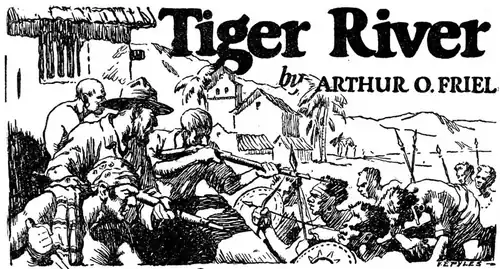
The first part of the story briefly retold in story form.
DEEP in the South American jungle on the banks of the upper Amazon, José Martinez, outlaw, camped and meditated his troubles. Suddenly he was startled by a voice from across the water; and as he waited, a river-canoe, containing twelve native paddlers and four white men, approached. With a shout of recognition José welcomed the white travelers.
“It's the Señor Tim Ryan,” he cried.
The other three were McKay, Knowlton and Rand—all his old friends from North America. They informed José that they were in search of gold and asked him to join them. He accepted and told them of the rich prospect in the little-known region of the Tigre Yacu, a branch of the Amazon—and immediately they were fired to go.
They set about procuring three small canoes at a native town a short way down the river, and got rid of their large boat. After a quarrel with a Moyamba trader there—an incident which promised to brew trouble later on—they started out anew and soon were well into the savage territory of the head-hunters.
As they were making camp one evening Knowlton and Rand volunteered to go into the jungle to fetch some game. They had just succeeded in bagging two ducks when a fierce storm came up, and the two sought refuge in the hollow of an enormous tree. Just as Rand reached the shelter, a savage leaped upon him, and the two fell fighting. A bolt of lightning crashed, and Knowlton, who had not yet entered, saw the tree topple, imprisoning his friend and the strange assailant. The next moment he himself was knocked unconscious and pinned down by a falling branch.
Later, the rest of the party, searching for their missing companions, came upon the helpless Knowlton and rescued him from two prowling tigres. Rand proved to he unhurt; the man who had attacked him, a white Indian, had been killed by the falling tree.
THE party returned to the river and continued their journey. They presently arrived at a stretch of water, thick with boulders, and were prospecting about for gold when they were surprised by a band of the white Indians and made prisoners. Taken to the native village, they were informed that on the morrow one of the strangers was to die, and it was soon pointed out that Rand was to be the victim. The explorers were then confined in a mud but and left to meditate some plan of escape.
Daubing themselves with powder and red dye, the captives appeared the following morning as men near death with some curious disease. The natives were frightened and fled, and the five friends recovered their possessions and escaped. They located their canoes and were quickly on their way once more.
Realizing the urgent need for a temporary rest, they put in at a sheltered cove and fell to preparing a camp. Suddenly a strange roaring noise filled the air, and they were astonished to see the entire tribe of their late captors running for dear life, pursued by a troop of what proved to be the terrible head-hunters. The white men volunteered to save the fugitives, and with their powerful guns finished off the enemy in short order. Thereupon the native chief wished to show his gratitude by not only adopting his rescuers into the tribe but by having them marry his daughters as well. This the North Americans refused to do; hut José indicated that he was of a different mind.
JOSÉ'S decision brought about a quarrel with the four North Americans, and he took himself off with his newly adopted people, leaving the explorers to continue their trip alone.
The party then left the river and traveled a difficult jungle trail, haunted day and night by mysterious “Things” which did not show themselves until the white men one afternoon were brought up short at the edge of a great chasm in the wilderness. The creatures—green-skinned natives, they proved to be—came out of hiding and forced the strangers to descend over the cliff.
The explorers found a perilous path down and, reaching the valley, proceeded to a curious-looking building there, from which they heard the sound of a bell ringing. They reached the place when night was advanced and were surprized to be welcomed by a strange woman and her attendants. They were given wine for refreshment and were on the point of drinking when McKay, growing suspicious, snapped to his friends:
“Don't drink it, fellows! It's doped!”
At the same time the visitors heard a low, muttering sound outside the walls, then yells and gunshots. With a bound the men leaped to their rifles.
CHAPTER XXIV
Lost Souls
“ SANTO DIOS!” screamed Flora Almagro. “Las bestias—the beasts are out!”
If the fighting creatures outside were animals, then they were animals with the voices of men. They yelled, screeched, howled in a bedlam of blows and crashes punctuated by the recurrent rifle shots. Yet beneath the human voices sounded a ferocious undertone of bestial grunts and snarls—a fearsome, inarticulate growl more appalling than the death-shrieks momentarily scaling high and breaking off short.
“Where away, cap?” called Tim, gun cocked and pistol loosened for a quick draw.
“Stay here!” snapped McKay. “Back behind the table! Heave it over!”
“That's the stuff,” approved Knowlton, glancing at the high wall-slits. From the outside no man could shoot through those openings, nor could any creature larger than a house-cat squeeze in at them. With the wall at their backs, the massive table as a bulwark, and only two entrances, they could hold this strong room against all comers until their ammunition ran out—and even longer, with their machetes.
They leaped around the table, tugged at one edge, swung it up and let its heavy top slam down with a crushing thump. The gold bowl and cups clanged on the floor, the liquor splashing on the purple dress of the woman and the bare legs of the girls.
“Here!” ordered the captain, pointing.
Flora, her poniard gleaming, dashed around the table and sought to get behind them. The Indian girls followed with less speed—in fact, they seemed unafraid and kept looking at the doors.
“No, madam,” McKay said somberly. “You do not stand at our backs with that knife. Over there, if you please—farther along.”
“Cristo!” she spat. “You think me an asesino—a cutthroat? You would let them kill me”
“We let no man kill you. But we know what was in the wine!”
It was a snap shot, but it scored. Her face blanched, her eyes and mouth opened, and she slipped away from him, poniard up in a position of defense.
“Over there!” he repeated inexorably, pointing again. “And stay there!”
Several feet away, still staring at his bleak face, she stopped where he had designated—protected by the upturned table, but beyond reach of any of her defenders. Still farther on, the daughters of Pachac clustered well away from her, and in their faces now plainly showed sullen hatred of the woman they had served.
“Lights out along here!” commanded McKay, knocking a lamp from its bracket with his rifle-muzzle. The others threw the lights nearest them to the floor and trampled on the oil which splashed out, killing the flame. That side of the room now was very dim, while the two entrances were well illumined.
Two nude figures came slipping in at the farther doorway. Four rifles darted to an aim. But they sank without a shot. The pair were women—daughters of Pachac.
At sight of them Flora Almagro hissed like a cat.
“You devils!” she screamed. “You, you freed the beasts! You opened the gates! When they are driven back I kill you!”
Whether the girls understood the Spanish words or not, they evidently recognized the accusation and cared nothing for the threat. Their lips curled and their heads lifted in a defiant gesture worthy of their maddened mistress herself. Tauntingly one pointed toward the infernal tumult outside. The other flashed her teeth in a triumphant smile. Obviously they were not only guilty but proud of it.
Infuriated by their insolence, she sprang at them with dagger uplifted, forgetful of the shoulder-high table-top intervening. She collided with the solid barrier so forcibly that the blow crumpled her gasping to the floor. The Indian girls near her surged forward.
But, sensing the menace from those whom so recently she had threatened, she closed a hand again over the weapon and lifted its point against them. They paused, hesitated, hung back. Holding them off with gleaming blade and blazing eyes, she hitched back to the wall and leaned against it, struggling to regain her breath.
Outside the conflict was advancing under the unglassed slits serving as windows, ventilators, and loop-holes. The gunshots had dwindled to an occasional blunt roar, and those inside heard more clearly the impacts of blows, the gasping grunts of close-locked antagonists, the moans of wounded and dying. Thus far no man had entered the house. A stubborn hand-to-hand battle evidently was going on, with one side slowly gaining ground. Through the turmoil sounded a hoarse voice exhorting:
“At them, camaradas! Over them, esclavos! Kill! Kill! Butcher the accursed atormentadores—the torturers! Strike! Bite! Crush their skulls! Kill! Kill!”
Rand, after scanning the hollow embrasure of a slit above him, clambered up to its firing-step and leaned into the opening, peering down. Out there in the moonlight he saw wrenching, wrestling figures heaving about in mortal combat—naked arms and knotted fists clutching clubs, rising and battering down—shaggy heads and hulking shoulders hurling themselves past at some foe just beyond—distorted, red-smeared faces falling backward in death—the flare of a discharging rifle.
Over the fighting forms hung a haze of dust and powder-smoke, and from them rose the rank odor of bodies long unwashed. Yet, despite the blur, despite the animal smell, the peering man in the wall was sure some of those battling bodies were white.
This was no Jivero attack. It was an eruption within the walls of the fortress itself. In Rand's mind burned the word he had just heard from the throat of that unseen leader—esclavos—slaves.
It came again, from almost under him, that savage voice, that same word.
“Hah! El capataz de esclavos—the slave-driver—the foreman! Welcome, señor—welcome to death and hell!”
Back into Rand's range of vision reeled a stocky, brutal-visaged Indian, a rifle clutched aloft in his fists. He struck downward. The gun was torn from his grip. A long, lean white body, topped by a black-bearded face split in a grin of hate, leaped into view, swinging down the captured gun with terrific power. The crunching thud of the blow sounded above the rest of the tumult. The Indian capataz collapsed, his head a red ruin.
“Hah!” croaked the deadly voice again. “How do you like my blow, you fiend? On, camaradas! They break! On to the doors!”
In another bound he was gone. So swift had been his movements that the watcher's brain retained only a fleeting memory of black hair and grinning teeth. Before his eyes now passed a surging hurly-burly of other black heads, upshooting arms, lurching bodies—
“Dave!” crackled McKay's voice.
At the same instant came a struggling, thumping noise from the outer door. Rand jumped down and took his place in the line.
Bump — bump — bump — a grinding creak—another struggling sound. Then that hoarse voice again.
“So, you pig! You would block the door, hah? You hug the wood, hah? Then hang your brains on it to show your love for it!”
Another bump, followed by the thud of a falling body. Hoarse breathing, the slap of bare feet in the corridor, and a triumphant yell.
“Now for that cat who steals the brains of men! Now for that seductora! Let her drink her own brew and— Por Dios, what is this?”
Into the room bounded the lean killer of the capataz de esclavos, followed close by his naked fighting mates. At sight of the upturned table, the four grim figures behind it, and the gun-muzzles grinning at him, he halted in his tracks. Slit-eyed he peered into the dimness along that farther wall, and his jaw dropped. At the same instant four trigger-fingers slacked their tension, and across the faces of the Americans darted the light of recognition.
“Begorry, it's Hozy!” rumbled Tim.
José it was. But not the same José whom they had last seen. He was naked as any wild man of the jungle—naked as the men pressing in at his back, none of whom had a rag of clothing save a narrow loin-clout. His black hair and beard, which he had always kept scrupulously clean, now were dingy and matted with dirt, and half his face was smeared red from a gash on his forehead. But despite his dirt and blood, notwithstanding his loss of clothing and kerchief and machete and knife, there was no mistaking his hawk face and his tigerish poise. And behind him showed the saturnine countenance of Pachac, his adopted father.
“Ho! It is the Señor Tim and— But quick, my friends, tell me! You have not eaten food given you by that woman Almagro—where is that foul corrupter?—you have not drunk of her cheer? Quick, señores, before it becomes too late!”
“Only some guayusa,” answered Knowlton. “Make that gang of yours keep back!”
Without turning his head, José ripped out commands in Spanish and some Indian tongue. The men behind, who had been shoving to get past, stood still.
“And you feel alert, amigos? You feel no heaviness coming on you? No?”
“No.”
“Bueno! Then you are safe. But lower the guns, friends—these are no enemies of yours. They are poor creatures much abused, who at last break free from the vilest slavery ever laid on men. All they now seek is the cruel cat who made them what they are. Si, and I too hunt her! Where is she?”
Knowlton, glancing sidelong toward Flora, found her still on the floor below the table-top. But she was no longer leaning against the wall. Crouching, her poniard still lifted and menacing, she was creeping closer to the wooden bulwark between her and her foes, hiding from them and darting looks here and there like a cornered wild thing seeking a line of escape and finding none.
“Why?” curtly demanded McKay.
“Why?” echoed the naked outlaw, his voice strident. “Why? Use your eyes, Captain McKay, and see why! See what you too would have been tomorrow!”
He turned on his heel and grunted monosyllables at those behind. Then he walked before them to the middle of the room, eyed the still ready rifles and the hard faces above them, laughed harshly, and drew an imaginary dead-line with one extended toe. Turning again, he extended his arms sidewise as a sign to his followers that none should advance beyond that line. Over one shoulder he jeered:
“Look at them, capitan—and see yourself in them! Are they not handsome?”
The captain and his companions looked. They saw men whom they recognized as members of the band of Pachac. They saw others, both white and brown, whose faces were new. And in those visages they found something that sent a chill crawling up their backs.
 MANY of those faces still were working with blood-lust, many of the savage eyes were hot with unquenched thirst for revenge. But they were brutish, those countenances—the faces of men debased; and the eyes were those of animals—of dogs, of pigs, but not of men. Some of them were grimacing like caged lions; some grinned without mirth; more were sullen; and all, or nearly all, were well-nigh empty of human intelligence. Behind those leering masks dwelt darkened minds, which responded to the commands of José only as the mentalities of broken beasts respond to the crack of a whip.
Bestias, the woman had called them, and bestias they were. For that Spanish word means, not only “beast,” but “idiot.” These men were both.
Nor was that all. On the bare bodies shifting about were welts of slave-whips—not only welts, but cruel scars years old. And among them moved some which stepped jerkily, as if partly crippled. As those short-stepping men came to the edge, where the lights struck them fair, the reason for their grotesque gait was revealed. Like Rafael Gonzales, who had stumbled into Iquitos with madman's gold; like the unknown mestizo speared in the back on the ridge trail, those men were maimed—then toes amputated. And each of the cripples was white.
“Si, look at them!” mocked José again. “Look at the missing men of the Tigre Yacu! Here they are, all but those who have died by torture and suicide and the fight this night. Look at the faces of men who were as brave and quick of wit as any of you señores! Look at the bodies that dared all hardships to find such a fate! Look at the feet that carried them through barbaros and tigres and snakes—to this! Hah! And ask again why we hunt the mujer de mal who did this thing!”
Once more he faced the four who had been his partners. His voice sank to a low, deadly level. His eyes roved from man to man, glittering with ruthless determination.
“Señores, you have been my friends. All—except perhaps you, McKay—still are my friends, if you wish. But we will have that woman, whether you protect her or not. If you try to block us we fight—and you die. In spite of your guns, your pistols, your many bullets, your steel—you die. We are too many and too near, and you cannot get us all before you go under. And if you die so, you die as quijotes, as fools.
“I cannot hold these tortured men from their vengeance on her if I would. And I will not try. We will avenge ourselves, and we will do it now. Decide quickly what you will do.”
Every man of the four knew he spoke the cold truth. If his implacable tone had not driven home his inflexible decision, the sight of those lowering faces behind him would have confirmed it to the last degree. Yet the woman was a woman; they were white men; and they would not hand over any woman, no matter what she might have done, to such a mob as that.
There was a tense pause. Then the outlaw's mouth twisted in a mirthless smile. He shifted his gaze toward his wives and their sisters, bunched, behind the table and watching the parley without fear but with spellbound interest. He studied the gap between them and Knowlton, who was Number Four in the defensive line. He glanced at the girls. In answer to his unspoken question, one of them pointed downward at the hidden woman.
“So!” he said. “She is there, hiding her cowardly body, as I thought. Shoot if you will, you who were my friends. I go to whisper sweet words in her ear.”
He dropped the rifle captured from the capataz, which he had been holding as a club. Empty-handed, he strode toward the spot where the woman crouched.
But he had no need to lean over the bulwark and look for her. As he lifted a foot for the last step she sprang up.
“Si! I am here, pig,” she screamed. “Take me—and take this with me!”
Like a striking snake she threw herself at him. Her poniard thrust for his throat.
Then it was that the outlaw's quickness, which more than once in the past had preserved his life, saved him once more. Swift as was her stab, his recoil was a shade swifter. In one backward leap he was four feet away, grinning like a snarling jungle-cat. She fell forward on the upturned table-edge, balked by the wood wall that had hidden her.
But hardly had she touched it when, with another lightning movement, she threw herself up and back on her feet. Her eyes blazed with insane fires.
“Live, then, animal!” she shrieked. “Here is one well-beloved, who goes to death with me!”
Like a flash she turned and sprang at Knowlton, her Señor Gold-Hair. Her upraised dagger darted for his heart.
“Come, my golden one—” she panted as she struck.
Instinctively the ex-lieutenant sidestepped and snapped his rifle upward in a parry. The barrel caught her wrist and blocked its slanting swoop. In the next flashing instant she was seized from behind and hurled down.
The wives of José, daughters of a fighting chief who belted his waist with the hair of his foes, had leaped. Maddened by the stab at their man, they were jumping forward even as she hurtled at Knowlton. Now they were on her like tigresses, tearing at her face, twisting the poniard from her hand. Screams of hate echoed in the room.
As José and his band hurled themselves at the table, as the Americans surged forward, something bright and keen rose out of the knot of struggling women. Like a lightning flash it fell.
Slowly, still quivering with rage, the daughters of Pachac arose and stepped back.
Flora, the last of the Almagros, the jungle Circe who changed men to beasts with her terrible drink, the enslaver of the missing men of the Tigre Yacu, lay still, her own dagger buried to the hilt in her breast.
CHAPTER XXV
The Devil's Brew
FOR a long minute the big room of purple and gold was still. In the silence the only sounds were the breathing of men and the soft flutter of flames blown about in the gold lamps by a breeze stealing in at the loop-holes.
Then three groups again became conscious of one another. The Americans looked up at the Indian girls whose explosion of fury had swept their tyrant into death. Then both men and women faced toward the staring creatures now hanging over the edge of the table.
Vague though the minds of those lost men might be, they had no difficulty in grasping what they saw. Violent death being as old as life itself, perception and understanding of it is instinctive in all creatures. And those men still possessed eyes to see and instinct to interpret. Gazing down at the motionless figure, the blanched face, and the sinister handle jutting from the still bosom, they gradually drew back and let their clouded eyes rove among the gold vessels bestrewing the floor. The fight was done, the enemy dead, and their groping brains already were forgetful of it all.
One among them, besides José, seemed more alert—grim old Pachac, whose gaze rested watchfully on the Americans. Yet his face was hard set, as if it were an effort to concentrate his attention and hold it unwavering. The blight on the minds of the rest evidently had touched his also, but lightly. Among the whole crew the only one retaining full mental vigor was the indomitable son of the Conquistadores, José Martinez.
Now that outlaw did a strange thing. Over the body of the woman whom he had just sought in implacable vengefulness, over the poniard which had licked out at his throat a few minutes ago, he made the sign of the cross.
“Sea como Dios quiera,” he said soberly. “As God wills, so let it be.”
But there was no hint of regret or forgiveness in his tone, or in the face he turned first to his followers and then to his erstwhile partners of the Tigre Yacu.
The Americans had let their guns sink while they looked down on the woman. They did not lift them again. With the butts grounded, they looked pityingly at the hulking wrecks of manhood beyond the barrier.
Even McKay's iron face showed his feeling for those poor creatures, tortured, maimed, darkened in mind. For the moment he had forgotten José. And José, studying him, suddenly stepped toward him.
“Capitan,” he said impulsively, “I have been a hot-headed fool.”
McKay's gray eyes met his. McKay's set mouth softened.
“And I, José, have been a bull-headed jackass.”
Their right hands shot across the barrier and gripped hard.
“That is a queer animal, capitan—a burro with a bull head,” grinned the Peruvian. “And it has no right to live. So let it not come between us again.”
“It won't.”
The hands parted. Both men looked again at the human herd, and down at the quiet woman on the floor.
“Does this end it, José?” asked Rand, nodding down at her.
“This ends it, comrades. Unless some of those slave-driving Indios outside escaped—and I do not think it—this whole nest of devils is cleaned. Now we have more cleaning to do; to clean this room and the yard and ourselves. Whether we can clean the minds of these poor people I do not know, but we can clean our bodies, and it shall be done. Then there will be a tale to tell.”
“Then let's be at it,” said Knowlton, wrinkling his nose at the rank smell filling the room. “You clean up outside, and we'll fix up here. And for humanity's sake give this crowd a bath.”
“It is not their fault, Señor Knowlton. Wait until you have seen the sty they were forced to herd in, poor devils! Si, and I with them—I am one of them, except that my brain is clear. And that it is clear I owe not to myself but to Huarma, one of my brides—the tallest one, yonder. But of that you shall hear.”
He touched Pachac on the shoulder and muttered something. The chief's face relaxed, as if it were a relief to have no longer to try to think, and he turned docilely to follow the lead of his stalwart foster-son. José's voice began to snap in commands, and his hand pointed toward the corridor. At once the listless, aimless crowd became alive and began to press out of the room. The Peruvian followed them up, rounding up stragglers, knocking a gold cup out of one man's hand, shaking to his feet another, who had lain down on the floor and closed his eyes. Last of all, he and Pachac passed out side by side.
The Indian girls had drawn away from the table now and stood grouped at the rear doorway, seeming a little afraid of the bearded men but not in the least awed by the realization of what they had done to their mistress. The Americans gave them no further attention.
Leaning their guns against the wall, they moved out the table and swung it back on its legs. Rand and Tim stooped and lifted the quiet form from the floor. Up on the board they laid her, and just below the hilt of the poniard they crossed the hands which had sought to wield it in death-strokes when, brought to bay by the beasts she had made, she had thought to take with her the leader of the pack or the stranger on whom her sensuous fancy had settled.
Then, moving about the room, the four gathered up the scattered cups and ornaments and the big bowl which, with its venomed liquor, had been thrown over by the upturning of the table. These they placed around her, the bowl inverted at her head, the cups and heavy ornaments down the sides in gleaming array. When this was done they pulled from the wall a long section of the achote-dyed hangings, and this they stretched along over the table-top. Then they picked up their rifles again and moved over toward the door.
What they could do they had done. On the dim side of the room the last of the Almagros now rested under a purple shroud, surrounded by the gold with which she had sought to betray four more men into hopeless misery worse than death. And the men, keenly alert, were masters of her house and about to explore its secrets.
McKay paused and glanced around. Then he decided—
“Better leave one man here.”
“What for?” wondered Knowlton. “Nothing to guard against in this room.”
“Maybe. But Indians are Indians—a knife is a knife—gold is gold.”
Rand nodded. The girls still stood as if waiting for them to withdraw. And the captain was determined that there should be no pilfering from that shrouded table.
“I'll stay,” he volunteered. “Go ahead.”
He stepped back to the couch and sat down. The others lifted lamps from the brackets and went out.
In the corridor they found the big double entrance-door standing wide, gaping vacantly at the moonlit yard, whence sounded the shuffle of bare feet and occasional orders from José. Along the passage other doors, all closed, showed in the soft lamplight. Nowhere was any staircase. The living quarters in this broad, low house were all on one floor.
McKay flung open the nearest door, advanced his lamp, and looked around. Then he stepped back.
“This is her room,” he said. “Bring her in here.”
The other pair complied. Back to the table they went, and slowly they returned, bearing with them the shrouded figure. While the captain lighted the way they took her to a great canopied bed and laid her down. Then they drew the purple curtains and left her in her last sleep.
Though they glanced around the room, they did not finger. Their roving eyes took in the fines of the high bed, various massive articles of furniture evidently built from some cabinet-wood cut in the surrounding jungle, a number of old tapestries about the walls, and numerous gold ornaments carelessly strewn about on stands and drawer-chests. There was no sign of occupancy of the room by any person other than the woman who now lay there.
Passing out, they shut the door firmly behind them and looked steadily at the Indian girls, who had come into the corridor. Then McKay addressed Rand, who had followed them.
“All right, Dave. Come along. This shut door is all the guard needed here.”
He judged rightly. As he and his companions turned down the hall the girls moved to the outer entrance. Covet the shining trinkets though they might, they would not venture to open that portal beyond which waited darkness and death.
 FROM room to room the men worked their way, wrestling with doors which stubbornly resisted, though none had a lock to hold it barred against inspection. Each time, after shoving and prying the wooden barrier open, they found that the difficulty was due to the sagging or warping of the door, indicating long disuse. And each time when they penetrated it they found the room musty and dingy, its furnishings mouldy and its weapons—for there were old weapons in some of them—coated thick with rust and spider-webs.
Bats veered out into the corridor or swirled around the walls, and countless shells of long-dead beetles and other insects crackled under foot. Everything told the same tale: Here once had lived a large family which now was gone.
Not all the rooms, however, were so hard of access or filled with decay. A few showed signs of fairly recent tenancy, and one wide chamber obviously formed the quarters of the daughters of Pachac. Except this one, however, none gave indications that it was still being used for sleeping purposes. The others seemed to be occasional guest-rooms. The eyes of the explorers narrowed as they surmised where the “guests” had gone.
At length they found themselves in a lighted room undoubtedly used as the kitchen. There, among other things, they found the gold bowl which still held guayusa, now cooled, and a long stout shelf filled with tall square-sided clay bottles, tightly corked with wooden plugs. One of these had been taken from the shelf and stood beside the bowl. Lifting and shaking it, Rand heard the tell-tale gurgle showing that some of its contents had been poured out. Its plug came out easily—in fact, it still was damp. He poured some of the liquid into one hand.
“Looks like tea,” he said.
“Sleep-tea, undoubtedly,” Knowlton suggested.
“Yeah,” agreed Tim. “That there's the knockout stuff that kills yer brains, I bet. Gee, lookit the line-up of it on the shelf, will ye? Looks like a jungle blind tiger, with the clay bottles and all. She kept enough on hand to make a hundred idjuts a day, if it works quick.”
“Must work quick,” McKay declared. “Pachac's people haven't been here long. And look at them now.”
“Wonder what became of the women and children,” said Rand. “We've seen only men.”
“I'm wondering about quite a number of things,” added Knowlton. “José will straighten things up, perhaps. Come on, let's find him.”
Passing through a smaller room, which seemed to have been recently used for lounging and dining, they entered again the great main hall where they had been entertained. It was empty of life. As they stepped into the corridor, intending to leave the house and explore the yards, the lean figure of José stalked in at the moonlit doorway. Behind him came Pachac, and after them more of the brainless crew swung into sight.
“Ha, amigos! At last José is himself again—without a shirt or a knife, it is true, but clean white from hair to heel. Por Dios, what a difference water makes in a man! And all this crowd behind have become men instead of pigs, though it took much scrubbing. Now the women have been set free and take their turn at the bath. What have you found here? You have searched, yes?”
“Nothing but rust and spider-webs—and bottles of brain-killer,” Knowlton told him.
“That broth—it shall be thrown over the walls! But come, let us sit—and, por amor de Dios, give me a cigaret! I have had no smoke for years.”
They entered the big room, where even as he snatched the proffered tobacco and papers, he glanced about in search for Flora Almagro. Rand pointed a thumb backward across the hall. José nodded.
“Years?” echoed McKay.
“Years, capitan. Time is measured by life, not by suns. A man may live years in a week, or only a week in years. Is it not true? And I have been in this place for years, though it is hardly two weeks since I came. Ah-h-h!”
He gulped smoke into his lungs and exhaled rapturously.
Behind him the brown and the white men who had been slaves came sifting into the room. As their leader said, they once more we men, clean from scalp to sole, their skins glowing from the strenuous ablutions they had given themselves; and somehow they seemed to stand the straighter now, to look a little more alive, as if that bathing had refreshed brain as well as body. Yet, though no longer driven beasts, one glance at them showed that their minds still were fettered in a black bondage.
As they pressed in and spread out like an aimlessly flowing stream, the five reunited partners watched them soberly. José sadly shook his head.
“My people,” he said. “The people who followed me into this, as well as those who came before me. And you, too, señores, would have been spared much if you had never joined José Martinez at the mouth of the Tigre Yacu. I have a heavy task before me, friends—to clean the minds of these men as I have cleaned their bodies. I hope it can be done, but only my wife Huarma can do it.”
“How?” puzzled Knowlton.
“She is wise in the ways of herbs and drugs, señor. Though very young, she is the medicine-woman of her people. And what one evil leaf has done, another good leaf may undo. We shall see.”
“You mean to say that all these men were robbed of their brains by a jungle herb?” demanded Rand.
“I do, Señor Dave. You have heard of the floripondio?”
Blank faces answered him.
“You have not. Be thankful that you have none of it within you now. If you had, you soon would know more of it than words can tell you.
“I am not a medico or a droguero—one skilled in drugs—but I know of that devil-weed, for I have heard of it from men of the Napo country. Up that Rio Napo—and in other places too, no doubt—it is sometimes given a man by his woman when she tires of him and wants another; and he becomes an imbecile who will be the slave of that woman and of her new love, not knowing what he does.
“It is steeped like a tea, señores, that is all; made like the guayusa. But where the guayusa drives weariness from the most tired man and makes him keen, the floripondio deadens the brain of the strongest. Put into food or drink, it soon does its deadly work without the man knowing what is paralyzing his mind. Then he is lost.
“So, friends, that is the reason why the missing men of the Tigre have not come back. That is the reason why you now see these who are before you turned to animals. Only a little leaf of the jungle, plucked and put into water—cooked over the same fire that warms innocent food—and then used by human fiends to wreck the reason of men!”
CHAPTER XXVI
Fantom Treasure
THE missing men of the Tigre and their new comrades in misfortune, the men of Pachac, stood for a time looking dully about them. Then, as if by simultaneous tacit consent, they lay down on the floor and disposed themselves for rest. Uncovered, unbedded, they relaxed and closed their eyes like men long inured to nothing better. Only Pachac himself still stood, pathetically dependent on the brain of his new son.
“Tired, yes,” nodded José. “They have worked under the lash since sunrise, they have fought hard tonight. So have I. But my mind is not burdened like theirs, and it will not yet allow me to rest. Let us sit, comrades, and”
A fresh padding of feet in the corridor interrupted him. In at the door flocked women and children, led by the daughters of the chief; the weaker portion of the white Indian tribe. Scanning them, the five partners saw at once that the curse of the floripondio had not been put on their minds. Their eyes darted eagerly about in search for husbands, brothers, fathers. Having found their men, they ran to them; then sank silently down at their sides without disturbing their rest.
The outlaw's somber face lightened.
“That will help much,” he declared. “With the women to follow the orders of Huarma and care for their men, much may be done. I have not seen them since the accursed drug was put on us, and I feared they too were darkened in mind.”
He spoke to the tallest of his brides—the one who, he had said, was Huarma the medicine-woman. With dignity worthy of her father, yet with due deference to her hawk-faced lord, she responded. He nodded again.
“The women and children,” he explained, “have been used as slaves on the plantation, which lies back among the trees to the west. The woman Almagro thought it not worth her trouble to drug them—she knew they dared not try to escape without their men. Is it not true, señores, that human fiends always are tripped at last by something they have left undone? If that woman had not held in contempt the women of Pachac, and in particular the daughters of Pachac, we should not now be here, nor would she be lying dead across the corredor. But now that we are all together once more, let us speak of what has been and of what may be.”
He dropped his cigaret-stub, eyed the table, and, with a grin, strode to it. Shoving the big upturned bowl to the middle of the board, he swung himself up and squatted on its broad yellow base. Then he beckoned with both hands to his wives and their sisters and father. Laughingly the girls approached and ranged themselves along the table-edge, placing their parent in the middle. The Americans smiled as they contemplated the scene.
“Begorry, Hozy ol'-timer,” grinned Tim, "ye look like a baboon king—naw, that ain't the word”
“Barbarian,” chuckled Rand.

THE LAND OF THE HEADHUNTERS
“Yeah. Jest what a barbarian king is I dunno, but Hozy's one.” The metaphor was not bad. Seated on a golden throne, with his foster-father at his feet staring owlishly outward; with his comely women lined at his sides and his people prostrate before him; with the royal purple lining the walls of the spacious hall, the bare-flamed gold lamps glowing, and the jungle moon slanting its white beams in at the narrow openings behind—José Martinez, man without a country, naked and fiercely bearded, looked to be the truculent ruler of some forgotten kingdom resurrected from prehistoric
And here in this untamed land, where the rise and fall of nations and the passage of centuries meant nothing at all, he truly was a king; for in his sinewy hand rested whatever power existed.
Now his gaunt face cracked wide, and he seized an empty gold cup and held it aloft in a grotesquely dramatic gesture.
“Dios guarde al rey!” he cackled. “God save the king! But of what good is it to be king when one can not drink his own health? Tomorrow, my ambassadors from North America, we must search our royal cellar for wine not doctored. Then our treasure shall be doubled, for if we drink enough we can see two bars of gold where only one was. Hah!”
“What's that? Bars of gold? Where?” demanded McKay.
“Where? Where but here, capitan? Why do you think all these men have been held slaves, robbed of brains, driven with whips? For what, but to work in the mine?”
“Great guns! You mean that? What mine?”
“The mine of gold in the mountain to the rear. Si! Gold! The gold of mad Rafael Gonzales! Hah! You are astonished, yes? You believed, as I did, the wail of the woman that the mine was destroyed? She sang you that same song, and you have not had time to think why these men were”
He stopped short and sprang up, suddenly pale. The others too, except the sleeping men, lost color and staggered. The solid floor had quivered under them.
From the cordon of mountains outside sounded a low rumbling growl. Again the floor shuddered slightly. Then all was still.
“Once more the temblor!” breathed José, his eyes darting about the walls. “Once more the ground shivers. But it is past—until it comes again. And these solid old walls have stood worse shocks, no doubt. Let us forget it.”
Yet the gleam was gone from his eye and the ring from his voice as he went on, and the sudden fire that had swept the veins of the Americans at the magic words “gold mine” had as swiftly cooled. Each felt the hand of an awful power hovering over the house, able, at its brute whim, to crush it and its occupants into jumbled stones and mangled corpses.
“Gold is here, amigos,” said José. “And it is ours. But let us start at the beginning. First tell me how you came here, and what happened before and after.”
 HE SAT on his yellow throne, and the four disposed themselves as comfortably as might be on the long couch. To stand would not help them if another quake came.
Briefly Knowlton detailed the happenings since José had turned his back on them at the lake of the burning sands. As the minutes passed and no further sound came from the mountains all forgot the recent ground-tremble. And when the tale was done the Peruvian's face again was alight with interest.
“So that was the heavy blow we earth-rats felt this afternoon—the falling of the trail along the cliff. We felt the temblor too, down there in our hole—si, it sickened us!—but what the blow meant we did not know. Nor did I know, until this moment, of that shelf along the rock; we came in by another way.”
“Then there's a way out?”
“There is one—there may be others. We shall see. But when the rains fall hard, as they will soon, that way will be closed. We came in here, señores, through the ground!
“Si, es verdad. It is true. My father Pachac knew that way, and told me of no other. We came as he directed. We left the path at a watery ravine, going up in the water and killing our trail. And after wading far we followed Pachac, who went over the hills to more water, and so here.
“If you looked about you today, you must have seen that this place is a gulf among mountains. And if it had no outlet, when the rains came they would fill it up, and it would be a lake. Yet it is dry and firm—why? Because at one place near its middle there is a hole, and that hole runs away under the earth to the other side of a mountain to the south, and through it all the rain-streams run out. It has not much water now, and we came in along its bed without much trouble—though it was a long, black journey, and I had to club snakes to death as I advanced.”
Thus the mystery of the vanishing trail of Pachac and his people was explained. The Americans made no comment. José went on.
“Now this is the tale of this place, and of the family of Almagro, as my Padre Pachac knows it:
“Long ago, before Pachac was born, and while his father's father was a very young warrior, there came from somewhere to the north a band of hard-fighting men who seemed all of the same family. They came as if seeking a place where they would not be found by some one or something they had left behind them—not fleeing, but always watching toward the rear. And they brought, besides themselves, their women and slaves—white women and Indian workers—the woman dressed and armed like men, and the Indians carrying burdens.
“They found this gulf among the mountains, which then was much easier to enter than now, for into it led a narrow twisting cañon. And they had no more than come into it when they spied gold—a yellow splash of it on the side of bare rock, plain to any eye. So here they stayed.
“Not long after they came, another band, much bigger, without women, also came from the north as if hunting them. But the heavy rains were now beginning, and the waters rushing from every side not only swept away all trace of the Almagro trail but discouraged and drove away the pursuers. They never returned.
“The Almagro family made their Indians work on the walls and on the gold. They were hard masters, and the Indians died out. Then the white men went out into the jungle round about, and with their guns they killed chiefs and made slaves of their people. These too they worked to death in their mine—men and women and children, all were driven like cattle until they died.
“This went on for years, and much gold was taken out, but the family stayed on. The older Almagros died, and the younger ones also grew old and died; but the gold still was there. Earthquakes came and closed up the entrance cañon and wrecked the mine; but they opened up their gold-hole again and kept burrowing. Yet, the more gold they got, the slower the work went and the weaker they grew.
“Two things made this so: They could not get enough Indians now, because the Indians either moved too far away or were too strong for them; and they would not mate with Indians and keep their family big. They mated among themselves, brother with sister, and most of the children died young or were dull of brain. Some were killed by Indians, some by earthquakes, some by snakes or other jungle things. The family grew very small—too small to be able to leave the place. They knew the Jiveros would get them.
“Then, from trying to enslave Indians by force, they began buying prisoners from those Indians. With the Jiveros they could do nothing, but with other Indians they arranged trades. Whatever prisoners they could buy they took, paying with gold, which the Indians could trade out by crossing the Curaray and then journeying down to the Napo.
“Pachac, and his father before him, knew of this trade in prisoners, but had nothing to do with it. They were wanderers, lived too far down the Tigre to make the trade profitable, did not want white men's goods, and would rather kill their enemies than sell them. But when Pachac's half-Spanish son grew up he had different ideas. He wanted white men's guns and cartridges, and Pachac let him keep prisoners and send them here. So that, amigos, is what was meant when we were told we should go to the wheel.”
“What is the wheel?” queried Rand.
“It is a thing made to crush ore, and a man-killer. In some ways it is like the trapiche sugar-mill used in the Andes, which is worked by cattle going around and around. Here men are the cattle. Many a poor slave must have worn out his life on the infernal thing.”
“What's that big bell outside for?” Knowlton asked.
“What is was used for at first, or where it came from, I can not tell you. I know only the tale as it is told me by Pachac. But now it has been used to call in the men from the mine. I suppose that if an Indian attack should come it would be rung at any time, but since I have been here it has rung only at night, after a day without end—a day of horrible toil.
“We were herded in a foul pen behind here, with stout gates which no man could pass. The pen opens into a walled passage leading into the mine. A rotten breakfast at daybreak—a day of torture under the whips of those unfeeling Zaparo brutes we killed tonight—another rotten meal after dark—a night sleeping on the filthy stones of our pen—then back to more labor. That is the life here.
“Men who have tried to escape were maimed so that they were not likely to travel far again—the toes cut off. Some of them now lie here in this room. One—Rafael Gonzales—reached Iquitos, as you know. And you say another was killed by green men above? So some did try again—perhaps the floripondio was weak at times and men grew cunning and desperate for a while.
“But I think that accursed drug was put in the food at certain times to keep the men always dull of brain. I think, too, that the use of it was an idea of the woman Flora and not of her father—though I do not know that to be so. But Huarma, my wife, saw that mujer de mal putting it into food after we men had been sent to the pen, so I know it was given us at times.”
“How come ye to dodge it?” Tim wondered.
“I did not dodge it, Señor Tim. The woman betrayed us all. We knew nothing of her brew, and when she received us in friendly manner and gave us food and drink we took it gladly—and awoke in the morning unable to think and covered by the guns of those slave-drivers—guns taken from men who had won through to this place before us and then been made idiots.
“But Huarma, chosen as one of the house-slaves, spied and learned what the thing was that had made us beasts. Then she told women sent to the plantation to find for her a certain herb—I do not know what—it is one of the medicine secrets of her people. This she brought to me at night, with clean food and drink, though she would have died if the guards had caught her. Night after night she came, and my mind grew keen, and our father's dullness too was partly cleared away—she had not enough medicine for us both, and she gave me the best of it. But she warned me to keep playing fool until her chance should come to open our gate and let me lead an attack. Tonight that chance came.”
“A reg'lar he-woman, I'll say!” admired Tim. “But where's all this gold ye tell about?”
José arose, stretching his long arms wide, a triumphant grin lighting his face.
“Come and see, comrades—partners! It is put every noon into a vault—the pure gold which has been melted into bars. The guards alone handle it, but I know where it goes—in at a door in the wall near the mine entrance. There must be a huge room there in the side of the mountain, piled with the gold of four life-times. Come!”
They came. Out into the moonlight, down a yard where the stones still glistened redly and bodies lay piled beside the wall, they followed him. On into a patio where shone a deep pool of water— evidently the bathing-place of the Almagros—and through a ruined gate like that of a prison-yard; across a walled space whose fetid odor told that it was the slave-pen, they strode. There after hauling open another solid gate, they entered a long runway terminating in a black tunnel. At the tunnel-mouth their guide paused.
At his right showed a stout wooden door, set in the wall and heavily barred.
“Hah!” he exulted. “Here lies the treasure of the Almagros! After all their crime and cruelty it goes to a slave, and to his comrades who tomorrow might also have been slaves. If you would use your gold, you Almagros, reach out now from the fuego del infierno where you roast, and snatch it to buy a drop of water from your master the devil! We come to take it from you. Ho, ho, ho!”
He tugged at a bar, which slid with an ease telling of constant use. Eager hands forced the other bars away. The door swung open.
Holding aloft the lamps they had brought, the four stepped in and stared about. For a moment they stood speechless.
“Carramba!” José spat then. “What demon's work is this?”
They saw a stone-walled, stone-roofed, stone-floored cell not more than twenty feet square. They saw nothing else.
The vault was empty.
CHAPTER XXVII
The Head-Hunters
DAYS passed.
Days of work, they were; days of striving to restore the drug-deadened minds of the former slaves to their one-time vigor; days of search for the vanished treasure of the Almagros, of exploration and critical examination of the mine. And each was followed by an evening of discouraged discussion.
Far more success was achieved with minds than with mines. Under the skilful treatment of Huarma the men of Pachac steadily shed the incubus of brain-blight, awaking each morning with clearer eyes and quicker wits.
Pachac himself, whose curative treatment at the hands of his daughter had begun while he still was a fellow-slave of José, now was wholly himself again, though gloomy in spirit because he had lost his most cherished possession—the gruesome girdle woven from the hair of his slain enemies. At some time during his term of bondage it had been cut off him by a brutal guard who found that it served as a protection against whip-blows, and now it could not be found again despite the most persistent search.
But the survivors of the Tigre's missing men, who had been here long before the coming of José and his tribe, showed little response to the ministrations of the youthful medicine-woman. Their brains had been permeated for months, or years, by the terrible floripondio; and it was useless to expect a speedy revival of their mental faculties. True, they seemed a trifle less brutish, and in time they might regain full control of themselves. But for the present they gave little indication that they would ever again be the men they had been.
In view of the fact that most if not all of the white men among them had been dangerous criminals before ever they came up the Tigre, perhaps it was as well for the others that their power to plan and execute violence now was more or less atrophied.
They were kept at work, these witless creatures, both for their own good and for the benefit of the community; but not at their former tasks in the mine. First they and the reviving warriors of Pachac were divided into squads which dug graves on the hillside beyond the walls; and there Flora Almagro and the men of both sides who had fallen on that red night of revolt were buried deep. Then they were turned to cleaning up the house and its yard, making the moldy old rooms again habitable and the former slave-pen fit to traverse. After that the Pachac men were set by their chief at making new weapons, while the others were drawn off to work with the women on the plantation—light labor which gave them the fresh air and clean sunlight of which they had been so long robbed in the gloomy mine-holes.
For the present, the mine was deserted by all except the restless five adventurers, who, after a thorough inspection, also left it and returned to their first search—for the Almagro wealth. Their examination showed that the mine was practically worked out. Some gold yet remained, but what was in sight made the inspectors shake their heads; and the place was so honeycombed with shafts and tunnels as to show that the mountain not only was virtually looted of its treasure but absolutely unsafe to work in. An unusually sharp earth-shock would probably cause it to crumple on itself, crushing the mine into nothing. And, in the past few days, several more slight quakes already had occurred.
Yet the pinching vein of yellow in the mine was all the gold they found. Hunt high, hunt low, not one bar out of the tons which must have come from it could be discovered.
They ransacked house, yards, and even the mine itself for some trace. They pounded walls and floors, listening for hollow sounds. They swam about in the bathing-pool, hunting under water. In only one place did they find sign that gold had ever lain. That was on the stone floor of the vault where, José swore, he had seen bars taken in at noon.
That floor bore out his assertion. Between its stones were many grains of the metal, evidently chipped from the bars by rough edges and corners of the rock. But where it had gone, and how, no man could tell, though all sorts of wild guesses were made.
“By cripes, them dead ones done jest what ye dared 'em to, Hozy,” Tim said sourly one day. “They hopped up off o' their gridirons and yanked the whole layout down to their Winter quarters. Mebbe it's melted by now and they're swimmin' in it.”
José grinned, but with little enjoyment.
“I wish we had saved one of those slave-drivers as a prisoner that night,” he regretted. “He could be made to tell things, perhaps. But then there was neither time nor reason to think of anything but killing. And now—dead men tell no tales.”
They were standing at the tunnel-mouth as they talked, the hot afternoon sun glaring down on one side, the dark empty mine yawning at them on the other. Along the walled passage leading from mine to pen no other figure moved. Somewhere up the yards Pachac and his men were lazily working away at the manufacture of their new weapons. Out on the plantation, well away from the walls, the women and their male assistants were toiling as they pleased. Within the house the chief's daughters were busy at various occupations. For several days even the distant menace of the Jivero signal-drums had been stilled. All was peace. Yet, from force of habit, each of the partners was carrying his gun.
“Well,” said Knowlton, as they turned toward the house, “it doesn't get us anything coming back and mooning around this vault like a bunch of kids who had lost their baseball. The stuff's gone somewhere, and we've looked everywhere. The only thing left is to take this whole place apart stone by stone, and that would use up a few years of time. Guess we'd do better to scout around these hills and locate a new mine.”
“The pot of gold was at the end of the rainbow, but somebody's moved the pot,” nodded Rand. “Or maybe the rainbow's moved. Either way, it's up to us to move also, unless something develops soon.”
He glanced around at the mountain-tops looming beyond the wall. José followed his look.
“I doubt, Señor Dave, if you will find gold anywhere else in this valley,” he said. “Remember, the Almagros were here many years. If more gold were here they would have smelled it out long ago.”
“Sure. But there's a whole cordillera along here for us to browse in. Say, do you keep feeling as if those mountains were watching you—hostile—ready to jump on your back?”
“Always,” the outlaw admitted. “Perhaps those Almagros felt it too, and built these walls more to make them feel safe than to shut out the barbaros.”
“Made 'em thick enough, anyways,” said Tim. “Ye could run a tunnel right through 'em from end to end, and nobody'd ever know 'twas there.”
McKay stopped short. His eye ranged along one of the walls—the one in which the door of that empty vault was set.
“By George!” he exclaimed. “Tim, I'll bet you've hit it. Secret passage in the wall from that vault to—some place under ground, maybe. We'll rip a hole in this wall and find out. What say, José?”
“Por Dios! Capitan,'it may be— But no. We have tested the stones in that vault and found no entrance. Of what use would be a tunnel ending in a solid wall?”
“True. But there's something, somewhere, that we haven't found. I want a breach made in this wall, just to”
“Hark!” Rand cut in.
Across the gulf, thin and high, echoed a scream.
It was the cry of a fear-stricken woman. It came from the direction of the plantation, it swelled from one isolated note of fright to the voices of other women breaking out in mortal terror.
“Demonio!” José cried sharply. “The women of Pachac do not scream unless the devil himself is after them!”
He darted away toward the yards. The other dashed after him.
As they ran they heard the outcries coming nearer. Then the screams died down, the women needing all their breath for running. But from the yards where Pachac and his men lounged now rose a new up roar—a harsh outbreak of surprize and rage. Then, high over all, sounded another appalling note from the plantation.
It was the awful death-yell of a man.
 THROUGH the old slave-pen, through the patio with its quiet pool, and into the yard beside the house ran José and his comrades. That yard now was empty; for Pachac and his warriors had plunged through the big open gate, and their yells of wrathful definance roared outside the walls. José tore on around the corner to join them, his swarthy face contracted into a fighting-mask. But the Americans, with McKay in the lead, lunged straight at the wall.
There rose a crude ladder lashed to the rough scaffolding which they had noticed on their first arrival—one of several short stair-flights by which defenders could man the walls in haste. Up this swarmed the captain and the following three. Hardly had McKay jumped into position against the upper stones when his rifle began to crack. In rapid succession the other guns added their wicked voices in a chorus of death.
Streaming toward them, close at hand now, they saw the panting women throwing themselves up the hill toward safety. Close behind, their light-skinned but paint-streaked faces grinning in mingled ferocity and triumph, bounded warriors of the Jiveros.
The dreaded drums at the west, which a few days ago had muttered back and forth, had not been merely grumbling among themselves over the killing of an ambushed band by the men of Pachac back on the Tigre. The ensuing silence had not meant peace. Now the vengeful killers from the Pastassa were here to gain heads and women and to destroy this stronghold which for generations had repulsed their fathers.
And the big gate was open, nearly all the defenders outside, and their women prizes almost within reach of their clutching hands.
But the hands of those foremost pursuers closed, not on the flying hair or bare shoulders of their prey, but in death-clawings at the ground. From their elevated platform the four gunmen stabbed flame and death downward. From the gate the roar of José's repeater broke out. From the disordered ranks of the men of Pachac a ragged flight of arrows whirred.
The sudden storm of lead and of five-foot shafts struck the nearest Jiveros to earth. Warriors collapsed, pitched headlong, kicked, rolled, were still. Others, disconcerted by the abrupt belch of death from walls which a moment ago had been empty, slowed to fit arrows to their bows. But behind them a thick stream of other savages came pouring across the bowl and up the slope. The rush was checked only for an instant.
“Holy Saint Pat!” panted Tim between shots. “They's a reg'lar army o' the hellions!”
The women reached the gate and reeled within, eyes glazed with terror and lungs gasping for breath. The Americans clattered their breechbolts without raising fresh cartridges. Their magazines were shot out—and the extra ammunition was inside the house.
“José!” roared McKay. “Inside, quick! Inside!”
Another defiant blast from the outlaw's gun drowned the command. An ululation of rage from the men of Pachac followed. Outnumbered though they were, they were seeing red and thirsting to close with their hereditary foes.
“!” gritted McKay. “It'll be a massacre! Hold 'em, men! Hold 'em with your side-arms!”
He dropped his rifle, leaped down into the yard, sprinted for the gate. The three remaining on the wall unholstered their forty-five's and opened again on the enemy. The ripping roar of the big pistols, the impact of the heavy bullets among them, again slowed the Jiveros in the van, but did not stop them—except those hit, who were stopped forever. The others, though they flinched and batted their eyes at each recurrent crash, loosed a storm of arrows in retaliation. And they came on.
The deadly shafts splintered against the walls, hurtled overhead, hissed between the pistol-fighters. Too, they plunged into the unbulwarked white Indians. Several of Pachac's men dropped, writhing.
Out on their rear now raced McKay with pistol drawn. In three bounds he was beside José and Pachac. His gun and his voice broke out together—the weapon hurling lead at the oncoming savages, the commands striking José like blows.
“Inside!” Bang! “Jump—” Bang! “—you—” Bang! “idiot!” Bang-bang! “No brains!” Bang-bang! “Inside, jackass!”
José jumped. For once he had forgotten that, as fight-commander of this gang, he must govern them—he had reverted to the lone fierce jungle-rover fighting against odds, thinking only of killing as long as he could. McKay's voice brought him to himself. He lunged at his men, cursing, shoving hitting, propelling them in through the wall.
The Indians themselves were sobered a little by the fall of their kinsmen under the Jivero arrows. Under the crackling orders of José and the weight of his fist and foot they gave way, turned, and sprang for cover. But they took all their dead with them, and their wounded too, though the stricken men still living would not live long with the poison of those arrows in their veins. No Jivero should take a head from them until the whole tribe of Pachac was down.
Last of all, McKay and José backed in, dodging javelins thrown by Jiveros leaping toward them. As the massive gate was heaved shut the firing ended. The pistols of the three above were empty.
An instant later the Jiveros struck the gate and the walls.
CHAPTER XXVIII
The Mountains Speak
LATER on the survivors of this battle were to learn that only a wandering woman, seeking herbs in the forest beyond the plantation, had prevented a complete surprize of the Almagro fortress and a Wholesale massacre of its men.
She had spied the first of the Jiveros slipping along through the jungle, creeping toward the house. Screaming, she had fled with the speed of mortal fear, first to the plantation and then toward the protecting walls, her sisters dashing after her. Thanks to their frenzied swiftness and the devastating gunfire, they all reached cover.
But the dull-brained men working with them on the plantation died. Whether they failed to grasp their peril and stood blankly gaping until the Jiveros were upon them, whether a sudden flare of manhood prompted them to leap at the savages and attempt to protect the retreat of the women, will never be known. But none of them lived to move far from the spot where he was standing when the alarm broke out.
Now Knowlton and Rand and Tim, standing a few seconds longer at the wall after emptying their pistols, glanced around at a horde of rushing savages grimacing at them in fury, howling a jungle hymn of hate, brandishing aloft the ghastly trophies chopped from those missing men of the Tigre who would never go out again. The sight of those severed heads and of the vindictive triumph in the faces of the wild men exhibiting them both sickened and infuriated the whites. They threw their pistols into aim once more, then remembered their uselessness.
“Got to git more shells!” rasped Tim. “And then, ye butchers—then!”
He stooped and seized McKay's abandoned rifle preparatory to sliding down the ladder. As he did so an arrow impaled his hat and knocked it into the yard, the shaft hurtling on and slithering up and over the house-roof. Others whizzed around Rand and Knowlton, who ducked and dropped to the yard below. A gloating yell swelled from outside, the bowmen believing the quick disappearances due to hits.
The three sprinted for the door, Tim passing McKay's gun to him on the run as they plunged inside. The captain clutched it automatically, his whole mind busy with the urgent problem of bringing order out of chaos, whipping the disordered rabble into an efficient fighting force. And a problem it was; for these men, little less wild than the ravening Jiveros outside, knew only one style of fighting—the slipping, dodging combat of the thick bush, the jungle-animal method of grappling with a foe and dispatching him—and now that they found themselves cooped within white men's walls they hardly knew how to make use of themselves.
Those few who had been trained in rifle work by the dead Spanish-Indian son of Pachac were useless now as gunmen, for, though the guns of the conquered slave-driver were at hand, there were hardly any cartridges of that calibre—José himself had only a handful left for his own rifle. The others, though equipped with their new arrows and spears and clubs, had no poison with which to smear the points of the missiles and no chance to use the bludgeons. All were in a fever to meet their foes instanter, but none acted in cohesion with the rest.
Some shot arrows or hurled spears upward at random, hoping to hit enemies outside by pure luck. Others scrambled to the fighting-runway overhead, stood still while they loosed at the Jiveros, and were swept down to death by counter-flights of venomed shafts. A few even sought to reopen the big gate and jump out with spear or club. The whole yard was a furore of blundering action.
José himself, though struggling furiously to get his men in hand, hardly knew what he wanted to do with them. He too was a jungle fighter, not a soldier. And McKay, who saw that these raging warriors would never consent to herd themselves inside the house and do their battling through narrow slits, could not impress on their hot minds the only other expedient—to carry on a running skirmish along the walls. Nor could he get José, assailing his own men with fist and foot and lurid language, to listen to his roaring counsel. And Pachac, his teeth gritting in impotent craving to bludgeon some Jivero with a huge club gripped in his knotty fists, was neither able nor willing to understand the white man.
The reappearance of his own comrades, their pockets and shirt-fronts crammed with the reserve ammunition, was a godsend to the captain. Mechanically accepting a hatful of mingled rifle and pistol cartridges shoved at him by Knowlton, he yelled:
“Up on the walls! Merry, left wall—Dave right—Tim front! Shoot, duct, run, shoot! Up and at 'em!”
The three jumped for their respective walls. But each halted and threw up his reloaded rifle. Atop the stonework hands and heads were appearing—heads of warriors who had scaled up on the shoulders of Others and now were heaving themselves inward like old-time pirates clambering over the bulwarks of a fighting prize.
For a few seconds the yard roared with the rattle of gunfire. The heads flopped backward and were gone. The Americans reloaded and again ran for their stations.
By the time they had scaled their ladders more heads were rising across the stones. Each swiftly shot his own sector clear, then ducked to evade a hail of missiles hurled by Jiveros farther out. They crawled a yard or two, then popped up and slammed a few bullets into the enemy before sinking and moving on a little farther.
The renewed rip of the guns and the up-and-down-and-over tactics of the gunmen had drawn the eyes of every white Indian. Now, with their example plain before all, McKay hammered home his plan of battle.
“José!” he bellowed, his voice booming through the ferine chorus from outside. “Divide forces! Man the walls! Make your men keep moving! Like that!”
His rifle swept around, indicating the dodging three who were shooting down the enemy while keeping themselves protected.
“Keep them moving!” he repeated. “Otherwise they'll be killed like those!”
And he pointed to the corpses of Indians who had stood still long enough to become targets.
This time José listened, saw, understood. At once he began driving the idea into the head of Pachac. That veteran, after viewing again the way the three riflemen were working, put the plan into effect at once.
The warriors, whom neither José nor McKay had been able to handle, caught the idea quickly when their chief howled it at them, and sprang with alacrity to the sides pointed out. This moving, sliding method of warfare was not, after all, much different from bush fighting, except that it was carried on along a narrow wall-path, above ground and behind a stone barrier. From every angle it was the best mode of defense under the conditions.
It not only gave the men on the wall the maximum protection coupled with ability to see their enemies and shoot straight, but it kept them ranging all along instead of holding only small sections. True, their bows were clumsy weapons to handle in such narrow quarters, and the rear of the place was virtually unprotected, due to lack of men. But such strength as the defenders had was now put where it could be used with most deadly effect.
Scrambling along the runway, rising to heave spears and dart arrows out and down, dropping and moving on, civilized and savage allies carried on their jack-in-the-box warfare. Few heads rose now on the other side, for most of the Jiveros had drawn back to get a straighter aim at their quarry; and those who did attempt scaling were quickly shot down by the ready guns. Some of the assailants took cover around the big butts of near-by trees, but the main body scorned defense, moving about in the open and snapping spear or arrow at the appearing and disappearing heads within the walls. And into their mass poured a galling fire which carpeted the hillside with dead.
Yet McKay, though he now had marshaled his forces into the only feasible formation, felt in his bones that this was a losing fight. Rapidly he ran along all three walls, ascending ladders, glancing about, crashing a bullet or two into savages, then descending and dashing to another section; and he saw that, as Tim had said, there was a “reg'lar army o' the hellions,” far outnumbering his own weirdly assorted garrison in both men and missiles.
It could not be long before the cartridges and arrows and javelins of his men would run out. Then only five machetes, a few empty rifles, and a meager supply of clubs would remain with which to assail the savages who would come crawling over the walls on all sides. To fight hand-to-hand in the yard against an overpowering force meant inevitable death. To withdraw into the house meant slower death; for the vengeful Jiveros, if unable to batter a way in, would camp outside and besiege them until starvation claimed all immured inside.
José too saw this. He, like McKay, was running from place to place, keeping his men moving up and down, preventing a bunching of forces at any one spot, scaling the ladders now and then to look out and spit bullets and curses at the beleaguering head hunters. The two met before the big house-door, within which the women and children were packed,'watching.
“Por Dios, capitan!” grinned the outlaw. “For once I think José is caught in a trap which he can not break free from! But the Jivero who cuts my throat shall cross a heap of his comrades to get me.”
“Looks bad,” admitted McKay, mopping his dripping face. As he spoke two of the white Indians toppled from the runway, quivered on the stones, and lay still. “Too many for us. We'll have to get inside before long.”
“Si. Our arrows fail, and— Hah! Down you fiend!”
His rifle jumped and a head rising beyond the right front wall was gone.
“—and we go in and starve,” he went on, pumping his lever. “I would rather stay out and fight to the end, but the women— Ho! Santa Maria! We have no women—we all are fighting men! Look!”
For the first time both noticed that those waiting women and children were armed, and that the faces which recently had been distorted with terror now were set in desperate resolution. The ancient weapons of the Almagros, the useless guns of the dead guards, the knives of the kitchen, all had been gathered up and were clutched in the hands of the women and boys of the Pachac tribe.
“That is the answer—death now in the open, not death like starving rats!” vowed José, his eyes snapping. “To the walls, all of us! Let us”
He staggered. So did McKay. The ground was quivering again.
 FOR a moment the fighting died. Defenders and assailants alike felt that tremor, heard a muffled growl in the mountains looming around. Savage and civilized men felt an unnerving sinking at the stomach, a chill along his spine. And the women and children, though stoically resolved to meet death fighting to the end against their encompassing human foes, cried out and sprang from the doorway as the floor crept beneath their feet.
The ground became quiet and the growling died. For a few seconds the tense silence held. Then a rifle-shot cracked, and Tim's gruff voice exulted:
“Yah! Ye dirty butcher, how d'ye like that one?”
A new yell of fury outside answered. Again arrows thudded against the house-roof. A howl of defiance broke from the men of Pachac. The hopeless battle was on again.
“That settles it!” granted McKay. “If we get a bad shock the house may go. Get them out in the open!”
They were all outside already, and they stayed out. McKay and José parted. The captain loped to a section at the left front where several of the white Indians had been shot down, and where the other defenders were out of arrows. He clambered up just in time to blow away two fierce faces which topped the wall. To his dismay, he found no Jiveros now in sight. They had rushed in and now were close to the stones, working upward in force. He grimly held his fire, awaiting the rising of the next heads.
José, working along the left wall, found the same condition. Knowlton, whose hot gun was the only firearm on that section, still was doggedly firing as his chance came; but the Indians on his runway now were looking desperately around for clubs, loose stones, anything with which to continue their fight. Their bows were becoming useless, both because they had nothing more to shoot and little to shoot at—for here too the Jiveros had closed in. Even as José looked along the weakening line be saw Knowlton hand his rifle to the nearest Indian for use as a club, draw his pistol, and loosen his machete. He clamped his jaws and jammed his four remaining cartridges into his own gun. Close work was at hand.
Tim and Rand, with their Indian fighting mates, were in similar straits. Tim had already shot his rifle out and now was working along with his pistol, drilling the up-shooting heads. Rand was even worse off—his automatic had jammed, and pounding on the wall failed to loosen its action. And here, as on the other sides, the head-shrinkers now were climbing in ever-increasing numbers.
Yet no man of the garrison left his wall. No man even thought of it. McKay, with his rifle, and Tim and Knowlton with their hand-guns, were shooting faster and faster. José sprang on the top of the stones and chopped with red machete. Indians who had clubs followed his example, crushing skulls with hoarse grunts of satisfaction. Indians who had none yelled to the women below to pass up their weapons.
Instead of complying, the women themselves climbed the ladders and, with knife and ax and ancient muzzle-loader, attacked the slayers crawling up and over at them.
Huarma and her sisters, the daughters of Pachac, rose beside José and, screaming hate into the ears of the encroaching Jiveros, swung the clubbed guns of the late guards down on head after head. The other women of Pachac, with whatever weapons they had gleaned from the house, hacked and clubbed and stabbed. The men of Pachac grappled bare-handed with antagonists who snaked themselves up to a footing.
From somewhere roared the voice of Pachac himself, howling in ferocious joy as he smashed the skulls of his enemies. And the Americans, though some cartridges still were left, sheathed their pistols and joined the hand-to-hand conflict with slashing steel. All along the top of the wall the last furious death-grapple was in full swing.
“Hah!” shrilled the voice of José. “A fight of fights! Kill! Men of Pachac—women of Pachac—kill! Fight to the last! Kill!”
Suddenly a flare of orange flame shot high in the northwestern sky. A roaring inferno of noise burst among the mountains. The ground heaved like a rolling sea.
A grinding, cracking crash of collapsing stones and timbers echoed from the house of Almagros. A deep stroke boomed from the big bell in the yard, terminating in a thumping jangle as it fell.
The walls, with their battling antagonists still heaving and clubbing and grappling, pitched outward in a harsh rumble of sliding stone. A long scream rang across the gulf. Then fell an awful silence.
CHAPTER XXIX
Out of the Wall
RAIN hissed down.
Cold, heavy, thick and fast it deluged a jumble of stones and timbers which had been a house; sluiced along between lines of other stones which had been walls; washed red stains from contorted men sprawling motionless on the sides of a knoll; beat back the senses of other men who groaned, stirred, sat up, stared dizzily around. Then it slid away down the hillsides, collected in new born streams, snaked along depressions, and, at the bottom of the gulf, crept upward again in a shallow but steadily rising pool.
In the memories of the first men to regain consciousness echoed receding yells of fear and the slap of bare feet fleeing into the jungle. Now from the wrecked walls a new sound crept into the swish and splash of the rain—moans of crushed and mangled fighters not yet dead but dying. Into the horrid chorus broke other noises—cries of men, women, children, revived by the wet chill and staggering up from the ground to learn the fate of those whom they held most dear.
Through the blurring sheets of falling water lurched indistinct figures holding arms before their faces to fend the drowning deluge from mouths and nostrils, peering about for relatives or friends, calling with voices growing sharper as those whom they sought remained silent. Then over all bellowed a fog-horn voice erupting from a tattered figure in dripping khaki, from whose red beard drizzled a stream of rain turned pink by a bleeding nose.
“Cap! Looey! Davy! Hozy! Where are ye?”
For a time none of the voices for which he listened made any response. Other voices in plenty arose; some in joy of reunion, some in repeated shouts of certain names, some in dull groans of pain. Other forms came blundering into his path, but all were those of Indians who peered at him and then stepped away on their own quests. Again and again he roared through the unceasing tumult of the downpour. Then he jumped ahead, drawing his machete.
A tumbling thing on the ground a little farther on became two things. One of them pitched to its feet and glowered down from its six-foot height at a naked huddle of flesh which twitched a few times and became quiet. As Tim pounded up it turned sharply, and the bloody-nosed veteran looked into the swollen face and blazing eyes of McKay. Under him lay a powerful Jivero with head twisted aside.
“Huh! Don't ye know this here war's gone bust, cap?” demanded the red man, slapping his commander joyously on one shoulder. “Enemy's beat it for the woods, screechin' their heads off—them that ain't jellied under them stones. What ye got to pick on this feller for?—bad cess to him!”
McKay essayed a grin, tried to answer, made a wheezing sound, and rubbed his throat, in which showed the prints of big Jivero fingers.
“Awright, never mind apologizin'. Ye sure busted this guy's neck right. Come on, le's git the rest o' the gang.”
Together they forged on along the tumbled mass of stone, squinting sharply at every prostrate form they found, the captain turning his aching neck at times from side to side.
“I figger they got slung out, same as I did,” Tim roared conversationally. “I got throwed clear and lit on my nose and went to sleep awhile. Dang near busted me neck, I guess—she feels sort o' crackly now. How come ye to keep that Jivero o' yourn? Fall on him?”
“Yes. Got thrown end over end. Struck on my stomach—also on his head. Knocked us both out.”
“Uh-huh. And then ye both come to and done a dog-eat-dog stunt, hey? Oh, loo-oo-ooey! Da-a-ave! Hoz—”
“Here!” came Knowlton's voice.
Around a corner of the leveled walls a vague shape came stumbling as if hurt. In a few more steps it became the lieutenant, shielding his face with one arm. The other hung at his side.
“Good!” he exclaimed. “You two are still on your legs. Where's Dave?”
“Dunno yet. What ails ye? Bust somethin'?”
“Shoulder's out of joint. Wrenched this leg somehow, too, but it's whole. Handsome nose you've got, Tim.”
“Yeah? She feels like a dill pickle. Seen Hozy? Any Jiveros round that side?”
“José's all right. He's hunting around now for Pachac. No Jiveros, except dead ones. Must be a frightful mess under the wall—they were packed three deep when the rocks went over them.”
“So much the better for us,” was McKay's comment. “You sit down under this tree and let us snap that shoulder back. Then wait while we find Dave. He was on the other wall. Got any cartridges?”
“Nope. Shot out.”
McKay dived a hand at the lieutenant's holster, drew out the empty pistol, replaced it with his own. The three moved to the shelter of the big tree near by, where Tim braced his feet and held the blond man tight. McKay, with an outward pull, drew the dislocated shoulder back into place. Knowlton went white and leaned against the trunk.
“You won't need a gun, probably,” added the captain, “but you'd better have one on. That one's loaded. Stick here until we come back.”
He and Tim turned and squelched away through the streaming grass in search of Rand. Now that all others of their five-cornered partnership were accounted for, they gave no attention to the shifting figures or the medley of noises around them, except to watch for any belated Jivero creeping out of the débris and seeking escape. They saw none such, for every head-hunter able to get away had gone long ago, shocked witless by the cataclysm.
After passing the next corner, however, they slowed and began careful inspection along the line marking the right wall, where Rand had last been seen. Here the ruins seemed to have fallen both ways, as if the convulsed earth had twisted like a wounded snake, heaving some parts of the roughly cemented barrier outward while others toppled in toward the house. As they advanced the rain began to decrease and the wreckage became more plain.
Along it was proceeding work of mingled succor and slaughter. Men of Pachac, armed with spears and clubs picked up from the sodden ground, were using them as levers to pry loose members of their own tribe or as weapons to exterminate Jiveros trapped among the stones. No quarter was given or asked. Head-hunters died with fierce defiance on their faces, savage to the last. The Americans saw, scowled, but said nothing. It was the primal law of the jungle—kill or be killed.
 SOME distance down the wet stones they paused. There a little knot of white Indians, themselves smeared red from hurts received in the collapse, were working carefully to extricate a half-crushed man of their race. One of them, spying the American pair, pointed downward and grunted rapidly.
Though the words meant little to the listeners, they saw in the Indian face something which brought them up on the rocks. There the aborigine pointed to McKay's boots, then down under the trapped man.
“Cripes! Must be Dave!” guessed Tim. “Pair o' boots in there, under this hurt guy!”
Their eyes met. Then each looked quickly away. If Rand was caught under those stones
Restraining their impulse to jump in and help—for more men would only hinder the work—they stood tensely waiting while the hole was enlarged and the Indian drawn out, his face gray with suffering but his jaws clamped tight. Then they got a look into the ruin.
“Poor Davey!” McKay muttered.
They saw a dead Jivero. From below him, between his right arm and his side, projected a booted leg.
For a moment they stood motionless, dreading the sight of the mangled form which must lie beneath that of the enemy. Then they started. The leg had moved!
It strained weakly as if trying to draw itself back. The foot quivered, jerked from side to side, grew still.
McKay scanned the rocks rimming the opening. They were loosely balanced, likely to slip and drop at any moment. He indicated a couple which must be held or braced. The Indians remaining—two had carried away their injured comrade—stepped to the menacing blocks and strained back against them. McKay and Tim stooped, braced themselves, and, with a slow, careful pull, drew the Jivero up and away from his death-trap. Pitching him outward, they reached again and grasped the boots, now both exposed. With another steady draw they lifted Rand.
He was lying aslant, head much lower than his feet, curved in a strained position in a crooked cavern of jagged stones. If he had been conscious when that foot moved he now had lost his senses again. His face, appearing from a dim crevice as he was raised by the legs, was dark and bloated from suffocation. Under him the rescuers glimpsed a welter of smashed things that had been men.
They drew him up and bore him away down the slippery rocks. The Indians loosed their holds on the stones and skipped aside. The blocks slid, grated, and fell with a sullen crunch into the place where Rand had lain.
Out on good ground they laid him down and tore off his shirt, which hung in ripped rags. McKay felt for the heart. It was beating.
“Glory be!” rejoiced Tim, interpreting the slight relaxation of his captain's face. “Begorry, he ain't hardly scratched, neither! Head's all right—legs look straight—arms all sound— How's the ribs? Caved? Nope. Say, them dead guys jest sort o' cushioned him. Squeezed him black in the face, but that's all. Gee, talk about luck!”
And a few minutes later, sitting groggily up and blinking at the figures which seemed whirling around him Rand proved Tim's words true. His frame was whole, though wrenched and strained. His constricted lungs were functioning normally again, the congestion of blood had left his head, and the few cuts and bruises he had received were of no consequence. Yet, but for the fact that a living man of Pachac happened to be caught above him and attract the attention of other Indians, he would have been squeezed to death down in the chaotic rubble long before he could have been found. He owed his life to pure luck.
“'Lo, Rod,” he mumbled. “Where's—Merry? What happened?"
“Merry's holding up a tree and waiting. Nothing much happened. Volcanic explosion somewhere up north—earthquake— everything tumbled down, including us. Jiveros are mostly buried. Now we're all taking a shower-bath. That's all. Feel like walking now?”
Rand dizzily shook his head. But after a minute the surroundings stopped whizzing around him, and he began struggling up. His mates promptly aided him to his feet. Arm in arm, the three passed back down the line to rejoin Knowlton. And as they went, the rain ceased.
In the clearing air they saw Knowlton's blond head bobbing along beyond the rock-jumble which had been the front wall, and before they reached the corner he came limping around it, his face beaming at sight of die Rescued man. He halted and waited, gave Rand a slap on the back as they passed, and fell in behind. Reunited once more, the four went on to find José.
As they passed on, their minds now at ease regarding one another, they saw in stark detail the work of the sudden spasm of nature. The house and the walls were stone-heaps. From them now sounded no more of the half-conscious moans; for the injured men of Pachac had died in their traps or were being taken out, while all the Jiveros caught alive had been despatched. Here and there protruded a hand or a foot of some warrior who never again would fight. At intervals lay broken white Indians attended by little groups of their own people. And at one spot was a number of bodies lying side by side on the soaked earth. Among them were a few women—the fighting women who had gone to death like men.
In the hillside itself gaped narrow fissures. Beyond, the faces of the mountains altered. Bare slides grinned out where had been unbroken green. In the precipice along which the four had toiled not many days ago gaped new crevasses. Many other changes, of which the Americans never learned, had been wrought around them.
One, of which they were not to remain long in ignorance, was that the mine of the Almagros was no more. Another was that the underground passage through which José and his people had entered this place now was blocked forever.
As they rounded the corner beyond which José had last been seen they found no sign of him. In the thin mist now rising from the drying ground moved only the forms of the Indian garrison and their women. They were alternately giving attention to their less fortunate fellows and scanning the jungle.
“If those Jiveros come back now—” muttered Rand.
“Huh! Come back from where, feller?” demanded Tim. “Under them there rocks? That's where dang near all of 'em are. Them that got clear are runnin' yet, and ye won't”
A sudden yell cut him short. It came from the rear end of the mass which had been the house. Up there the startled four saw the missing José. He had been clambering around to get a comprehensive view of the devastation. Now he was prancing and waving his arms as if demented.
“Señores!” came his shout. “Come here! El oro!”
“What! The gold?” burst in one amazed chorus from the battered soldiers of fortune.
“Si! We have it at last! Valgame Dios, it is a treasure like that of the Incas! It is— See! With your own eyes come and look! Santa Maria! What a yellow gleam!”
Still throwing his arms about, he disappeared down the rubble of stone and timber. Afire with excitement, the Americans leaped away along the line, even Knowlton forgetting his painful leg. Climbing over the ruins of the wall between, they joined José and stood petrified at what they saw.
From the space where the rear wall had stood now slanted a pile of yellow bars. That wall, buckling outward, had spewed out with its stones what had been piled just behind those stones. There in one gleaming heap lay tons of the precious mineral. How many more tons were concealed within the ruin no man dared guess.
“See, it is as you said, Tim and capitan! Behold that wall—it ran from the vault to the end of the house. It was hollow—it had not so much stone as the other wall. There was a passage in it—some way of swinging blocks aside in the vault—another entrance here at the house. The house had a double rear wall with much space between the two—I have thought before now that somehow the house seemed longer outside than inside, but I never thought to measure. And the gold was piled to the roof! Por Dios! There may be an underground space too—there may be”
His voice cracked. Dazedly the others followed his gestures as he talked and danced about. They saw that he had hit the truth. Their eyes came back and clung to the golden glory rising from their feet to the wrecked treasure-room of the Almagros. Then they sank down on the nearest stones and dumbly fumbled in their soggy clothing for something with which to make cigarets.
So, at last, fickle Fate had thrown at the fighting five the golden lure which she had dangled so long before their eyes. And the grim mountains of the Pastassa spurs, which had held the merciless Almagros in their unyielding grip until no Almagro was left, now had smashed all their handiwork into chaos. A little while, and the gulf where they had lived and died would be a noisome pest-hole. And the booty wrung from the bowels of the stone by four generations of torture and treachery would go out on the backs of men who fought hard—but fought clean.
CHAPTER XXX
The King of No Man's Land
THE banks of the Tigre Yacu were full. Between the shores where, a few weeks ago, clear water had crept languidly along at the bottom of a rock-strewn natural ditch, now rolled a turbid flood; and from both sides sounded the splash and gurgle of smaller streams hurrying in with the burden of water dumped on the hillsides by the latest rain. Now the sun had broken out again, and from every dripping leaf sparkled gems of moisture.
In a little cove, where the downward sweeping waters slowed and swung about in a wheeling eddy, a grotesque object floated and tugged at its moorings of stout bush-rope; a nondescript creation such as the mysterious Tigre, which before now had washed many a weird thing southward in its eternal journey from the cordillera to the Marañon, never had upheld on its rest less bosom.
Two stout canoes, covered over, formed its nucleus; reenforced with logs, they up held a platform with built-up sides and curving roof. A combination of balsa, pontoon, raft and box, it was, and as ugly a vessel as ever traveled jungle waters. Yet, for all its homeliness, it was a treasure-ship. The box-like platform held a fortune in pure gold.
Now the men who had created it stood lined along the bank: Four Americans, one hawk-faced Spaniard, and some forty Indians whose skins were only a shade darker than those revealed by rips in the clothing of the khaki-clad white men. Near the lean South American loitered a number of lithe young women whose dark eyes turned to him at his every word or movement. Farther back were a sprinkling of other women and children.
These were the survivors of the no-quarter battle with the Jiveros and the earth-convulsion which had crushed that fight into nothingness at its desperate height; the five partners and the death-thinned people of Pachac. Among them Pachac himself no longer stood.
Caught and killed in the collapse of the wall he was holding, he had passed out as he would have wished—in the flaming fury of hand-to-hand battle with his foes. Now the commander of the tribe was the man whom he had taken as foster-son—José Martinez, outlaw, killer, and son of the Conquistadores.
For days after the wrecking of the house of Almagro every able-bodied man, woman, and child had toiled feverishly at the great gold-pile, the white men driven by their own treasure-hunger and the Indians by the crackling voice of their Spanish chief. From dawn to dark, with hardly a pause to snatch food from the plantation, they had transported the yellow bars in a steady stream to a spot well up the nearest mountain, where the air was fresh and clean. Fortunately, the sky had remained overcast much of the time, and, as often happens in the Andes region after an earthquake, the air had been decidedly cold.
Thus favored, the toilers had been able to labor long in the midst of the ruins before the sun turned hot and the air became pestilential. By the time they were compelled to flee, the place had been quite thoroughly looted.
Even had it been possible and desirable to extract and bury or burn the dead and reconstruct the demolished house, the grim decree of the mountains forbade it. Not only had they plugged the natural drain of the gulf in their spasm, but at every fresh rainfall they sluiced more water into the pool which had formed and was stealthily creeping farther and higher along the bottom and sides of the misshapen bowl. Henceforth no man should live in the chasm where so much of human maltreatment and misery had resulted from their first admittance of men.
When the deluges of the forthcoming wet season should end, the sinister knoll and its stones and bones would be sunk under a stagnant lagoon wherein only reptilian creatures could spawn; and the Almagros, after all their ruthlessness and strife, should lie forgotten forever in a bed of slime. So the stern giants towering around had deter mined, and so it should be.
But none of those who toiled to salvage the treasure-trove had any desire to remain. As soon as their prize was safe they sought a way out, eager to be gone for all time from that hole. And, thanks to the jungle craft of the nomads of Pachac, they found at length an exit whereby they could reach again the vague path by which they had journeyed up the Tigre. Thanks also to the Indians, they lived off the forest and the bush while the gold was brought out and packed down the trail and while the clumsy river-craft was built and loaded.
Nowhere had they met Jiveros. But a few days after the earthquake they had heard the drums off to the west begin to grumble again, and guessed that the survivors of the savage expedition had returned to their own land with their tale of doom. Nor had they seen again any sign of the gaunt green-dyed servitors of Flora Almagro who had speared the escaping toeless man and forced the Americans adventurers over the edge of the abyss. What had become of them only the inscrutable jungle could tell; and, as always, the jungle remained dumb.
Now the time for parting was at hand. And for a time no word was said. Wistfully, yet proudly, José stood among his people and looked at his four comrades who Were leaving him. Like his men, he wore on his body the loin-mat of the white Indians; but, unlike them, he retained around his shaggy head a faded red kerchief, and in one hand he held his battered old rifle—his crown and his scepter as king of the little tribe. Down one bare leg, too, dangled his machete.
None of his hard-won gold was on the bank. In fact, it was miles away, secreted in a cave which he had discovered just outside the mountains ringing the gulf. His only visible possessions now were his gun, his bush-knife, and the partly filled tin of .44 cartridges which the Americans previously had left with the updrawn canoes.
“No, señores, I will not have my share of the treasure carried farther now,” he had said when making his cache. “Of what good is it to me? Now that I have it, I can think of only one use for it; and the time to use it so has not yet come. You are eager to go out, while I—where should I go? Let us move on with your gold. Mine will keep here.”
The Americans, though asking no questions, had guessed at what he intended eventually to do with his prize—and had guessed wrong. Now, standing beside their laden craft, they thought of it again. McKay bluntly spoke out:
“Where do you expect to hang out after you leave here, José? We'd like to keep in touch with you. Going back over the Andes to gild the palms of the authorities and enjoy life? Or down the Amazon? Or over to Europe?”
A slow smile passed over the outlaw's face and died. He answered with the cool dignity of a caballero.
“Once, capitan, a misbegotten creature arose between us—a burro with a bull head. It came up because you had a thought like the one you have now. But it shall not lift its head again.
“You think the natural thing, capitan, but you have it wrong. I, José Martinez, return across the Andes and buy the favor of officials? Bah! Who throws meat to yelping dogs which are too far off to bite him? Not I. Still less do I journey to those dogs and drop the meat in their greedy jaws.
“And down the Amazon, or across the sea, should I be content? No. I have been too long a wild rover of the jungle. In the jungle I stay.”
His eyes went to the girls near him, and again his lips widened—this time in the sardonic grin of José the bushman.
“And if I would desert my brides, amigos—for they never could come with me into the cities, and I must abandon them if I go—if I thought of forsaking my little tigresses of the Tigre Yacu, there is another reason why I should stand by them.”
The four looked into his twinkling eyes, then at his girl wives.
“What! Already?” blurted Knowlton.
“Why not, señor?” laughed the other. “Did I not once say to you that if we Spaniards would pause at times between our fighting and our gold-hunting we could people the world with fighting men? And every man should prove his words by deeds, is it not true? Unless Huarma and her sisters and I are much mistaken, soon there will be five little Josés asking me for little guns to play with.”
“Gee gosh!” muttered Tim.
“Quite so, Señor Tim. And that is not all. The four sisters of my wives have decided that they also should become brides of their chief. And who am I that I should deny them? So all the nine daughters of Pachac become the wives of the son of Pachac.”
McKay threw up his hands.
“Come on, fellows,” he said. “He's raving. Let's go.”
“One moment, capitan,” laughed the white chief. “Help me with a problem. With sons each year for twenty years, how many shall I have?”
The captain shook his head and glanced at the boat. Rand answered.
“Barring twins, one hundred and eighty.”
 “OOF!” grunted Tim. “Cap, ye're right. Hozy's crazy as a bedbug. Hozy, jest wait till the first nine all git to squallin' together, and ye'll never wait for the other hundred and seventy-odd. Ye'll come a-runnin' and jump into this here river, squeakin': 'Here goes nothin'!'”
“You do not know me, comrade,” chuckled José. “If they vex me I shall go out and kill a few Jiveros. That is one reason why I stay—to kill Jiveros.”
“A laudable ambition,” conceded Knowlton. “But where does your gold fit into your plans? None of my business, maybe, but”
“But why is it not your business, friend? I will tell you what is in my mind.”
He looked along the silent line of his adopted people, and his face sobered.
“There was a time, before I had fought against those Jiveros, when I had for them some respect. I said to you that if my head must be taken by any man I would wish it to go to those fighting wild men. But since I have fought them, since I saw the headless bodies of those poor fellow-slaves of mine who were cut to pieces on the plantation, since I have heard the true tales told of them by Pachac and his people— No, I have no respect for those accursed ones! They are beasts.
“Now, as you say, I have gold. Now that I have gold, it means little to me—the gold itself. It was a bait, a lure, a thing that kept me striving on in spite of death and the devil. And that struggle to get it, señores, the fighting and adventure and hope and despair—that was the real prize—that was living! And far above all those things, amigos, I treasure the memories of the days and nights I have spent with my North American comrades—men I could trust, men I could like, men in whose company I could sleep without awaking to find a knife near my throat.
“But that time is past, and you go. Now I look to what is ahead of José—and of the people of José. I have looked on the mountains to the north and found them good. Not that hole of the Almagros, but the great wild cordillera which no man owns—where the shrinkers of heads travel, where more gold lies waiting, where the law of the yellow-dog men of the western cities does not reach. I will make those mountains mine!”
The old flush of enthusiasm was rising in his cheeks, the old ring creeping into his voice.
“Si! Mine! I will not be a petty chief of a vagabond tribe—I will be a king of the wild lands! A barbarian king, perhaps, as you said not long ago—but a ruler of hard fighting men, a maker of war on the demons who shrink the heads of men and make beasts of women. Si! I, José!
“Behold these people of Pachac. They have no tribe name that I can recognize. They call themselves only The White Ones. No, not Yámeos. The White Ones. And in other parts of this thick country the spurs, and north toward the Curaray, are more of The White Ones. So these tell me. They tell me, too, that they can lead me to some of those other White Ones, and from them we shall learn of still more. All are bitter haters of the Jiveros.
“Now for my gold. Already that young half-Spanish son of Pachac had trained a few of these men to use rifles. I shall carry on what he began. With my gold I trade for more guns—and I get the best! I buy many cartridges. I bring together the other White Ones. And there in the mountains we make a stronghold that shall make that one of the Almagros seem a house of clay. We drive the Jiveros howling west to the Morona—to the Santiago! Por Dios, we sweep them back against the Great Cordillera itself!”
The four stood fascinated as the magnitude of his ambition fired them. Then Rand spoke—
“And then, the first thing you know, you'll be at war with two governments.”
“Si? The government of Peru, which has cast me out? The government of Ecuador, which can not rule what it claims? They can not even agree on their own boundaries, as you señores must know. Ecuador calls this its Provincia del Oriente, but what does it mean? Nothing. And to me the paper laws and decrees of both of them are nothing. This is No Man's Land, and I will be its king!”
“Begorry, it's jest like I said!” exulted Tim. “Didn't I tell ye so, Dave, down by that red-hot lake? The King o' No Man's Land, jest like I seen it comin'! And I'll tell the world ye'll make one rip-roarin' king too, ye ol' scalawag. Dang it, I wisht I could stick round awhile. If I only had a new outfit— But shucks, I got to git me money home. So long, ol'-timer, and more power to ye!”
He reached a red-haired fist and gave the chief of the White Ones a mighty grip. In turn the others followed his example. Then they clambered aboard their treasure-ship, set themselves at the powerful steering-oar they had built, and nodded to José.
Slowly, regretfully, the outlaw lifted his machete to sever the bushropes mooring the straining craft.
“Adios, camaradas!” he called.
“Hasta luego,” countered McKay.
“What! You will come back some day?”
“Never can tell. We might get bored and come looking for some excitement.”
“Hah! Come to me in the mountains and I will feed you excitement until you choke! Until then— Vaya con Dios! Go with God!”
The blade chopped down. The craft swung outward and checked. Again the steel fell, shearing another rope, and the boat floated free.
Amid a final chorus of yells it gathered headway and surged down-stream, its crew swinging at the long rudder. Then it settled itself for its long voyage to the mighty Marañon. Hands shot up in the last gesture of farewell. Around a slight bend it drifted, and the jungle of the Tigre Yacu blotted it from sight.
For a time the red-crowned man at the water's edge stood motionless, his face somber, his dark eyes dwelling wistfully on the spot where his partners had vanished. Then, with a sigh, he stooped and lifted the case of cartridges to his shoulder.
Up-stream he turned, warily scanning the bush. Up-stream the armed warriors and the rest of the little tribe silently followed him. And into the green shadows the coming King of No Man's Land and the nucleus of his army of The White Ones passed and were gone.
THE END