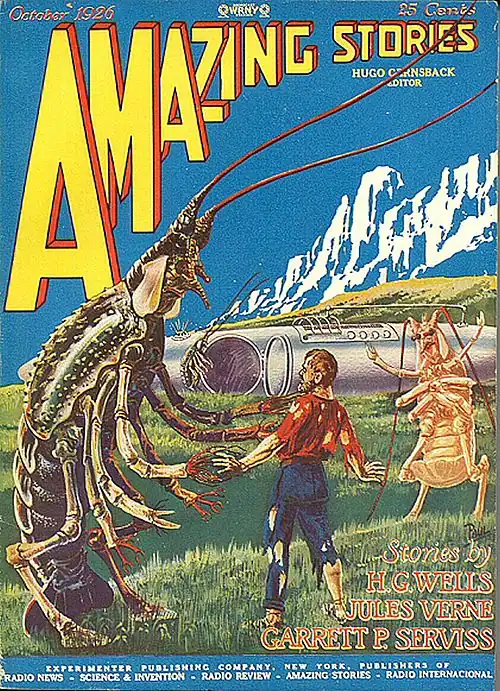
depicts the story from "Beyond the Pole," by A. Hyatt Verill, wherein one of the fearful, lobster-like creatures is shown investigating the, to them, strange, human creature which has so suddenly burst into their domain.
Copyright Acknowledgment
"The Purchase of the North Pole," by Jules Verne, copyright 1911, by Vincent Parke & Co, (Parke, Austin & Lipscomb Co.)
In Our Next Issue:
THE MAD PLANET, by Murray Leinster. A tremendous Story by the author of "The Runaway Skyscraper," and a sure classic. This fascinating story tells how our planet undergoes a gradual change and becomes inhabited by giant insects,
powerful, gripping narrative. Do not miss it.
BEYOND THE POLE, by A. Hyatt Verill. The final instalment, wherein our explorer describes his further adventures as guest of the lobster-like race. Any number of surprises and scientific conclusions will be found in these chapters of the best new scientific story of the year.
THE ISLAND OF DR. MOREAU, by H. Wells. The final instalment, wherein we find the beast people at large on the island, and learn what happens to them when left to their own devices. As surprising an ending as you could wish for
with thrills that you follow breathlessly, and which you will never forget.
THE DIAMOND LENS, by Fitz-James O'Brien This is one of the world's classics. A story written years ago, but which retains its flavor to the fullest extent and brings in an exquisite microscopic being, the enchanting heroine of the story. This was crowded out of the September issue.
A DRAMA IN THE AIR, by Jules Verne. A little
known story by the famous author. It was one of
the first stories ever published by him, and while
it does not contain the great scientific interest of
his later stories it is considered a perfect gem by
followers of Verne literature.
THE SECOND DELUGE, by Garrett P. Serviss. A worthy successor to the story "A Columbus of Space." Although this story does not deal with interplanetarlan travel it is a powerful as well as gripping story of a second deluge, which visited our planet. Don't miss it.
HOW TO SUBSCRIBE FOR "AMAZING STORIES." Send your name, address and remittance to Experimenter Publishing Co., 53 Park Place, New York City. Checks and money orders should be made payable to Experimenter Publishing Co., Inc. Mention the name of the magazine you are ordering inasmuch as we also publish RADIO NEWS, SCIENCE & INVENTION, RADIO REVIEW and RADIO INTERNACIONAL. Subscriptions may be made in combination with the other publications just mentioned at special reduced club rates. Send postal for club rate card. Subscriptions start with the current issue unless otherwise ordered. ON EXPIRATION of your subscription we enclose a renewal blank in our last number to you, and notify you by mail. Then, unless we receive your order and remittance for a renewal, delivery of the magazine is stopped. CHANGE OF ADDRESS: Notify us as far in advance as possible, giving your old address as well as the new one to which future magazines are to go. It takes several weeks to make an address change in our records.
AMAZING STORIES is published on the 10th of each month. There are 12 numbers per year. Subscription price is $2.50 a year in U. S. and possessions. Canada and foreign countries $3.00 a year. U. S. coin as well as U. S. stamps accepted (no foreign coin or stamps). Single copies, 25 cents each.
All communications and contributions to this journal should be addressed to Editor AMAZING STORIES, 53 Park Place, New York, N. Y. Unaccepted contributions cannot be returned unless full postage has been included. ALL accepted contributions are paid for on publication.
AMAZING STORIES. Monthly. Application for second class matter at the Post Office at New York, N.Y. pending. Title Registered U. S. Patent Office. Copyright 1925, by E. P. Co. Inc., New York. The text and illustrations of this magazine are copyrighted and must not be reproduced without giving full credit to the publication. AMAZING STORIES is for sale at all newstands in the United States and Canada. European Agents, S. J. Wise Et Cle, 40 Place Verte, Antwerp, Belgium. Printed in the U.S.A.
New England Advertising Representative T. F. Magrane, Park Square Bldg., Boston, Mass.
Western Advertising Representatives Finucan & McClure, 720 Cass., Chicago, Ill.
Pacific Coast Advertising Representatives A. J. Norris Hill Co., Hearst Bldg., San Francisco, Cal.
Kansas City Advertising Representatives Davies & Dillon, 15 W. 10th St., Kansas City, Mo.
Detroit Advertising Representative, Ray Basil, Donovan Bldg., Detroit, Michigan.
VOLUME 1
October, 1926 NO. 7
THE MAGAZINE OF SCIENTIFICTION
HUGO GERNSBACK, F.R.S., Editor
DR. T. O'CONOR SLOANE, M. A., Ph.D.; Associate Editor
WILBUR C. WHITEHEAD, Literary Editor
C. A. BRANDT, Literary Editor
Editorial and General Offices: 53 Park Place, New York, N. Y.
WHEN reading one of our scientifiction stories in which the author gives free rein to his imagination, providing he is a good story teller, we not infrequently find ourselves deeply thrilled. The reason is that our imagination is fired to the nth degree, and we thus obtain a real satisfaction from the time spent in reading the story, improbable as it often appears at first. I should like to point out here how important this class of literature is to progress and to the race in general.
The human mind is a tremendously complex machine, which often works in a very strange manner. A man sets out to invent a certain house appliance, and while engaged in his experimental work, gets a certain stimulus that takes him in an entirely different direction, so that the first thought of the house appliance may end in the invention of a factory labor-saving device, or perhaps something even more important.
When Alexander Graham Bell was a young man, he occupied himself by devising means of enabling the deaf to hear. This led him into electrical research work, and the apparatus, far from becoming a device by which the deaf can hear, became the present telephone. To be sure, loud-speaking telephones are made today for the use of the deaf, but this is only a by-product and not at all the actual and more important use of the instrument.
Hundreds and thousands of similar instances could be cited. An author, in one of his fantastic scientifiction stories, may start some one thinking along the suggested lines which the author had in mind, whereas the inventor in the end will finish up with something totally different, and perhaps much more important. But the fact remains that the author provided the stimulus in the first place, which is a most important function to perform.
On the other hand, many devices predicted by scientifiction authors have literally come true for many generations. There is an old popular saying that what man imagines, man can accomplish. This proverb of course, should be taken with a grain of salt, because not everything that man imagines is possible. For instance, I can imagine that I blow out the sun, or grasp the moon in my hand, or cut off my head without dying. Naturally such things are impossible. On the other hand, many of the so-called wild ideas which we read in our scientifiction stories may prove to be not quite so wild if they give an actual stimulus to some inventor or inventor-to-be who reads the story. And as long as there is a stimulus of any sort, we have no reason to complain, because we never realize where progress in any direction may lead us.
There is the well-known story of the inventor who had patented a mouse-trap, and finally sold the patent to a manufacturer, who found that an excellent burglar alarm could be made from the mouse-trap, with but a few changes. Another case of an original stimulus which, perhaps, went wrong, but finally became righted.
We should not, therefore, become too impatient if occasionally we encounter a seemingly impossible prediction or improbable plot. It is beyond our power to foresee what reaction this may produce in some one, and what tremendous consequences it may have in the future. And, strange to relate, the patent offices of most countries follow scientifiction stories pretty closely, because in many of these the germ of an invention is hidden. It is not necessary to actually build a model to be an inventor; often it becomes necessary, for court proceedings and for patent reasons, to find out who really was the original inventor of a certain device; if the inventor is an author who brought out the device, even in a fiction story, this would, in the long run, entitle him to ownership of the patent, always providing that the device is carefully described, as to its functions, its purpose and so forth.
For instance, in the United States, the inventor would have two years from the publication of the story to apply for a patent. Thus it will be seen that a scientifiction story should not be taken too lightly, and should not be classed just as literature. Far from it. It actually helps in the progress of the world, if ever so little, and the fact remains that it contributes something to progress that probably no other kind of literature does.
This work is in the public domain in the United States because it was published before January 1, 1930.
This work may be in the public domain in countries and areas with longer native copyright terms that apply the rule of the shorter term to foreign works.