Arsenic and Compounds, as As (7900)
(except AsH₃ and As₂O₃)
Issue 2: 15 August 1994
SAMPLING
(0.8-μm cellulose ester membrane)
ACCURACY
MEASUREMENT
GENERATION
mL; conc. HClO 4, 1 mL; 140 °C
Background absorption is overcome by the use of D ₂ or H₂ continuum.
This revises P&CAM 139 [1]); a similar method appears in the criteria document [2]. Method 7901 uses a sampler designed to collect As ₂O₃ vapor and an alternate measurement technique (graphite furnace-AAS). Method 7300 (ICP-AES) also gives an alternate measurement technique.
REAGENTS:
- Nitric acid, conc.
- Hydrochloric acid, conc.
- Sulfuric acid, conc.
- Perchloric acid, conc.*
- Calibration stock solution, 1000 mg/mL.* Commercially available or dissolve 1.320 g primary standard As 2O3 in 25 mL 20% (w/v) KOH. Neutralize with 20% (v/v) HNO 3 to a phenolphthalein endpoint. Add 10 mL conc. HNO3 and dilute to 1 L with distilled or deionized water.
- Ashing acid, 3 volumes HNO 3, 1 volume H2SO4, and 1 volume HClO 4.
- Hydrogen.
- Argon.
- Distilled or deionized water.
- Sodium borohydride, pellets.
- Air, compressed.
- See SPECIAL PRECAUTIONS.
EQUIPMENT:
- Sampler: cellulose ester filter, 0.8-μm pore size, 37-mm diameter; in cassette filter holder.
- Personal sampling pump, 1 to 3 L/min, with flexible connecting tubing.
- Atomic absorption spectrophotometer with appropriate hydrogen burner head or quartz tube furnace, and arsenic hollow cathode lamp or EDL and arsine generation system.
- Regulators, two-stage, for air, hydrogen and argon.
- Beakers, Phillips, 125-mL, or Griffin, 50-mL, with watchglass covers.*
- Volumetric flasks, 25- and 100-mL.*
- Pipets, volumetric, as needed.*
- Hotplate, surface temperature 140 °C.
- Clean all glassware with conc. nitric acid before use and rinse thoroughly with distilled or deionized water.
SAMPLING:
- Calibrate each personal sampling pump with a representative sampler in line.
- Sample at an accurately known flow rate between 1 and 3 L/min for a total sample size of 30 to 1000 L. Do not exceed ca. 2 mg total dust loading on the filter.
SAMPLE PREPARATION:
- Open the cassette filter holders and transfer the samples and blanks to clean beakers.
NOTE: Analyze the backup pad separately if qualitative indication of As 2O3 vapor is desired. Use Method 7901 if quantitative collection of As 2O3 vapor is desired. - Add 5 mL ashing acid and cover with a watchglass.
- Heat on hotplate (140 °C) until the solution is colorless.
- Add 1 mL conc. HNO 3 and/or 70% HClO 4 drop by drop as needed to complete the ashing.
- Remove the watchglass.
- Heat on 140 °C hotplate until dense SO 3 fumes appear.
- Allow the mixture to cool.
- Transfer the solution quantitatively to a 25-mL volumetric flask.
- Dilute to volume with distilled or deionized water.
CALIBRATION AND QUALITY CONTROL:
- Prepare working standards. Add known amounts, covering the range 0.2 to 8 μg As/100 mL (0.05 to 2 μg As per sample), of 1000 μg/mL As calibration stock solution to 100-mL volumetric flasks containing 4 mL conc. H 2SO4 and dilute to volume with distilled or deionized water.
- Analyze working standards together with the blanks and samples (steps 18 through 25).
- Prepare calibration graph (absorbance vs. solution concentration, μg/mL).
- Analyze a standard for every 10 samples.
- Check analytical recoveries with at least one spiked media blank per 10 samples.
- Use method of standard additions occasionally to check for interferences.
- Set spectrophotometer according to manufacturer's recommendations and to conditions on page 7900-1.
- Set up arsine generator per manufacturer's instructions.
- Pipet 5 mL aliquot of the 25-mL sample into the arsine generation flask.
- Add 25 mL distilled or deionized water, 3 mL conc. HCl, and mix well.
- Connect the flask to the generation system.
- Introduce a single sodium borohydride pellet or sodium borohydride solution to the sample solution.
- Allow the gases to flush into the flame of the atomic absorption instrument.
- Record the absorbance readings.
NOTE: If the absorbance values of the samples are above the linear range of the standards, dilute the solutions, or use a smaller aliquot, reanalyze, and use the appropriate dilution factor in calculations.
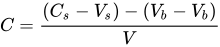
, mg/m³
This method was evaluated in July, 1976, over the range 0.02 to 3 mg per sample by laboratory testing with spiked filters. Precision and accuracy data are given on page 7900-1 [1].
[1] NIOSH Manual of Analytical Methods, 2nd. ed., V. 1, P&CAM 139, U.S. Department of Health, Education, and Welfare, Publ. (NIOSH) 77-157-A (1977).
[2] Criteria for a Recommended Standard...Occupational Exposure to Inorganic Arsenic, U.S. Department of Health, Education, and Welfare, Publ. (NIOSH) 75-149 (1975).
Mark Millson, NIOSH/DPSE.