(1)  .
.
(2) 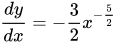 .
.
(3)  .
.
(4) 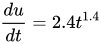 .
.
(5) 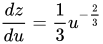 .
.
(6) 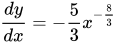 .
.
(7) 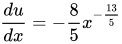 .
.
(8) 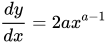 .
.
(9) 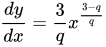 .
.
(10) 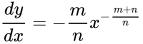 .
.
(1)  .
.
(2) 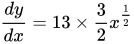 .
.
(3)  .
.
(4) 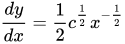 .
.
(5) 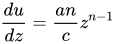 .
.
(6)  .
.
(7) 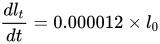 .
.
(8) 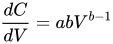 ,
,  ,
,  and
and  candle power per volt respectively.
(9)  .
.
 .
.
(10)  .
.
(11)  ,
,  ,
,  ,
,  ,
,  ,
,  .
.
(12) 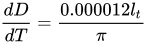 .
.
(1) (a)  .
.
- (b)
 .
.
- (c)
 .
.
- (d)
 .
.
(2) 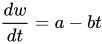 .
.
(3)  .
.
(4)  .
.
(5) 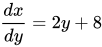 .
.
(6)  .
.
(7)  .
.
(8) 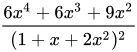 .
.
(9)  .
.
(10) 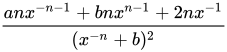 .
.
(11)  .
.
(12)  ,
, 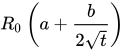 ,
,  or
or 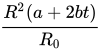 .
.
(13)  ,
,  ,
,  ,
,  .
.
(14) 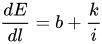 ,
, 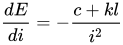 .
.
(1)  ;
;  .
.
(2) 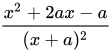 ;
; 
(3) 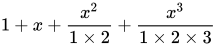 .
.
(4) (Exercises III.):
(1) (a) 
- (b)
 ,
,  .
.
- (c)
 .
.
- (d)
 .
.
(2)  , .
, .
(3)  , .
, .
(4)  .
.
 .
.
(5) , .
(6)  ,
,  .
.
(7)  ,
,  .
.
(Examples, p. 41):
(1)  ,
,  .
.
(2) ![{\displaystyle {\dfrac {3a{\sqrt {b}}}{2{\sqrt {x}}}}-{\dfrac {6b{\sqrt[{3}]{a}}}{x^{3}}}}](../_assets_/d7a8781288c2d44c6c6f7c6c5d85d1639e06b39f.svg) ,
, ![{\displaystyle {\dfrac {18b{\sqrt[{3}]{a}}}{x^{4}}}-{\dfrac {3a{\sqrt {b}}}{4{\sqrt {x^{3}}}}}}](../_assets_/ea1da96de937a1b855dd5a64e03c4955f7f0ea2e.svg) .
.
(3) ![{\displaystyle {\dfrac {2}{\sqrt[{3}]{\theta ^{8}}}}-{\dfrac {1.056}{\sqrt[{5}]{\theta ^{11}}}}}](../_assets_/3d494e7f43257ff74fcd93fe4eeae08c012e838a.svg) ,
, ![{\displaystyle {\dfrac {2.3232}{\sqrt[{5}]{\theta ^{16}}}}-{\dfrac {16}{3{\sqrt[{3}]{\theta ^{11}}}}}}](../_assets_/b753676171e2a1b1d5990c7f07d146e13f57d774.svg) .
.
(4)  .
.
 .
.
(5)  ,
,  .
.
(6)  ,
,  .
.
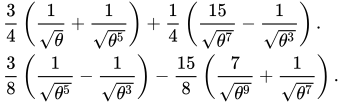
(7) 
(2)  ;
;  ; and
; and  feet per second.
(3)  ;
;  .
.
(4)  feet per second.
(5)  feet per second per second. Yes.
(6) Angular velocity  radians per second; angular acceleration
  radians per second per second.
(7)  .
.  .
. 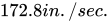 ,
, 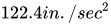 .
.
(8) ![{\displaystyle v={\dfrac {1}{30{\sqrt[{3}]{(t-125)^{2}}}}}}](../_assets_/b192f986f586cdf9eadb45705edb0434f948567f.svg) ,
, ![{\displaystyle a=-{\dfrac {1}{45{\sqrt[{3}]{(t-125)^{5}}}}}}](../_assets_/1bc9df66f4413851213161349fabc29a86cc292b.svg) .
.
(9)  ,
, 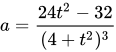 ,
,  and
and  .
.
(10)  ,
,  .
.
(1)  .
.
(2)  .
.
(3) 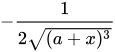 .
.
(4) 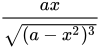 .
.
(5)  .
.
(6) ![{\displaystyle {\dfrac {{\frac {3}{2}}x^{2}\left[{\frac {8}{9}}x\left(x^{3}+a\right)-\left(x^{4}+a\right)\right]}{(x^{4}+a)^{\frac {2}{3}}(x^{3}+a)^{\frac {3}{2}}}}}](../_assets_/a0239579c610ac2f370e764fe0fd1b2446e81778.svg) .
.
(7)  .
.
(8)  .
.
(9) 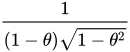 .
.
(1) 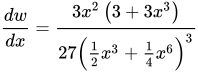 .
.
(2)  .
.
(3) ![{\displaystyle {\dfrac {du}{dx}}=-{\dfrac {x^{2}\left({\sqrt {3}}+x^{3}\right)}{\sqrt {\left[1+\left(1+{\dfrac {x^{3}}{\sqrt {3}}}\right)^{2}\right]^{3}}}}}](../_assets_/b15cbed690c2f034b448b9b46a8c27184e6420f3.svg) .
.
(2)  .
.
(4) 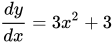 ; and the numerical values are:
  ,
,  ,
,  , and
, and  .
.
(5)  .
.
(6) 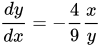 . Slope is zero where
  ; and is
  where
where  .
.
(7)  ,
,  .
.
(8) Intersections at ,  . Angles
  ,
,  .
.
(9) Intersections at  ,
,  . Angles
  .
.
(10)  ,
,  ,
,  .
.
(1) Min.: ,  ; max.:
  ,
,  .
.
(2)  .
.
(4)  square inches.
(5) 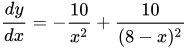 ;
;  ;
;  .
.
(6) Max. for  ; min. for .
(7) Join the middle points of the four sides.
(8)  ,
,  , no max.
(9)  ,
,  ,
,  .
.
(10) At the rate of  square feet per second.
(11)  .
.
(12)  .
.
(1) Max.:  ,
,  ; min.:
  ,
,  .
.
(2) 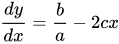 ;
;  ;
;  (a maximum).
(3) (a) One maximum and two minima. (b) One maximum. (; other points unreal.)
(4) Min.:  ,
,  .
.
(5) Max:  ,
,  .
.
(6) Max.:  ,
,  . Min.:
  , .
, .
(7) Max.:  ,
,  . Min.:
  ,
,  .
.
(8)  ,
,  .
.
(9)  .
.
(10) Speed  nautical miles per hour. Time taken
  hours. Minimum cost £
 .
.  .
.
(11) Max. and min. for  ,
,  . (See example no. 10, here.)
(12) Min.:  ,
,  ; max.:
  ,
,  .
.
(1) 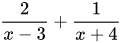 .
.
(2) 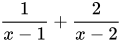 .
.
(3) .
(4)  .
.
(5) 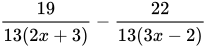 .
.
(6) 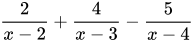 .
.
(7)  .
.
(8)  .
.
(9) 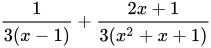 .
.
(10)  .
.
(11) 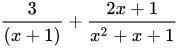 .
.
(12) 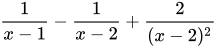 .
.
(13)  .
.
(14)  .
.
(15)  .
.
(16) 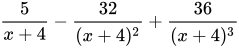 .
.
(17)  .
.
(18)  .
.
(1) 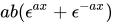 .
.
(2)  .
.
(3)  .
.
(5)  .
.
(6)  .
.
(7)  .
.
(8)  .
.
(9)  .
.
(10)  .
.
(11)  .
.
(12)  .
.
(14) Min.:  for
for  .
.
(15)  .
.
(16)  .
.
Exercises XIII. (p. 162.)
(1) Let  (∴
(∴  ), and use the Table on page 159.
(2)  ;
;  minutes.
(3) Take  ; and use the Table on page 159.
(5) (a) 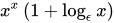 ; (b)
; (b)  ; (c)
; (c)  .
.
(6)  second.
(7) (a)  ; (b)
; (b)  .
.
(8)  ,
,  .
.
(9)  is
is  of
of  ,
,  kilometres.
(10)  ,
, 
 , mean
  ;
;  ,
,  ,
,  .
.
(11) Min. for  .
.
(12) Max. for  .
.
(13) Min. for  .
.
(1) (i) 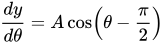 ;
;
- (ii)
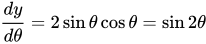 and
and 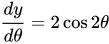 ;
;
- (iii)
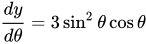 and
and 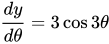 .
.
(2)  or
or  radians.
(3) 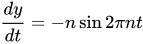 .
.
(4)  .
.
(5) 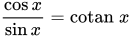 .
.
(6)  .
.
(7) The slop is 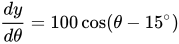 , which is a maximum when
 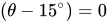 or
or  ; the value of the slope being then
  . When
  the slope is
  .
.
(8) 
 .
.
(9)  .
.
(10)  ;
;  .
.
(11) (i) 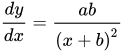 ;
;
- (ii)
 ;
;
- (iii)
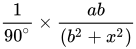 .
.
(12) (i) 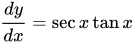 ;
;
- (ii)
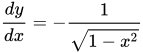 ;
;
- (iii)
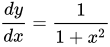 ;
;
- (iv)
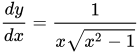 ;
;
- (v)
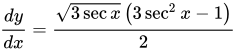 .
.
(13)  .
.
(14)  .
.
(15)  ; is max. for
  , min. for
  .
.
(1)  ;
;  .
.
(2)  ;
;
 ;
; .
.
(3)  ;
;  .
.
(4)  .
.
(5)  ,
,
 ,
,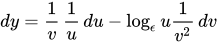 .
.
(7) Minimum for  .
.
(8) (a) Length feet, width = depth =  foot, vol. = cubic feet.
- (b) Radius = feet =
 in., length = feet, vol. =
  .
.
(9) All three parts equal; the product is maximum.
(10) Minimum for  .
.
(11) Min.: and  .
.
(12) Angle at apex  ; equal sides = length =
![{\displaystyle {\sqrt[{3}]{2V}}}](../_assets_/d28871054607f1f3b0365a456d409bee4cfa1284.svg) .
.
(1)  .
.
(2)  .
.
(3)  .
.
(4) (a) 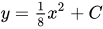 ;
;
- (b)
 .
.
(5)  .
.
Exercises XVII. (p. 205.)
(1) 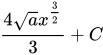 .
.
(2)  .
.
(3)  .
.
(4) 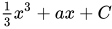 .
.
(5)  .
.
(6)  .
.
(7) 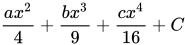 .
.
(8) 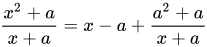 by division. Therefore the answer is
  . (See pages 199 and 201.)
(9)  .
.
(10) 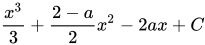 .
.
(11) 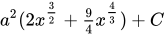 .
.
(12)  .
.
(13) 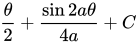 .
.
(14) 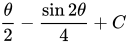 .
.
(15) 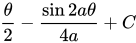 .
.
(16)  .
.
(17)  .
.
(18)  .
.
Exercises XVIII. (p. 224.)
(1) Area  ; mean ordinate
  .
.
(2) Area  of
of  .
.
(3) Area  ; mean ordinate
 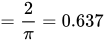 .
.
(4) Area  ; mean ordinate
  .
.
(5)  ,
,  .
.
(6) Volume  .
.
(7)  .
.
(8)  .
.
(9) Volume  ; area of surface
  (from to
  ).
).
(10)  ,
,  .
.
(12) Arithmetical mean  ; quadratic mean
  .
.
(13) Quadratic mean 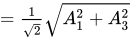 ; arithmetical mean
  . The first involves a somewhat difficult integral, and may be stated thus: By definition the quadratic mean will be
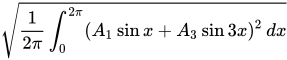 .
.
Now the integration indicated by

is more readily obtained if for  we write
 .
.
For  we write
  ; and, for
  ,
,
 .
.
Making these substitutions, and integrating, we get (see p. 202)
 .
.
At the lower limit the substitution of for  causes all this to vanish, whilst at the upper limit the substitution of for gives
  . And hence the answer follows.
(14) Area is  square units. Mean ordinate is
  .
.
(16)  . (This solid is pear shaped.)
(1)  .
.
(2) 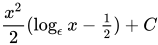 .
.
(3) 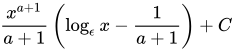 .
.
(4)  .
.
(5)  .
.
(6)  .
.
(7) 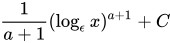 .
.
(8)  .
.
(9)  .
.
(10)  .
.
(11) 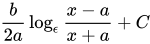 .
.
(12) 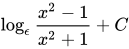 .
.
(13)  .
.
(14) 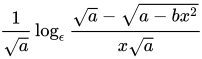 . (Let
  ; then, in the result, let
 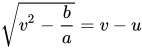 .)
.)
You had better differentiate now the answer and work back to the given expression as a check.
Every earnest student is exhorted to manufacture more examples for himself at every stage, so as to test his powers. When integrating he can always test his answer by differentiating it, to see whether he gets back the expression from which he started.
There are lots of books which give examples for practice. It will suffice here to name two: R. G. Blaine’s The Calculus and its Applications, and F. M. Saxelby’s A Course in Practical Mathematics.