CHAPTER VII.
SUCCESSIVE DIFFERENTIATION.
Let us try the effect of repeating several times over the operation of differentiating a function (see p. 14). Begin with a concrete case.
Let  .
.
| First differentiation,
|
 . .
|
|
| Second differentiation,
|

|
 . .
|
| Third differentiation,
|

|
 . .
|
| Fourth differentiation,
|

|
 . .
|
| Fifth differentiation,
|

|
 . .
|
| Sixth differentiation,
|
|
 . .
|
There is a certain notation, with which we are already acquainted (see p. 15), used by some writers, that is very convenient. This is to employ the general symbol  for any function of
  . Here the symbol
  is read as “function of,” without saying what particular function is meant. So the statement
  merely tells us that
  is a function of , it may be
  or
or  , or
, or  or any other complicated function of .
The corresponding symbol for the differential coefficient is  , which is simpler to write than
  . This is called the “derived function” of .
Suppose we differentiate over again, we shall get the “second derived function” or second differential coefficient, which is denoted by  ; and so on.
Now let us generalize.
Let 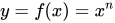 .
.
| First differentiation,
|
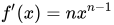 . .
|
| Second differentiation,
|
 . .
|
| Third differentiation,
|
 . .
|
| Fourth differentiation,
|
 . .
|
|
|
etc., etc.
|
But this is not the only way of indicating successive differentiations. For,
if the original function be ;
once differentiating gives  ;
;
twice differentiating gives 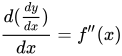 ;
;
and this is more conveniently written as  , or more usually
  . Similarly, we may write as the result of thrice differentiating,
 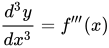 .
.
Examples.
Now let us try  .
.
 ,
, ,
,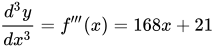 ,
,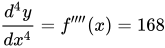 ,
,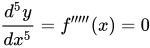 .
.
In a similar manner if  ,
,
![{\displaystyle \phi '(x)={\frac {dy}{dx}}=3\left[x\times 2x+(x^{2}-4)\times 1\right]=3(3x^{2}-4)}](../_assets_/82969747aa372fb05ed6e131fb9d6a1dfc72fa80.svg) ,
, ,
,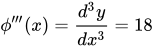 ,
,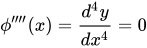 .
.
Exercises IV. (See page 255 for Answers.)
Find and for the following expressions:
- (1)
 .
.
- (2)
 .
.
- (3)
 .
.
- (4) Find the 2nd and 3rd derived functions in the Exercises III. (p. 46), No. 1 to No. 7, and in the Examples given (p. 41), No. 1 to No. 7.