Chaparejos
CHAPAPEJOS
By ANTHONY M. RUD
Author of “Smoke”, “Gila Joe”, etc.
It was mocking Fate that decreed that Toi-Yabe Tolman, ex-outlaw but now law-abiding prospector, should come face to face with the one man who could identify him to the sheriff—and that that man should be Haj Maddox, in whose evil brain hate and vengeance were ever ready to seize the slightest opportunity for fresh plotting.
I
 NE man squatted on his heels before the Squeejaw saloon at Hartnett, and rolled brown paper cigarettes. In front of the Cactus Spine, two false-fronted frame buildings farther down the dusty street, a heavy-bodied counterpart of the idler lounged with bowed, muscle-bound legs thrust out in a concave-sided V on the shaded sand. He likewise rolled and smoked brown paper cigarettes.
Neither seemed to notice the other. Yet they had passed on horseback, warily. They knew each other only too well. If Toi-Yabe Tolman, the tall, desert-lean prospector who hunkered as he smoked, had guessed Haj Maddox was in town, the meeting would not have occurred. He hated Maddox, and despised him. Likewise he feared Maddox, as one may fear a rattler in his blanket.
Haj Maddox, an eighth-blood Pima, his father a Greek peddler with asthma—incidentally, named Socopoulos—was a hog-bodied, loose-mouthed, swarthy individual with black, close-set eyes. He had used many names for many crimes, usually of the petty or sneaking variety. Sometimes of a sort even less admirable. Unfortunately once the leader of the Silver Peak gang of stage robbers, of which notorious organization Toi-Yabe had been a lieutenant, had used Maddox as a go-between.
Just once. That had been enough. Even the flint-eyed leader of those outlaws, the ex-gambler, Cold Deck Diehl, lost control of himself and beat to a bruised pulp that apish, greasy thing in human form. And Diehl, who had learned boxing in the East, broke one of his valuable gambler's hands on the fellow.
Toi-Yabe thought it all over. His obvious move was to walk over, pick a quarrel, and shoot the bulky enemy full of holes. Then the world would be better off—and Toi-Yabe Tolman, owner now of a promising proved up claim inside the first ridge of the Red Chalk range, would not have the constant worry of a sheriff possibly on his trail. Over in Esmeralda—for what he had been careful to make seem good and sufficient reason—they thought him dead. They even had paid the reward to the individual who had come upon a certain body, and some of Toi-Yabe's undoubted possessions, at Golman's Well in the Corduroy Hills.
But Haj Maddox had started in genuine surprise and recognition. He grinned loosely, grunted a hail—unanswered. Then he looked back steadily, a set, sneering hate and triumph in his black eyes and puffy mouth. Toi-Yabe Tolman! Two thousand dollars walking around loose, provided at Silver Peak they'd pay the reward again. Probably they wouldn't. Anyway, certain plans just taking shape in the cunning mind of Haj—unspeakable things, they were—might easily fit themselves well to the presence of a fugitive outlaw. Whenever Haj became daring, it was because he saw his way clear to make another seem guilty of his crime. Once in New Mexico a man was hanged—but that is another story, better forgotten by men who like to believe justice and the law synonymous.
Toi-Yabe arose, snapped away his cigarette, turned and strode swiftly toward the Cactus Spine saloon. Thumbs hitched in his belt, hands ready for the deadly swoop and draw of .44s, he came straight to Haj Maddox. The latter squirmed, but did not dare attempt to get to his feet. His black irised eyes showed like bull's-eyes in discs of white.
“Yuh recognized me,” said ТOi-Yabe in a low, even tone. “Well, I'm dead—an' aim to stay dead! Get me?”
“Oh, yes, yes, yes!” came the hurried, slurred reply. “They pay the reward. Yo're dead, Toi-Yabe! I not goin' t' say nothin'.”
“All right,” snapped the ex-bandit. “Yo're a liar, an' worse. Jes' let me tell yuh suthin' though, snake—yuh ain't even a hombre! I got suthin' on down thisaway, an' I ain't alone! If yuh want to keep on livin', dust outa town!” His right hand fell to the wooden butt of a six-gun.
“Oh, yes, yes,” smirked Haj, albeit his features still bore the print of fear. “I was goin' so quick, anyhow. I am bound onward, too far—a long ways, eh? I don' come back. Clear to Laramie!”
Toi-Yabe nodded once, briefly. Without deigning to look around again at the enemy who might have shot, he strode back to the rhombus-fronted, notorious Squeejaw—a crazy wooden shack ready to collapse with the first stiff wind, yet one of the most celebrated rendezvous and honky-tonk in all southern Nevada.
But Haj Maddox had scuffled up furtively and dashed with short, padding steps to the deserted bar of the Cactus Spine. He needed a drink, several drinks. With enough of the peppered whisky under his belt he could plan hellishly. And now was the time for liquor! Already he had worked out a scheme which would have revolted an orang-utan; but earlier than the meeting with Toi-Yabe he had not picked his victim. Here was one, Toi-Yabe Tolman! Not until the fourth straight whisky did Haj really decide certainly upon the ex-bandit.
Haj grinned blackly, showing a few stumps of teeth to the bar mirror. Of a sudden he began talking owlishly, confidentially, to a bored bartender only too glad to listen. Haj wanted a quart to take along. He was going on, clear to Laramie. And he was starting right away. Right away! He staggered, clasped the stained cherry for support.
They do certain things even for men they distrust, down there at the desert's edge. The bartender did not try to dissuade Haj Maddox; that was not within the code. He gave over the quart of liquor, but saw it stowed at the bottom of a saddle pack. And the man in the white apron also filled Maddox's two canteens with fresh water. Then, as Haj clumsily mounted and rode away swaying in the saddle, the server of refreshment shrugged and shook his head.
“He'll never make through, damn' if he will!” was his muttered judgment. And then he forgot about Haj Maddox.
But the pudgy one's alibi was there, ready made for use if necessity demanded.
 TONE BELLINGER was sheriff of Nye County. “Stun-Bruise,” as was his cognomen from the valley of Great Salt Lake to this sandy hell's kitchen of Nevada, was forty-six, but looked older, and harder even than his nickname. He had been a cowman and a farmer, never a miner. He was a Mormon apostate and a bitter enemy of all things Mormon. Three emissaries came at various times from the Mormon State of Deseret, determined to kill him. Three grimly lettered crosses over at the Boot Hill at Hartnett revealed the gun speed and shrewdness of the quarry, and the stark courage, also.
Stun-Bruise had been a Mormon. He loved a Mormon girl and had no earlier wives. She smiled happily when he passed on horseback, raising his straight-brimmed, low-crowned hat. She loved him, but love on the part of woman was not then considered of importance in Deseret.
She was “sealed” for marriage with one of the Council whom she had not even seen—knowingly. She fled by night to the man of her heart's choice, and he rose to the occasion. He damned Mormonism briefly, and then fled the valley, finally distancing the secret Danite band of “Avenging Angels” which took his trail.
But less than a year later, a long way distant from the Mormon power and safe except from the assassin emissaries sent to extirpate those who found the shackles of Mormonism insupportable, a son was born to Stone Bellinger—a lusty, nine-pound youngster who yelled like a Piute the instant he was presented to his new surroundings.
Stone Bellinger did not know—or care. His girl wife was smiling weakly, trying to return the kisses he gave while the life ebbed from her slender, lovely body.
“Our boy!” she breathed. “You will—make him—a man like—you?” Mayhap that should not have been a question mark, but an exclamation point. But just then the girl mother for whom a strong man had thrown away his faith, his chance at wealth, his all save love, died. Her lips curved richly in a half-smile of confidence! She knew her fate, and smiled.
Stone's greatest weakness came to the surface then, unfortunately. Always he had been a hard man, just but inflexible—owing to the influence of his Mormon training, perhaps. Now he cursed harshly, holding himself and that little, red-cuticled atom responsible for his wife, Genevra's, death. True, he did not level an accusation even mentally against the tiny lad; yet the feeling overwhelmed paternal affection from the very first. He avoided sight of the infant. Getting an Indian woman to care for the baby temporarily, he then hired a widow at Tonopah, a rather coy lady of thirty who had one child of her own—and definite hopes still in the field of matrimony.
So four and one-half years passed. The widow, from the first honestly admiring Sheriff Stone Bellinger, took excellent care of little Dick, and, as the months grew into years, implanted in the baby mind a hero worship of the stern, hard-riding sheriff father. But those years ended it. A middle-aged assayer stopped for a time at Hartnett. The widow, despairing now of ever becoming Mrs. Stone Bellinger, smiled at the newcomer and used her wiles successfully. Dickie lost the nearest to a mother he ever had known.
The only other white woman of the region available then was Mrs. Thorgesson, a dull-featured, big-armed Scandinavian of forty-odd, the muscled, ignorant relict of a drunken miner. Mrs. Thorgesson seemed happy enough to leave her washboard, however. She plunged into housekeeping again and the care of a child with rough-handed enthusiasm. She sewed several pairs of red flannel kilts for Dickie.
And then, each time she was paid by Stone, she guzzled a quart or thereabouts of whisky and let the household run itself for thirty-six hours.
Dickie never had seen kilts before. He hated them and protested vehemently. But in the old country, kilts for boys had been up-to-date attire when Mrs. Thorgesson had been a flicka. Therefore she overruled his protests with a heavy hand. Once when Dickie, rebelious, had dared even to run to the father he rarely saw, Stone was not able to become outwardly sympathetic.
“Mebbe pretty soon he's big enough for pants,” he said gruffly, and strode out.
But nothing short of an outright command would have made an impression on the phlegmatic Mrs. Thorgesson. She grunted, fingering the money she had got. And then, when she was sure Stone had ridden out of town, she went to the Squeejaw honkytonk for her quart of liquor. An hour later she was singing hoarsely. There was no supper prepared that night for the youngster. He found some hard bread, and choked down a few bites of it through a throat constricted with a pain of tears which under the kindly care of his first foster-mother he had learned to repress.
He had fallen asleep, still clothed, when the rear door squeaked on its rusted hinges. He did not awaken, nor did the housekeeper hear. A crouching, bulbous shadow entered. For a moment it squatted in the doorway, then tiptoed into the shack. This time only petty pilfering was the purpose of the stealthy intruder, but on his next visit Haj Maddox would have a far more serious mission! He intended to fulfill that mission soon.
For the moment, though, he walked on tiptoe, a faint jangle coming from his Mexican spurs. In place of the empty, overturned whisky bottle beside the snoring housekeeper, Haj left a quart with seals unbroken. Then from a heap of clothing in one corner of the next room, he sorted out a pair of shoes and a pair of stockings—tiny size—and, grinning, fled with these to his horse.
After some trouble he had located the mining claim of Toi-Yabe Tolman. With the stealth which was his Pima heritage, Maddox would leave these stolen trifles of child attire somewhere thereabouts. He rode, grinning evilly. It might be possible even yet to collect that reward. At any rate he, Haj, would secure ample revenge upon Toi-Yabe, whom he hated. And then there would be the youngster—ransom, perhaps. That far in advance his brutish mind was content to figure only hazily.
 ICKIE BELLINGER awoke ravenous. He scrambled up, jerked with a scowl at his rumpled kilts, and then ran in to the littered, reeking room of the housekeeper. “Old Torky,” as he called her, still slept. She sprawled half off, half on the cot bed. Dickie scowled. He called to her, at first in a low, disapproving voice, but then louder. He was hungry; couldn't she understand?
This time she couldn't. She had awakened earlier and found the second bottle. It would be many, many hours before she took an interest in the affairs of her charge.
The hard lump tightened in the boy's throat. His lower lip quivered from its usual line of decision. He didn't want any more of that darn' hard bread. He was hungry!
An idea struck him. He went into his own room, and rummaged through a broken tomato packing case where he kept the odds and ends of his small possessions. He had money! He would go to Chong Yen's restaurant and buy bre'fuss, jes' like daddy did!
The money was in a bronze coin bank, the figure of an Indian. When shaken, it rattled faintly. Dickie knew how to get the money out; he had seen Old Torky do it. So now he pried and shook and shook; and finally out jingled the money—a dime and two nickels. That was all.
But the little fellow saw no discrepancy between that sum and the high prices for edibles chalked on the wall of Chong Yen's restaurant-laundry next door to the lantern-jawed, leering Squeejaw. He left the house, squaring his shoulders importantly, and marched down the dusty single street.
Chong Yen, thriftily utilizing the morning hours in washing for the town, came forward, arms soapy. Perhaps just the glint of surprised recognition showed in his seamed, parchment features.
“H'lo. How do, li'l fellah?” he questioned, wiping his arms.
“Bre'fuss! Me's hungry!” announced Dickie with careful nonchalance, standing on tiptoe to slap the twenty cents upon the lunch counter. Then, by stepping on the rail and kneeing up, he managed to mount one of the stools. The level of the board still came even with his chin.
“Lots o' bre'fuss!” he repeated, of a sudden an odd, unsure notelike wistfulness shaking the peremptory decision. After all, he was a very small boy, acting for the first time in his five years as a man of affairs.
Chong Yen looked at him, at the small change on the counter, and cast a brief, expressionless glance at his chalked menu—the least item of which was, “Coffee—two-bits.”
But then a quick, subtle change came in his wooden features. Perhaps Chong Yen liked children. Perchance he recalled one time years before when he had been a newcomer in Hartnett, a day on which the father of this tiny lad intervened just when some drunken miners were engaged in the hilarious pastime of braiding his queue into the tail of a bronc with nervous heels.
At any rate he grinned and chuckled. He came around the counter.
“Missy Tolgesson dlunk?” he queried.
“Ye-ah!” said Dickie, with distaste and resentment.
“Huh!” grunted Chong Yen. He lifted Dickie from the stool and carried him back. There was a low, scrupulously clean board table, and a box which stood on end made an excellent chair. Forthwith the Chinaman set forth a dish of delicious canned peaches, which Dickie devoured, the while watching with anxious, glowing eyes the further preparations. Chong cut and sawed out the tenderloin of a choice beefsteak, and had it sizzling in no time. Hot rice, toasted bread, and a dish of beans with hot, crisped bacon—perhaps not the fare for a pampered baby, but Dickie did not know the taste of fresh milk, and was accustomed to hearty plain food. He ate till he could eat no more, then sighed vastly, getting down with difficulty. He never had been pampered.
“Fanks,” he said—and then remembered the business side of the transaction. “I give you my money.”
Chong grinned. Then his face quickly became impassive again.
“Suah!” he agreed, bowing. “Мak' change!” And with that he gravely passed back a dime and a nickel. In that transaction there was more understanding of his youthful customer than could have lain in the providing gratis of a dozen meals.
Before the Oriental let him leave, Dickie carried a neat bundle in which reposed two cheese and two ham sandwiches. Chong knew “Old Torky,” and in an obscure way he was repaying a long cherished debt.
 N THE way back a Mexican lounger gratuitously insulted Dickie—right at a moment when the boys pride had swelled almost to the bursting point!
“Buenos dias, nina!” he greeted mockingly, doffing his sombrero and showing white, even teeth in a wide grin.
Dickie gasped. Little girl, indeed! His chin came up with a snap and his tiny fists clenched. He ignored the lounger, but his steps hurried, became uneven, and a rosy flush overwhelmed his cheeks and flowed over the back of his neck. Nina! It was those darn', darn' kilts! Oh why couldn't he have pants like a big man—an'—an' chaps like daddy wore?
Stone Bellinger alone, among the prospectors, miners and general drifters at Hartnett, wore leather chaparejos as he rode. A cowman he had been, and a cowman sheriff he would remain, even though his lot was cast among other sorts of Westerners. The nearest ranch of any sort lay in the secluded Demijohn Valley, forty-five miles to the northeast.
The last steps Dickie took at a run, flinging himself inside the shack and slamming the door. Dry sobs were in his throat, but no tears flowed. He saw without caring that Old Torky had not come to consciousness. Darn her anyway! Darn her for making him wear kilts.
But then he looked into his own disordered room, and what he saw spilled on a table brought a flash of inspiration. A sewing basket had been overturned. Shears—chaps! Maybe pants, too!
He closed Old Torky's door silently and tiptoed back to the table. There were the implements! Hastily seizing scissors and a paper of safety pins that lay on top, he dropped to the floor and scrambled under the table. There he pulled the cover down until he was screened from any casual observer who might come into the room, and went busily to work.
Poking the sharp-pointed shears through the material of his red kilts at the waistline in front, he sawed his way down the weave of the cloth until a last chew of the none-too-sharp shears severed the binding at the bottom. This made the kilts gape open alarmingly in front, but Dickie stuck manfully to his task, his fingers trembling from over-zealousness and a rush of excitement.
Straining his rounded stomach into smallest compass, he managed to turn the kilts completely around so that the slit was exactly at the back. Then he repeated the process with the scissors, cutting a new slit down the opposite side of the kilts. This finished, he dropped the shears from his trembling fingers and seized the paper of safety pins. A little flush of triumph rose in his face as he succeeded in pinning together the bottom flaps around above his right knee. Here were his trousers! In his excitement he stuck the point of a pin deep in his finger, but went on, disregarding the pain.
In a trice he had fastened three pins in his right pants-leg, and two in the left. That would do, because somehow or other he couldn't make his fingers work to fasten the other pin. He tiptoed again to the hall door and listened.
Old Torky snored. Triumphant, Dickie flushed as he looked down at his handiwork. On the wall hung a cracked mirror the beloved daddy used when he shaved. Dickie climbed up and secured it. His blue eyes glistened with pleasure then as he held the glass this way and that, reflecting the metamorphosed kilts. Course they weren't exactly pants, but they were a lot better than those darn', darn' things!
Now if he only had chaparejos to wear outside!
The sheriff unrolled the bundle
The drive of inspiration was in him, though. He looked down. On the littered floor was an old fragment of rag carpet, raveled at the edges and stiff with dirt. Dickie caught his breath. The chaps! Sitting down with the dull shears, he forthwith attacked the ancient fabric.
It proved a long, slow job, one which made his hand and wrist ache fiercely. The hours dragged along. In the other room Old Torky ceased snoring, and groaned heavily. Then there was the sound of a staggering step, a gurgle as of liquid being decanted—another gurgle. Then by and by, a creak of cot springs. And finally another snore.
Dicky had sawed out one long, irregular triangle of rug and affixed it by pins and raveling tied together, when his aching arm and the demands of his stomach made him call a halt. He remembered the sandwiches, and forthwith ate them all. It was long past noon.
Later, the joy of creation a trifle dulled, but determination unimpaired, he started the task of sawing out a duplicate, growing heavy-eyed as the shadows crept down from the westward buttes.
II
 UT in a valley of the Red Chalk Range, Toi-Yabe Tolman frowned down puzzledly at a pair of small shoes and a pair of child's stockings he had found behind a boulder. He looked about him. A kid of some kind! The valley, though, was as silent as a dead desert calm; even his own animals were not grazing on the sparse vegetation jus then. He was sure that no one else could be within miles—and certain also, or nearly so, that these garments had not been behind the boulder the day before. Why, he had sat on that stone to eat his beans and pan biscuit! Yet he might have overlooked them, as he had been thinking almost entirely of Haj Maddox and what that treacherous coyote might be expected to do with his knowledge that the ex-bandit, Toi-Yabe Tolman, still lived.
Toi-Yabe rolled up the shoes and stockings and tossed them back to the place he had found them. Then he looked deep into the crannies of the narrow cave he used as a provision cache, and later devoted a half hour to a climb, reaching a spot which gave him a bird's-eye view of the valley. But beside a pair of far buzzards slowly circling, no living thing was in sight. He returned to his labor with drill, pick and shovel.
Unaware of the net being woven for him, he labored in the shaft he was sinking diagonaly downward at a right-angle to the slanting side of the bare mountain. Float gold was plentiful about the claim he owned. Low grade ore also was present in irregular veins two feet below the surface, separated and broken by white, barren bull quartz. The low grade ore represented a certain, though small, sale value on account of the nearness to Hartnett and the rail head at Lamar; yet Toi-Yabe, always a firm believer in rich float gold as a certain index of the nearness of a mother lode—a theory which has made dozens of prospectors very rich, and thousands destitute—chose to ignore the $250 a ton rock and delve on the gambler's chance.
That evening, crouched with frying-pan and coffee pot before a small blaze of mesquite twigs, Toi-Yabe suddenly heard the click of steel on rock, the sounds of a shod horse approaching! With possible trouble stirred up by Haj Maddox foremost in mind, Toi-Yabe slid quickly from the firelight to the protection of a boulder, hands dropping to his six-guns.
“Howdy!” came a hail in a tired voice. “'Sall right, hombre. It's me—Stone Bellinger.”
Undoubtedly that news would have been reassuring to many; Toi-Yabe was not certain that he welcomed it. He let the sheriff approach and dismount from his lathered roan, however, and then emerged.
“Wasn't sure,” he apologized gruffly.
“Uh-huh,” acknowledged Stone, uncinching. “Got enough water?”
Toi-Yabe merely gestured at the narrow black aperture which housed his water cans and grubstake. Bellinger investigated, poured a panful for the roan and a drink for himself. Then he slouched back to the fire, poured himself a cup of coffee, and accepted the tin plate heaped with beans and bacon, tendered by Toi-Yabe, with a nod of acknowledgement.
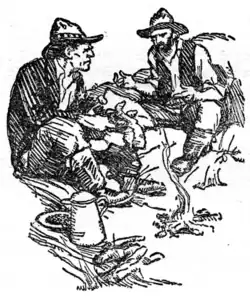
Such was desert hospitality given and taken by men almost a match in sternness and taciturnity. Toi-Yabe, realizing that the sheriff simply had chanced upon the claim at the end of a long ride and had grasped the chance to rest his horse, would not have spoken during the moments of smoking that followed except that he remembered the curious find made that day. Reaching back of the boulder, he brought up the small roll of shoes and stockings he had discovered, and tossed them across the fire.
“Ever see any yonkers up thisaway?” he queried. “These was lyin' here when I come back from town.”
The officer unrolled the bundle. Then a frown gathered on his forehead. Why, those things looked about big enough for his own kid—really something like the duds he'd seen on Dickie a few times! But of course there was no possible way Dickie could get out here, he assumed. Besides his own son, however, Stone Bellinger strove in vain to recall any children this size in the region outside of a few Mexican babies down at Tres Casas, and these, of course, wore neither shoes nor stockings.
“Yuh say yuh ain't seen any party up this side of the Red Chalk?” he questioned, glancing keenly up through graying brows. He did not know or ask the name of his host; a shrewd judge of men was Stone Bellinger, a man who cared nothing for names or ready-made reputations.
“Nope.” Toi-Yabe's answer was laconic, final.
Bellinger considered.
“Then I reckon I'll tote 'em along with me, in the mornin',” he concluded. And he went to roll up in his blankets, without further ado.
Next morning he was up in the false dawn's graying, before Toi-Yabe, built a fire, fed and watered the roan, made the coffee, and prepared a simple meal. Seeing that the prospector still slumbered—apparently only; Toi-Yabe was not altogether sure of the sheriff's intentions—Stone ate quickly and in silence, then set the coffee pot on the dying embers, saddled, and rode away toward Golman's Well. Toi-Yabe waited until the clicking of hoofs died away into silence before thrusting back a revolver into its holster and arising. He grinned a trifle wryly; a year before, it would have been courting sudden death for him to have camped a night with any sheriff!
 N HOUR later, with his drilling for a small blasting charge completed, Toi-Yabe affixed a cap and generous length of fuse to the sticks of forty per cent. He lighted the sputtering cord with its heart of black powder, then hastened over to the gully in which the animals were tethered. The burros could be counted on; they knew dynamite; but Cochise, the pinto pony, always snorted and reared, a wild, straining whiteness coming into his eyes. Only when Toi-Yabe was near could he be prevented from going into a nervous frenzy.
Seconds elapsed. Then a satisfying grroommm! announced that the tamping had been effective; that the force of the giant powder had been exerted downward, as well as in the direction of the shaft mouth.
As if that explosion had been an awaited signal, a sudden, faint pop-popping began, borne to Toi-Yabe seemingly from over the low mountain into which he was driving the shaft. He listened, tense, making certain that the gun battle—for the character of that fast shooting was unmistakable—was not in his valley, though probably just beyond the ridge. Then he shrugged. It was none of his affair. He went back to examine the shaft, bending to fan away the poisonous fumes with broad-brimmed Stetson before sliding down.
A cursory glance was rather disappointing. The rock showed no marked change in character, being if anything a trifle more barren in appearance. But suddenly Toi-Yabe became quiet, crouched on one knee. He had heard a most curious sound, one which brought every desert trained faculty into play! A low, rushing murmur came to his ears!
That instant he became aware, too, that a strange coolness was seeping in around his lowered knee and shin. Quickly he bent lower, testing with his ear, sniffing carefully. He heard it more plainly now. Water! He was near a subterranean stream or spring, that almost priceless discovery in this arid range! Water! If cool and sweet, it would allow him uninterrupted search for treasure, and comfort beyond imagining!
At last he found the tiny crevice through which a distinct chill of air rose in a steady current. With his ear to the crack he could hear the murmuring rush of waters even more distinctly. Feverishly then, forgetting for the time all thoughts of gold, he widened the crack, and into it thrust a prepared dynamite cartridge. Lighting the fuse, he scrambled out and away. Such was his haste he did not glimpse a furtive, oddly clad little figure on an abutment of rock just above.
Thoroughly frightened, gasping for breath after his flight and climb to escape the terrible man who had snatched him from his bed before dawn that morning, Dickie Bellinger wanted to climb down and speak to the tall, lean prospector—but had been too much in the grip of terror. One of the safety pins had opened, allowing the top of his rough cut “chaps” to drag behind as he crawled on hands and knees, but he paid it no attention now. He wanted someone, anyone—even Old Torky would have been welcome. So he came closer to that funny hole where the big man had gone.
He was close enough now so he could almost rubberneck over and see the man, when suddenly the latter reappeared, scrambling, running. Toi-Yabe had used only a short length of fuse this time, and he possessed a wholesome respect for dynamite.
Dickie stared, bewildered. What made that funny man run in and out of that hole? Was it the big bang he had heard?
That second, while Toi-Yabe still sprinted for the horse, Dickie's questions were answered decisively. Of a sudden a hideous, jarring roar blasted his ears. The rock upon which he crouched, quaked and leaped, throwing him sidewise, and the shock drove consciousness from him. He saw a swirl of black and green; then he knew no more.
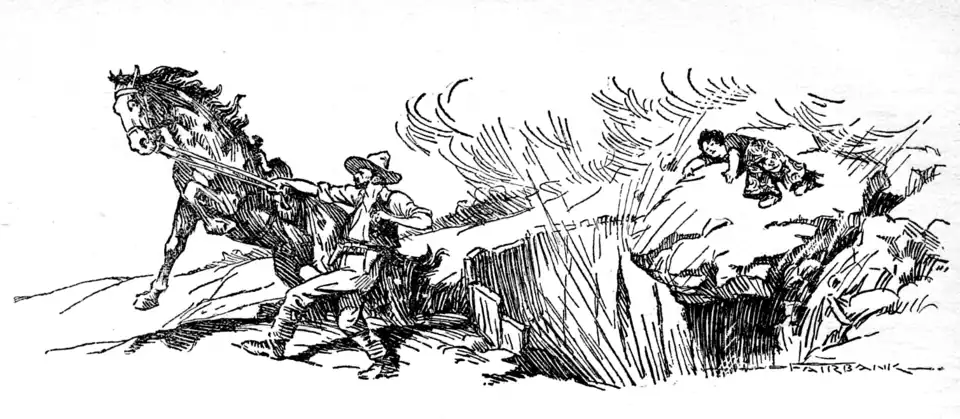
It was as well. Though protected by a foot-high sleeve of rim rock so that none of the upflung débris struck him directly, Dickie had perched on a battered ledge which had been about to slide of its own weight. The second shock was just enough; unostentatiously nine hundred pounds of rock, cracking to fragments, broke away, hesitated, then slumped gently into the prospect shaft, bearing on its top a tattered, unconscious little five-year-old who on this morning alone had lived through enough perils for a lifetime.
Toi-Yabe was delayed a few minutes in spite of his impatience. The pinto, Cochise, just then decided he had quite enough of these rumbling explosions, and acted fractious. So Toi-Yabe saw neither the small avalanche nor the figure of Dickie.
But he came on as soon as possible; and it was while fanning the fumes with his Stetson that he caught sight of something decidedly strange there in the bottom of the shaft. Was that the yellow, curly head of a child, for the love of heaven? He blinked, gasped as sudden, icy dread clutched his heart. His mind raced. The shoes and stockings—the sheriff's pointed question—
Had he killed some little youngster unknowingly?
III
 VEN as these thoughts flashed through his mind he was scrambling down, however. He lit sliding in the loose rock. It was a child, a boy, half buried, but still breathing! Toi-Yabe flung himself to his knees, tearing away the rock with his finger.
“God, I hope he ain't hurt!” he half prayed in the stress of anxiety.
Just then came an odd straining creak from the floor and the rock walls about him; supposedly solid as they were, just then they moved slowly an inch, two
But Toi-Yabe was lifting out the youngster, noting with increasing bewilderment the queer attire—and the fact that Dickie wore both shoes and stockings. Hurriedly examining the child, Toi-Yabe could discover naught save a multitude of small bruises. Just then Dickie sighed and moved in Toi-Yabe's arms.
“Oh—oh!” he gasped. “Torky! Oh!”
“'Sall right, old-timer. All O. K.” broke in the prospector, vastly relieved. “I'll have yuh fixed up an' goin' strong in jes' a second. I wonder how in hell yuh ever got”
He rose to his feet, bearing Dickie with one arm and stamping a way over the loose rock toward the upward slant. Right there a black aperture, through which cold air rushed vehemently, separated the floor from the side wall—and inch by inch, to the accompaniment of weird creaks, that crack was widening alarmingly!
Toi-Yabe saw and understood—just too late. A cry ripped from his throat, and he sprang for the slant. But as one boot was upraised to catch a foothold, suddenly and with no further ostentation, a rough circle of foot-thick rock—the thin floor of the shallow shaft—dropped downward into unmeasured blackness!
Toi-Yabe, holding fast to Dickie, pitched forward, an involuntary cry bursting from his set, dry lips, and one arm grabbing widely and seizing—nothing! Tumbling headlong, he went into the black, fathomless pit. In the brief split second of falling he touched nothing; and gave himself up for lost. There was no telling how deep might be this awesome subterranean cavern.
He found out almost instantly. With a ripping splash which reverberated from close-constricting walls, the section of rock ceiling struck the surface of a black, sweeping, almost silent river hastening on its way beneath the rock arches to the flume which gave it back to the daylight in the far, almost inaccessible canyon of the Virgin River.
Toi-Yabe and his companion in misfortune struck the upflung spray in falling; and then his breath was caught from him in a constricted gasp. He clove the surface of an icy stream, was caught by the full force of the deep current, and fought with a reaction of furious energy against the whirling, sucking current, against the bruising outthrusts of the rock wall, and above all against the unbelievable chill of this subterranean river.
The immersion brought a choked outcry of terror from Dickie, coming abruptly to consciousness. With childish instinct he flung both arms about the neck of Toi-Yabe and held on with all his strength. It was, perhaps, the best thing possible, as Toi-Yabe, in the following seconds, could not even spare the use of one arm.
This was no sunken spring of the desert, gradually cooled by its hidden course. In its majestic onsweep could be recognized the force of miles of descent and the pull of a predetermined outlet. In its gripping cold was the taste of far distant snows of the high Sierras.
Hampered as he was by Dickie, by heavy boots, crisscrossed belts with their weights of cartridges and holstered six-guns, Toi-Yabe struggled for every breath he drew. Much of the time, as helpless as a curled piñon chip in a whirlpool, he was drawn beneath the surface, flung sidewise or end-on against slime-smoothed granite, or bruised by obstacles in the curving course.
He scraped his fingernails along a slippery wall, and then without warning was tossed to the far side of the river. There he struck with stunning force against something which held him a moment in spite of the dragging power of the relentless river. Instinctively he clutched and, though his fingers slipped as if trying for a hold on buttered brass, this was a rock formation of such shape that he was allowed to grip one elbow about it, clasping his own bent wrist. Instantly he was swirled about, his boots swinging to the surface as his body skittered as a float of little appreciable weight.
“Hold on, kid!” he gasped.
Only then did he truly come to grips with the immensity of the stream's momentum. For several seconds he held on, breathing in great gasps of the chill air, coughing and choking out the water which had descended to his lungs.
He did not dodge comprehension of the issue. If once he let go of this upright column which, like an I-beam, let the flood roar past on both sides, both of them were finished. He never would have the stamina to struggle again with the sweep of the current. Slowly and with infinite carefulness he drew himself back to a precarious kneeling position against the sloping pedestal base of the I-beam. The fingers of one hand explored upward, but found nothing save added inches of the slippery column.
If he only could see! Little hope stirred in his mind that even at the top of this sliver of granite lay anything promising escape; yet in the very fiber of Toi-Yabe Tolman was that deep-wedged élan of the battler; that flexibility of ready, combative spirit which takes emergencies and perils exactly as they come, and compresses from each the full blood of opportunity,
An opportunity to determine just how bad really was his plight came to mind. He edged closer to the pillar, slipped from the rounded pedestal nearly losing his grip, then slowly won back until he could hold his weight against the current with his left elbow and hand. Then he reached to his right holster. The revolver was gone!
His lips set grimly, yet he did not falter. In the long, careful process of shifting back so that he could reach the other gun he reflected sardonically that if a few million thirsty animals like his own tethered and deserted burros and pinto back there in the arid valley just could get at this river for a while—upstream, of course—he'd be able to wade out of the damned thing!
 HE second Colt was there. He lifted it, flirted it sidewise and back to remove as much water as possible, and then pulled the trigger. Click! One cartridge, at least, had been ruined by the immersion. This time his thumb drew back the hammer and released it in one smooth motion. The muzzle shot red-yellow fire into the dripping blackness, and the explosion of the big revolver, caught and thrown back by the cramping ceiling, was deafening.
But Toi-Yabe did not care. He even grinned.
“Hold it, kid!” he cautioned again.
There, only two feet above the level of his head, ran a smooth, yard-wide ledge—probably a high-water mark of some day long past, or perhaps the remnant of a river bed which once existed when this stream held far greater volume!
The problem was ticklish enough. Climbing to the ledge meant mounting to the sloping base of the pillar, straightening upward, securing some sort of hold in a crevice or outcrop on the floor of the ledge. Kneeling, with one arm crooked about the upright rock, he just could reach across and touch the finger-tips of one hand to the sharp edge. Between pillar and wall below the ledge swift water swirled.
Twice he essayed to stand, and both times the impossibility of obtaining a dependable foothold was emphasized by bruising falls against the pillar and back into the water. Once only a quick grab of both arms saved him from being swept away.
Now in spite of his great reserves of strength he felt the dulling of exhaustion. His shoulders ached. The feet in his watersoaked boots had numbed into clods. He still could move them from the knees and ankles, but sensation had departed.
“Freezin'” he muttered. “Hope yo're warmer'n I am, little feller!”
Gaining the kneeling position again by slow, painful degrees, he reached down one hand carefully and unbuckled one of his two crossed cartridge belts, that which held the empty holster of his right-hand gun.
He slipped the fraction of an inch; clutched and froze. Then inch by inch with infinite caution, he encircled the slender pillar with the strap, while holding the buckle clamped between his teeth. A leaning forward—a meeting of the two ends—a quick pull.
He made an inarticulate noise of triumph, one that was chopped into jiggling syllables by his irresponsible teeth. The belt was in place! It hung slantingly in the water with the loop of the cartridges below. Toi-Yabe tested it with one hand, found that it could slip no lower, Then he reached about and loosened the viselike grip about his neck, securing a sound hold of the terrified, speechless child.
That instant he thrust one knee into the loop, drew up the other foot, and stood erect! From that position it was easy enough to cross the narrow gap to the ledge.
Upon hands and knees, little Dickie close beside him, feeling his way upon the down-slope of the ledge, Toi-Yabe started in the direction of the spot where he had dropped from surface of the valley above. Far, far up-stream there would be a hole in the roof of this cavern, and light—if nothing else hopeful. It seemed too much to expect that he could negotiate a way to the point where his mishap had occurred and there manage to climb to the hole. Yet this seemed the greatest chance. Probably it was the only one.
The two made rather rapid progress for a time, Toi-Yabe keeping his left hand upon the outside edge and groping forward and sidewise with his right before going ahead. Always he held Dickie inside. Once the ledge narrowed to little more than two feet of width. Here a wedge of the rock had dropped away, too. By sitting down, letting his boots touch the surface of the stream again, he managed to lift himself and the boy along the broken causeway, however, to the reassuring widening beyond where the ledge rose a trifle. He breathed freer.
Illustration: The two made rapid progress for a time
The relief was short-lived. Three or four yards beyond, Toi-Yabe's left hand found a sharp right-angle in the edge, and his groping right encountered nothingness! He inched forward, lifted out the Colt revolver. A shot blazed into the inky darkness, causing Dickie to cry out and shrink close. During the momentary life of that red-yellow flare Toi-Yabe saw that what he had dreaded most lay before him. This was the end of the ledge! True, ten or twelve yards beyond a six-inch sliver of horizontal rock still clung to the arching tunnel wall, yet all the rest had broken away. Since manifestly it was impossible to cross the stream or breast the current, they could proceed no farther in this direction.
But one alternative remained, and Toi-Yabe, his wide mouth tightened, played it. He turned and slowly made his way with the lad back through the pitch blackness. Time for them did not exist. Since they had fallen into the water he supposed several hours had elapsed; and now, with every prospect of another blind end to his ledge of comparative safety, he was tortured by the picture of the suffering he had brought upon the child—suffering borne uncomplainingly, however.
 T THE break in the ledge where the black, speeding surface curved on two feet below he leaned, cupped his hand, and drank, then offering some to Dickie. The water was hard with mineral, yet it lacked even a trace of alkaline bitterness. This showed clearly that for a long distance upstream, at least, the river did not see the surface and daylight. Though Toi-Yabe never was to ascertain the fact, the stream likewise kept to its subterranean channel until it mingled its substance with that of the stern Virgin, bound for a mating with the great Colorado.
Time unmarked, unguessed, crawled along. When he was tolerably certain that he had passed the pillar which had given him access to the ledge, Toi-Yabe halted and fired, desiring another brief glimpse. There right ahead, a few yards, was the self-same pillar or another exactly like it! Such similarity was not probable. Toi-Yabe grimaced. The progress of the two was like that of a heavy lizard, yet he certainly had believed they must have traversed much more than this distance. He continued the grim, almost hopeless journey, speaking brief words of encouragement to Dickie.
He reached what seemed the end, indeed. A cave-in of the wall had filled the ledge with loose rock. One large, jagged chunk in particular blocked the way. The remaining shots from Toi-Yabe's six-gun revealed that the blockade extended over a width of only four or five feet, though for all he could do in climbing, the burdened ledge itself might as well have given away.
Methodically reloading the weapon, the prospector probed forward with one hand leading his charge. He soon found that the risk of clinging to this jutting as he edged about would be a poor chance, indeed. Loose rock slivers fell away, and more came from the wall. Instead of attempting this, Toi-Yabe dug carefully with his fingers, lifting out pieces of granite and dropping them in the stream. Soon he met the large boulder. Tentatively he wrenched, and then crowded back in quick alarm. With a grinding crash quickly followed by a splash the overbalanced weight of granite fell into the stream!
Toi-Yabe, who had dared hope for no such immediate success, quickly seized Dickie, and edged past the spot upon which more rock might fall at any moment. He found himself upon a broadening, ascending curve of the ledge, where the low, rushing mutter of the onyx waters seemed to die away. Here, though he did not pay it much attention, the stream dived still deeper in a brief arc. Along the breast of this curve sheer centrifugal force threw outward small whitecaps, invisible now.
A dozen yards more, and then Toi-Yabe stopped, quivering—and not from the cold which had left his veins there while he wrestled with the cave-in of rock. Unless hope deceived his eyesight, ahead and high on the same side he traveled, was a faint but discernible streak of gray! It had to be light; and the presence of light in this tunnel could mean nothing save an aperture in the ceiling—possibly just such a break in the floor of the valley as that one through which Toi-Yabe and the lad had come into peril!
It was characteristic of the tall, lean ex-bandit that an unexpected hope, instead of causing him to rush forward in an impulse of tumultuous relief, held him quiet one interminable minute, arm around Dickie, considering. Then he drew the newly loaded six-gun, snapped two spoiled cartridges, and obtained an explosion from the third.
But he saw little during the brief flash, except that a ten-foot ledge inclined upward. He rose to his feet.
“Looks good, little feller,” he said.
“I'm c-cold!” chattered Dickie.
That second, from perhaps fifty yards in front and above him, a shot blazed forth in answer to his own! The leaden slug went pttt upon some part of the rock wall, then whined on in ricochet. Almost the same instant a second flash and report came; where the bullet went Toi-Yabe did not know. He thrust Dickie behind him. His gaze was fastened upon the broad way gently inclining upward in a slow curve; he had caught an ephemeral glimpse of a crouching figure there at the top of the slope.
Toi-Yabe dropped to his elbow, forcing Dickie to lie down.
“Stay right there, рard!” he whispered. Reloading the fired chambers of the .44, he shifted his single remaining belt holster to the rear and began the Indian stalk. The other man had all the advantage, yet Toi-Yabe, obsessed by a gnawing sympathy for the lad whose life had been thrust into his hands, was in no mood to compromise. More than once he had fought to a finish with an opponent in the chaparral; his bandit days were filled with such encounters. Now with the gray light high to the right becoming more and more plain, he was ready to exercise every wile and kill without mercy this unknown man who obstructed the road.
Another might have cried out, attempting parley—and surely failing, as circumstances were ordered. Тoi-Yabe, believing that the skulker above would think him hugging the inside wall, bellied forward on the very brink of the river. Now he saw vaguely the wide flat of a horizontal lie of the ledge, though strive as he might he could distinguish no hint of his unknown opponent.
A third shot blazed. This time Toi-Yabe saw momentarily the man's head and extended arm. Yet Toi-Yabe held his fire. He knew now where the other was waiting, and went for that spot with a minimum of delay. Knowing that he himself was shielded by an impenetrable blackness, Toi-Yabe covered the yards swiftly but noiselessly, keeping to the outside.
The grayness was becoming more pronounced. Toi-Yabe saw that it must come from a ceiling aperture some distance beyond and to the side of his quarry. It did not show up the bed of the ledge, however. So, following a rapid approach of what he estimated to be forty yards, Toi-Yabe assumed his slow crawl again, leaving the outside for the first time. In a hand-to-hand tussle, as this well might prove to be, he preferred the rock wall at his back.
Who could be the man who was ready to dispute with lead any encroachment upon this peculiar subterranean preserve? What was his reason for jealousy? Toi-Yabe, creeping forward, would have liked an answer to both questions.
IV
 HE expected gunfight to a decision did not occur. Toi-Yabe had crawled at least far enough, he thought. Still, he heard a sound ahead. It was the aspiration of slow but jerky breathing! Then came a low groan, some muttered unintelligible words.
Toi-Yabe frowned. A futile decoy! He edged toward the sound, however, rose to his feet. His thumb held back the filed hammer of his six-gun. He hoped grimly that it did not misfire again from a water-soaked cartridge when he came to the showdown.
Outside in the big sunlit world a mere handful of nimbus had been over the sun for a space of minutes. Alone in a painfully blue Nevada sky, the cloud held on a while, and then gave up. In another clime it might have been thought the precursor of a storm; here it was something to be looked at and viewed with wonder. Of course no rain was expected.
Toi-Yabe did not know anything of the cloud; yet as he inched along, waiting to kill a man whose hand had fired three times at him—and without excuse—he saw the gray light brighten, become even intense! The broad ledge gradually became limned by reflected sunlight.
Then Toi-Yabe saw his man!
The prospector did not fire immediately—and eventually did not fire at all. The fact was that with the growing light of the inducted sun he saw a figure sprawled out, face against the rock and right hand limply holding a weapon, far ahead.
Toi-Yabe watched, his thumb holding back the hammer of the Colt. Thus he stood while long seconds ticked by.
Then he walked forward a step, two silent steps, three. After due deliberation he reached the prone body, quickly secured its two revolvers and made certain the man had no knife or derringer concealed.
After that Toi-Yabe looked more closely at his antagonist, finding him unconscious. He was Sheriff Bellinger!
Repressing his unbounded astonishment, Toi-Yabe hurriedly brought up Dickie, and then examined the wounded sheriff. The latter was wounded twice. One bullet had passed through the right side rather shallowly; whether or not it had damaged a vital organ the prospector could not determine. The second leaden slug had shattered Bellinger's right shinbone, and undoubtedly was more painful if not as dangerous. The sheriff had lost a great deal of blood. Toi-Yabe, utilizing the other's own clothes for bandages and a rude compress, managed to check the flow—albeit from the pools of blood on the rocky floor he doubted seriously that Stone Bellinger ever would recover consciousness.
“Daddy!” cried the boy, when first he glimpsed the face of the inert man.
He squirmed away from Toi-Yabe, to run to the side of his idol—the man who from the first had chosen the grim pursuit of the law's vengeance rather than the love he himself had helped to create.
“The hell!” gasped Toi-Yabe Tolman. This affair had grown too complicated for even his keen abilities in analysis. The kid belonged to the sheriff. The sheriff had half-recognized the shoes and stockings, apparently. He, Toi-Yabe, unwittingly had imperiled the lad, only to save him from the subterranean river—and find at the other end of the cavern Stone Bellinger, ready to fight to the last gasp against someone! And then, there was the memory of that rapid gunfire heard across the ridge—shooting which occurred only a short time after the sheriff departed from Toi-Yabe's camp. What did it all mean?
He drew Dickie away, comforting the lad, assuring him that the daddy would be all right after he'd had a good long sleep—phrasing hope rather than certainty. Then by tactful questions he drew from the boy a lurid, nightmarish tale of being snatched from bed, gagged, and carried away by a big, fat man on horseback. Toi-Yabe obtained a serviceable description of that big, fat man, and his mouth drew into a line. Haj Maddox! What the fool's idea could have been was hard to discern, yet motives now were unimportant. Maddox once and for all had placed himself beyond the pale of sympathy or toleration. Only justice could await him now.
The running fight down the neighboring valley with the sheriff riding hard in pursuit and shooting only at the legs of Haj's fleeing animal, in order not to wound his own son, Dickie gave with a dramatic force entirely unconscious. Haj, terrified at the unexpected meeting which jettisoned his scheme in an instant, thought only of his own escape. Riding as hard as he could force the cayuse, he came to rocky, uneven ground down among the cave formations, steadily losing his lead over the relentless Bellinger.
A sudden idea came to the fleeing criminal. Passing a black crevice in the hillside, one which looked like it might drop to the bowels of the earth, Haj bent from the saddle and tossed Dickie into it. He figured Stone Bellinger would stop, and that was exactly what the sheriff did—but for another reason.
Both men fired, and both scored hits. Bellinger tumbled from the saddle, while ahead of him the horse of Haj Maddox stumbled and pitched headlong, dying. And then, while both men were dazed, little Dickie scrambled up and climbed to escape them, unaware that his own father was one of the creatures of this terribly real nightmare.
Later, Haj realized that now he was committed. Either the sheriff and his boy died right then and there, or Haj could plan on stretching hemp. Shots were exchanged. Bellinger was wounded again, but managed to crawl to the sheltering crevice. Grinning like a wolf, Haj Maddox was satisfied. He did not dream of another entrance to that cavelike hole. He settled, six-gun in hand, to await the appearance of either the boy or man. He would be in no danger; this sort of pot-shot gun-fighting suited him right down to the ground.
Toi-Yabe did not learn all of this from Dickie, yet he could surmise the situation. His face took on the hammered bronze expression well known to his old associates of bandit days, the killer's mask. He removed his own watersoaked belt and gun, replacing it with the sheriff's two belts and long-barreled Remingtons. He hefted the weapons, saw that they were freshly loaded, and then slipped them up and down in their holsters. Then, cautioning Dickie to remain beside his father, he climbed up the narrow way to the irregular opening to the sunlight.
 NOWING the cowardly Maddox of old, Toi-Yabe felt certain that the kidnapper would be ambushed close to the mouth of the cavern, waiting like a bloated spider to pounce upon its prey. The chief fact, then, to be determined, was the exact direction and whereabouts of the ambush. Just back of the shielding slate overhang which made an elbow of the crevice at ground level, he froze to immobility, listening.
Yet it was not through the sense of hearing that Toi-Yabe discovered the necessary information. Not a sound came to him. Haj, if he were there, had found a restful position, apparently, and was enjoying the anticipatory wait.
Toi-Yabe suddenly sniffed gently. Borne to him, diffused but yet pungent, came an aroma he recognized, one which set up within him the acute appetite of long deprivation—cigarette smoke! The smoke reached his nostrils, but where did it come from? There was almost no breeze at all.
Then he suddenly tautened. A wisp of bluish gray fumes, holding together, drifted lazily across his vision, coming from the left. Well, Haj was there. One time was as good as another. Crouching, his muscles coiled like steel springs, he drew both guns. Then with a wild, terrific shout of jeering triumph, he leaped up like a jack-in-the-box and alighted—running, and shooting! He had one brief glimpse of Haj Maddox, back against one boulder while his left elbow rested on another. Maddox shot. Toi-Yabe shot twice while scarcely on the ground. All three bullets went wild. Then Toi-Yabe, chuckling in sinister fashion, dove behind the identical boulder which sheltered his enemy!
“I've come for yore ears, Maddox!” Toi-Yabe chuckled in a blood-curdling tone. “Be sayin' yore prayers, hombre, if yuh got any.” He went on without cessation, the while watching eagle-eyed for the slightest glimpse of the criminal who huddled on the other side of the rock.
Toi-Yabe knew his man. The leap and yell had been carefully calculated, and successful. Now, while possessing no real advantage in position or otherwise over Maddox, Toi-Yabe played deliberately for the yellow streak he firmly believed Maddox possessed. As the assortment of threats and promises came about the four-foot boulder, the shrinking, appalled kidnapper's nerve broke. “I ain't got no fight with yuh, Toi-Yabe!” he quavered at last. “Le's call it quits.”
“No quits!” retorted Toi-Yabe. He calmly shot away an inch of Stetson rim which showed for an instant at one side of the sheltering boulder. “Throw yore guns away, an' reach for the sky!”
“Yuh ain't goin' to”
“I'll count five! Then I'm comin'! One—two—three”
“I—I give up!” came the yelp of terror seemingly unadulterated.
A pair of six-guns clanked to the rocks, and the green-swarthy, hatless head and two upraised arms of Haj Maddox appeared. An odd, desperate gleam shone from his black beads of eyes, nevertheless.
At a loss to account for it for a second, Toi-Yabe studied his prisoner. Then he noted that Haj's hands were held aloft palms backward—and he smiled grimly. An old trick, but good at times.
“A'right. Come here,” he bade, seeming to let his revolvers droop carelessly.
It seemed to be what Haj had hoped to see. With a sound between a grunt and squeal, he suddenly yanked down his right hand.
That same split second a slug from one of the big Remington's smashed through his navel. The stratagem had failed. Haj's palmed derringer exploded, indeed, just as he buckled, screaming, but the bullet merely smudged a whitish streak upon the rock between Toi-Yabe's feet and ricocheted away.
Merciless, grim, Toi-Yabe lifted the dead body of Maddox and dragged it far down the valley, dropping it without ceremony. Then he returned to Dickie and his father.
Bellinger was conscious.
“Did yuh get him?” he queried in a whisper.
Toi-Yabe nodded.
“He's out there—the only hombre I ever hope to kill I wouldn't cover up from the buzzards!” he added. “But now I'll get yuh a drink. I want yuh to take it easy. The kid here an' me so we can take care of yuh right. Is that O. K.?”
The trip over and back, and then the ensuing days of Bellinger's early convalescence, were strange days indeed in the career of Toi-Yabe Tolman. Shamelessly from the first he made a partner of the five-year-old, though realizing the idolatry of Stone which occupied nine-tenths of the lad's heart. Little by little Toi-Yabe learned the whole pathetic story of the kilts and the home-made chaparejos,
Once when alone he clenched a fist and shook it at the back of the sheriff, who now was sitting up.
“Damn yuh!” muttered Toi-Yabe. “I'd take pleasure in belting yuh a couple, myself, if yuh was well! A father—huh!”
But then, while Dickie had the parent he worshipped all to himself and signs of a different attitude were plain in the expression of Bellinger, Toi-Yabe occupied himself mysteriously. He pretended to be prospecting a far canyon branching from this valley. Actually, with some of his own clothes and one of Bellinger's worn bearskin chaps, he was making strange upward and downward passes with a coarse needle.
Then came a day when he called the boy and made him don a certain costume—complete, in imitation of his daddy's, even to the belts and holsters—the latter cut down from those of Maddox. Then he made the impatient Dickie await call, while he squatted down beside the sheriff. Then and there the latter heard the entire story of the boy he had shunned.
“Come here, Dickie!” concluded Toi-Yabe, rising unexpectedly.
With a glad, excited shout Dickie, asmile from ear to ear, dashed out proudly, stopped, threw out his chest, and slapped his hands to the empty holsters.
“I got pants—an' real, honest-to-time chaps!” he cried joyfully.
“That-thar's yore son,” remarked Toi-Yabe dryly, avoiding looking at Stone Bellinger, down whose rugged cheeks tears now coursed frankly. “If 'twas me, I'd say yuh didn't deserve him!”
And with that he turned on his heel, just seeing the lad run to his father, and went to where the laden burros and pony were waiting.
“C'mon, Cochise,” he bade quietly. “'S time we was mooching along. I reckon, though, somehow, it's goin' to plan to move my camp over thisaway be damn' lonesome in the next valley.”

This work is in the public domain in the United States because it was published before January 1, 1930.
The longest-living author of this work died in 1942, so this work is in the public domain in countries and areas where the copyright term is the author's life plus 82 years or less. This work may be in the public domain in countries and areas with longer native copyright terms that apply the rule of the shorter term to foreign works.

Public domainPublic domainfalsefalse