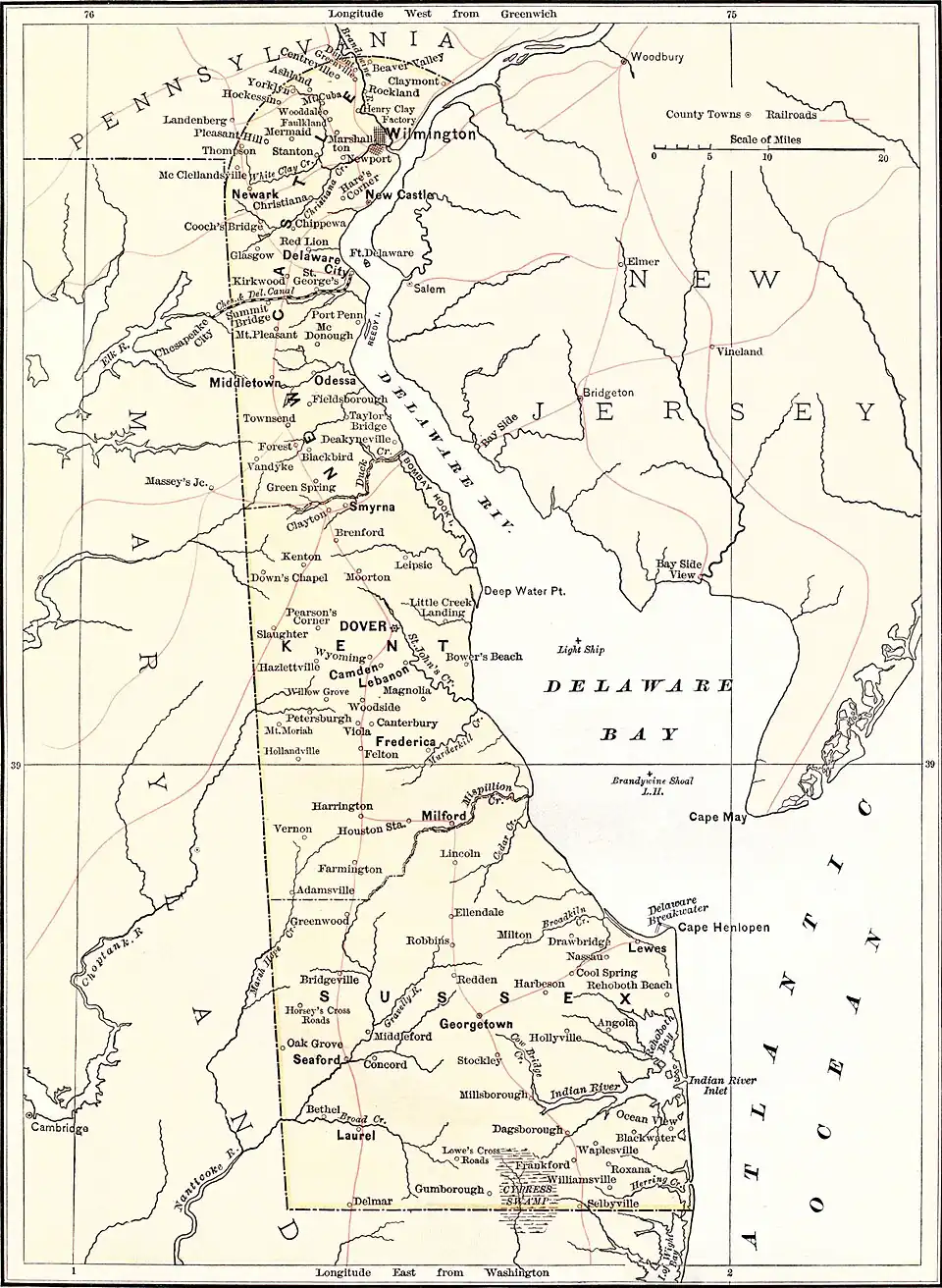
On the 28th of August 1609
Henry Hudson sailed into the Delaware Bay; but, finding the water shallow and difficult to navigate, he made no exploration, leaving that honour to the Dutch
navigators,—Hendrickson in 1616, and in 1623 Mey, whose name is borne by the eastern cape of the bay. There is a tradition that Lord De la Warr, when on his way to
Virginia in 1610, anchored in the bay, but it is not authentic. It was in 1626 that Gustavus Adolphus, king of
Sweden, by the advice of a Hollander, William Uesselinx, issued letters-patent for a settlement on the west shore of the Delaware
River—called by the Indians Poutaxat, and by the Dutch South
River—for a trading-post. The queen dowager, the royal council, the nobility, the bishops and clergy, as well as large numbers of the people, contributed money for the
colony ; but the long war with
Germany, and the death of the king, caused the scheme to fail. In 1639 Queen Christina sent out a colony under the charge of a Dutchman, Peter Menewe, who first landed at the mouth of the Delaware, near the present town of Lewes, which they named Paradise Point. Here they made a purchase from the Indians of all the land on the west side of the river, from Cape Henlopen, at the mouth of the bay, to Trenton
Falls ; and as none of the Swedes understood the Indian language, the deeds were written in Dutch, and sent to Sweden for preservation. The first settlement the Swedes made in their newly acquired country, which they called New Sweden, was near the Delaware River, where the Christine and Brandywine Creeks join, and where the city of Wilmington now stands. Here they built a fort, which they called Christiana. The Dutch had a few weak settlements on the Jersey shore, but they also claimed the west bank of the river, and wrote a remonstrance to Menewe, though they did not, perhaps could not, interfere with the colony, which Minnewitz governed for three years, appointing at his death a successor. The Dutch proved troublesome neighbours, and as a retaliation for the building of Fort Christiana, they built Fort Casimir, six miles below the Swedish settlement. Still Governor Stuyvesant and the Swedish governor, Printz, were on amicable terms; and when the former visited his new fort on the west side of the Delaware, the two promised to be neighbourly and friendly, and to act as allies if needful. But in 1654, Governor Rising was sent from Sweden with a large number of colonists; and his first act was to take Fort Casimir, which he did without bloodshed, renaming it the Fort of the Holy Trinity, in honour of
Trinity Sunday, when he captured it. This brought Governor Stuyvesant from
New York, with six or seven vessels, and as many hundred men, who not only retook Fort Casimir, but marched to Fort Christiana and captured it also. Stuyvesant compelled the Swedes to swear allegiance to the Dutch Government, and those who refused the oath were forced to leave the country. Thus the colony of New Sweden was obliterated, and the Dutch became owners of the west shore of the Delaware River, having at Fort Casimir, which they called New Amstel, a governor of their own, though under the jurisdiction of the governor of Manhattan (New York). In 1664 Sir Robert Carr, after capturing Manhattan, sailed up South River, and took New Amstel, changing the name of the river to Delaware, and New Amstel to New Castle on Delaware; though the Swedish chronicler
affirms—“ there has never been a castle in it.” For nine years was the colony held by the English, Carr being governor under Governor Lovelace of New York. Lord Baltimore had claimed, during the Dutch administration, all the lower part of the territory, within two miles of New Amstel, and whilst Governor Lovelace was in office he still urged his claim. In 1673 the Dutch admiral Eversten stormed New York, took it without capitulation, and again there was a Dutch governor on the Delaware. This rule was short, for in the very next year all the English colonies were ceded back to England by the Peace of Westminster. Yet the settlement on the Delaware seemed doomed to change its
owners ; for, becoming the property of the duke of York by a special grant, there was a governor sent to New Castle in the name of the duke, who himself never visited his possessions in America. In 1682 the duke gave, or nominally sold,
“ the three lower counties” to
William Penn, so that they became a part of Pennsylvania. At first an effort was made that the
“ three lower counties” should send their delegates to the Pennsylvania assembly, which should legislate for the whole; but as the interests of the two sections of the province were different, the
“ three lower counties” insisted upon a separate assembly held at New Castle. After Penn's death, in 1718, there was a lawsuit between his heirs and those of Lord Baltimore, as to the boundary line between their possessions. The suit was carried into the
Court of Chancery in England, and pending the
trial the
“ three lower
counties ” were not sure to whom they belonged, and so paid no land rents. In 1768 the
suit was decided, and commissioners appointed, who defined the boundary line of
Maryland as it now stands. It was in
the year 1776 that
the first constitution of the
State of Delaware was framed, whereby
“ the three lower counties on the Delaware” lost their awkward name, and again had a new form of
government. In the same year Delaware, as one of the thirteen colonies, signed the
Declaration of Independence; and in 1787 the
State, in convention, adopted
the constitution of the
United States. In 1792
a new State constitution was enacted, and again in 1831, which is now in force. Under it, the governor is
elected for four
years, and the legislature meets
biennially at
Dover, the
State capital. Delaware was one of the original thirteen
States, and, though slave-holding, remained loyal to the
Union at the secession of the Southern States in 1861.