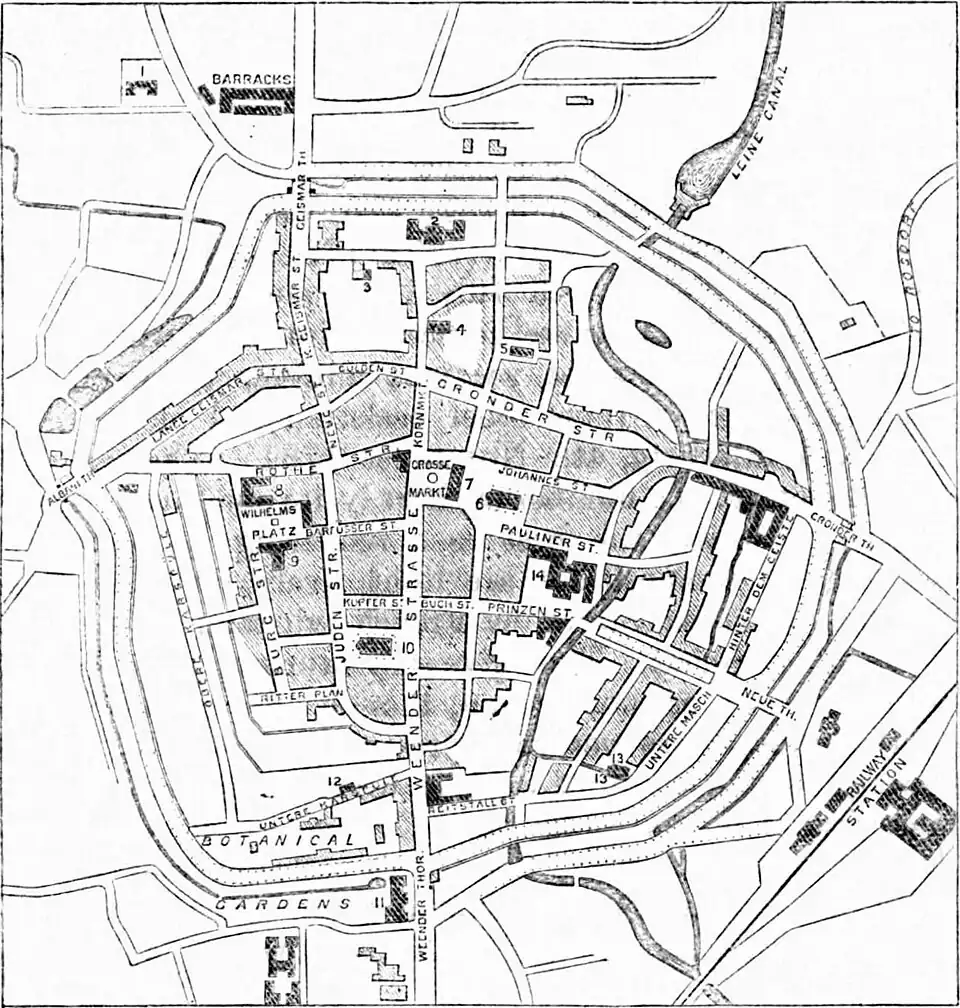
GÖTTINGEN, the chief
town of a circle of the same name in the
land-drostei of Hildesheim and province of Hanover, Prussia, is pleasantly situated at the foot of the Hainberg in the fertile valley of the Leine, about 67
miles to the south of Hanover, on the Hanover and Cassel railway. It is traversed by the Leine, which separates the
Altstadt from the
Neustadt and
Masch; and it is surrounded by ramparts which are planted with lime trees and form an agreeable promenade. The
streets in the older part of the
town are for the most part crooked and narrow, but the newer portions are spaciously and regularly built. Apart from the churches and the numerous university buildings, it has few structures of any public importance. There are several thriving industries, including, besides the various branches of the publishing trade, the manufacture of woollen and cotton goods, and of physical and mathematical instruments. The university, the famous Georgia Augusta, founded by
George II. in 1734, and opened in 1737, rapidly attained a leading position, and in
the year 1823 its students numbered 1547. Political disturbances, in which both professors and students were implicated, lowered the attendance to 860 in 1834; and the expulsion of the famous seven professors (Albrecht, Dahlmann, Ewald,
Gervinus, Weber, and the brothers Grimm) in 1837 still
further reduced its prosperity. The events of 1848, on the other hand, told somewhat in its favour; and since the annexation of Hanover in 1866 it has been carefully cherished by the Prussian Government. In the winter session 1877–78, its students numbered 909, and the teaching staff 124,—its numerical strength thus entitling it to rank as the eighth on the list of German
universities. The present professoriate includes, among other distinguished names, those of Benfey, Lagarde, Lotze, Ritschl, and Weber. Amongst those who have been teachers within its walls may be mentioned, besides the seven already named, Haller, Gesner, Gatterer, Sprengel, Heyne, Blumenbach, Herbart, Heeren,
O. Müller,
K. F. Hermann, and Eichhorn. Neander, Ewald, and the distinguished chemist Bunsen, it may be added, were natives of Göttingen. The university library contains upwards of 500,000
printed volumes and 5000 manuscripts. There is a good chemical laboratory, as well as adequate zoological, ethnographical, and mineralogical collections, the most remarkable being Blumenbach’s famous collection of skulls. The other establishments more or less connected with the university, such as the observatory, botanical
garden, and various hospitals, do not call for special notice. The
Gesellschaft der Wissenschaften publishes the long-established and well known
Göttingische Gelehrte Anzeigen. The
population in 1875 numbered 17,057.