Floor Games/Section IV
Section IV
CASTLES AND WAR
GAMES, BUT VERY LITTLE
OF WAR GAMES
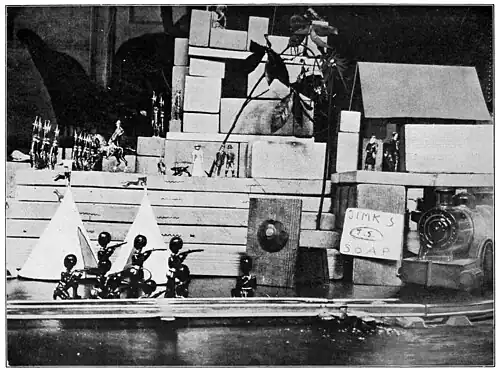
The School of Musketry. On the terrace the Town Guard parades in honor of the two mayors
CASTLES AND WAR GAMES, BUT VERY LITTLE
OF WAR GAMES
I have now given two general types of floor game; but these are only just two samples of delightful and imagination-stirring variations that can be contrived out of the toys I have described. I will now glance rather more shortly at some other very good uses of the floor, the boards, the bricks,
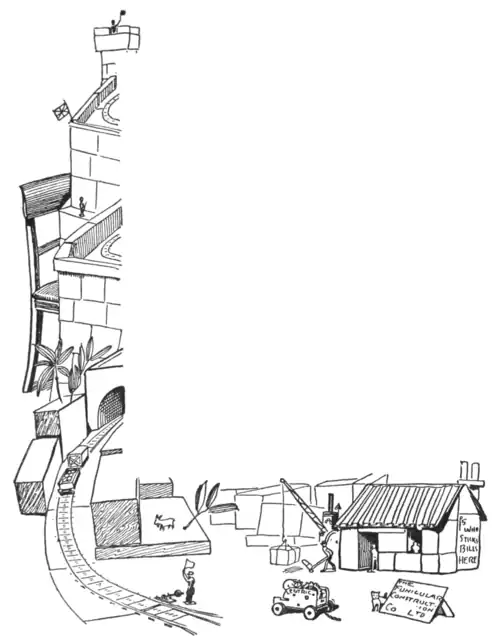
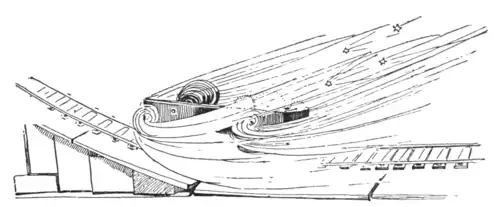
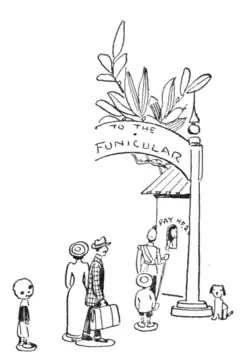 the soldiers, and the railway system—that pentagram for exorcising the evil spirit of dulness from the lives of little boys and girls. And first, there is a kind of lark we call Funiculars. There are times when islands cease somehow to dazzle, and towns and cities are too orderly and uneventful and cramped for us, and we want something—something to whizz. Then we say: "Let us make a funicular. Let us make a funicular more than we have ever done. Let us make one to reach up to the table."
What is a 'lectric? You may well ask. 'Lectrics were invented almost by accident, by one of us, to whom also the
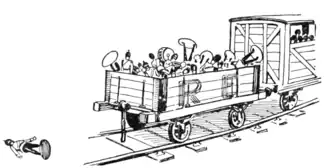
You know, perhaps, what a toy engine is like. It has the general appearance of a railway engine; funnels, buffers, cab, and so forth. All these are very elegant things, no doubt; but they do not make for lightness, they do not facilitate hill-climbing. Now, sometimes an engine gets its clockwork out of order, and then it is over and done for; but sometimes
it is merely the outer semblance that is injured—the funnel bent, the body twisted. You remove the things and, behold! you have bare clock-work on wheels, an apparatus of almost malignant energy, soul without body, a kind of metallic rage. This it was that our junior member instantly knew for a 'lectric, and loved from the moment of its stripping.
(I have, by the by, known a very serviceable little road 'lectric made out of a clock-work mouse.)
Well, when we have got

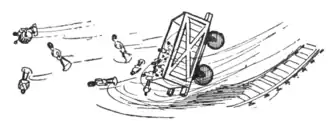
make them have level-crossings, at which collisions are always being just averted; the lines go over and under each other, and in and out of tunnels. . . .
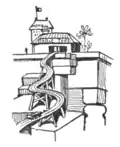
The marble tower, again, is a great building, on which we devise devious slanting ways down which marbles run. I do not know why it is amusing to make a marble run down a long intricate path, and dollop down steps, and come almost but not quite to a stop, and rush out of dark places and across little bridges of card: it is, and we often do it.
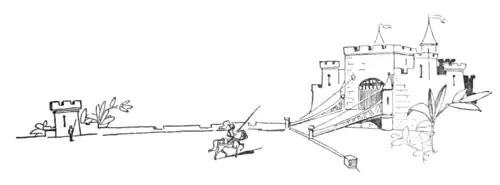
Castles are done with bricks and cardboard turrets and a portcullis of card, and draw-bridge and moats; they are a mere special sort of city-building, done because we have a box of men in armor. We could reconstruct all sorts of historical periods if the toy-soldier makers would provide us with people. But at present, as I have already complained, they make scarcely anything but contemporary fighting men. And of the war game I must either write volumes or nothing. For the present let it be noth-