Greenland by the Polar Sea/Chapter 6
JUNE 4th.—We had no other choice but to get away from Nordenskjöld Fjord as quickly as possible. A hunting expedition across the ground where Hendrik and Bosun had shot their musk-oxen gave no result; we merely made the acquaintance of a stone desert which gave no promise for the filling of our meat-pots, and close behind the mountainous coast lay the inland-ice. As the weather appeared to be clearing up, I decided to go in along Chip Inlet. The fjord had to be charted, and it would be as well to get it done on our outward journey. Also, at a distance the land looked good; the mountains had even slopes and many cloughs seemed to cut into the land like valleys. We therefore set off in spite of the discouraging haze. The fog lasted obstinately all during our day's journey, until we were quite near to land; then the clear sky slowly began to break through, with rich promise for the day from which we now expected so much. In the forenoon the sun at last conquered the raw thickness.
A cold, snow-white, mountainous land lay before us in full winter dress, but brilliantly beautiful with cone-shaped mountains, big cloughs, and sloping foreland. No glacier covered the land; here was at last a piece of Peary Land which seemed to promise good hunting.
But pushing ahead was slow work. We had to walk the whole way, two men by the sledges and one in front, and thus twelve hours elapsed before we had covered the 31 kilometres to the point which we found convenient for making our camp. We cooked a panful of porridge and a cup of tea, whereafter Ajako and I at once went into the country; out of consideration for our dogs we could not nurse our own weariness. On snowshoes and with each our own dog, we went into the mountains along the sloping fells.
It was at once evident that we were in Peary Land, for such fertile oases we had not seen before. In some places we found thick, lush grass, not merely the miserable meagre tufts to which we were accustomed. Everywhere Polar willow grew abundantly, and poppies, saxifrage, and cassiope, but everything is yet withered with winter. Here is at any rate plenty of fuel, if only we can find something to cook. At the beginning of our expedition we shot a couple of ptarmigan and gave them to the hungry dogs, which were helping us on our hunt for musk-ox.
We followed the slope of the mountains along the fjord and soon found excrements of musk-ox, but all very old. Probably the snow is too deep this time of the year. Ptarmigan we saw in abundance, but decided we could not afford to spend ammunition on them.
On a steep, picturesque brink leading down towards a clough we discovered an owl, which was apparently sitting on its eggs, for hardly had we discovered it before another owl, which we had not seen at all but which sat not far from the first one, began to detract our attention from the nest. First it ran along a big snowdrift, but as we did not let ourselves be deluded, it flew up and began circling above us, anxiously hooting and apparently very nervous as we approached its mate. As we continued our walk undisturbedly, however, it became downright impudent; high up from the air it would throw itself with lightning quickness down at us, rushing at our heads with such tricky violence that we had to defend ourselves with the butts of our guns. Then it shot up in the air again, circling for awhile above us, to fall down once more right on our heads. Its manœuvres were sudden, silent, and incalculably swift, and when it passed right in front of us its strong beak whizzed past our eyes, and we had to duck to protect our faces from its outstretched claws.
On the utmost point of the brink we found a primitive nest containing nine white eggs, not unlike hen's eggs but somewhat smaller and rounder. The nest, which was very simple, consisted of a depression of the soil with a little grass at the bottom. We left them in peace, to the great surprise of the male owl, which was only accustomed to fight against ermine and wolf, which know not mercy.
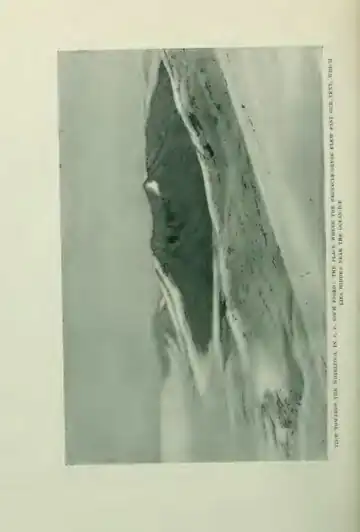
Some distance further ahead Ajako shot two hares, whereafter we parted to hunt each in our own direction. I climbed the mountains to obtain a view, whilst he continued right ahead. The mountain I ascend is a slate-stone mountain 40 metres high, black and cone-shaped, with crumbling stones which provide a poor foothold. When at last I reach the top I obtain a view which nearly takes the breath away from me. I have to rub my eyes before I dare to believe in the reality of that which I look upon. Before my feet, in along the fjord, I discover a whirlpool with a couple of floating ice-mountains.
An arm of the fjord, only 2 kilometres broad, cuts into the country, first in the direction of north-west towards Mascart Inlet, to which it seems to send an arm, later, turning north and north-east in the direction of de Long Fjord, it is lost among the mountains, where I cannot see its head. But the circumstance that here, in the middle of a Sikûssaq fjord, nearly at N. Lat. 88°, we came across an opening in the ice, points to the probability that this narrow branch must be part of a channel which either runs out into Mascart Inlet, or probably into Jewell Inlet. There is a very strong current in the open water. From the high ground on which I stand I can plainly discern vortices. And the main direction runs towards Chip Inlet. On the firm edge of the ice I discover to my surprise and joy two seals, and in the snow the depressions of a third which has just gone down.
This surprising discovery opens up unsuspected possibilities.
The land itself is ice-free in all directions—i.e., without a connected glacier; merely an occasional local tongue of a glacier shoots from the summits down into the many cloughs which intersect the mountain. But everywhere one sees deep snow.
The head of the main fjord is plainly visible about 30 or 40 kilometres inland from our camp, and only now it becomes clear to me that it is an entirely new fjord we have discovered. Chip Inlet was not very long, and was supposed to run parallel with Nordenskjöld Fjord, but this fjord does not exist at all. But north of Nordenskjöld Fjord a large new fjord cuts eastward for about 50 kilometres into Peary Land. Near its head a big mountain is discerned which crosses the run and merges into the inland-ice. Whilst the south-west side of the head of the fjord is thus directly connected with the main glacier, large snow-covered but apparently ice-free stretches of land spread out in the direction of north-east.
When Ajako and I meet again our faces beam with joy over the great discovery we have made; but for the moment we are, of course, most interested in the opportunities which this unexpected whirlpool with its seals offers us. Provided the ice near the edge where the seals lie is not eaten into too much by the current underneath, we have here the possibility of a welcome store of meat. But as seal-hunting brings the best result during the warm sunshine of noon, we postpone for the time being the hunt, taught by our sad experience at Dragon Point, where the seals, I do not know for what reason, were very timid. So we return to our camp, with no other catch than the two hares.
Of fresh musk-ox tracks, or merely of year-old excrements, we saw none; the signs of life we ran across appeared to be several years old. But it is possible that musk-oxen are to be found still further in along the fjord, and these regions are to be explored as soon as we have had a rest. In the meantime we have been in incessant activity for over thirty hours. We ran across lemming holes everywhere, and also ptarmigan, which in couples celebrate the mating season with a lively cackling.
By midnight we are once more back in the tent. Again two poor dogs have to be killed to provide food for their mates; they give a poor meal with scanty nourishment, but nevertheless they constitute "some belly-fill," to keep life in those which have to push on.
I have not been in the mood for scribbling in my diary, and during the last two days I have kept exclusively to meteorological observations, which four times during night and day pleasantly checks our time.
The weather and the bad state of the ground persecute us systematically. There is snow in abundance, through which we must toil our way; on the last journey we found snow up to 1 metre deep and had to put skis under the runners of the sledges. The loose snow which freezes into balls under the paws of the dogs treats them much worse than does hunger; in their attempts to cleanse their painful paws, which may be so full of hard ice lumps that the toes become quite distended, they bite, like the little lemming I recently described, big bleeding wounds in their paws which leave a trail of blood in the snow. This affliction is the chief reason for the difficulty we have in driving them ahead, and it quite unnerves them.
And now travelling conditions are to be still worse! The snowstorm begins on the 5th, and on the 6th it rages with increased violence; and the snow gathers in big, deep drifts where the sledges will stick when we have to continue our journey.
There is nothing for it—we must, like the little saxifrage which sometimes winters in full bloom, sleep everything away and let the storm pass over us as if we did not exist; later on we shall have time enough to face its consequences.
On the 7th of June the storm seems still on the increase; the snow whips against the canvas of our tent, the squall threatens to tear it to rags. Our ten still living dogs are lying outside in the snow, and they seem to have a difficulty in reconciling themselves to all this adversity. We dare not kill any more, or we shall be left without effective teams. Hunting in this storm is unthinkable.
At last! At last the sun had mercy on us and appeared with a clear blue sky, quite early in the morning. About two o'clock we dug ourselves out from the tent and made our preparations for the hunt, and for a reconnoitring expedition which Koch and Ajako were to undertake. We were lying deep in big snowdrifts, so that only the ridge of our tent was visible; it was like mid-winter and nothing around us bore witness to the fact that we were already far into June, the loveliest and mildest of all the summer months.
Nothing could be seen of our sledges. Only the points of the uprights stuck out, and of the dogs merely the contours of their bodies could be suspected in the snow. Their quietness was uncanny and showed, unfortunately, that not one of them had spirit enough left in it to gnaw at the traces, or to go out robbing between the sledges and the tent. They had given up entirely and were now trying merely to keep warm, rolled up in a ring with heads buried between legs and tail.
At four o'clock Koch and Ajako set out. I had to remain keeping watch over dogs and tent; the latter would be torn to strips if under these conditions the dogs were left without control for a day. Fain would I have exchanged yet another night and day of inactivity for my comrades' lot; but someone must do the miserable job.
For a long time I stood in the drifting snow looking after my departing friends. Koch was to chart the inner reaches of the fjord, whilst Ajako hunted in an attempt to save the sad remainder of our dogs.
At an even march they go in along the fjord, where stormy clouds are yet drifting round the thunder-split peaks. One of them is on skis, and slowly they glide through the loose new drifts. Ajako, the undaunted hunter whose straight back and lithe movements plainly reveal that he has not yet given up hope of finding big game, is in appearance not unlike the wolfdog which he leads at the end of a trace. Like his dog he is light, with tense muscles, hardy and used to starvation. By his side goes Koch—broad of shoulder, strong of build, tough, and showing the consciousness of his strength in the swing wherewith he walks, like a young Great Dane.
Good hunt, oh wolves! Never have warmer wishes accompanied two wanderers; for to-day is the day! The great seriousness is over us and our fate.
Whilst I stand here weighing our chances, with the raw blast in my face, my thoughts go out to the other party which has endured the same weather as we. May they have had more success on their hunting before the storm overtook them and put its seal on the land.
Opposite to me a couple of ptarmigan are sitting cooing caressingly to each other. Their coat is quite brown, and they sing about the summer that should have been. Their cheerful presence is stimulating and makes one forget the uncanniness of the storm-rushing clouds.
Occasionally they look enquiringly at the tent and the man at its entrance; but there is no cause for their anxiety—they may safely coo for me all through my lonely day. I cannot afford to spend a ball on so little meat, and our shot-gun and its ammunition was deposited for the return journey by the mouth of Nordenskjöld Fjord.
My day will to-day be stamped by excitement, but it is excitement of the kind which one should not feel too frequently during an expedition.
For the first time during a long period there is a positive temperature, 1-2 degrees of warmth (Cent.). There is a dead calm and hardly a cloud in the sky. Whilst I wait in the mild weather I am tempted to kill time by writing.
It is now six o'clock in the afternoon, thus it is fifteen hours since my comrades left. They were to return immediately if they caught a seal by the whirlpool on their outward journey, and their absence is therefore not a favourable sign.
I feel as if I were on a redoubt, alone against fifteen.
The dogs are raging with hunger; nearly all of them have bitten themselves loose from harness and traces, and are repeatedly attacking the tent, where a small piece of boiled meat is still kept. It would have been an uneven fight, had not experience given them a respect for the whip which they know that their beloved master has always ready to hand. They have suffered through the snowstorm, but this would not have meant much for a wolf-dog if recently they had not so often been given flabby dog-flesh instead of real food. It is for this reason that they are now so desperate and threatening, and they would surely throw themselves over me if only they dared. They express their suffering in very different ways. The nobler natures amongst them are no longer greedy and offensive; their eyes have taken on a singular forsaken and melancholy expression; they keep away and seek the snow-bare patches of ground, where they try to let the warmth of the sun ease the pains of their empty stomachs. The plebeians amongst them, on the contrary, have got an evil expression in their eyes; they lay siege to the tent and approach the entrance whenever they think they can take me by surprise.
Poor animals! But what else can we do for them but to walk ourselves half to death into the country on hunting tours which last for days. We really do not save ourselves!
The day goes slowly, and I often seize myself in the belief that my watch has stopped. In vain the ptarmigan try to cackle some relief into the monotony.
A couple are cackling to each other warmly and tenderly of the nest which they are going to build. Their gurgling gutturals remind me of a bull-frog's croaking in the ponds of Sealand. I forget where I am, and my thoughts go back to the garden of my father's vicarage, where so often I have listened to these remarkable frogs, whose clear, bell-like tones from the deep mud of the pond could fill the air with harmony in the cool Danish summer evenings.
A mild breeze wafts the fragrance of the wild roses of the cemetery wall towards me, and many old memories revive, so that in the midst of ice I live over again that which once was. I see my dear old mother coming from the strawberry-beds, her apron filled with big red berries; as usual, she picks out the biggest and gives them to us, and it is as if the flavour is doubly sweet and precious when one knows that every one of them has cost her pains in her old back as she bent down to pick them. And I hear my father's firm, somewhat heavy tread between the trees of the garden. He takes his evening walk, stopping frequently in front of the fruit-bushes, the growth and thriving of which he follows from day to day in his dear garden. Now and then there is a sound of the balls from the croquet-ground. The cool evening breeze sighs round the great lime-trees, while the white fruit-blossoms float down on to the garden paths.
During the heat of noon the first wingèd sign of summer comes to me as a couple of bluebottles buzzingly break into the tent and circle round that innocent little piece of meat which so vigilantly I watch over. Three curious gulls sail across our camp on pointed wings, to disappear towards the whirlpool; and when I add that a couple of small buntings have also tried to keep me company during the day, I have finished my day's biology.
In the quiet, mild weather the sun quickly melts the snow.
At eleven o'clock in the evening Koch returns to the tent after his twenty-five hours' walk. No game has he seen. His discoveries fully confirm my observations of the other day from the black slate-stone mountain. We are in quite a new fjord which has nothing to do with Chip Inlet, and which has not been visible from the route which has previously been followed. We agreed to call this fjord I. P. Koch Fjord. Neither is to be found the great island, marked down inside the mouth of Chip Inlet; in its place we have a tall mountainous peninsula which, with no less than sixteen glaciers, shoots out between Nordenskjöld Fjord and I. P. Koch Fjord. The land north of the fjord and to the east is partly ice-free, but it consists of wild alpine landscapes where one cannot hope to find musk-oxen.
Ajako has gone further into the fjord, and at nine o'clock in the morning he has not yet returned. But as long as he remains absent we keep on hoping.
Heigh!!!
At nine o'clock on the 9th, after thirty hours' hunting, Ajako returns to the tent; he has shot two seals by the whirlpool, and three hares. The hares he carries on his back, but the seals he has left, as it will be more practicable to move our camp nearer towards the whirlpool.
Our joy over this report is so intense that we feel as if warm waves beat through our bodies, and we cannot prevent ourselves from shouting meaningless words. There is now a hope that, at any rate for the time being, we can keep part of the dogs alive; and it is not unthinkable that we may succeed in shooting still more seals. Ajako has been far in along the fjord, where he has found some old excrement of musk-oxen; but everything points to the probability that these animals many years ago left this district, which they have probably passed on their way eastward. Furthermore, he has seen an owl brooding, and a white fox eagerly hunting fat lemmings.
The beautiful weather has tempted a lot of Arctic gulls towards our little camp—they sail above our heads or sit on the hummocks along the mountain slopes, from which places they hail the returned hunter with shrill, merry cries.
The camp is now moved a few kilometres further in along the fjord, so that from our tent we may have a convenient view of the little whirlpool which temporarily will be our larder.
June 10th-13th.—Unfortunately both Koch and Ajako are taken ill again. Koch has nausea and has felt dizzy after the long walk of yesterday. His stomach will not stand the everlasting diet of meat which we have to live on; occasionally he is given a little oat-porridge, but as we have to economize strictly under the uncertain conditions life offers us, it is unfortunately impossible to let him have the daily ration which his constitution seems to claim.
Ajako has overstrained his eyes in the sharp light during the long hunt, and has again gone snow-blind. So, as soon as the tent is raised, I leave my comrades and drive to the pool to fetch Ajako's seals. It is beautiful and quiet weather, and the warmth has again tempted a couple of seals to take a sun-bath. One of them is, unfortunately, very shy and dives down long before I get within range; but I succeed in catching the other. We are now on top again, for as we have so few dogs left, these seals, with their profusion of blubber, will see us through for some time.
Our cup of joy is, as usual, not unmixed with bitterness, as it appears that some serious illness is breaking out among the dogs. The hind quarters of some of them are becoming paralyzed. This may be a consequence of the cannibalist diet with which they have too often to be satisfied. Dog-flesh seems to contain some poison; at any rate, the liver and intestines contain something which does not agree with the dogs, for after devouring it they frequently vomit, and during the day they are limp and weak and have pronounced diarrhoea. Two of them have already been killed, as we cannot hope for a speedy recovery.
Yet another matter is troubling us: We have great difficulty in making the dogs eat sufficient food. The blubber, which is so good for them and at which in the beginning they rushed with such greediness, they will not touch at all now. This, however, has nothing to do with the disease, but is well-known by everybody who on long journeys has had to starve his dogs for periods. When at last one arrives at a place where there is food in plenty, the dogs eat only a few good meals, and after that they turn so finicky that they will only accept solid meat.
On the 11th of June Koch feels somewhat better, and immediately goes out into I. P. Koch Fjord to complete the cartographical work which he began.
On the following day he is again tired and unwell, and as Ajako constantly suffers from pains in his eyes we decide to remain here for another few days, although it is desirable that we should catch up with our comrades as soon as possible.
After this numerous seal-hunts miscarry; the few animals that have their home by the whirlpool are so shy that they disappear as soon as we show ourselves. So in the forenoon of the 14th we agree to break camp and continue our interrupted journey.
During the night we are aroused by barnacle-geese, which two by two fly across the tent in flocks, to settle down on the grassy slopes. For a long time their cries vibrate with a fresh, promising sound. There is always adventure in the boom of a wild-goose flight, when on their broad wings they disappear beyond the horizon.
June 14th-15th.—We had long been looking forward to the day when our work here should be finished, so that with a good conscience we could set our course towards Cape Salor on the northern extremity of the great island off the mouth of Chip Inlet. McMillan had promised us that we should there find one of Peary's depots from his last Polar expedition, cachèd in 1908, and consisting of pemmican, biscuits, sugar, and paraffin. These were tempting delicacies.
We start at eight o'clock in the evening and, as for the first time during a long period going is good, we succeed in making the 40 kilometres to Cape Salor in twelve hours. We halt east of the cape, right opposite to Cape Emory, where we expect to pick up information from Wulff. It is baking hot, the temperature being the highest we have yet experienced. In 2 degrees of heat (Cent.) we half-strip, after which Ajako and I set out for the depot, which should be about 4 kilometres distant from our camp.
The sun scorches our faces. On the ice the snow is melting and has already formed pools of more than a metre depth in the old Polar-ice. Dripping with perspiration we reach the depot, where a tin box, hanging down from the end of a staff, contains a greeting from our comrades. Right off us there is a pressure-ridge of about 20 metres; outside this the ice is smooth, whilst the pressure-ice of the old Polar-ice commences already a few kilometres seaward. Along the ice-foot there is an old track of bear.
The depot proves a disappointment in so far as we find only three cans of paraffin and six tins of pemmican.
To our surprise, we find excrements of musk-ox also on this island, which almost entirely consists of high, rugged mountain-land without a trace of valley tracts. The musk-oxen, then, must have been here only temporarily. Three barnacle-geese come flying from far out on the Polar Sea, and on land the ptarmigan are cackling.
We are back again in the tent at eleven o'clock, gourmandizing to our hearts' content on Peary's pemmican. This Polar pemmican, in contrast to the sort with which we are acquainted, has a wonderful addition of lots of raisins and sugar kneaded into the meat and fat, so that it has the consistency almost of a sweetmeat; at any rate, no marzipan cake could have tasted better. For the sake of economy, we mix it with porridge, and boil it into a thick gruel, which settles down in our stomachs with an unusual, but not uncomfortable, heaviness.
Wulff's letter, which is as usual a welcome sign of life in our monotonous treadmill round, goes from hand to hand and gives rise to much discussion and conjecture. We then snuggle down in our sleeping-bags, relishing for the first time outside our tent the unusual summer warmth. We close our eyes after a journey of thirty-six hours.
But our food has been heavier than our customary meals of hare; our sleep is restless and we frequently wake up.
(Upload an image to replace this placeholder.)
(Upload an image to replace this placeholder.)
