Index:Aether and Matter, 1900.djvu

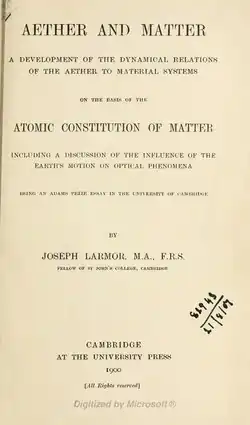
Title Aether and Matter
Author Joseph Larmor
Year 1900
Publisher Cambridge University Press
Location Cambridge
Source djvu
Progress To be proofread
Transclusion Index not transcluded or unreviewed
Pages (key to Page Status)
v vi vii viii ix x xi xii xiii xiv xv xvi xvii xviii xix xx xxi xxii xxiii xxiv xxv xxvi xxvii xxviii xxix xxx
1 2 3 4 5 6 7 8 9 10 11 12 13 14 15 16 17 18 19 20 21 22 23 24 25 26 27 28 29 30 31 32 33 34 35 36 37 38 39 40 41 42 43 44 45 46 47 48 49 50 51 52 53 54 55 56 57 58 59 60 61 62 63 64 65 66 67 68 69 70 71 72 73 74 75 76 77 78 79 80 81 82 83 84 85 86 87 88 89 90 91 92 93 94 95 96 97 98 99 100 101 102 103 104 105 106 107 108 109 110 111 112 113 114 115 116 117 118 119 120 121 122 123 124 125 126 127 128 129 130 131 132 133 134 135 136 137 138 139 140 141 142 143 144 145 146 147 148 149 150 151 152 153 154 155 156 157 158 159 160 161 162 163 164 165 166 167 168 169 170 171 172 173 174 175 176 177 178 179 180 181 182 183 184 185 186 187 188 189 190 191 192 193 194 195 196 197 198 199 200 201 202 203 204 205 206 207 208 209 210 211 212 213 214 215 216 217 218 219 220 221 222 223 224 225 226 227 228 229 230 231 232 233 234 235 236 237 238 239 240 241 242 243 244 245 246 247 248 249 250 251 252 253 254 255 256 257 258 259 260 261 262 263 264 265 266 267 268 269 270 271 272 273 274 275 276 277 278 279 280 281 282 283 284 285 286 287 288 289 290 291 292 293 294 295 296 297 298 299 300 301 302 303 304 305 306 307 308 309 310 311 312 313 314 315 316 317 318 319 320 321 322 323 324 325 326 327 328 329 330 331 332 333 334 335 336 337 338 339 340 341 342 343 344 345 346 347 348 349 350 351 352 353 354 355 356 357 358 359 360 361 362 363 364 365 366 367 368 369 370 371 372 373 374
CONTENTS

Page
Chapter I Introduction 1
SECTION I
Chapter II Historical survey 6
Astronomical aberration of light: Bradley's guiding ideas. Optical refraction uninfluenced by the Earth's motion: Fresnel's explanation. Aberration as measured by a water-telescope. Theoretical views of Cauchy. Views of Sir George Stokes as to constitution of the aether: suggested partial analogy of material substances like pitch; irrotational viscous motion unstable, also involves dissipation of energy: irrotational character of finite motions of the aether explained by its high rigidity or rotational elasticity. Maxwell's formulation of Fresnel's theory. The general absence of any optical influence of the Earth's motion suggests that the aether may move along with the Earth: the difficulties of this mode of explanation. Maxwell's discussion of electrodynamic theory relative to moving bodies. Introduction of atomic electric charges into the aether theory. Aether stagnant. Alleged difficulties of the electric theory. Maxwell's original scheme effective for systems at rest: nature of its adaptation to moving systems. A constitutive aether affords the only explanation of an atomic constitution of matter: the various atomic theories: electric aspect of an atom. MacCullagh's optical aether is the electric aether. Molecules may be systems of electrons: the duality of positive and negative dynamically necessary. Maxwell's elimination of ' electricity ' from the theory is available for ordinary electrodynamics, but cannot be extended to problems involving radiation.
Chapter III General kinematic theory of optical rays in moving media 30
Specification of a ray: ray-velocity: wave-velocity: wave-front: principle of Least Time: application to a moving medium. Theories of aberration: if the aether moves sensibly its motion must be irrot-

Page:Aether and Matter, 1900.djvu/24 Page:Aether and Matter, 1900.djvu/25 Page:Aether and Matter, 1900.djvu/26 Page:Aether and Matter, 1900.djvu/27 Page:Aether and Matter, 1900.djvu/28 Page:Aether and Matter, 1900.djvu/29 Page:Aether and Matter, 1900.djvu/30 vibrations of the molecular system: the methods of dynamics of particles adequate to the problem: the system referred to rotational coordinates; the condition for circular principal vibrations. Any purely constitutive potential energy for the molecule leads to the Zeeman phenomena, with the requisite generality. Inference as to effective isotropy of the molecule. The Faraday effect and Becquerel's law of dispersion deduced from the Zeeman effect when the freely mobile electrons are all negative; or when the dispersion is controlled by one absorption band, or by several bands for which the Zeeman constant is the same. Optical rotations necessarily of dispersional type; and therefore not simply related to material structure. Direct kinematic analysis of optical rotations for crystalline media, b y reference to rotating frame: law of rotation in different directions: the permanent types of vibration when rotation is superposed on double refraction: problem of refraction into a chiral medium not determinate.

Index 357