NASA Facts/Russian Space Stations
NASA Facts National Aeronautics and |
 IS-1997-06-004JSC |
| International Space Station | January 1997 |
International Space Station
Russian Space Stations
IntroductionThe International Space Station, which will be assembled between mid-1998 and 2003, will contain many Russian hardware elements developed in the nearly 30 years of the Russian space station program. The history of Russian space stations is one of gradual development marked by upgrades of existing equipment, reapplication to new goals of hardware designed for other purposes, rapid recovery from failures, and constant experimentation. The earliest Salyut stations were single modules, designed for only temporary operations. Mir, the most recent station, is a permanent facility in orbit since 1986 with a base made up of four separately-launched modules. Additional modules have been added to now total six laboratory modules and one docking module, added to allow the Space Shuttle to more easily dock with the station. U.S. Space Shuttles have been periodically docking with the Mir since July 1995. U.S. astronauts have maintained a permanent presence onboard Mir since March 1996 and that presence is expected to continue through 1998. Prelude to Space Stations (1903-1964)In 1903, Russian schoolteacher Konstantin Tsiolkovsky wrote Beyond the Planet Earth, a work of fiction based on sound science. In it, he described orbiting space stations where humans would learn to live in space. Tsiolkovsky believed these would lead to self-contained space settlements and expeditions to the Moon, Mars, and the asteroids. Tsiolkovsky wrote about rocketry and space travel until his death in 1935, inspiring generations of Russian space engineers. Soviet engineers began work on large rockets in the 1930s. In May 1955, work began on the Baikonur launch site in central Asia. In August 1957, the world’s first intercontinental ballistic missile lifted off from Baikonur on a test flight, followed by the launch of Sputnik 1, world’s first artificial satellite, on October 4, 1957. On April 12, 1961, Yuri Gagarin lifted off from Baikonur in the Vostok 1 capsule, becoming the first human in space. |
A year later, Soviet engineers described a space station comprised of modules launched separately and brought together in orbit. A quarter-century later, in 1987, this concept became reality when the Kvant module was added to the Mir core station. First-Generation Stations (1964-1977)
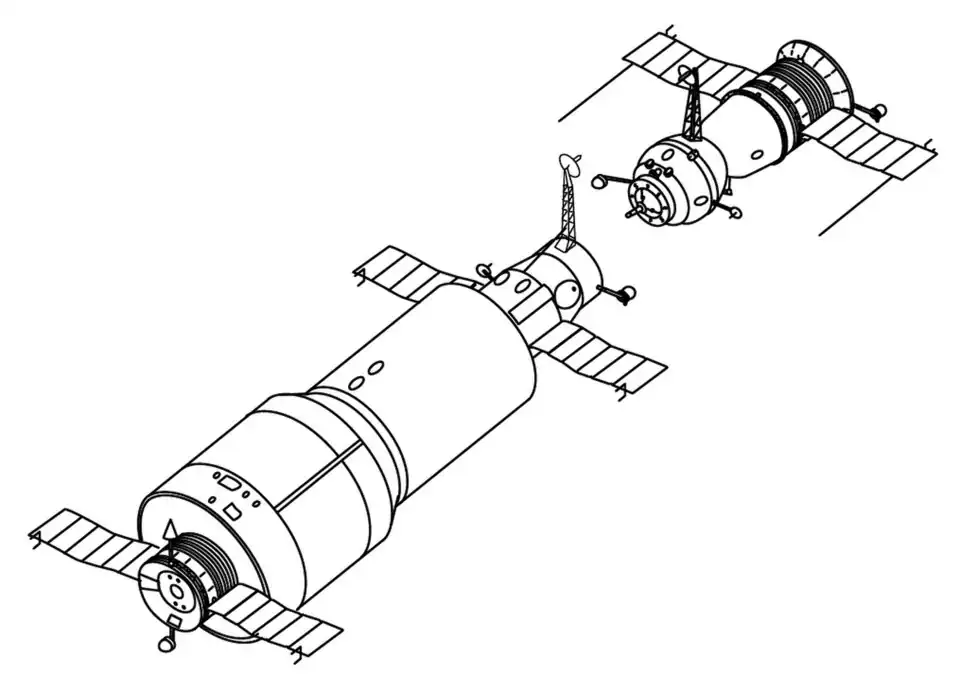
First-generation space stations had one docking port and could not be resupplied or refueled. The stations were launched unmanned and later occupied by crews. There were two types: Almaz military stations and Salyut civilian stations. To confuse Western observers the Soviets called both kinds Salyut.
|
|
The Almaz military station program was the first approved. When proposed in 1964, it had three parts: the Almaz military surveillance space station, Transport Logistics Spacecraft for delivering soldier-cosmonauts and cargo, and Proton rockets for launching both. All of these spacecraft were built, but none was used as originally planned. Soviet engineers completed several Almaz station hulls by 1970. The Soviet leadership ordered Almaz hulls transferred to a crash program to launch a civilian space station. Work on the Transport Logistics Spacecraft was deferred, and the Soyuz spacecraft originally built for the Soviet manned Moon program was reapplied to ferry crews to space stations. Salyut 1, the first space station in history, reached orbit unmanned atop a Proton rocket on April 19, 1971. The early first-generation stations were plagued by failures. The crew of Soyuz 10, the first spacecraft sent to Salyut 1, was unable to enter the station because of a docking mechanism problem. The Soyuz 11 crew lived aboard Salyut 1 for three weeks, but died during return to Earth because the air escaped from their Soyuz spacecraft. Then, three firstgeneration stations failed to reach orbit or broke up in orbit before crews could reach them. The second failed station was Salyut 2, the first Almaz military station to fly. The Soviets recovered rapidly from these failures. Salyut 3, Salyut 4, and Salyut 5 supported a total of five crews. In addition to military surveillance and scientific and industrial experiments, the cosmonauts performed engineering tests to help develop the second-generation space stations. Second-Generation Stations (1977-1985)
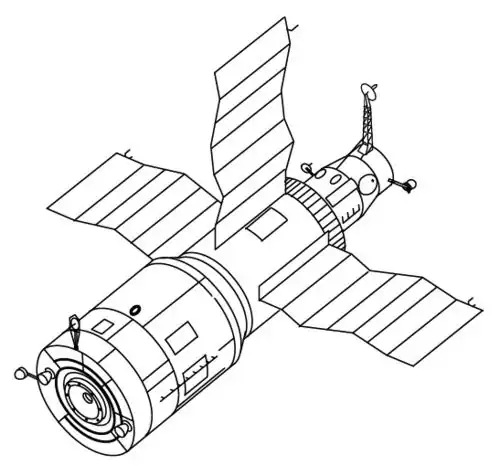
With the second-generation stations, the Soviet space station program evolved from short-duration to long-duration stays. Like the first-generation stations, they were launched unmanned and their crews arrived later in Soyuz spacecraft. Second-generation stations had two docking ports. This permitted refueling and resupply by automated Progress freighters derived from Soyuz. Progress docked automatically at the aft port, and was then opened and unloaded by cosmonauts on the station. Transfer of fuel to the station took place automatically under supervision from the ground. A second docking port also meant long-duration resident crews could receive visitors. Visiting crews often included cosmonaut-researchers from Soviet bloc countries or countries sympathetic to the Soviet Union. Vladimir Remek of Czechoslovakia, the first space traveler not from the U.S. or the Soviet Union, visited Salyut 6 in 1978. |
Visiting crews relieved the monotony of a long stay in space. They often traded their Soyuz spacecraft for the one already docked at the station because Soyuz had only a limited lifetime in orbit. Lifetime was gradually extended from 60-90 days for the Soyuz Ferry to more than 180 days for the Soyuz-TM.
Salyut 6 Key Facts
|
logistics spacecraft redesigned to serve as an experimental space station module.
Third-Generation Station: Mir (1986-present)Third-Generation Station
Mir is the first permanent space station. The station has been in orbit for 11 years, and staffed continuously for the past 7 years. The complex presently weighs more than 100 |
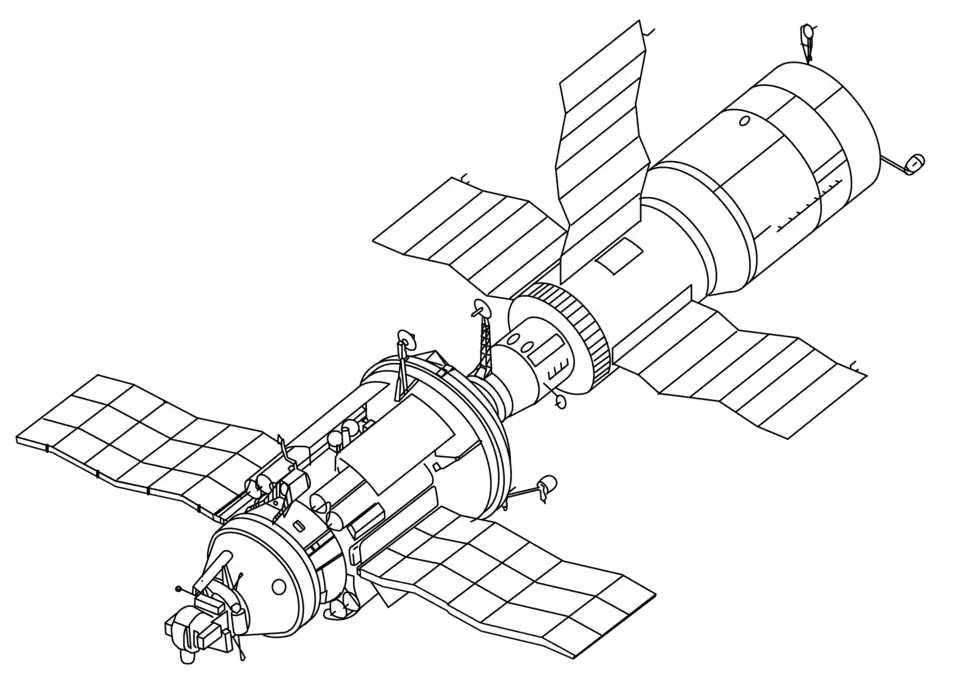
tons, and consists of the Mir core, Kvant, Kvant 2, Kristall, Spektr, Priroda and Docking modules. Mir measures more than 107 feet long with docked Progress-M and Soyuz-TM spacecraft, and is about 90 feet wide across its modules. Mir Module Descriptions
|
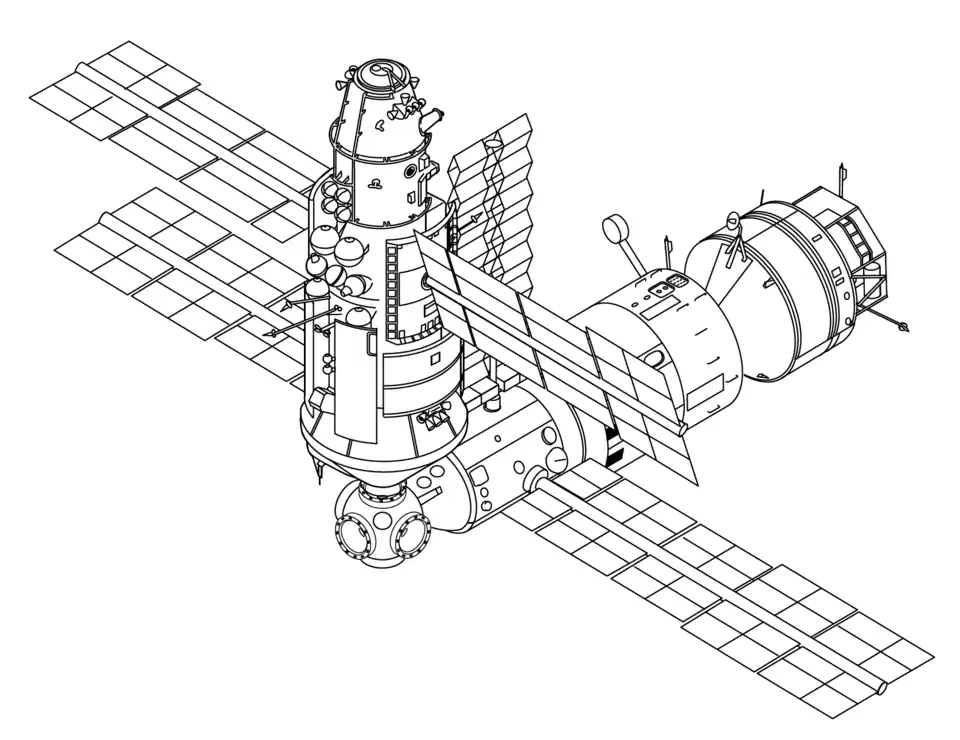
|
| Mir Space Station, 1989, with Base Block, center; Kvant module, right; and Kvant-2 module, top |
Modules for Mir’s radial berthing ports first dock at the front port. Each module carries a manipulator arm which locks into a socket on Mir. The arm pivots the module into place at the proper radial port Mir Key Facts
|
|

This work is in the public domain because it was created by the United States National Aeronautics and Space Administration (NASA), whose copyright policy states that "NASA material is not protected by copyright unless noted".
Please note that use of NASA logos is restricted by law, but these are not copyright restrictions.

Public domainPublic domainfalsefalse