But there is another way out of this difficulty. The equation must be true for all values of  ; therefore it must be true for such values of as will cause
  and
and  to become zero, that is for
  and for
  respectively. If we make , we get
  , so that
  ; and if we make , we get
  , so that
  . Replacing the
  and
and  of the partial fractions by these new values, we find them to become
  and
and  ; and the thing is done.
As a farther example, let us take the fraction 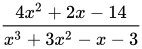 . The denominator becomes zero when is given the value
  ; hence is a factor of it, and obviously then the other factor will be
  ; and this can again be decomposed into
 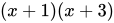 . So we may write the fraction thus:
 ,
,
making three partial factors.
Proceeding as before, we find

Now, if we make , we get:
 ; that is,
  .
.
If , we get:
 ; whence
  .
.