B. If two aggregates  and
and  are such that is equivalent to a part
  of and to a part
  of , then and are equivalent;
C. If is a part of an aggregate ,  is a part of the aggregate , and if the aggregates and are equivalent, then is equivalent to both and ;
D. If, with two aggregates and , is equivalent neither to nor to a part of , there is a part of that is equivalent to ;
E. If two aggregates and are not equivalent, and there is a part of that is equivalent to , then no part of is equivalent to .
The Addition and Multiplication of Powers
The union of two aggregates and which have no common elements was denoted in § 1, (2), by  . We call it the "union-aggregate (Vereinigungsmenge) of and ."
If  and
and  are two other aggregates without common elements, and if
  and
and  , we saw that we have
 .
.
Hence the cardinal number of only depends upon the cardinal numbers  and
and  .
.
This leads to the definition of the sum of a and b. We put
(1)
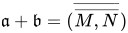
.