104
THE FOUNDING OF THE THEORY
we call its cardinal number (§1) "Aleph-zero" and denote it by  thus we define
(1)

.
That is a transfinite number, that is to say, is not equal to any finite number  , follows from the simple fact that, if to the aggregate
  is added a new element
  , the union-aggregate
  is equivalent to the original aggregate . For we can think of this reciprocally univocal correspondence between them: to the element of the first corresponds the element
  of the second, and to the element
  of the first corresponds the element
  of the other. By §3 we thus have
(2)

But we showed in §5 that  is always different from and therefore is not equal to any finite number .
The number is greater than any finite number :
(3)

[493] This follows, if we pay attention to §3, from the three facts that 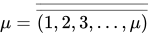 , that no part of the aggregate
 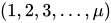 is equivalent to the aggregate , and that is itself a part of .
On the other hand, is the least transfinite cardinal number. If  is any transfinite cardinal number different from , then
(4)

.