120
THE FOUNDING OF THE THEORY
then  is not equal to
  . For, if
  is a new
element, we have by (1):
is a new
element, we have by (1):
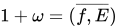 ,
,
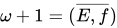 .
.
But the aggregate

is similar to the aggregate E, and consequently
 .
.
On the contrary, the aggregates  and
and  are
not similar, because the first has no term which is
highest in rank, but the second has the highest
term . Thus is different from
are
not similar, because the first has no term which is
highest in rank, but the second has the highest
term . Thus is different from  .
.
Out of two ordered aggregates  and
and  with
the types
with
the types  and
and  we can set up an ordered
aggregate
we can set up an ordered
aggregate  by substituting for every element
  of
an ordered aggregate
of
an ordered aggregate  which has the same type as , so that
(3)

;
and, for the order of precedence in
(4)

we make the two rules:
(1) Every two elements of which belong to
one and the same aggregate are to retain in
the same order of precedence as in ;
(2) Every two elements of which belong to two different aggregates  and
and  have the same relation of precedence as
  and
and  have in .