Page:Cyclopedia of Western Australia, volume 1.pdf/50
of the continent became substantially that which it at present appears.
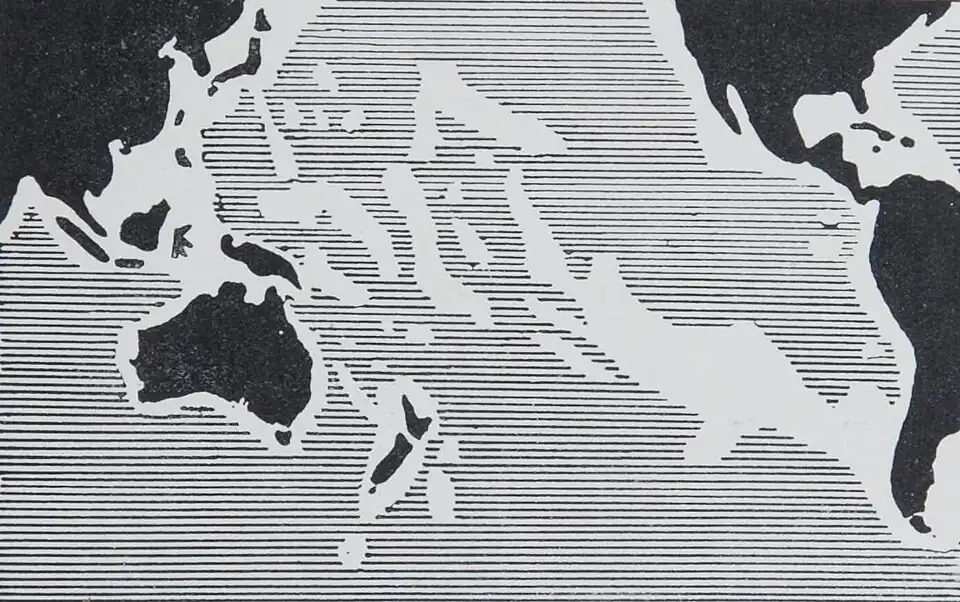
Ocean Depths Around Australasia.
The shaded portion is deeper than 1,500 fathoms.
It was while this old connection with Asia, and perhaps South America, lasted that Australia and New Zealand received along that route the ancestral types of their present native faunas. The reptilian forms of life which dominated the earth's surface during the Mesozoic period had then passed their prime; the birds of the air had become an important feature and the beasts of the field had begun to put in an appearance. These latter were lowly-organized animals and laid eggs. They were the Prototheria, a division now surviving only in Australia, the Platypus and the Echidna, or "native porcupine," being its representatives. The Metatheria (a more highly-organized division of the mammalia which bring forth their young in a partially-developed condition only, and nourish them at breasts encased in a marsupia or "pouch" until completely developed) became extensively spread over the world during the Tertiary period, but today survive only in the Australasian region, and—as the opossum family—in North and South America. After the arrival of the Metatheria Australia became separated from the northern land mass, and has remained an island ever since. New Zealand became separated still earlier (apparently about the time of greatest bird life development), but Tasmania, Kangaroo Island, and the islands of west and north-west Australia remained part of Australia long after the arrival of the Metatheria—until quite recent times, in fact. Except bats, rats, and mice, whose means for dispersal over wide areas and across seas are quite exceptional, none of the Eutheria, or true placental mammalia, ever reached Australia until introduced by man. The dingo is a near ally of the dhole of India, though rather more wolf-like and now absolutely untamable permanently.
Among the progenitors of the present marsupial fauna were some giant forms, now known only more or less fully by their fossil remains. There was the Diprotodon, a kind of wombat as large as a rhinoceros, the casts of whose complete skeleton are now in all the principal Australian museums; there was the Nototherium—an animal as large as (and in some respects resembling) the Tapirs—a gigantic kangaroo which stood about 12 ft. in height. These were vegetable feeders, but there are remains of large extinct carnivora also, one being named Thylacoleo, because supposed to have been a kind of "pouched" lion. The Thylacinus or "pouched hyena" and the Sarcophilus or "devil"—two species now surviving only in Tasmania—existed on the mainland along with the gigantic creatures just mentioned. There were also struthious birds, allied to the moa of New Zealand, and as large as the ostrich, whose skeletons have been recovered along with the Diprotodon in the dried-up swamps of the Lake Eyre basin. Enormous alligators ranged southward far outside of the tropics, and a land lizard (Megalania), very nearly akin to the present-day "goanna," but upwards of 20 ft. in length, was the terror of the dry-land creatures. Some giant turtles and tortoises also appear in the life of this ancient period, and as a part of the present-day fauna, including some of the frogs, have their closest affinities now in South America, it would seem that their ancestors came here while the now submerged South Pacific continent reached as far east as Patagonia.
The changes which caused the extinction of the Diprotodon and his congeners, leaving only their fossil remains distributed from Cape Leuwin to the Gulf of Carpentaria, must be held to have exercised the influence accountable for the distribution of the present fauna as now observed in each of the Australian States. That fauna which is isolated from the rest of the world will still compete within itself for advantages in the battle for existence. A difference in climate, of food supply, or predaceous foes must necessarily lead to modifications of form or habit to contend with such change, or, in the alternative, must cause that fauna to become extinct. It is thus that in Australia, as throughout the world in general, the life regions are zoologically impoverished regions from which all the largest and fiercest creatures have died out; and it is well for man that it should be so.
MAMMALIA.
Of the total mammalian fauna of Australia that part which is now to be found dwelling within the