| | Demotic. |
Hieratic. | Hieroglyphic. |
|
|
|
|
|
|
| ent, “who” |  |  | | nty |
| Perso (“Pharaoh”) |  | 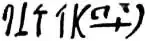 | | Perꜥo ꜥnḫ wz, śnb |
| yôt, “father” |  | 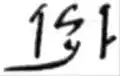 | | ỉtf |
| ꜥônkh, “live” |  |  | | ꜥnḫ |
| ekh, “know” |  |  | | rḫ |
| ahe, “stand” |  |  | | ꜥḥꜥ |
| eine, “carry” |  |  | | ỉn |
| ms (phon.) | _-_Demotic.jpg) | _-_Hieratic.jpg) | | ms |
| s (alph.) | _-_Demotic_-_first_version.jpg) |  | | s |
| s (alph.) | _-_Demotic_-_second_version.jpg) |  | | ś |
| m (alph.) | _-_Demotic.jpg) | _-_Hieratic.jpg) | | m |
| n (alph.) | _-_Demotic.jpg) | _-_Hieratic.jpg) | | n |
The early scribe’s outfit, often carried slung over his shoulder,
is seen in the hieroglyph 𓏟. It consisted of frayed reed pens
or brushes, a small pot of water, and a palette with two circular cavities
in which black and red ink were placed, made of finely powdered
colour solidified with gum. In business and literary documents
red ink was used for contrast, especially in headings; in demotic,
however, it is very rarely seen. The pen became finer in course of
time, enabling the scribe to write very small. The split reed of the
Greek penman was occasionally adopted by the late demotic scribes.
Egypt had long been bilingual when, in papyri of the 2nd century
A.D., we begin to find transcripts of the Egyptian language into
Greek letters, the latter reinforced by a few signs borrowed from
the demotic alphabet: so written we have a magical text and a
horoscope, probably made by foreigners or for their use. The
infinite superiority of the Greek alphabet with its full notation of
vowels was readily seen, but piety and custom as yet barred the way
to its full adoption. The triumph of Christianity banished the old
system once and for all; even at the beginning of the 4th century
the native Egyptian script scarcely survived north of the Nubian
frontier at Philae; a little later it finally expired. The following
eight signs, however, had been taken over from demotic by the Copts:
- ϣ = š, from 𓆷 šꜣ, dem.
.jpg) ,
, .jpg) .
.
- ϩ = h, probably from 𓄑
𓏛 ḥw (or 𓇉 ḥꜣ), dem.  .
.
- Ϧ (Boh.) = ḫ, from 𓆼 ḫꜣ, dem.
 .
.
- Ⲝ (Akhm.) = ḫ, from 𓐍
𓏭, 𓐍
𓏏𓏤 ḫy, ḫt, dem.  .
.
- ϥ = f, from 𓆑 f, dem.
 .
.
- ϭ = č from 𓎡 k (or 𓐍 ḫ), dem.
 ,
,  .
.
- ϫ = ğ, from 𓍑 dꜣ (or 𓅷𓏤
tꜣ), dem.  .
.
- ϯ = ti, from 𓂞
𓏏 dy·t, dem.  .
.
For origins of hieroglyphs, see Petrie’s Medum (1892); F. Ll.
Griffith, A Collection of Hieroglyphics (1898); N. de G. Davies, The
Mastaba of Ptahhetep and
Akhethetep, pt. i. (1900);
M. A. Murray, Saqqara
Mastabas (London, 1905);
also Petrie and Griffith,
Two Hieroglyphic Papyri from
Tanis (London, 1889) (native
sign-list); G. Möller, Hieratische
Paläographie (Leipzig,
1909); Griffith, Catalogue of
Demotic Papyri in the J.
Rylands Collection (Manchester,
1909). (F. Ll. G.)
E. Art and Archaeology.—In
the following sections
a general history of the
characteristics of Ancient
Egyptian art is first given,
showing the variation of
periods and essentials of
style; and this is followed
by an account of the use
made of material products,
of the tools and instruments
employed, and of the
monuments. For further
details see also the separate
topographical headings (for
excavations, &c.), and the
general articles on the
various arts and art-materials
(for references to
Egypt); also Pyramids;
Mummy, &c.
The wide and complex subject of Egyptian art will be treated
here in six periods: Prehistoric, Early Kings, Pyramid Kings,
XIIth Dynasty, XVIIIth-XXth Dynasties, XXVIth Dynasty
and later. In each age will be considered the (A) statuary,
(B) reliefs, (C) painting.
Prehistoric.—The earliest civilized population of Egypt was
highly skilled in mechanical accuracy and regularity, but had
little sense of organic forms. They kept the unfinished treatment
of the limbs and extremities which is so characteristic of most
barbaric art; and the action was more considered than the form.
(A) In the round there are in the earlier graves female figures
of two races, the Bushman type and European, both probably
representing servants or slaves. These have the legs always
united, sloping to a point without feet (Plate I. fig. 1); the arms
are only stumps. The face has a beaky nose and some indication
of eyes. Upon the surface is colouring; red for the Bushman,
with black whisker though female; white for the European
type, with black tattoo patterns. Other female figures are
modelled in a paste, upon a stick, and the black hair is sometimes
made separately to fit on as a wig over the red head, showing
that wigs were then used. Male figures are generally only heads
in the earlier times. Tusks with carved heads (Plate I. figs. 2, 3)
are the earliest, beginning at S.D. (sequence date) 33;[1] heads
on the top of combs are found, from S.D. 42 to the close of such
combs in the fifties. All of these heads show a high forehead
and a pointed beard; and such expression as may be discovered
is grave but not savage. In later times whole figures of ivory,
stone and clay are found, with the legs united, and the arms
usually joined to the body. A favourite way of indicating the
eyes was by drilling two holes and inserting a white shell bead
in each. The figures of animals (Plate I. figs. 4, 5) are quite as
rude as the human figures: they only summarily indicate the
- ↑ In the prehistoric age when absolute dating is out of reach a “sequence dating” by means of the sequence of types in pottery, tools, &c., has been proposed in Petrie’s Diospolis Parva, pp. 4 et sqq. The earliest prehistoric graves yet known are placed at S.D. 30, and shortly before S.D. 80 the period of the first historic dynasty is entered.


