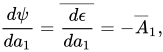
The multiple integrals in the last four equations represent the average values of the expressions In the brackets, which we may therefore set equal to zero. The first gives
|
(241)
|
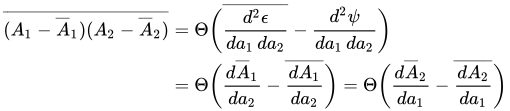
as already obtained. With this relation and (191) we get from the other equations

|
(242)
|
|
(243)
|

|
|
We may add for comparison equation (205), which might be derived from (236) by differentiating twice with respect to

:

|
(244)
|
The two last equations give

|
(245)
|
If

or

is known as function of
,

,

, etc.,

may be obtained by differentiation as function of the same variables. And if
, or

, or

is known as function of
,
, etc.,
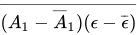
may be obtained by differentiation. But

and
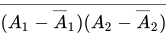
cannot be obtained in any similar manner. We have seen that
is in general a vanishing quantity for very great values of

, which we may regard as contained implicitly in
as a divisor. The same is true of
. It does not appear that we can assert the same of
or
, since