104
THE FUNCTION  AND
AND
as practically equivalent to the values relating to the most common energy
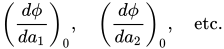
|
|
In this case also

is practically equivalent to

. We have therefore, for very large values of

,

|
(337)
|
approximately. That is, except for an additive constant,

may be regarded as practically equivalent to

, when the number of degrees of freedom of the system is very great. It is not meant by this that the variable part of

is numerically of a lower order of magnitude than unity. For when
is very great,
and
are very great, and we can only conclude that the variable part of
is insignificant compared with the variable part of

or of
, taken separately.
Now we have already noticed a certain correspondence between the quantities  and and those which in thermodynamics are called temperature and entropy. The property just demonstrated, with those expressed by equation (336), therefore suggests that the quantities and
  may also correspond to the thermodynamic notions of entropy and temperature. We leave the discussion of this point to a subsequent chapter, and only mention it here to justify the somewhat detailed investigation of the relations of these quantities.
We may get a clearer view of the limiting form of the relations when the number of degrees of freedom is indefinitely increased, if we expand the function in a series arranged according to ascending powers of  . This expansion may be written

|
(338)
|
Adding the identical equation