THE CANONICAL DISTRIBUTION.
111
where  denotes the value of
  for the modulus
  . Since the last member of this formula vanishes for
  , the less value represented by the first member must also vanish for the same value of
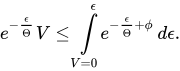
  . Therefore the second member of (359), which differs only by a constant factor, vanishes at the upper limit. The case of the lower limit remains to be considered. Now
|
|
The second member of this formula evidently vanishes for the value of
, which gives

, whether this be finite or negative infinity. Therefore, the second member of (359) vanishes at the lower limit also, and we have

|
|
or

|
(362)
|
This equation, which is subject to no restriction in regard to the value of

, suggests a connection or analogy between the function of the energy of a system which is represented by

and the notion of temperature in thermodynamics. We shall return to this subject in Chapter XIV.
If  , the second member of (359) may easily be shown to vanish for any of the following values of
  viz.:
viz.:  ,
,  , ,
, ,  , where
  denotes any positive number. It will also vanish, when
  , for
, for  , and when
  for
for  . When the second member of (359) vanishes, and , we may write

|
(363)
|
We thus obtain the following equations:
If ,

|
(364)
|