130
MAXIMUM AND MINIMUM PROPERTIES.
Since  is a function of the energy, and may therefore be regarded as a constant within the limits of integration of (421), we may multiply by under the integral sign in both members, which gives

|
|
Since this is true within the limits indicated, and for every value of

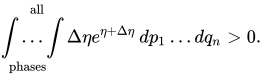
, it will be true if the integrals are taken for all phases. We may therefore cancel the corresponding parts of (419), which gives
|
(422)
|
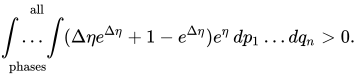
But by (420) this is equivalent to
|
(423)
|
Now

is a decreasing function of

for negative values of
, and an increasing function of
for positive values of
. It vanishes for

. The expression is therefore incapable of a negative value, and can have the value 0 only for
. The inequality (423) will hold therefore unless
for all phases. The theorem is therefore proved.
Theorem II. If an ensemble of systems is canonically distributed in phase, the average index of probability is less than in any other distribution of the ensemble having the same average energy.
For the canonical distribution let the index be

, and for another having the same average energy let the index be

, where
is an arbitrary function of the phase subject only to the limitation involved in the notion of the index, that