202
SYSTEMS COMPOSED OF MOLECULES.
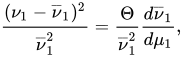
From equation (539) we may get an idea of the order of magnitude of the divergences of  from its average value in the ensemble, when that average value is great. The equation may be written
|
(541)
|
The second member of this equation will in general be small when

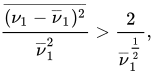
is great. Large values are not necessarily excluded, but they must be confined within very small limits with respect to

. For if
|
(542)
|
for all values of

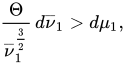
between the limits

and

, we shall have between the same limits
|
(543)
|
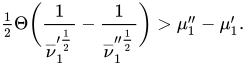
and therefore
|
(544)
|
The difference

is therefore numerically a very small quantity. To form an idea of the importance of such a difference, we should observe that in formula (498)
is multiplied by
and the product subtracted from the energy. A very small difference in the value of
may therefore be important. But since

is always less than the kinetic energy of the system, our formula shows that
, even when multiplied by

or

, may still be regarded as an insensible quantity.
We can now perceive the leading characteristics with respect to properties sensible to human faculties of such an ensemble as we are considering (a grand ensemble canonically distributed), when the average numbers of particles of the various kinds are of the same order of magnitude as the number of molecules in the bodies which are the subject of physical