|
|
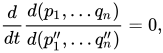
which substituted in (34) will give
|
|
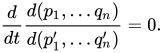
The determinant in this equation is therefore a constant, the value of which may be determined at the instant when

, when it is evidently unity. Equation (33) is therefore demonstrated.
Again, if we write  for a system of
  arbitrary constants of the integral equations of motion,
  ,
,  , etc. will be
functions of , and
, etc. will be
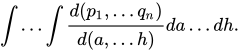
functions of , and  , and we may express an extension-in-phase in the form
|
(35)
|
If we suppose the limits specified by values of
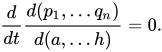
, a system initially at the limits will remain at the limits. The principle of conservation of extension-in-phase requires that an extension thus bounded shall have a constant value. This requires that the determinant under the integral sign shall be constant, which may be written
|
(36)
|
This equation, which may be regarded as expressing the principle of conservation of extension-in-phase, may be derived directly from the identity

|
|
in connection with equation (33).
Since the coördinates and momenta are functions of , and , the determinant in (36) must be a function of the same variables, and since it does not vary with the time, it must be a function of alone. We have therefore
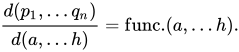
|
(37)
|