22
CONSERVATION OF EXTENSION-IN-PHASE
where  represents the same value as in the preceding formula, viz., the constant value of the maximum coefficient of probability, and
  is a quadratic function of the differences
  ,
,  , etc., the phase
  being that which at the time
  corresponds to the phase
 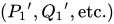 at the time
  .
.
Now we have necessarily

|
(53)
|
when the integration is extended over all possible phases. It will be allowable to set

for the limits of all the coördinates and momenta, not because these values represent the actual limits of possible phases, but because the portions of the integrals lying outside of the limits of all possible phases will have sensibly the value zero. With
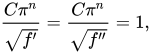
for limits, the equation gives
|
(54)
|
where

is the discriminant
[1] of

, and

that of
. This discriminant is therefore constant in time, and like
an absolute invariant in respect to the system of coördinates which may be employed. In dimensions, like

, it is the reciprocal of the 2nth power of the product of energy and time.
Let us see precisely how the functions
and
are related. The principle of the conservation of the probability-coefficient requires that any values of the coördinates and momenta at the time
shall give the function
the same value as the corresponding coördinates and momenta at the time
give to
. Therefore
may be derived from
by substituting for

their values in terms of

. Now we have approximately
- ↑
This term is used to denote the determinant having for elements on the principal diagonal the coefficients of the squares in the quadratic function , and for its other elements the halves of the coefficients of the products in .