|
(55)
|
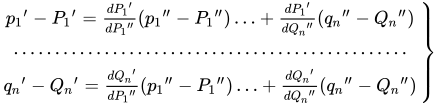
and as in

terms of higher degree than the second are to be neglected, these equations may be considered accurate for the purpose of the transformation required. Since by equation (33) the eliminant of these equations has the value unity, the discriminant of
will be equal to that of

, as has already appeared from the consideration of the principle of conservation of probability of phase, which is, in fact, essentially the same as that expressed by equation (33).
At the time  the phases satisfying the equation

|
(56)
|
where

is any positive constant, have the probability-coefficient

. At the time

, the corresponding phases satisfy the equation

|
(57)
|
and have the same probability-coefficient. So also the phases within the limits given by one or the other of these equations are corresponding phases, and have probability-coefficients greater than
, while phases without these limits have less probability-coefficients. The probability that the phase at the time
falls within the limits

is the same as the probability that it falls within the limits

at the time
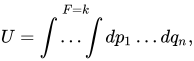
, since either event necessitates the other. This probability may be evaluated as follows. We may omit the accents, as we need only consider a single time. Let us denote the extension-in-phase within the limits

by

, and the probability that the phase falls within these limits by

, also the extension-in-phase within the limits

by

. We have then by definition
|
(58)
|