remaining constant ( ) will then be introduced in the final integration, (viz., that of an equation containing
  ,) and will be added to or subtracted from
  in the integral equation. Let us have it subtracted from . It is evident then that

|
(72)
|
Moreover, since  and
and  are independent functions of
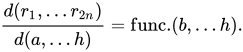
  , the latter variables are functions of the former. The Jacobian in (71) is therefore function of , and , and since it does not vary with it cannot vary with . We have therefore in the case considered, viz., where the forces are functions of the coördinates alone,
|
(73)
|
Now let us suppose that of the first  integrations we have accomplished all but one, determining
  arbitrary constants (say
  ) as functions of , leaving
  as well as to be determined. Our finite equations enable us to regard all the variables , and all functions of these variables as functions of two of them, (say
  and
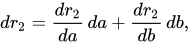
and  ,) with the arbitrary constants . To determine , we have the following equations for constant values of .

|
|
|
|
whence

|
(74)
|
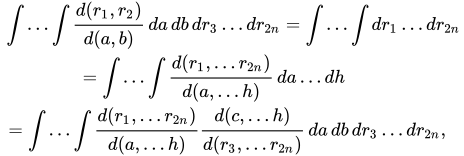
Now, by the ordinary formula for the change of variables,
|
|