28
CONSERVATION OF EXTENSION-IN-PHASE
where the limits of the multiple integrals are formed by the same phases. Hence

|
(75)
|
With the aid of this equation, which is an identity, and (72), we may write equation (74) in the form

|
(76)
|
The separation of the variables is now easy. The differential equations of motion give  and
and  in terms of
  . The integral equations already obtained give
  and therefore the Jacobian
  , in terms of the same variables. But in virtue of these same integral equations, we may regard functions of as functions of
  and
and  with the constants . If therefore we write the equation in the form

|
(77)
|
the coefficients of

and

may be regarded as known functions of
and
with the constants
. The coefficient of

is by (73) a function of

. It is not indeed a known function of these quantities, but since
are regarded as constant in the equation, we know that the first member must represent the differential of some function of
, for which we may write

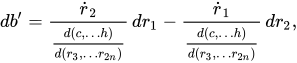
. We have thus
|
(78)
|
which may be integrated by quadratures and gives
as functions of

, and thus as function of
.
This integration gives us the last of the arbitrary constants which are functions of the coördinates and momenta without the time. The final integration, which introduces the
remain-