CANONICAL DISTRIBUTION.
33
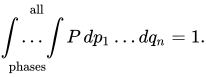
cient of probability, whether the case is one of equilibrium or not. These are: that  should be single-valued, and neither negative nor imaginary for any phase, and that expressed by equation (46), viz.,
|
(89)
|
These considerations exclude

|
|
as well as

|
|
as cases to be considered.
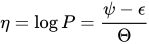
The distribution represented by
|
(90)
|
or

|
(91)
|
where

and

are constants, and
positive, seems to represent the most simple case conceivable, since it has the property that when the system consists of parts with separate energies, the laws of the distribution in phase of the separate parts are of the same nature, a property which enormously simplifies the discussion, and is the foundation of extremely important relations to thermodynamics. The case is not rendered less simple by the divisor
, (a quantity of the same dimensions as

,) but the reverse, since it makes the distribution independent of the units employed. The negative sign of
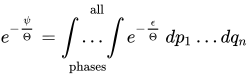
is required by (89), which determines also the value of
for any given
, viz.,
|
(92)
|
When an ensemble of systems is distributed in phase in the manner described,
i. e., when the index of probability is a