and the system  as one of an ensemble of systems of
  degrees of freedom distributed in phase with a probability-coefficient

|
|
which has the same modulus. Let

,

be the coördinates and momenta of

, and

,

those of
. Now we may regard the systems
and
as together forming a system

, having

degrees of freedom, and the coördinates and momenta

,

. The probability that the phase of the system
, as thus defined, will fall within the limits

|
|
is evidently the product of the probabilities that the systems
and
will each fall within the specified limits, viz.,

|
(94)
|
We may therefore regard
as an undetermined system of an ensemble distributed with the probability-coefficient
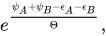
|
(95)
|
an ensemble which might be defined as formed by combining each system of the first ensemble with each of the second. But since

is the energy of the whole system, and

and

are constants, the probability-coefficient is of the general form which we are considering, and the ensemble to which it relates is in statistical equilibrium and is canonically distributed.
This result, however, so far as statistical equilibrium is concerned, is rather nugatory, since conceiving of separate systems as forming a single system does not create any interaction between them, and if the systems combined belong to ensembles in statistical equilibrium, to say that the ensemble formed by such combinations as we have supposed is in statistical equilibrium, is only to repeat the data in different