
|
|
|
(209)
|
|
(210)
|
|
(211)
|
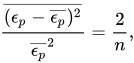
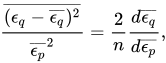
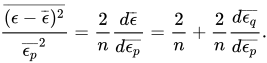
These equations show that when the number of degrees of freedom of the systems is very great, the mean squares of the anomalies of the energies (total, potential, and kinetic) are very small in comparison with the mean square of the kinetic energy, unless indeed the differential coefficient  is of the same order of magnitude as
  . Such values of can only occur within intervals (
 ) which are of the order of magnitude of
  unless it be in cases in which
  is in general of an order of magnitude higher than
  . Postponing for the moment the consideration of such cases, it will be interesting to examine more closely the case of large values of within narrow limits. Let us suppose that for
  and
and  the value of is of the order of magnitude of unity, but between these values of very great values of the differential coefficient occur. Then in the ensemble having modulus
  and average energies and
  , values of
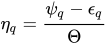
  sensibly greater than will be so rare that we may call them practically negligible. They will be still more rare in an ensemble of less modulus. For if we differentiate the equation
|
|
regarding
as constant, but

and therefore

as variable, we get
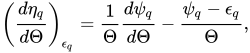
|
(212)
|
whence by (192)
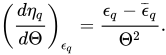
|
(213)
|