Page:NIOSH Manual of Analytical Methods - 3800.pdf/16
ORGANIC AND INORGANIC GASES by FTIR Spectrometry: METHOD 3800, Issue 1, dated 15 March 2003 - Page 16 of 47
APPENDIX B . System Tests.
These procedures must be conducted at least once on new or significantly altered (by replacement of components, dis- and reassembly, etc.) systems. The tests described in Sections B2 and B4 must also berepeated during either the pre-test preparations or quality assurance procedures. In all cases, activate the FTIR system and allow sufficient time for the infrared source, the infrared detector, and (if required) the temperature control systems to stabilize before proceeding.
B1 Absorption pathlength
Obtain one or more absorbance spectra of a calibration transfer standard (CTS) gas (ethylene at 200 to 300 ppm-meters is recommended) at the gas temperature and pressure of a reference CTS spectrum of the same compound. For each spectrum, calculate the indicated absorption pathlength according as
Equation B1
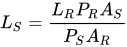
where
= pathlength indicated by the sample CTS spectrum (meters).
= pathlength of the reference CTS spectrum (meters).
= area of the reference CTS spectrum (abs cm-1).
= area of the reference CTS spectrum (abs cm-1).
= pressure of the sample CTS spectrum (mm Hg).
= pressure of the reference CTS spectrum (mm Hg).


When multiple CTS spectra are available, assign to the mean of the single-spectrum results. The reference CTS spectrum pathlength and concentration used must be based on multiple, high-quality gas standards and physical length measurements (see Appendix D, Section 5). The analyst must document criteria for the selection of the analytical region and any baseline correction procedures employed.
B2 Residual Squared Area
Note: If the following calculations are performed during testing or as part of the QC procedures (steps 14 through 17), perform them using a workspace air spectrum instead of the “water vapor (absorbance) spectrum” described in the two paragraphs below.
Use the integration time selected for field testing in recording the spectra described below. Record a background spectrum of dry N2 gas or zero air. Using a suitable impinger, humidify the N2 or zero air stream and record a single-beam spectrum at an absolute pressure between 725 and 795 mm Hg. Form the absorbance spectrum of this water vapor sample from the single beam spectra. Assign the spectrum a unique filename and save it for the calculations described below.
From this water vapor spectrum, subtract a scaled spectrum (see Appendix A) formed from the water vapor reference spectrum to be used in subsequent quantitative analyses. The scaling factor may be varied to minimize the absorbance in the resulting difference spectrum in the various analytical regions to be used in the analyses. Subtract a constant offset, a linear function, or a quadratic function from the difference spectrum in each analytical region to form a residual spectrum R for each region. For each residual spectrum R with discrete absorbance value for i = p to q, in the wavenumber range to , the residual squared area (RSA) is defined as:


NIOSH Manual of Analytical Methods, Fourth Edition